
Africa Macro | Stablecoin Infrastructure | June 2026
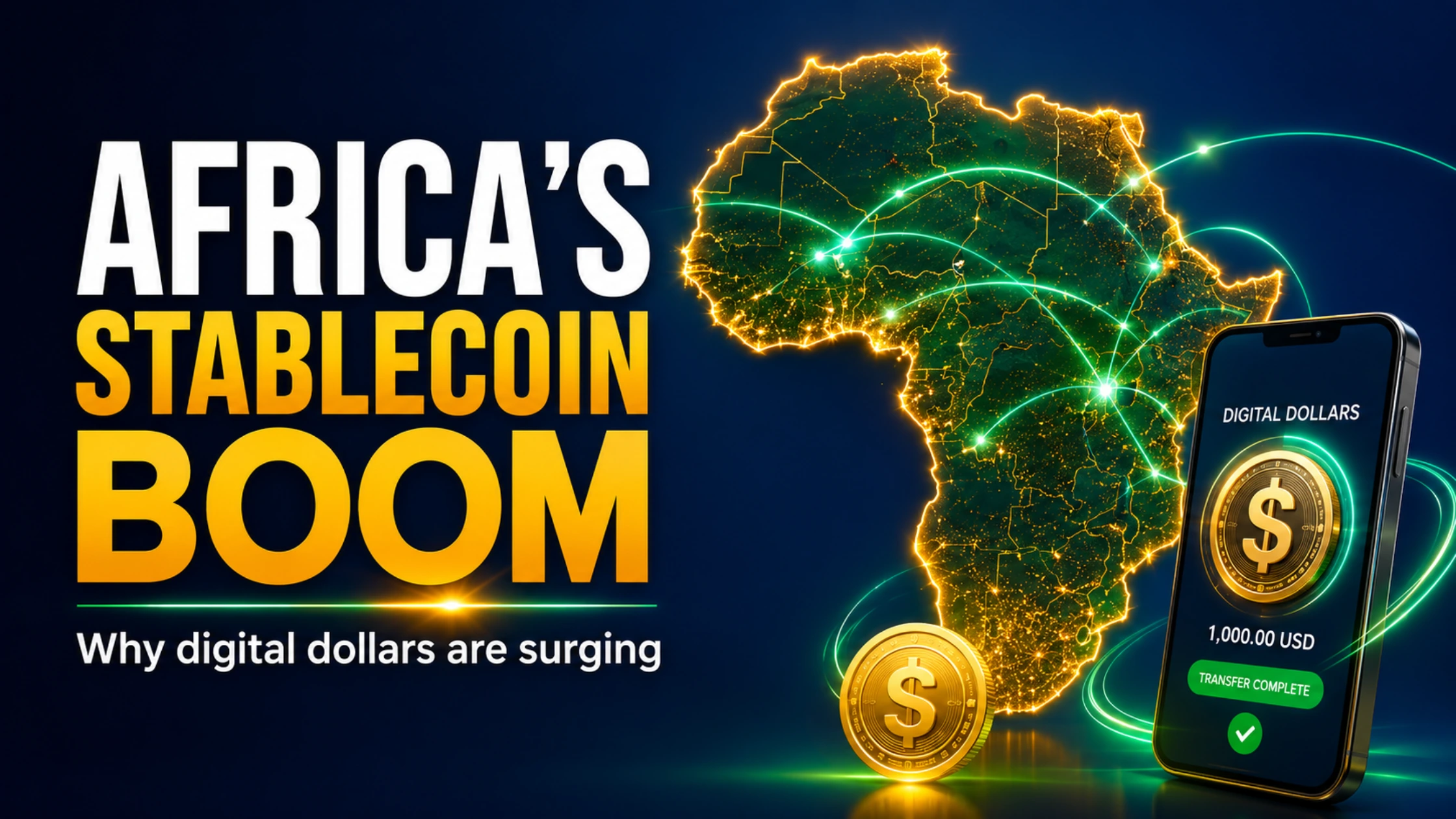
The Africa Dollar Trap: How 54 Countries, $2 Trillion in Dollar-Denominated Debt, and 1.4 Billion People With Smartphones Are About to Make Africa the World’s Largest Stablecoin Market
Africa is already the world's most utility-driven crypto market — and the West has not priced it in yet. Between July 2024 and June 2025, Sub-Saharan Africa received more than $205 billion in on-chain value, a 52% year-over-year increase, with stablecoins accounting for 43% of that volume ($88B+). Nigeria alone accounts for 40% of stablecoin inflows ($92B in on-chain value received in the 12 months to June 2025). On Yellow Card's platform, stablecoins now represent 99% of all transactions. The structural driver is not speculation — it is survival: 54 African countries carry $2T+ in dollar-denominated sovereign debt, their local currencies systematically depreciate against the dollar (the naira lost 69% of its value in 2024 alone), capital controls trap savings in devaluing local currency, and 709 million registered mobile money accounts provide the distribution infrastructure for stablecoin wallets at scale. Kenya's mobile money penetration hit 98% by late 2025. Ethiopia's stablecoin adoption grew 180% year-over-year. Nigeria ranks #2 globally in crypto adoption. This article maps the country-level incentive structures, the platform infrastructure (Yellow Card, Bitso Africa, M-Pesa), and the political economy of central banks fighting and losing against stablecoin adoption. The DN Africa Stablecoin Demand Index scores 12 markets across four dimensions to identify the highest-potential corridors for operators, investors, and the protocols that will settle this demand.
There is a common misconception in Western crypto analysis about Africa. The misconception is that Africa is an emerging stablecoin market. It is not emerging. It has emerged. The emergence happened quietly, without venture capital press releases or ETF filings, because it was driven not by institutional mandate but by economic desperation.
When your currency loses 69% of its value in a single year — as the Nigerian naira did in 2024 — you do not wait for your central bank to issue guidance on stablecoins. You open Binance, buy USDT, and store your purchasing power in a dollar-denominated digital asset that your central bank cannot devalue. When the official foreign exchange window has a queue measured in months and the parallel market charges a 15% premium, stablecoins are not a crypto product. They are the only available substitute for a functioning monetary system.
This is the Africa Dollar Trap. Fifty-four countries bound to the dollar through $2 trillion in sovereign debt, IMF conditionality, oil pricing, and commodity export revenues. Local currencies that systematically depreciate against the dollar. Capital controls that prevent citizens from holding dollars directly. And 709 million mobile money accounts providing the distribution infrastructure for a digital dollar alternative that the dollar's own custodians — U.S. financial institutions — never built.
Africa did not invent stablecoins. But it is currently the world's most structural stablecoin market, and Western markets have not priced what that means for USDC demand, for Solana and Tron transaction volume, for the GENIUS Act's stated goal of dollar dominance through digital rails, or for the protocols that will become the settlement layer for Africa's $2.5 trillion annual cross-border trade.
"If you can get into USDT or USDC, you can easily swap that into hard dollars elsewhere. Transactions that would otherwise be stalled by currency shortages move through stablecoin rails instead." — Nigerian trade exporter, AllBusiness Africa, 2026
The Structural Case: Four Forces Creating Unstoppable Stablecoin Demand
Force 1: Currency debasement is relentless and structural
The naira lost 69% of its value against the dollar in 2024. The Ethiopian birr has depreciated continuously since the IMF-mandated float in 2023, triggering 180% year-over-year growth in stablecoin adoption. The Egyptian pound lost 60%+ of its value between 2022 and 2024 under IMF loan conditions that required devaluation. Ghana's cedi has lost over 55% against the dollar since 2021. Zimbabwe's history of currency collapse needs no elaboration: the country has destroyed five currencies since 2008.
These are not cyclical events. They are structural features of dollar-indebted, commodity-export-dependent economies facing the Triffin dilemma at the periphery: the more they need dollars (to service debt, buy oil, import food), the more their local currencies depreciate, the more dollar-denominated debt service costs rise, the more their central banks suppress FX rates, and the more ordinary citizens seek dollar alternatives. Stablecoins are the thermodynamic output of this system pressure. They will continue to be demanded as long as the structural conditions persist.
Force 2: $2 trillion in dollar-denominated sovereign debt creates permanent FX demand
African sovereign debt to international creditors — the IMF, World Bank, bilateral creditors like China, and Eurobond markets — is denominated overwhelmingly in U.S. dollars. As of 2024, Africa's external debt service reached $163 billion annually. Every dollar of that service must be obtained in the foreign exchange market. Nigeria alone spent $5.21 billion on external debt service in 2025. The structural pressure this creates on domestic FX reserves is permanent: central banks must prioritise dollar reserves for sovereign debt service, leaving less availability for the private sector, which turns to parallel markets, and increasingly, to stablecoin rails.
Force 3: 709 million mobile money accounts are the ready distribution infrastructure
The single most important fact about African stablecoin adoption is infrastructure that already exists. Kenya's mobile money penetration reached 98% by late 2025 — the highest in the world. M-Pesa serves 51.36 million active users in Kenya alone, handling transactions equivalent to nearly 25% of Kenya's GDP annually. Tanzania, Uganda, and Ghana have mobile money penetration rates above 60%. West Africa contributed over a third of all new global mobile money accounts in 2023.
This infrastructure is the distribution layer for stablecoin on-ramps. Kenya's M-Pesa-to-crypto corridor allows users to buy USDT directly from their mobile money wallet through platforms like Mara (now M-Pesa integrated), Binance P2P (KES markets), and local exchange aggregators. Kenya's monthly crypto trading volume exceeds $900 million, enabled almost entirely by M-Pesa on-ramps. Ethiopia's Telebirr (with 45+ million users) is beginning the same journey. Nigeria's PalmPay (30 million users) and Opay (40+ million users) are building crypto bridge products.
Force 4: Stablecoins solve specific problems that nothing else can
The Western crypto narrative focuses on investment returns. The African stablecoin use case is functional: remittances, trade settlement, FX hedging, and savings preservation. A Kenyan exporter invoicing a South African buyer sends $10,000 USDT on Tron in 30 seconds for $0.01, versus 3-5 days and $50-200 through the banking system. A Nigerian diaspora worker sends $500 home via USDT at 1% total cost versus 5-7% through Western Union. A Ghanaian importer hedges against the cedi's depreciation by holding USDT between receiving cedi payments and making dollar purchases. None of these require belief in crypto ideology. They require functional alternatives to broken banking infrastructure.
Country Profiles: Where the Adoption Is Real and Where It Will Go
Nigeria: The world’s most intense stablecoin market by volume
Nigeria ranks #2 globally in the 2026 Global Crypto Adoption Index and first in Sub-Saharan Africa by volume. Nigeria alone received approximately $92 billion in on-chain value during the mid-2024 to mid-2025 period — nearly triple South Africa's figure — driven by naira volatility and limited USD access. Naira depreciation of 69% in 2024 drove the explosion. The population of 220 million with approximately 25.9 million crypto users creates a market no single platform can monopolise. The Central Bank of Nigeria has vacillated between hostility (blocking crypto exchange bank accounts in 2021, fining Binance $10B in 2024) and tolerance (dropping the Binance case, issuing VASP licensing framework). The direction is toward regulated tolerance because the alternative — 25 million users moving to P2P rails outside any regulatory framework — is worse.
Kenya: The infrastructure model for the continent
Kenya is the technical proof-of-concept for Africa's stablecoin future. Mobile money penetration reached 98% by late 2025, with 51.36 million active subscriptions. M-Pesa's integration with crypto on-ramps has made Kenya's monthly crypto trading volume exceed $900 million. The Central Bank of Kenya has adopted a "cautious but observational stance, allowing the market to develop while monitoring risks." Parliament passed a VASP licensing framework bill in 2025, creating the regulatory clarity for platforms to operate openly. Kenya's model — mobile money as the universal on-ramp, regulated VASP framework, observational central bank stance — is the template every other African market is moving toward.
Ethiopia: The fastest-growing market on the continent
Ethiopia saw 180% year-over-year growth in retail-sized stablecoin transfers, making it the fastest-growing stablecoin market on the continent. The birr's post-IMF-float depreciation created acute dollar demand in a country with extremely limited formal financial infrastructure. Ethiopia's Telebirr (the state telecom's mobile money service) has 45+ million users but limited crypto integration, creating a gap that platforms like Yellow Card and Binance are filling. Ethiopia ranked #12 in the 2025 Global Crypto Adoption Index — extraordinary for a country where internet penetration is still below 30% but accelerating rapidly.
Ghana: The regulatory model
Ghana represents Africa's most advanced regulatory approach to stablecoins. The country achieved a 95.06% score on the 2024 GSMA Mobile Money Regulatory Index — first globally — and has now passed a VASP Bill creating a Virtual Assets Regulatory Office (VARO). Ghana abolished a controversial 3% digital asset tax in July 2025, replacing it with a more proportionate 10% consumption tax on VASP fees. The regulatory clarity has attracted platforms: Bitso Africa, Yellow Card, and Mara all operate openly in Ghana. With the cedi having lost over 55% against the dollar since 2021, demand is structural.
The Platform Infrastructure Map: Who Is Building Africa’s Stablecoin Rails
| Platform | Key Markets | Volume Signal | Primary Use Case | Stablecoin |
|---|---|---|---|---|
| Yellow Card | 20 African markets | Stablecoins = 99% of txns; USDT 88.5% | Remittances, FX hedging, savings | USDT (88.5%), USDC (9.9%) |
| Binance P2P | Nigeria, Kenya, Ghana, South Africa | Dominant P2P volume; handles 85%+ of retail flows | FX arbitrage, savings, remittances | USDT primary |
| Mara | Kenya, Nigeria, Rwanda, South Africa | M-Pesa integrated on-ramp | Retail savings, M-Pesa bridge | USDT, USDC |
| Bitso Africa | Nigeria, Kenya, South Africa | Institutional and B2B corridors | Cross-border trade settlement, B2B | USDC primary |
| Chipper Cash | 14 African markets | Multi-million monthly active users | Remittances, consumer payments | USDT, USDC via partner rails |
| Tron Network (TRX) | Africa-wide (Nigeria dominant) | Most-used chain for USDT in Africa | Low-cost P2P transfers | USDT on Tron (~$0.01 fee) |
| cNGN (Nigeria) | Nigeria | Naira stablecoin; gaining traction | Domestic payments, regulatory sandbox | Naira-pegged (cNGN) |
The Political Economy: Why African Central Banks Are Losing the War Against Stablecoins
Every major African central bank has attempted to suppress, restrict, or ban stablecoin and crypto adoption. All of them have failed, or are in the process of failing. The pattern is consistent: ban, ignore ban, regulated tolerance, formal framework.
The Central Bank of Nigeria banned crypto in 2021, ordering banks to close crypto exchange accounts. Within 12 months, P2P trading had migrated to Binance and local platforms, removing even the limited banking-system visibility the CBN had. In 2024, the CBN fined Binance $10B for forex market manipulation. Binance settled at an undisclosed amount, reinstated Nigerian operations, and today Nigeria remains the #2 global crypto market. The CBN achieved nothing except removing itself from the transaction flow.
The lesson is structural: when 25 million citizens are using an asset class to preserve purchasing power in the absence of any legal alternative, criminalising the asset class does not reduce demand. It reduces transparency, eliminates regulatory leverage, and drives activity to unregulated P2P channels. The rational central bank response — which Ghana, South Africa, and Kenya are pursuing — is a VASP licensing framework that brings platforms into compliance while collecting transaction data and tax revenue.
The PAPSS African Currency Marketplace (launched July 2025 by Afreximbank) is the most serious fiat competitor to stablecoin rails: a direct African-currency-to-African-currency exchange designed to reduce dollar dependence in intra-African trade. If PAPSS achieves significant adoption, it would reduce the stablecoin share of intra-African trade settlement. However, PAPSS does not address the savings and hedging use cases where dollar exposure is the entire point. Stablecoins and PAPSS serve different use cases in the same ecosystem.
Market Implications: Africa Is the GENIUS Act’s Largest Proof of Concept
Treasury Secretary Bessent's stated rationale for the GENIUS Act stablecoin framework is dollar dominance through digital rails. The premise: if USD-pegged stablecoins become the settlement layer for global commerce, U.S. dollar hegemony is extended even as physical dollar reserves decline. Africa is the largest live validation of this thesis.
Sub-Saharan Africa's $88B+ in annual stablecoin volume is dollar-denominated demand for digital dollar instruments. Every naira that converts to USDT is a dollar reserve that flows back into the U.S. stablecoin issuer's treasury (USDT issuers back supply with U.S. Treasuries; USDC explicitly so). Africa's stablecoin economy is already buying U.S. government debt indirectly. As volume grows from $88B toward the $300-500B range within 5 years, the structural demand for U.S. Treasuries from African stablecoin issuance expands proportionally.
For crypto investors, the plays are: Tron (dominant settlement chain for African USDT, structural transaction volume growth), Circle/USDC (regulatory positioning in VARO and FSCA-licensed markets creates institutional moat), and platforms with mobile money integration (Mara, Yellow Card) as the highest-growth distribution layer. Explore exposure through Bybit or Binance for Tron and stablecoin plays; institutional corridor plays through BloFin. Reference the DN Stablecoin Trust Score for issuer-level analysis and the DN AI Payment Demand Index for the AI agent convergence layer on the same rails.
The Risks to the Africa Stablecoin Thesis
Risk 2 — Currency stabilisation reduces urgency: Nigeria's naira has shown increased stability since late 2024 (N1,350-1,430/$ range vs. N1,800+ earlier in 2025). A sustained naira stabilisation would reduce the urgency of USDT hedging for Nigerian users. Structural demand would remain but velocity would moderate.
Risk 3 — Regulatory crackdown escalation: A coordinated FATF-driven crackdown on USDT Tron transactions could disrupt Africa's primary stablecoin rail. Tether's grey-zone regulatory status is a persistent risk; USDC's compliance positioning becomes a competitive advantage if USDT faces enforcement action in key African markets.
Risk 4 — CBDC competition: Multiple African central banks are developing Central Bank Digital Currencies (Nigeria's eNaira, Ghana's e-Cedi, Kenya exploring options). If CBDCs achieve mobile money integration at scale, they would compete for the savings and payments use cases currently served by stablecoins. Nigeria's eNaira has seen limited adoption to date, but the competitive risk grows as mobile infrastructure matures.
The Bottom Line: The World’s Largest Stablecoin Market Is Already Here
The structural demand for dollar-equivalent savings instruments among 1.4 billion people facing systematic currency debasement is not a future scenario. It is a present-tense reality generating $88B+ in annual stablecoin transaction volume growing at 52% annually. The infrastructure to serve this demand — 709 million mobile money accounts, platforms operating in 20+ markets, regulatory frameworks being built in Ghana, South Africa, Kenya — is being assembled now.
What Western crypto markets have not priced is the compounding effect of this demand on the stablecoin ecosystem: more USDT and USDC demand means more T-bill purchases by issuers, means more dollar hegemony through digital rails, means more political will to pass GENIUS Act-type frameworks, means more regulatory clarity, means more institutional adoption, means more African volume, and the cycle continues. Africa is not a downstream beneficiary of crypto adoption. It is one of the structural demand engines of the next stablecoin growth cycle, and it is already running.
Frequently Asked Questions
Between July 2024 and June 2025, Sub-Saharan Africa received more than $205 billion in on-chain crypto value, a 52% year-over-year increase per Chainalysis. Stablecoins accounted for 43% of that volume — approximately $88B+. Nigeria alone accounts for 40% of stablecoin inflows, receiving approximately $92B in on-chain value in the same 12-month period. On Yellow Card's platform, which operates across 20 African markets, stablecoins now represent 99% of all transactions, with USDT holding 88.5% share and USDC at 9.9%.
Four structural drivers: (1) Currency debasement — the Nigerian naira lost 69% of its value against the dollar in 2024 alone; the Ethiopian birr, Ghanaian cedi, and Egyptian pound have all suffered major depreciations; stablecoins are the only accessible dollar-equivalent savings instrument; (2) Capital controls — official FX windows are restricted; stablecoins bypass these restrictions; (3) Remittance cost — sending $500 via Western Union costs 5-7%; via USDT on Tron it costs approximately 1% including all fees; (4) Trade settlement — USDT on Tron settles in 30 seconds for $0.01 versus 3-5 days and $50-200 through the banking system. None of these use cases require crypto conviction — they require functional alternatives to a broken monetary infrastructure.
By volume, Nigeria dominates with approximately 40% of Sub-Saharan Africa stablecoin inflows and approximately $92B in on-chain value received in the 12 months to June 2025. Nigeria ranks #2 globally in the 2026 Chainalysis Global Crypto Adoption Index. By growth rate, Ethiopia is the fastest-growing market at 180% year-over-year in retail stablecoin transfers. By infrastructure quality, Kenya scores highest: 98% mobile money penetration (the world's highest), M-Pesa-to-crypto integration, and a VASP licensing framework passed by parliament in 2025. By regulatory clarity, Ghana ranks first among African markets with a VASP Bill, a Virtual Assets Regulatory Office (VARO), and 95.06/100 on the GSMA Mobile Money Regulatory Index.
The Africa Dollar Trap refers to the structural condition of 54 African countries simultaneously bound to the dollar through their external obligations — $2T+ in dollar-denominated sovereign debt, commodity pricing in dollars, IMF loan conditionality — while their domestic currencies systematically depreciate against the dollar. The trap: the more they need dollars, the more their currencies depreciate, the more their dollar-denominated debt service costs rise in local currency terms, the more their central banks suppress FX availability, and the more ordinary citizens seek dollar-equivalent alternatives. Stablecoins are the only accessible exit from this trap for 1.4 billion people without access to a U.S. bank account.
Tron is the dominant blockchain for USDT transfers in Africa, particularly for P2P remittances and retail transactions. A Tron USDT transaction costs approximately $0.01, making it the only economically viable chain for sub-$100 transfers. USDT on Tron is the de facto standard for Nigeria-to-diaspora remittances, Ghana cross-border trade settlement, and Kenya P2P exchanges. Binance Smart Chain is a secondary layer, primarily for users already on the Binance platform. Solana and Ethereum are used for institutional flows and USDC transactions where the higher security profile matters more than the marginal fee difference.
Treasury Secretary Bessent's GENIUS Act frames stablecoins as a tool for extending U.S. dollar dominance through digital rails. Africa is the largest live validation of this thesis: every African USDT or USDC transaction is dollar-denominated demand for digital dollar instruments. USDT and USDC issuers back their stablecoin supply with U.S. Treasuries — meaning Africa's $88B+ in annual stablecoin volume represents indirect demand for U.S. government debt. As volume grows toward $300-500B annually over the next five years, the structural demand for U.S. Treasuries from African stablecoin issuance scales proportionally. Africa is not a beneficiary of the GENIUS Act; it is one of the primary economic justifications for it.
The DN Africa Stablecoin Demand Index scores 12 African markets across four dimensions (each scored 0-25): currency debasement severity (how acute is the pressure to seek dollar alternatives?), stablecoin accessibility (how easy is it to acquire and use USDT/USDC in this market?), regulatory stance (how crypto-friendly is the regulatory environment, where higher = more open?), and mobile penetration (what percentage of the population has the infrastructure to use stablecoin wallets?). Scores are composited for a 0-100 total. Markets scoring 70+ are classified as high-potential corridors. The index is a MODEL instrument updated quarterly. It is not a financial product or investment recommendation.
Five key platforms: (1) Yellow Card — operates in 20 African markets; stablecoins represent 99% of all transactions; largest institutional-grade African crypto platform; (2) Mara — M-Pesa integration makes it the most accessible Kenya retail on-ramp; building toward a Pan-African mobile money bridge; (3) Bitso Africa — focused on B2B and institutional cross-border corridors in Nigeria, Kenya, and South Africa; (4) Chipper Cash — 14 African markets, multi-million monthly active users, remittance and consumer payment focus; (5) Binance P2P — dominant for retail P2P volume in Nigeria, Ghana, and Kenya through KES, NGN, and GHS markets. Tron Network is the primary settlement layer for P2P flows. Ethereum and Solana serve institutional and USDC-denominated flows.
Four primary risks: (1) PAPSS competition — Afreximbank's African Currency Marketplace (launched July 2025) enables direct African-currency-to-African-currency settlement without stablecoin intermediation, potentially capturing intra-African trade flows; (2) Currency stabilisation — the Nigerian naira stabilised in the N1,350-1,430 range by mid-2026; sustained currency stability reduces the urgency of USDT hedging; (3) USDT regulatory risk — Tether's grey-zone regulatory status creates enforcement risk; a coordinated FATF crackdown on USDT Tron transactions would disrupt Africa's primary stablecoin rail; (4) CBDC competition — Nigeria's eNaira, Ghana's e-Cedi, and other central bank digital currencies could compete for payment use cases if they achieve mobile money integration at scale, though the savings and hedging use cases would remain with dollar stablecoins.
Embed grant: The DN Africa Stablecoin Demand Index may be reproduced with attribution to decentralised.news.
DN-INTERNAL links to resolve: DN Stablecoin Trust Score, DN AI Payment Demand Index, DN Power Brokers Framework, Debasement Clock, Cycle Position Clock.
Sources: Chainalysis 2025 Global Crypto Adoption Report, Yellow Card Africa Stablecoin Report Aug 2025, Transak Africa Fintech Report Jan 2026, AllBusiness Africa June 2026, Ripple Africa Regulation Report Apr 2026, Nairametrics Dec 2024 and May 2026, GSMA Mobile Economy Africa 2025, Communications Authority of Kenya Sept 2025, TechCabal Apr 2026, Tekedia Mar 2026.
As of: June 13, 2026. Scoring is editorial framework. Not financial advice.