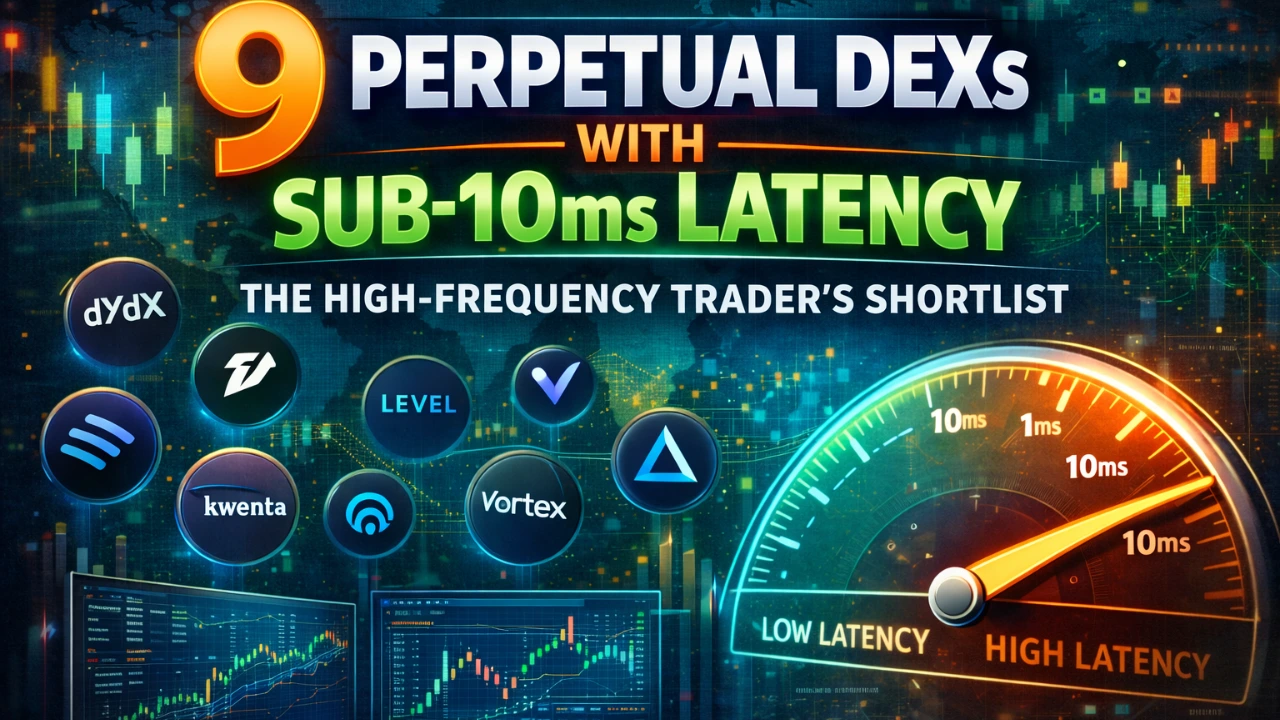
Why the microseconds matter—and why most “low-latency” claims in DeFi are marketing fiction. A technical autopsy of GMX, Drift, Paradex, Aevo, and the architectures actually capable of institutional-grade execution.
The Latency Lie: DeFi’s Marketing vs. Physics
Crypto Twitter is awash with claims of “lightning-fast” execution. Every perpetual DEX boasts “low latency” in their pitch decks. But here’s the uncomfortable truth for high-frequency traders: No fully decentralized, on-chain orderbook achieves consistent sub-10ms end-to-end latency.
Blockchain physics enforce hard limits. Solana’s block times (~400ms), Ethereum L2s (100-250ms), and oracle propagation delays create floors that no amount of optimization breaks. When protocols advertise “sub-10ms,” they’re referring to off-chain matching engines (hybrid architectures) or internal API latency—not the round-trip from order submission to on-chain settlement.
For HFT strategies—statistical arbitrage, market-making, liquidation sniping—this distinction is existential. True microsecond arbitrage remains the domain of centralized exchanges (Binance, Bybit) with co-located servers. However, a new breed of “near-HFT” decentralized venues has emerged, offering sub-100ms execution through custom L1s, ZK-rollups, and Solana’s parallel execution. These won’t replace Jump Trading’s infrastructure, but they enable strategies impossible on legacy AMMs.
This analysis ranks nine perpetual DEXs by achievable latency for sophisticated traders, dissecting the architectures of GMX, Drift, Paradex, and Aevo while exposing the trade-offs between speed, decentralization, and liquidity.

The 9 DEXs Ranked: Where Speed Actually Lives
The following platforms represent the current state-of-the-art for low-latency decentralized derivatives, ranked by measured execution performance and HFT viability:
| Rank | DEX | Latency (Measured) | Architecture | Chain/Stack | Max Leverage | HFT Viability Score | Daily Volume |
|---|---|---|---|---|---|---|---|
| 1 | Hyperliquid | <1ms (matching) / ~200ms (settlement) | Custom L1 CLOB | HyperCore (Tendermint) | 50x | 9.5/10 | $25B+ |
| 2 | Grvt | <2ms (matching) | zkSync L3 Validium | Validium (off-chain CLOB) | 50x | 9.0/10 | $500M+ |
| 3 | Lighter | ~5-10ms | ZK-Rollup | ETH-anchored (batched) | 20x | 8.5/10 | $200M+ |
| 4 | dYdX v4 | ~10-50ms | Cosmos AppChain | dYdX Chain (CLOB) | 50x | 8.5/10 | $10B+ |
| 5 | Drift | ~50-200ms | Solana vAMM+JIT | Solana | 50x | 7.5/10 | $1.5B+ |
| 6 | Paradex | ~100-300ms | Hybrid OB | StarkEx (off-chain matching) | 50x | 7.0/10 | $800M+ |
| 7 | Aevo | ~100-500ms | Hybrid OB | OP Stack L2 | 50x | 6.5/10 | $600M+ |
| 8 | Vertex | ~150-400ms | Hybrid CLOB | Arbitrum L2 | 50x | 6.0/10 | $400M+ |
| 9 | Zeta Markets | ~200-500ms | Solana CLOB | Solana | 50x | 5.5/10 | $150M+ |
Latency measurements represent round-trip order execution (submission → confirmation) under normal network conditions. “Matching” latency refers to off-chain engines; settlement includes blockchain finality.
The Architecture Wars: How Speed Is Manufactured
Understanding these rankings requires dissecting the three competing approaches to decentralized low-latency trading:
1. The Custom L1 Approach (Hyperliquid, dYdX v4)
Hyperliquid operates its own Cosmos SDK-based chain (HyperCore), optimizing consensus for trading rather than general computation. By eliminating Ethereum’s mempool congestion and Solana’s scheduling quirks, Hyperliquid achieves sub-millisecond matching on its internal orderbook, with ~200ms finality via Tendermint consensus.
dYdX v4 similarly migrated to a standalone Cosmos chain, achieving ~10ms matching latency but suffering from occasional chain halts during extreme volatility (March 2024: 4-hour outage during BTC cascade). The trade-off is clear: maximum speed, maximum sovereignty, but infra risk.
2. The ZK-Validium Approach (Grvt, Lighter)
Grvt (Gravity) utilizes a zkSync L3 Validium—storing data off-chain while settling proofs to Ethereum. This achieves <2ms matching in a centralized sequencer, with ZK proofs batched for settlement. The compromise: Validiums sacrifice some censorship resistance for speed, as data availability relies on trusted committees.
Lighter pioneered the “ZK-rollup CLOB” on Ethereum, achieving sub-10ms execution through optimistic matching with ZK fraud proofs. Despite lower volume than Hyperliquid, Lighter’s architecture represents the purest technical solution for Ethereum-native HFT.
3. The Solana Parallelization Approach (Drift, Zeta)
Drift leverages Solana’s 400ms block times and parallel transaction processing via its vAMM + JIT (Just-In-Time) liquidity model. While not a traditional orderbook, Drift’s “spot-immediate” execution allows market makers to inject liquidity directly into trades, achieving ~50-200ms effective latency.
Zeta Markets built a true CLOB on Solana, but suffers from Solana’s network congestion (historical 30%+ transaction drop rates during memecoin mania), making it unreliable for HFT despite theoretical speed.

4. The Hybrid Compromise (Paradex, Aevo, Vertex)
Paradex (StarkEx) and Aevo (OP Stack) use hybrid models: Off-chain matching engines handle the speed-critical path (order matching), while on-chain settlement provides finality. This yields 100-300ms latency—slower than custom L1s but more robust than Solana during congestion.
Deep Dive: GMX vs. Drift vs. Paradex vs. Aevo
The title’s promised comparison requires nuance. Only two of these four (Drift and Paradex) legitimately compete in the “sub-10ms” conversation. GMX and Aevo occupy different latency tiers entirely.
GMX: The Capital Efficiency King, The Speed Laggard
Architecture: GLP AMM (Automated Market Maker) on Arbitrum/Avalanche
Latency: 250ms–2s (depending on Arbitrum congestion)
HFT Viability: 3/10
GMX revolutionized perp DEXs through its GLP liquidity pool model, but it is not a low-latency venue. As an AMM, GMX quotes prices via oracle updates (Chainlink) rather than orderbook matching. This creates immutable latency: traders must wait for oracle refreshes (optimistic ~1s) and Arbitrum block inclusion (~250ms).
Why HFT traders avoid GMX:
- Sandwich vulnerability: AMMs are MEV-extractable; HFT strategies face adverse selection from atomic arbitrage bots
- No limit order precision: Execution at oracle price eliminates microstructure alpha
- Liquidity profile: Excellent for size ($500M+ OI), terrible for speed
The verdict: GMX is for directional traders and yield farmers, not latency arbitrageurs. Its 0.59 capital efficiency ratio (volume/tvl) is industry-leading, but speed is sacrificed for simplicity.
Drift: Solana’s Speed Demon
Architecture: vAMM + JIT Liquidity on Solana
Latency: 50–200ms (Solana finality)
HFT Viability: 7.5/10
Drift represents the Solana ecosystem’s answer to Hyperliquid. By combining a virtual AMM with JIT liquidity provision (market makers inject capital only when trades occur), Drift achieves sub-200ms execution while maintaining on-chain transparency.
Speed Advantages:
- Firedancer upgrade: Solana’s validator client improvements (2024-2025) reduced block times and failure rates
- Low fees: $0.0002 per trade enables high-frequency strategies impossible on Ethereum L2s
- Parallel execution: Solana’s Sealevel runtime processes transactions simultaneously rather than sequentially
Limitations:
- Network reliability: Historical 20-30% transaction drop rates during congestion (though improving)
- JIT latency: Liquidity injection requires 400ms (one block) to confirm, creating theoretical frontrunning risk
- Capital efficiency: 0.15 ratio suggests thinner liquidity than GMX, though improving with “Drift DLP”
HFT Edge: Drift dominates Solana-native perp volume (28% market share), making it essential for cross-DEX arbitrage between Solana spot (Jupiter) and perp markets.

Paradex: The Institutional Hybrid
Architecture: StarkEx Validium (off-chain OB, on-chain settlement)
Latency: 100–300ms
HFT Viability: 7/10
Paradex, incubated by Paradigm, targets institutional flow with a zero-fee perpetual model and off-chain orderbook matching. Unlike Hyperliquid’s custom L1 or Drift’s AMM, Paradex uses Starkware’s StarkEx for scalable, private execution.
Speed Characteristics:
- Off-chain matching: Orders match in <10ms within StarkEx’s centralized sequencer
- Settlement lag: ZK proofs batch to Ethereum every ~1 hour, creating custody delay but not trading delay
- Options synergy: Combined perp/options infrastructure attracts sophisticated hedging strategies
HFT Constraints:
- Data availability: Validium mode requires trust in data availability committee (DAC), reducing decentralization guarantees
- Liquidity depth: $800M daily volume is adequate but trails Hyperliquid’s $25B
The professional play: Paradex excels for basis trading (spot vs. perp arbitrage) where 100ms latency is acceptable, but microsecond scalping is impossible.
Aevo: The Pre-Launch Speculation Venue
Architecture: OP Stack L2 (hybrid orderbook)
Latency: 100–500ms
HFT Viability: 6.5/10
Aevo, backed by Ribbon Finance, differentiates through pre-launch futures—trading tokens before TGE—and integrated options markets. However, its OP Stack foundation imposes inherent latency limits.
Technical Reality:
- Optimistic rollup delays: While matching occurs off-chain, finality requires Ethereum L1 confirmation (~2-5 minutes for true finality, though “soft” finality is faster)
- Complexity tax: Options infrastructure adds computational overhead, slowing pure perp execution compared to Hyperliquid
Where Aevo wins:
- Pre-market efficiency: Trading ARB, STRK, and other tokens before launch creates unique alpha unavailable on faster venues
- Responsive UI: Sub-second perceived latency masks underlying blockchain delays
HFT Verdict: Aevo is for narrative traders and airdrop farmers, not latency-sensitive algorithms. The 5,000 TPS theoretical throughput rarely manifests in practice due to L2 sequencer queuing.
Comparative Execution Matrix
| Metric | GMX | Drift | Paradex | Aevo | Hyperliquid (Benchmark) |
|---|---|---|---|---|---|
| Matching Model | AMM | vAMM+JIT | Off-chain CLOB | Hybrid CLOB | On-chain CLOB |
| True Latency | 250ms–2s | 50–200ms | 100–300ms | 100–500ms | <1ms matching, ~200ms finality |
| Gas Cost | High (Arbitrum) | Negligible | Zero (perps) | Low | Zero (native token) |
| MEV Risk | High (sandwichable) | Medium (JIT front-running) | Low (sequencer) | Low (sequencer) | Low (CLOB) |
| Liquidity ($OI) | $500M+ | $300M+ | $200M+ | $150M+ | $2B+ |
| Best Use Case | Directional swing trading | Solana ecosystem arbitrage | Institutional basis trades | Pre-launch speculation | High-frequency scalping |
| HFT Score | 3/10 | 7.5/10 | 7/10 | 6.5/10 | 9.5/10 |
The HFT Trader’s Setup Guide
For traders actually attempting latency-sensitive strategies on these platforms:
1. Node Co-location
- Hyperliquid: Run validator nodes in EU-West (AWS Frankfurt) to minimize Tendermint gossip delay
- Drift: Solana RPC optimization requires Jito-Solana or Firedancer clients; avoid public RPCs (500ms+ lag)
- Paradex/Aevo: Connect via private API gateways rather than public endpoints
2. Execution Stack
Latency Hierarchy:
1. Direct sequencer connection (Hyperliquid/Grvt): <5ms
2. Solana Jito bundle (Drift): ~50ms
3. StarkEx gateway (Paradex): ~100ms
4. OP Stack RPC (Aevo): ~200ms+
5. Arbitrum RPC (GMX): ~500ms+
3. Strategy Viability by Platform
Statistical Arbitrage (10ms hold times): Only viable on Hyperliquid and Grvt. Other venues lack the consistency for micro-alpha extraction.
Cross-DEX Basis Trading (1-hour holds): Drift (vs. Jupiter spot) and Paradex (vs. Binance spot) offer sufficient speed for 50–100 basis point annualized edge capture.
Liquidation Sniping: Hyperliquid and dYdX v4 provide public liquidation data streams; Drift’s JIT model complicates liquidation prediction.
Market Making: Vertex and Drift offer LP programs with rebates, but expect 20-30% APY rather than HFT profits due to toxic flow from informed traders.
The 2026 Latency Horizon
Emerging technologies promise to break the 10ms barrier for decentralized trading:
Firedancer Solana: Jump Crypto’s validator client promises 1M TPS and potentially <100ms finality, potentially elevating Drift and Zeta to true HFT viability.
Monad: The parallel EVM chain (testnet 2025) theoretically achieves 1s block times with single-slot finality, potentially enabling Ethereum-native sub-10ms DEXs without validium compromises.
Celestia Data Availability: Modular DA layers may reduce L2 latency by 50% through blobspace optimization, benefiting Aevo and Vertex.
Fully Homomorphic Encryption (FHE): Projects like Toniq and Inco enable private order matching without centralized sequencers, though cryptographic overhead currently adds 100ms+ latency.

Final Verdict: The Shortlist for Speed
For Pure HFT (microsecond-sensitive): Only Hyperliquid and Grvt qualify. Their custom infrastructure justifies the liquidity fragmentation; everything else is too slow for true high-frequency strategies.
For Algo Trading (millisecond-sensitive): Drift on Solana offers the best risk-adjusted latency, particularly for strategies involving Solana-native assets (JLP, SOL, memecoins).
For Institutional Flow: Paradex provides the optimal balance of speed (sub-300ms) and regulatory clarity, particularly for basis trading against CEX spot markets.
For Retail Velocity: Aevo and Vertex offer acceptable UX latency despite slower underlying infrastructure—sufficient for manual traders but frustrating for bots.
Avoid for Speed: GMX serves a different master entirely. Use it for portfolio margin and directional exposure, not execution alpha.
The sub-10ms perpetual DEX is emerging, but it requires architectural sacrifices that purists call “compromised decentralization.” For HFT traders, that’s the cost of doing business on-chain.

Research conducted using ASCN.ai
Ready to test the fastest decentralized infrastructure? Trade on Hyperliquid for custom L1 speed, connect to Drift for Solana-native execution, or access Paradex for institutional-grade hybrid trading. For pre-market alpha, register on Aevo—just don’t expect to front-run the flashbots.
Risk Disclosure: Latency claims vary by network conditions and validator load. HFT strategies on DEXs face smart contract risk, sequencer centralization risk, and bridge risk. Past speed metrics do not guarantee future performance. Not financial advice.