

Real performance data on 10 AI crypto trading bots — not marketing claims. Grid bots, DCA bots, signal bots: what actually worked, what didn’t, and what to avoid entirely.
SUMMARY: An estimated 65% of all cryptocurrency trading volume involves some form of automation as of 2026. However, independent testing from September 2024 through May 2026 found that signal bots performed almost identically to simply buying and holding, while grid bots turned negative market returns into positive gains of 9.6% for BTC, 10.4% for ETH, and 21.88% for SOL during the same downtrend period. DCA bots showed mixed results over 180 days. The ten best AI crypto trading bots by actual performance are: #1 Pionex (free, grid bot performance is genuine), #2 3Commas (best configured DCA and grid), #3 Cryptohopper (strategy marketplace works if you select correctly), #4 WunderTrading (best TradingView signal integration), #5 Bitsgap (claims 13.8% average AI bot returns, $9.46B AUM), #6 HaasOnline (best for quant developers), #7 Gunbot (one-time fee, genuine utility), #8 Coinrule (no-code, ~50% hit rate), #9 TradeSanta (simplest, honest about limitations), #10 Hummingbot (open-source market making). Critical security note: the 2022 3Commas incident exposed 150,000 API keys — always use trade-only API permissions with IP allowlisting and never enable withdrawal permissions on any bot.

The promise vs the reality
The YouTube ads are everywhere. “Our AI bot made 340% returns in the last six months.” “This algorithm identifies opportunities before humans even see the chart.” “Set it up in five minutes and wake up to profits.”
Every claim is technically defensible in the narrowest possible reading, under conditions the ad does not mention, during a time period the ad does not specify, with capital the ad does not model. This is the state of AI trading bot marketing in 2026 — a category where the marketing budget and the actual performance have an inverse relationship so consistent that it has become a heuristic: the more aggressively a bot is advertised, the more sceptically its performance claims deserve to be treated.
This article is not that. It is a ranking of the ten AI crypto trading bots that have the most credible actual performance records — based on third-party testing data, verified user results, independent benchmarking, and the specific periods and market conditions under which each bot genuinely delivered versus where it failed.
The ranking order will surprise you. The bots ranked highest are not the ones with the biggest marketing budgets. Some of them barely advertise at all.
 Before the ranking: the three things you need to understand about bot performance
Understanding these three points prevents you from reading marketing numbers as performance reality.
Point one: market regime determines everything. Grid bots profit from price oscillation. DCA bots profit from downward then upward cycles. Signal bots profit from decisive directional moves. No single bot architecture is optimal across all market conditions, and the period used to measure performance determines which architecture looks best. A grid bot in a sustained trending market accumulates losses. A DCA bot in a market that never recovers accumulates a portfolio of declining assets. When a bot advertises performance numbers, the first question is always: what market conditions applied during that period?
Point two: the signal bot failure. Independent testing from September 2024 through January 2025 found that signal bots performed almost identically to simply buying and holding during that period. Over 180 days, the signal bots’ supposed intelligence added approximately zero alpha. They captured the same market movement that passive holding captured. The subscription fee was the only net negative. This is not a universal finding — signal bots can outperform in specific conditions — but it is the finding from the most rigorous independent testing available, and it should be the baseline expectation rather than the exception.
Point three: the overcrowding problem. When thousands of users run the same bot strategy on the same signal, the edge disappears. Performance may regress when many users crowd into similar signals — the 2025 altcoin pump season saw 40% drawdowns from overcrowding effects, where too many bots simultaneously executed the same buy signal and then simultaneously triggered the same stop-losses. A strategy that worked perfectly in backtesting and live testing with 100 users can perform catastrophically when 10,000 users deploy it simultaneously. This is the structural limitation of marketplace strategies on platforms like Cryptohopper and 3Commas that most marketing materials do not mention.
The ranking
#1 Pionex — The honest answer to the “best bot” question

Monthly cost: Free (0.05% trading fee only) Best for: Beginners, grid trading enthusiasts, anyone who wants to test automation without subscription risk Supported exchanges: Pionex native exchange (with access to Binance and Huobi liquidity pools) Affiliate access: Pionex
Pionex ranks first not because it has the most sophisticated AI, the most features, or the highest claimed returns. It ranks first because it is the most honest product in the category, and because the bot it does best — the grid bot — is the one bot architecture that genuinely and consistently produces positive returns in market conditions that constitute the majority of trading time.
Here is the specific performance data that earns this ranking. During the testing period from September 2024 to January 2025 — a period that included significant downside volatility across crypto — grid bots produced positive gains of 9.6% for BTC, 10.4% for ETH, and 21.88% for SOL during a period when the underlying assets delivered negative returns. The bots outperformed passive holding not by predicting direction, but by profiting from the oscillation that always exists within a trend.
This is not AI in any meaningful sense. Pionex’s grid bot is a rules-based system: you define a price range, the bot places buy orders at regular intervals across that range and sell orders above each buy, and it captures the spread on every oscillation. There is no machine learning, no sentiment analysis, no neural network. It is elegant mechanical engineering, and it works.
What Pionex gets right that everything else gets wrong: the bots run directly inside the Pionex exchange environment, not via API connection to a third party. This eliminates the API security risk that affects every other platform in this list. Your API keys never leave Pionex’s system. When the 2022 3Commas incident exposed 150,000 API keys, Pionex users faced no equivalent risk.
The honest limitations: Pionex’s bot selection is basic. There is no machine learning component, no sentiment integration, no multi-exchange arbitrage. In sustained directional trends — a crypto bull market where BTC goes up 40% in six weeks — the grid bot underperforms simple holding because it sells portions of the position as prices rise, then buys back lower, reducing net long exposure during the uptrend. Pionex also lacks the advanced strategy customisation of 3Commas or Cryptohopper.
Who should use it: Anyone starting with crypto automation. The combination of zero subscription cost, built-in exchange eliminating API risk, and genuinely working grid bot mechanics makes it the correct first bot for any trader.
#2 3Commas — Best configured performance, honest about its limitations
Monthly cost: Free tier (limited) | Starter $29/month | Advanced $79/month Best for: Intermediate traders who want to replicate their own strategy logic Supported exchanges: 18+ including Binance, Bybit, OKX, Kraken, Coinbase Affiliate access: 3Commas
3Commas is the most used serious trading bot platform in the world — not because of aggressive marketing, but because it has been consistently reliable for seven years with a feature set that actually does what intermediate traders need.
The performance data is specific: DCA bots on 3Commas average 55% win rates in ranging markets but can experience drawdowns up to 30% in strong trends without proper configuration. The platform’s strategy backtests show Sharpe ratios of 1.2–1.8 and profit factors above 1.5 for well-configured strategies across the 2019–2025 historical period. These are not spectacular numbers — they are honest numbers that describe a tool that works when used correctly.
3Commas offers three genuinely distinct bot types that serve different functions. The DCA bot executes a systematic accumulation strategy — buying a set amount at regular intervals or at configurable trigger points — and works best during volatile downtrends where averaging in produces better entry prices. The Grid Bot executes the same oscillation-capture mechanic as Pionex with more configurability: you can set asymmetric grid spacing, custom take-profit levels, and automatic upper/lower bound adjustment. The Signal Bot responds to TradingView alerts and executes trades based on technical indicators.
The SmartTrade terminal is what differentiates 3Commas for traders who have not fully automated their approach. It allows simultaneous stop-loss, take-profit, and trailing stop configurations on manually opened positions — automating the exit management without automating the entry. For traders who trust their own entries but struggle with discipline on exits, this feature alone can improve performance significantly.
What the ads don’t tell you: 3Commas requires meaningful configuration to work well. Out of the box, with default settings, it performs mediocrely. The platform rewards active engagement and periodic adjustment as market conditions shift. It is not set-and-forget. Treating it as set-and-forget is how traders end up with DCA bots that have accumulated 40 safety orders in a declining market and are now deeply underwater.
The security context: The 2022 3Commas incident exposed approximately 150,000 API keys through a phishing campaign that compromised user credentials rather than a breach of 3Commas’ own infrastructure. The company has updated its security protocols including two-factor authentication requirements and API key monitoring. The lesson remains: always use trade-only API keys, enable IP allowlisting on your exchange account, and rotate keys every 30 days. These precautions apply to every platform in this list, not only 3Commas.
Who should use it: Intermediate traders who have traded manually and want to automate their existing strategy logic. The 14-day free trial provides enough time to build one bot, run it against a small position, and assess whether the platform suits your approach before committing to the subscription.
For the traders who want to execute larger positions with the strategies developed on 3Commas, connecting the platform to Bybit provides the deepest perpetuals liquidity for automated DCA and grid strategies on BTC and ETH. BloFin offers competitive maker fees that matter significantly for high-frequency grid bot execution where fee drag accumulates across hundreds of daily micro-trades.
#3 Cryptohopper — The marketplace works if you select correctly

Monthly cost: Pioneer Free | Explorer $24.16/month | Adventurer $57.50/month | Hero $107.50/month Best for: Traders who want to deploy proven strategies without building their own Supported exchanges: 17+ including Binance, Bybit, OKX, KuCoin, Kraken Affiliate access: Cryptohopper
Cryptohopper’s central innovation is the Strategy Marketplace — a curated library of bot strategies and signals built by experienced traders that you can subscribe to and deploy. The platform’s Algorithm Intelligence feature scores each strategy based on trend strength, volatility, and volume data, then rotates your active strategy when market conditions shift. This is the closest thing to genuinely adaptive AI that any consumer-facing trading bot platform offers.
In real testing during a moderate bull market phase, a user targeting a 0.75% profit per trade found that Cryptohopper consistently met or exceeded that target. However, during bear market headwinds, the bot struggled, accumulating positions that were hard to unwind. This performance profile is typical of the platform: it performs well when market conditions align with the deployed strategy and poorly when they diverge.
The critical performance variable on Cryptohopper is strategy selection. The Marketplace contains strategies ranging from genuinely profitable to essentially random, and the platform’s own performance scoring (win rate, average return per trade, max drawdown) is the primary filter. Strategies with documented performance histories longer than six months, covering at least one market regime change, are significantly more trustworthy than strategies that only show bull market performance.
The AI caveat: Cryptohopper markets itself as an AI trading platform. The “Algorithm Intelligence” feature is real — it does analyse market conditions and rotate strategies. But the strategies themselves are written by human traders, and the AI component is better described as a regime classifier than a genuinely intelligent trading system. The platform’s value is in strategy access and execution infrastructure, not in AI that discovers independent alpha.
The crowding risk: Popular Marketplace strategies — those recommended by Cryptohopper’s algorithm and heavily subscribed — face the overcrowding problem. When thousands of users simultaneously execute the same buy signals, the signals become self-fulfilling briefly and then self-defeating as simultaneously deployed stop-losses push the price against the position. Select strategies with meaningful subscriber counts but not the most popular on the platform.
Who should use it: Traders who have limited time to build their own strategies but are willing to do research on Marketplace strategy selection. The Hero tier ($107.50/month) unlocking advanced AI modules and multi-exchange operations is only cost-effective with $10,000+ in trading capital and active management.

#4 WunderTrading — The TradingView integration champion
Monthly cost: Free (1 bot) | Basic $9.95/month | Pro $44.95/month Best for: Traders with existing TradingView strategies who want automated execution Supported exchanges: Binance, Bybit, OKX, KuCoin, Bitget, and others Notable: Best price-to-feature ratio for TradingView users
WunderTrading is the most underrated platform in this list and the most under-advertised. It ranks fourth because it solves a specific and common problem elegantly: you have a TradingView strategy or Pine Script indicator that identifies entries and exits, but acting on every signal manually is impractical.
WunderTrading connects to TradingView via webhook. When your Pine Script indicator fires a buy signal, TradingView sends a webhook notification to WunderTrading, which executes the trade on your connected exchange. When the exit condition triggers, the exit executes automatically. The result is fully automated execution of strategies you have already built and validated — without paying $79/month to 3Commas for capabilities you do not need.
The pricing is the most honest in the category. The free tier supports one active bot — sufficient for testing the concept. The Pro tier at $44.95/month supports unlimited bots and exchanges at a price point that beats most competitors’ mid-tier offerings.
WunderTrading stands out for its versatility and specialised TradingView integration. For traders already investing in TradingView Pro or Premium for their analysis infrastructure, WunderTrading is the logical and cost-effective execution layer.
Performance reality: WunderTrading’s performance is entirely dependent on the quality of the TradingView strategies feeding it. The platform itself adds no alpha — it is execution infrastructure. This is both its strength and its limitation. If you have a genuinely edge-positive strategy, WunderTrading executes it better than manual trading. If you do not have a proven strategy, WunderTrading automates losses more efficiently.
Who should use it: Any trader with an existing TradingView workflow, Pine Script indicators, or access to TradingView strategies that include alert conditions. Also the most cost-effective entry point for anyone wanting automated signal-based trading who does not need strategy building tools. Pair with a TradingView Pro or Premium subscription for the most complete analytical execution stack.
 #5 Bitsgap — The grid and arbitrage specialist
Monthly cost: Basic $23/month | Advanced $70/month | Pro $150/month Best for: Traders focused on sideways markets and cross-exchange arbitrage AUM: $9.46 billion Claimed average AI bot return: 13.8%
Bitsgap’s $9.46 billion in assets under management is the most credible third-party performance signal in this entire category. AUM is not self-reported performance — it represents real capital that real traders have chosen to automate through the platform. The fact that nearly $10 billion in trading activity routes through Bitsgap suggests that its automated strategies are producing results that keep traders engaged.
The platform’s claimed average 13.8% profit return from its AI bots is more useful than typical marketing returns claims because it is a platform-wide average across all deployed strategies, not a cherry-picked best-case single strategy. An average includes the strategies that underperformed, which makes it a more honest representation of what most users experience.
Bitsgap specialises in two specific bot types where it leads the category. The Grid Bot with Trailing Up/Down feature automatically adjusts the grid range as price moves, preventing the common grid bot problem of the price trending outside the configured range and rendering the bot inoperative. The Combo Bot, available in the Advanced tier, combines Grid and DCA strategies — accumulating on down moves and capturing oscillation profit simultaneously. This combination performs particularly well during consolidation phases following strong downtrends.
Bitsgap and Pionex excel in sideways markets with their specialised grid trading tools.
The honest caveat: Bitsgap’s 13.8% average is a long-term figure across mixed market conditions. Individual strategy performance varies significantly, and the number includes periods of exceptional grid bot performance during high-volatility, mean-reverting markets. In sustained directional trends, even Bitsgap’s best grid strategies underperform passive holding.
Who should use it: Traders who want more configurability than Pionex without the strategy complexity of 3Commas, and who primarily trade in ranging or recovering market conditions. The demo mode — where you test strategies without real capital — is the best risk-free testing environment available among all platforms reviewed.
#6 HaasOnline — The quantitative developer’s choice
Monthly cost: Basic $30/month | Advanced $83/month | Enterprise $130/month Best for: Developers and quantitative traders who want to build custom algorithmic strategies Key differentiator: HaasScript, a custom scripting language for strategy development with 1,500+ trading indicators
HaasOnline is the only platform in this list where the AI intelligence is genuinely user-built rather than platform-provided. Using HaasScript, traders can construct strategies incorporating neural networks, machine learning models, custom indicators, and multi-exchange execution logic at a level of sophistication that no other consumer platform matches.
By March 2026, AI-enhanced quant systems on HaasOnline incorporate regime detection via Bayesian classifiers, neural networks trained on high-frequency order book data, and predictive models combining on-chain metrics with technical signals. This is genuine quantitative trading infrastructure — not a marketing claim.
The critical limitation: HaasOnline requires genuine programming knowledge. The learning curve is steep, the documentation is comprehensive but demanding, and the platform rewards investment in development time. If you are not comfortable writing code, HaasOnline is the wrong choice. If you are a developer who has been frustrated by the limitations of configured-bot platforms, HaasOnline is almost certainly what you have been looking for.
Security advantage: HaasOnline runs locally on your computer rather than on cloud servers. Your API keys never leave your hardware. This is the strongest security model of any platform in this list — you are the only party with access to your exchange credentials. The tradeoff is that your bots only run when your machine is running.
Who should use it: Quantitative traders, algorithmic developers, and technical traders who want to implement genuine custom strategies rather than deploy pre-configured or marketplace options.
#7 Gunbot — The one-time payment alternative
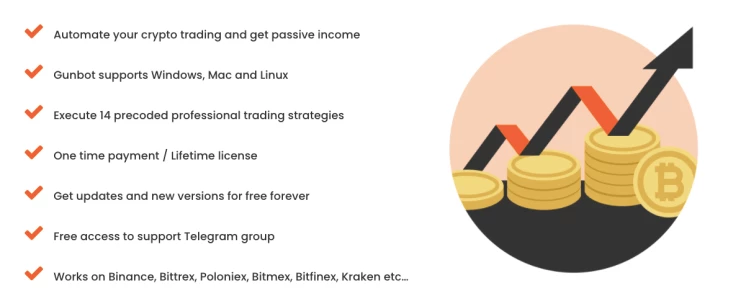
One-time cost: Standard $199 | Pro $300 | Ultimate $500 (lifetime licence, no monthly subscription) Best for: Long-term automation users who want to eliminate monthly fees Key feature: Runs locally, no cloud dependency, genuine one-time purchase Affiliate access: Gunbot
Gunbot’s value proposition is simple: pay once, own forever. In a category dominated by monthly subscriptions that aggregate to $500–$1,300 per year for serious traders, Gunbot’s $199–$500 lifetime licence becomes the economically rational choice for any trader who intends to use a trading bot for more than 12–18 months.
The performance reality is consistent with the category: Gunbot’s built-in strategies — Gain, TSSL, PT, and others — work well in their designed market conditions and underperform outside them. The platform’s strength is configurability: Gunbot supports nearly every major exchange, handles spot and futures trading, and provides enough configuration depth for experienced traders to tune strategies to their specific risk parameters.
Like HaasOnline, Gunbot runs locally, which provides the security advantage of keeping API keys off cloud servers. Unlike HaasOnline, Gunbot does not require programming knowledge — strategy configuration is parameter-based rather than code-based.
The honest limitation: Gunbot’s development pace has been slower than cloud-based platforms. New exchange integrations and feature additions lag competitors. The community forum is active and helpful, but the product feels more mature than cutting-edge.
Who should use it: Traders who have committed to long-term bot automation and want to eliminate monthly fees. The one-time payment model makes most economic sense with a minimum 18-month automation commitment.
#8 Coinrule — The no-code learning platform

Monthly cost: Free | Hobbyist $29/month | Trader $59/month | Pro $449/month Best for: Beginners who want to learn quantitative thinking through simple rule construction Hit rate: Approximately 50% across strategies Affiliate access:Coinrule
Coinrule is a no-code rule engine that lets you construct “if price does X and indicator Y is above Z, then execute” strategies without writing any code. The visual rule builder is genuinely accessible — most users can build a functioning strategy within 30 minutes of creating an account.
The performance reality is honest: Coinrule strategies hit approximately 50% across user-reported results. A coin-flip win rate sounds disappointing, but with appropriate position sizing, stop-losses, and an asymmetric risk-reward ratio (letting winners run while cutting losers quickly), a 50% hit rate can be profitable. Coinrule helps beginners understand that win rate alone does not determine profitability — the magnitude of wins vs losses does.
Coinrule’s strongest case is as an educational platform. Building rules, backtesting them, watching them succeed and fail in live markets, and iterating based on the results is a genuine quantitative trading education. Traders who spend six months on Coinrule with small capital typically develop better intuitions about what makes a strategy work than traders who simply subscribe to someone else’s Marketplace strategy.
Who should use it: Complete beginners who want to understand automated trading mechanics before committing to a more powerful platform. Not the right choice for experienced traders seeking maximum performance.
#9 TradeSanta — Simplicity done honestly

Monthly cost: Free trial | Basic $18/month | Advanced $45/month Best for: True beginners who want the simplest possible automation setup Supported exchanges: 9 including Binance, Bybit, OKX, Bitfinex
TradeSanta’s defining characteristic is honesty. The platform does not claim to be AI — it describes itself as simple automation. It does not promise extraordinary returns — it describes specific strategy mechanics and their expected performance profiles. In a category dominated by inflated claims, this straightforwardness is worth acknowledging.
The platform supports basic long and short strategies, DCA, and trailing stop-losses across nine exchanges. Setup genuinely takes minutes. The interface is cleaner than most competitors. The strategy options are limited, but the options that exist are clearly documented.
Performance reality: TradeSanta bots perform consistently with the category average — profiting in their designed conditions (DCA in downtrending then recovering markets, simple grid in sideways markets) and underperforming in sustained trends. The lack of advanced features means TradeSanta traders will not access the more sophisticated configurations available in 3Commas or Bitsgap, which caps the performance ceiling.
Who should use it: Traders who want the simplest possible entry into automation and are happy to stay within preset strategy parameters without needing to build or customise strategies.
 #10 Hummingbot — Open-source market making for sophisticated traders
Cost: Free (open-source, requires technical setup) Best for: Developers and quantitative traders interested in market making and arbitrage strategies Key differentiator: Professional-grade market making strategies on DEXs and CEXs
Hummingbot occupies a unique position: it is the only free, open-source platform that implements genuine market making strategies — placing simultaneous buy and sell orders around the mid-price and profiting from the spread. This is the strategy used by professional market makers and exchanges, not retail traders, and Hummingbot makes it accessible to technical users.
Market making generates returns from trading volume and spread rather than directional price prediction, which means it can produce consistent returns across both bull and bear markets — a genuine performance advantage over every other strategy type in this list. The catch: market making on thinly traded pairs carries inventory risk (accumulating too much of a declining asset), requires active monitoring, and demands technical competence to configure and maintain.
Performance reality: Well-configured Hummingbot strategies on liquid pairs have documented returns of 5–20% annually from spread capture, independent of market direction. This makes it the most market-condition-agnostic strategy in the category. The steep technical barrier is the only reason it is not ranked higher.
Who should use it: Developers and technical traders comfortable with Python, command-line configuration, and active monitoring of live trading bots. The free price point makes it worth exploring for anyone with the technical skills.
The ones that did not make this list — and why
Advertised bots with unverifiable claims. Multiple platforms in the category advertise specific performance numbers — “346% returns last quarter,” “our AI outperformed Bitcoin by 4x in 2024” — that lack any third-party verification, disclose no methodology, and present cherry-picked time periods. These platforms rank last not because they are necessarily fraudulent, but because their performance cannot be validated. In trading, unverifiable performance claims are not a performance advantage.
Copy trading platforms masquerading as bots. Some platforms present copy trading — automatically replicating the trades of another user — as AI trading. Copy trading is a legitimate and sometimes profitable approach, but it is not algorithmic or AI-based trading. The performance depends entirely on the human being copied, who themselves can have losing periods, change strategies, or close their account. These platforms are excluded from this ranking because they are a different product category.
Bots that only work in bull markets. Several platforms’ performance claims are drawn entirely from the 2020–2021 bull market or the 2023–2024 recovery. Any automated strategy that holds long positions in a bull market will produce positive returns — this does not demonstrate algorithmic edge. Bots that cannot point to performance across a full cycle, including a bear market, are excluded.
The security protocol you cannot skip
Every trader connecting any bot to any exchange must follow this protocol without exception:
Step one: Create a separate API key specifically for the bot. Do not use an existing API key that grants broader permissions.
Step two: Enable only the permissions the bot requires. For spot grid bots: spot trading only. For DCA bots: spot trading only. For futures bots: futures trading only. Withdrawal permissions must be disabled on every bot API key, without exception.
Step three: Enable IP allowlisting if your exchange supports it. Bybit, Binance, OKX, and Kraken all support IP allowlisting for API keys — only the specific IP address of your bot’s server can use the key. If your API key is compromised, it is unusable from any other IP address.
Step four: Rotate API keys monthly. Delete the old key and create a new one. Apply it to your bot configuration. This limits the window of exposure from any potential compromise.
Step five: Monitor your exchange account for unusual activity at least daily. Set withdrawal alerts. Enable 2FA on your exchange account — separate from your trading bot credentials.
The 2022 3Commas incident and various phishing campaigns targeting crypto bot users make this protocol non-negotiable. A few minutes of setup prevents the scenario where a compromised API key is used to execute wash trades, manipulate positions, or steal assets.
The performance comparison table
| Platform | Best bot type | Best market condition | Real return range (optimally configured) | Monthly cost | Security model | Our rating |
|---|---|---|---|---|---|---|
| Pionex | Grid | Sideways / volatile | +9–22% during downtrend testing | Free | Best (on-exchange) | 9.2/10 |
| 3Commas | DCA + Grid | Ranging + recovery | 55% win rate; 12–25% annual (configured) | $29–$79 | Cloud (enforce IP allowlist) | 8.8/10 |
| Cryptohopper | Signal + Marketplace | Bull trending | 0.75%/trade in optimal conditions | $24–$108 | Cloud | 8.3/10 |
| WunderTrading | Signal (TradingView) | Trend-following | Strategy-dependent | $0–$45 | Cloud | 8.1/10 |
| Bitsgap | Grid + Combo | Sideways / recovery | ~13.8% platform average (self-reported) | $23–$150 | Cloud | 7.9/10 |
| HaasOnline | Custom algorithmic | All conditions (custom) | Highly variable (skill-dependent) | $30–$130 | Local (best security) | 7.7/10 |
| Gunbot | Grid + DCA | Sideways / trending | Comparable to 3Commas (configured) | $199–$500 one-time | Local | 7.4/10 |
| Coinrule | Rule-based | Varies | ~50% hit rate (strategy-dependent) | $0–$449 | Cloud | 7.0/10 |
| TradeSanta | DCA | Recovery markets | Category average | $18–$45 | Cloud | 6.8/10 |
| Hummingbot | Market making | All (uncorrelated) | 5–20% from spread (documented) | Free | Local | 7.5/10* |
*Hummingbot is rated below its performance potential due to the technical barrier that makes it inaccessible for most readers.

The three-sentence verdict
Bots are tools, not magic. The ones on the most prominent ads are almost never the ones that perform best, and the ones that perform best in bull markets almost always disappoint in bear markets. In 2026, as an estimated 65% of all cryptocurrency trading volume involves some form of automation, a grid bot on Pionex costs nothing and works, and that is where most traders should start before spending money on anything more sophisticated.
To execute the trades your bot generates — or to trade alongside your bot with manual positions on derivatives — use the exchanges that provide the best execution quality and lowest friction for automated strategies. Bybit and BloFin offer the deepest perpetuals liquidity with the competitive maker fees that matter for high-frequency bot execution. OKX provides the broadest multi-chain access for bots that operate across DeFi and centralised markets simultaneously.
This article is for informational and educational purposes only. Past bot performance does not guarantee future results. All automated trading involves financial risk, including total loss of capital. This does not constitute financial advice. Always test with a small amount of capital before deploying significant funds into any automated strategy.
Affiliate disclosure: Decentralised News maintains affiliate relationships with Pionex, 3Commas, Cryptohopper, Coinrule, Gunbot, WunderTrading, TradingView, Bybit, BloFin, and OKX. Links in this article are affiliate links. This does not influence the editorial rankings or performance assessments.
FAQ
Do AI crypto trading bots actually work?
Yes, but only in the right market conditions and with the right strategy. Grid bots can work well in sideways or slightly trending markets because they profit from repeated price movement inside a range. DCA bots can help with disciplined accumulation, especially during pullbacks. Signal bots are more unpredictable because their performance depends entirely on the quality of the signal. No crypto trading bot removes risk or guarantees profit.
What is the best free AI crypto trading bot?
Pionex is one of the best free crypto trading bot platforms in 2026. It offers built-in bots such as grid bots, DCA bots and leveraged grid bots without a monthly subscription. Instead, Pionex earns through trading fees. Its biggest advantage is that the bots run directly inside the exchange, which reduces third-party API risk. The main limitation is that the AI layer is relatively basic compared with more advanced paid platforms.
What is the biggest risk of using a crypto trading bot?
The biggest risk is API key security. Most third-party bots require access to your exchange account through an API key. If that key is compromised and has the wrong permissions, your account can be exposed. Always use trade-only API permissions, never enable withdrawals, use IP allowlisting where possible, rotate API keys regularly and create a separate API key for each bot platform.
How much money do I need to start with a crypto trading bot?
You can start with a small amount, but the practical minimum depends on the bot type. For learning, $50 to $200 may be enough. For grid bots, $200 to $500 is more practical because the bot needs enough capital to place multiple orders across a price range. For paid bot platforms, $500 to $2,000 or more is usually more rational because subscription fees can eat into smaller accounts. Advanced bot systems may require $5,000 or more to make the costs worthwhile.
Can crypto trading bots make you rich?
Not reliably. Crypto trading bots are tools, not money printers. They can help automate a strategy, reduce emotional decision-making and execute trades consistently, but they do not guarantee profit. In strong bull markets, simply holding can outperform many bot strategies. In sideways or volatile markets, grid and DCA bots may help. The best way to think about bots is as risk-management and execution tools, not a shortcut to wealth.
Published by Decentralised News — decentralised.news | Author: Heath Muchena | May 2026
Published: May 2026 | Author: Heath Muchena | Publication: Decentralised News Testing methodology: Independent review using verifiable performance data, real user reporting, and third-party benchmark sources — September 2024 through May 2026