
Read our complete Velocity Exchange review for 2026, covering perpetual futures, fees, USDT collateral, lending, margin, liquidations, security risks and the best alternatives.
Last Updated: 17 July 2026
Summary
Velocity is an open-source, self-custodial decentralised exchange built on Solana. It is an independent fork of the Drift Protocol v2 codebase, deployed under a separate program ID and focused on perpetual futures, leveraged token swaps, lending, borrowing and insurance-fund staking.
Velocity combines Just-in-Time liquidity auctions, a decentralised perpetual order book and a virtual automated market maker. It uses USDT as its principal quote and settlement asset, while supported deposits can earn lending interest and contribute towards margin.
Current perpetual taker fees range from 0.035% to 0.020%, depending on 30-day trading volume. Makers receive a flat 0.0025% rebate. The most important concern is security verification: historical Drift audits cover the pre-fork codebase, while a dedicated post-fork Velocity audit was still being conducted by OtterSec when this review was updated.
Decentralised News verdict: Velocity presents an interesting combination of Solana execution, cross-collateral trading and DeFi lending. It is more appropriate for experienced perpetual traders, market makers and developers than complete beginners.
Referral notice: Decentralised News does not currently have a Velocity referral link. The link above is the standard platform link.
Velocity Exchange at a Glance
Category | Velocity Exchange |
Platform type | Decentralised perpetual futures and lending protocol |
Blockchain | Solana |
Custody | Self-custodial |
Codebase | Independent fork of Drift Protocol v2 |
Principal settlement asset | USDT |
Main products | Perpetual futures, token swaps, lending, borrowing and insurance-fund staking |
Margin system | Cross-margin by default |
Spot order book | No |
Liquidity architecture | JIT auctions, decentralised order book and virtual AMM |
Current taker fees | 0.035% to 0.020% |
Current maker fee | 0.0025% rebate |
Governance-token fee discount | No |
Developer access | TypeScript SDK, keeper tools and trading automation documentation |
Best suited to | Experienced traders, market makers, developers and DeFi users |
Main concerns | Smart-contract risk, oracle risk, liquidation risk, socialised losses and incomplete post-fork audit coverage |
What Is Velocity Exchange?
Velocity is a decentralised exchange and money-market protocol operating on Solana.
It allows traders to open leveraged perpetual futures positions from a self-custodial wallet. Users can also deposit assets, earn lending interest, borrow against collateral, swap supported tokens and stake into protocol insurance funds.
Velocity began with the Drift Protocol v2 codebase but operates independently. It has its own Solana program ID, software development kit, administrative architecture and protocol configuration.
The platform has also removed or changed several components inherited from Drift. These include the spot decentralised limit order book, high-leverage mode, prediction markets and governance-token staking discounts.
Velocity’s official documentation describes the protocol as a separate Drift v2 fork with a reduced feature set focused primarily on perpetual futures and lending or borrowing.
Is Velocity a Drift Protocol Rebrand?
No. Velocity should not be described simply as Drift under a new name.
It is more accurate to describe Velocity as an independent protocol developed from a fork of Drift Protocol v2.
Area | Drift v2 Codebase at the Fork Point | Velocity in 2026 |
Protocol deployment | Drift program | Separate Velocity program ID |
Primary quote asset | USDC | USDT |
Spot order book | Included | Removed |
Spot token use | Trading, collateral and lending | Collateral, lending and routed swaps |
High-leverage mode | Previously available | Removed |
Governance-token fee discounts | Supported in Drift design | Removed |
Prediction markets | Included in Drift codebase | Removed |
Perpetual futures | Supported | Core Velocity product |
Lending and borrowing | Supported | Core Velocity product |
Builder codes | Different system | Introduced by Velocity |
New liquidity modules | Drift architecture | Velocity-specific additions |
Audit coverage | Drift deployment and earlier code | Separate Velocity changes require separate review |
Developers migrating integrations must change the program ID, SDK package and quote-asset assumptions. Velocity uses USDT rather than USDC as its principal collateral and settlement asset.
How Velocity Exchange Works
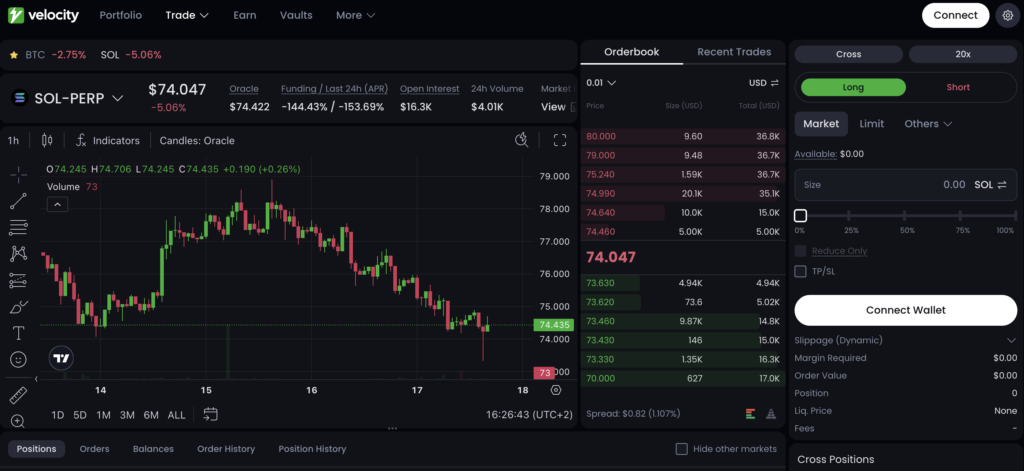
Velocity does not depend on one single source of liquidity.
Instead, perpetual orders can be filled through three complementary mechanisms:
- Just-in-Time auctions
- A decentralised limit order book
- A virtual automated market maker
This structure is designed to attract professional market makers while retaining an always-available backstop source of liquidity.
Just-in-Time Auctions
Perpetual market orders enter a short auction before being routed to the protocol’s AMM.
Market makers can compete to fill the trade at a price equal to or better than the auction’s permitted execution price. Velocity’s default JIT auction lasts approximately five seconds.
The auction begins at a comparatively favourable price and moves progressively towards the trader’s maximum permitted price.
This gives market makers an opportunity to improve execution before the order reaches the AMM.
Decentralised Limit Order Book
Velocity supports a decentralised limit order book for perpetual futures.
Users place orders on-chain. Keeper bots monitor these orders, organise them into an off-chain view of the book and submit qualifying matches for on-chain execution.
The keepers do not take custody of the trader’s assets. Their role is to identify executable orders and submit the corresponding transactions.
Virtual Automated Market Maker
If an order is not filled through the auction or by resting liquidity, Velocity’s virtual AMM can act as a backstop.
The AMM uses a constant-product curve together with configurable liquidity depth, spreads, inventory adjustments, oracle pricing and risk limits.
This structure can help bootstrap markets before substantial external market-maker liquidity arrives. It also exposes the protocol to inventory risk when traders become heavily concentrated on one side of a market.
Velocity’s official documentation confirms that JIT auctions, the decentralised order book and the AMM operate as its three principal sources of perpetual liquidity.
Velocity Perpetual Futures
Perpetual futures allow users to trade the price of an asset without owning it and without a fixed contract-expiry date.
A trader can:
- Open a long position when expecting a price increase
- Open a short position when expecting a decline
- Use leverage to control a position larger than the deposited collateral
- Set limit, trigger, stop-loss and take-profit instructions
- Use cross-collateral assets to support multiple positions
- Receive or pay funding depending on market conditions
Velocity quotes and settles perpetual profit and loss in USDT.
Holding another supported asset does not necessarily prevent a user from trading, but that asset may receive a lower collateral weight than USDT. The protocol can also create a USDT borrowing balance when a perpetual loss must be settled and the account does not hold sufficient USDT.
Velocity Token Swaps
Velocity does not have a conventional spot order book.
Supported spot assets primarily exist for:
- Collateral
- Lending
- Borrowing
- Routed token swaps
Velocity states that users can swap token pairs with up to 5x leverage. Swaps may be executed through direct routes or liquidity-pool infrastructure rather than through a traditional resting spot order book.
Before using a leveraged swap, traders should check:
- The source of borrowed capital
- Collateral requirements
- Expected output
- Price impact
- Minimum received
- Borrowing interest
- Swap-pool fees
- Liquidation exposure
- The effect on total account health
A leveraged swap is not equivalent to a basic wallet exchange. It can introduce debt, interest and liquidation risk.
Lending and Borrowing on Velocity
Velocity also operates as an overcollateralised money market.
Users can deposit supported assets and potentially receive variable lending interest. Other users can borrow those assets when they have sufficient collateral.
Deposited assets may serve two roles simultaneously:
- They can earn lending interest.
- They can provide collateral for perpetual futures.
This improves capital efficiency, but it also connects lending and trading risks.
For example, a user could:
- Deposit SOL
- Use the recognised value of that SOL as margin
- Borrow USDT
- Open a leveraged perpetual position
- Earn lending interest on the deposited SOL
- Pay interest on the USDT borrow
- Pay or receive perpetual funding
A decline in SOL could reduce the value of the collateral at the same time that the perpetual position loses money. The account could then approach liquidation from several directions.
Velocity’s documentation states that deposits can earn lending yield while supporting derivatives positions, subject to collateral weights and risk limits.
Understanding Velocity Cross-Margin
Velocity uses cross-margin by default.
Under cross-margin, deposits, borrows and perpetual positions inside the same subaccount contribute towards a combined account-health calculation.
This means excess collateral supporting one position can support another position. It also means losses in one part of the account can endanger other positions.
Example
Assume a trader deposits:
- $5,000 in USDT
- $5,000 worth of SOL
The USDT may receive a full collateral weight, while SOL may receive a lower weight because it is more volatile.
The trader’s recognised collateral may therefore be less than the $10,000 market value displayed in the account.
If SOL declines and a leveraged BTC position also moves against the trader, both changes can reduce account health.
Variables That Affect Account Health
- Deposit values
- Collateral weights
- Borrowed balances
- Liability weights
- Perpetual position size
- Unrealised profit or loss
- Initial-margin requirements
- Maintenance-margin requirements
- Funding
- Borrowing interest
- Position-size adjustments
- Market-specific risk parameters
Velocity calculates leverage and margin at market and position level. It does not retain Drift’s separate high-leverage account mode.
Velocity Trading Fees
Velocity’s perpetual fees are based on trailing 30-day trading volume.
Current Perpetual Fee Schedule
30-Day Perpetual Volume | Taker Fee | Maker Fee |
Less than $2 million | 0.0350% | 0.0025% rebate |
$2 million to $10 million | 0.0300% | 0.0025% rebate |
$10 million to $20 million | 0.0275% | 0.0025% rebate |
$20 million to $80 million | 0.0250% | 0.0025% rebate |
$80 million to $200 million | 0.0225% | 0.0025% rebate |
$200 million or more | 0.0200% | 0.0025% rebate |
A maker rebate means the eligible maker receives a small payment for adding executable liquidity.
Fee tiers are determined by trading volume rather than governance-token staking. The published values represent the on-chain configuration when this review was updated and can be changed by protocol administrators.
Velocity Fee Examples
Trade Size | 0.035% Taker Fee | 0.020% VIP Taker Fee |
$1,000 | $0.35 | $0.20 |
$10,000 | $3.50 | $2.00 |
$100,000 | $35.00 | $20.00 |
$1 million | $350.00 | $200.00 |
These examples show only the base trading fee. The actual cost can be higher once funding, spread, price impact and borrowing expenses are included.
The Real Cost of Trading on Velocity
Trading fees are only one part of the total cost.
Funding Payments
Perpetual positions may pay or receive funding.
Velocity updates funding lazily, generally around hourly intervals. The funding calculation is influenced by the difference between the perpetual mark price and the oracle-price time-weighted average.
A trader holding a position for several days may pay considerably more in funding than in entry and exit fees.
Spread and Slippage
The difference between the best available buying and selling prices creates an immediate cost.
Slippage can increase when:
- The order is large
- The market has limited depth
- Volatility is high
- Market makers temporarily withdraw
- The AMM has a significant inventory imbalance
Borrowing Interest
Borrowers pay variable interest determined by asset utilisation and demand.
Builder Fees
Orders can optionally contain a builder code and an additional builder fee. This fee is charged on top of the normal taker fee.
Swap-Pool Fees
Direct spot swaps do not have a standard spot maker or taker fee, but swaps routed through Velocity’s liquidity-pool infrastructure may carry a dynamic fee.
Liquidation Costs
Liquidated positions can be closed at an unfavourable time and charged a market-specific liquidation penalty.
Solana Transaction Costs
Normal Solana transaction charges are generally small, but congestion, priority fees and failed transactions can increase operational costs.
Velocity’s documentation distinguishes its base trading fees from funding, builder fees, dynamic swap fees and other position-related costs.
Velocity Order Types
Velocity supports several order controls for perpetual traders.
Order Type | Purpose |
Market order | Seeks immediate execution against available liquidity |
Limit order | Executes at the selected price or better |
Trigger market order | Activates a market order once a trigger is reached |
Trigger limit order | Activates a limit order after the trigger condition |
Stop-loss order | Attempts to reduce losses after an adverse price move |
Take-profit order | Attempts to close profitably after a target is reached |
Reduce-only | Prevents the order from increasing or reversing a position |
Post-only | Prevents immediate taker execution and seeks maker status |
Immediate-or-cancel | Fills available quantity immediately and cancels the remainder |
Stop-market orders offer a greater probability of execution but less control over price.
Stop-limit orders provide more price control, but the order may remain unfilled if the market moves beyond the limit too quickly.
Velocity supports reduce-only, post-only and immediate-or-cancel instructions alongside its primary market, limit and trigger orders.
Velocity Funding Rates Explained
Funding helps keep the perpetual market price close to its underlying reference price.
When funding is positive, long traders generally pay short traders. When funding is negative, shorts generally pay longs.
Funding can affect a trade in several ways:
- It can make a long-term position expensive to hold.
- It can create income for traders positioned against a crowded market.
- It can change rapidly during periods of speculation.
- It may differ considerably between exchanges.
- It can create arbitrage opportunities.
- It can erode a profitable directional trade.
Traders should inspect the current and predicted funding rate before entering a position.
A position that appears profitable based only on price movement can produce a disappointing net return after funding and fees.
Velocity’s funding mechanism uses market and oracle pricing inputs and is updated lazily around hourly periods. Funding receipts can also be capped when the AMM lacks sufficient retained equity to support fully symmetric payments.
How Velocity Liquidations Work
Liquidation can begin when an account’s total recognised collateral falls below its maintenance-margin requirement.
Because accounts are cross-margined by default, Velocity assesses the combined value of:
- Deposits
- Borrows
- Perpetual positions
- Weighted collateral
- Unrealised profit and loss
When an account becomes unhealthy, Velocity can first cancel its open orders. Liquidators can then reduce assets, liabilities or perpetual positions until the account returns above the required threshold and liquidation buffer.
Velocity displays an account-health measure. At zero health, the account may become eligible for liquidation.
Ways to Reduce Liquidation Risk
- Use less than the maximum available leverage.
- Maintain excess collateral.
- Avoid depending entirely on volatile collateral.
- Use separate subaccounts for unrelated strategies.
- Set reduce-only stop-loss orders.
- Monitor funding and borrowing expenses.
- Avoid opening several highly correlated positions.
- Reduce exposure before major market events.
- Test the platform using a small position.
- Do not treat the displayed liquidation price as guaranteed.
Cross-margin can be efficient, but it can also allow one poor position to damage an otherwise profitable portfolio.
Velocity Insurance Funds
Velocity uses insurance funds as a financial backstop for account bankruptcies and certain market deficits.
Users can stake supported assets into an insurance fund and potentially earn a portion of protocol revenue. However, the staked capital is exposed to losses when the fund is required to absorb bad debt.
Velocity states that its insurance funds are owned by their stakers. Revenue allocated to a fund can increase its share value, while bankruptcies and deficits can reduce the available assets.
Insurance-fund coverage also depends on market risk tiers. Certain speculative or isolated-tier perpetual markets may receive no shared insurance-fund protection. Uncovered losses can ultimately be socialised among open positions or lenders.
Insurance-fund staking should therefore be understood as risk underwriting, not guaranteed passive income.
Is Velocity Exchange Safe?
Velocity has several security-oriented characteristics:
- Self-custodial wallet access
- Open-source code
- On-chain deposits, withdrawals and settlement
- Oracle validity checks
- Margin and liquidation controls
- Market-specific risk parameters
- Insurance funds
- Contract-risk tiers
- Administrative guard rails
- Position-size controls
None of these features eliminates the possibility of loss.
Velocity Audit Status
The original Drift Protocol v2 codebase received audits before Velocity created its fork.
However, those audits did not cover:
- Velocity’s independent program deployment
- The new VLP module
- Velocity’s fee redesign
- Changed administrative permissions
- Builder-code functionality
- Every modification introduced after the fork
Velocity’s documentation stated that OtterSec was conducting a post-fork audit and that the report would be published once finalised.
Until that report becomes publicly available, readers should not describe the entire Velocity deployment as fully audited merely because earlier Drift code received security reviews.
Principal Velocity Risks
Smart-Contract Risk
A bug or exploit in the protocol could result in unexpected execution or loss of funds.
User-Interface Risk
A compromised front end could present malicious transactions even where the underlying contracts remain operational.
Oracle Risk
Velocity uses Pyth and Pyth Lazer pricing infrastructure. Incorrect, delayed or manipulated oracle information could affect trading, margin and liquidations.
Solana Network Risk
Congestion, outages, delayed transactions or changes to network conditions could interfere with position management.
Liquidation Risk
Leveraged positions can lose part or all of the deposited collateral.
Socialised-Loss Risk
If losses exceed available account collateral, market reserves and permitted insurance-fund coverage, deficits may be distributed among market participants.
AMM Imbalance Risk
Velocity’s AMM can accumulate directional exposure when traders become heavily concentrated on one side of a market.
Lending Liquidity Risk
Depositors may be unable to withdraw immediately when a high proportion of the asset pool has been borrowed.
Collateral Risk
A trader using a volatile token as collateral can suffer from both the collateral decline and losses on the leveraged position.
Administrative Risk
Authorised parties can modify selected protocol parameters, fees and risk settings.
Velocity itself identifies smart-contract, interface, blockchain, oracle, leverage, liquidation, AMM imbalance and socialised-loss risks.
Velocity Pros and Cons
Advantages | Disadvantages |
Self-custodial Solana trading | Newer independent deployment |
Open-source codebase | Velocity-specific audit was not yet complete when reviewed |
Perpetual futures and leveraged swaps | No conventional spot order book |
Cross-collateral margin | Cross-margin can transmit losses between positions |
Lending and borrowing | Lending withdrawals can be constrained by utilisation |
Maker rebates | Funding and borrowing costs can accumulate |
Volume-based taker discounts | Smart-contract and oracle exposure |
Advanced order instructions | Socialised losses remain possible |
JIT liquidity auctions | Liquidity may vary considerably by market |
Decentralised perpetual order book | More complex than a typical retail exchange |
Backstop AMM | Requires Solana wallet management |
TypeScript SDK and automation tools | Limited protection compared with regulated brokerage accounts |
Insurance-fund staking | Insurance-fund stakers can absorb protocol losses |
USDT-based settlement | USDT borrowing can arise when settling losses |
Who Should Consider Velocity?
Velocity may suit:
Experienced Perpetual Traders
Users who understand funding, leverage, maintenance margin and liquidation may appreciate the platform’s order controls and cross-collateral structure.
Solana DeFi Users
Existing Solana users can access derivatives and lending without moving into a separate custodial exchange account.
Market Makers
The maker rebate, JIT auctions, keeper infrastructure and decentralised order book provide several ways to supply liquidity.
Algorithmic Traders
Velocity provides a TypeScript SDK and documentation for keeper bots, market-making systems and automated trading applications.
Capital-Efficient Traders
Deposited assets can potentially earn lending interest while contributing towards derivatives collateral.
Who Should Avoid Velocity?
Velocity may not be suitable for:
- Complete beginners
- Users unfamiliar with self-custodial wallets
- Investors seeking capital protection
- Anyone who does not understand liquidation
- Users who require a conventional spot order book
- Traders who cannot monitor cross-margined positions
- People uncomfortable with smart-contract and oracle risk
- Users in jurisdictions that restrict crypto derivatives
- Anyone trading with essential savings or borrowed money
How to Start Using Velocity
Step 1: Create a Solana Wallet
Use a compatible Solana wallet and securely protect its recovery phrase.
Never enter the phrase into the Velocity interface.
Step 2: Obtain SOL and Collateral
SOL is required for network fees. Traders will also need a supported collateral asset, commonly USDT.
Readers needing an on-ramp can compare:
Check whether each exchange supports withdrawals of the selected asset through Solana before purchasing.
Step 3: Visit the Official Platform
Open Velocity Exchange and verify the domain before connecting a wallet.
Step 4: Deposit Collateral
Review the asset’s collateral weight, lending status and withdrawal liquidity.
Step 5: Examine the Market
Check:
- Mark price
- Oracle price
- Index price
- Order-book spread
- Available depth
- Funding rate
- Margin requirement
- Maximum position size
- Open interest
- Liquidation distance
Step 6: Open a Small Position
Test order execution, stop-loss functionality and position settlement before committing larger capital.
Step 7: Test a Withdrawal
A successful withdrawal confirms that the user understands the complete deposit, trading and exit process.
Best Velocity Alternatives in 2026
Velocity is not automatically the best perpetual platform for every trader.
The right alternative depends on whether the priority is:
- Order-book execution
- Low trading fees
- Cross-chain access
- Options
- Real-world assets
- Forex and commodities
- Trading bots
- Copy trading
- Centralised liquidity
- Institutional infrastructure
- A simpler user experience
Affiliate relationships do not remove the need to evaluate every platform independently.
Best On-Chain Velocity Alternatives
Platform | Best Suited To | Why Traders May Consider It |
Traders exploring pool-based perpetual execution | Uses a Matching Pool Mechanism and focuses on chain-abstracted perpetual trading | |
Traders seeking crypto and real-world perpetual markets | Privacy-focused DEX with perpetual markets covering crypto, stocks and commodities | |
Cost-sensitive and API-driven traders | Ethereum L2 order-book exchange using custom zero-knowledge proofs for matching and liquidations | |
Traders prioritising order-book performance | High-performance perpetual DEX with crypto and tokenised real-world markets | |
Traders interested in futures, options and privacy | Combines derivatives trading with a specialised Layer 2 and privacy-oriented products | |
Options and pre-launch market traders | Offers options, perpetuals, OTC products and automated strategies from one margin account | |
Traders preferring pool-based on-chain liquidity | Established perpetual and swap protocol operating across several EVM networks | |
Forex, commodities, stocks and index traders | Provides wallet-based leveraged exposure across crypto and traditional market categories | |
Traders in the Injective ecosystem | Supports spot, perpetual and expiry-futures markets through an on-chain order-book model | |
Multi-chain and API traders | Supports multi-chain deposits, perpetual accounts, cross-collateral and API integrations |
These protocols use materially different execution systems. MYX uses a matching-pool model, Lighter uses a custom ZK rollup, Aevo combines off-chain matching with on-chain settlement, GMX uses pool-based liquidity, and gTrade specialises in oracle-priced synthetic markets.
Best for Low or Zero Trading Fees: Lighter
Lighter’s standard accounts currently carry no maker or taker fee, although latency controls and separate premium-account conditions apply.
The platform is designed around verifiable order matching and liquidations using custom zero-knowledge infrastructure.
Best for Forex and Commodities: gTrade
gTrade offers leveraged markets spanning crypto, forex, commodities, stocks and indices.
Its liquidity model differs considerably from Velocity because trades use synthetic exposure backed by shared collateral vaults and oracle-based pricing rather than a traditional order book.
Best for Options: Aevo
Aevo combines perpetual futures, options, OTC products and automated strategies within a unified margin environment.
It is built on a custom OP Stack Layer 2 and uses off-chain order matching with on-chain settlement.
Best for Pool-Based On-Chain Liquidity: GMX
GMX is a decentralised spot and perpetual exchange operating across Arbitrum, Avalanche and MegaETH.
It may appeal to users who prefer pool-based liquidity and EVM-compatible wallets rather than Solana infrastructure.
Best for Verifiable Order-Book Execution: Lighter
Lighter generates proofs for exchange operations such as order matching and liquidations and settles protocol state through Ethereum.
It also provides APIs, subaccounts and advanced order types for sophisticated traders.
Best for Injective Traders: Helix
Helix is built around Injective’s on-chain exchange infrastructure and provides spot, perpetual and expiry-futures markets.
It also supports perpetual-grid trading tools across listed perpetual markets.
Best Centralised Velocity Alternatives
Centralised exchanges may provide deeper liquidity, faster account-based execution and a simpler onboarding process. They require users to trust the platform with deposited assets and may impose identity-verification requirements.
Platform | Best Suited To | Why Traders May Consider It |
Active derivatives traders | Broad futures, perpetuals, options, bots and copy-trading tools | |
Altcoin futures traders | Extensive cryptocurrency selection and numerous futures markets | |
Copy traders and bot users | Combines derivatives, automation and copy-trading products | |
Social and copy traders | Futures exchange with social and copy-trading functionality | |
Futures-focused traders | Derivatives-oriented interface and professional trading tools | |
Users wanting a straightforward futures platform | Provides perpetual futures and account-based trade management | |
Fee-sensitive futures traders | Futures-oriented exchange worth comparing on markets, fees and regional access | |
Options and institutional derivatives traders | Specialist platform for crypto options, futures and perpetuals |
Bybit offers futures, options and perpetual contracts as well as automation and copy-trading products. MEXC combines a large spot-token selection with futures markets, while Deribit specialises in options, futures and perpetual derivatives.
Velocity vs On-Chain Alternatives
Priority | Platform to Research First |
Solana-native cross-margin and lending | Velocity |
Matching-pool perpetual execution | MYX |
Privacy-focused crypto and RWA perpetuals | Aster |
Verifiable ZK order-book trading | Lighter |
High-performance order-book DEX | edgeX |
Futures and options in one account | Paradex |
Crypto options and pre-launch futures | Aevo |
Pool-backed EVM perpetuals | GMX |
Forex, stocks, indices and commodities | gTrade |
Injective spot and derivatives | Helix |
Multi-chain collateral and API access | ApeX Omni |
Velocity vs Centralised Futures Exchanges
Factor | Velocity | Centralised Futures Exchange |
Custody | User-controlled wallet | Exchange-controlled account |
Identity verification | Interface and jurisdiction dependent | Commonly required |
Execution | On-chain with keepers, makers and AMM | Centralised matching engine |
Transparency | Positions and protocol state are verifiable on-chain | Internal exchange systems |
Recovery support | Limited if wallet credentials are lost | Account-recovery procedures may exist |
Smart-contract risk | Yes | Generally no direct user smart-contract exposure |
Counterparty risk | Protocol and infrastructure risk | Exchange insolvency and custody risk |
Network dependency | Solana | Exchange servers and internal systems |
Spot market | No traditional spot order book | Commonly available |
Lending integration | Built into protocol | Varies by exchange |
Derivatives availability | Jurisdiction and interface dependent | Jurisdiction and account dependent |
Best for | Experienced self-custodial traders | Users prioritising liquidity and convenience |
Neither model is universally safer.
A decentralised exchange reduces conventional custody risk but introduces smart-contract, oracle and blockchain risk. A centralised exchange reduces wallet complexity but requires users to trust the platform’s custody and operational controls.
Velocity Exchange Review Verdict
Velocity is an ambitious Solana derivatives protocol built for more than simple directional trading.
Its combination of perpetual futures, JIT auctions, decentralised order-book liquidity, a backstop AMM, cross-collateral margin and integrated lending creates a sophisticated trading environment.
The strongest features include:
- Self-custodial Solana access
- Competitive volume-based fees
- Maker rebates
- Advanced order controls
- USDT settlement
- Lending and borrowing
- Developer automation tools
- Multiple liquidity mechanisms
- Insurance-fund participation
The largest reservations include:
- A newer independent deployment
- Incomplete Velocity-specific audit coverage when reviewed
- Cross-margin complexity
- Socialised-loss exposure
- Oracle and Solana dependence
- No conventional spot order book
- Variable lending and withdrawal liquidity
- The possibility of unsettled or constrained profit during market stress
Velocity may become a compelling platform for sophisticated Solana traders, builders and market makers.
It should not be treated as a beginner-friendly replacement for a regulated brokerage account or as a risk-free continuation of Drift.
The most prudent approach is to begin with a dedicated wallet, a small deposit, moderate leverage and a complete test withdrawal.
Frequently Asked Questions
What is Velocity Exchange?
Velocity is a decentralised perpetual futures, swap, lending and borrowing protocol built on Solana.
Is Velocity the new name for Drift?
No. Velocity is an independent fork of the Drift Protocol v2 codebase. It operates under its own program ID and has removed or changed several Drift features.
Does Decentralised News have a Velocity referral link?
Not yet. The Velocity links in this review are neutral platform links.
Is Velocity self-custodial?
Yes. Users connect a compatible Solana wallet and approve protocol transactions from that wallet.
What asset does Velocity use for settlement?
Velocity uses USDT as its principal quote and perpetual profit-and-loss settlement asset.
Does Velocity support spot trading?
It does not offer a conventional spot order book. Supported spot assets are used for collateral, lending, borrowing and routed token swaps.
What are Velocity’s trading fees?
Current perpetual taker fees range from 0.035% to 0.020%, based on trailing 30-day volume. Makers currently receive a 0.0025% rebate.
Can users earn interest on Velocity?
Users can deposit supported assets into lending pools and potentially receive variable interest. Returns are not guaranteed.
Does Velocity offer isolated margin?
Velocity’s primary model is cross-margin. Market and deployment settings should be checked before assuming isolated-position functionality is available for a particular market.
Can Velocity users be liquidated?
Yes. Accounts can be liquidated when recognised collateral falls below the maintenance-margin requirement.
Is Velocity audited?
The pre-fork Drift codebase received earlier audits. Velocity’s documentation stated that a dedicated post-fork OtterSec audit was in progress when this review was updated.
What are the best Velocity alternatives?
On-chain alternatives include MYX, Aster, Lighter, edgeX, Paradex, Aevo, GMX, gTrade, Helix and ApeX Omni. Centralised alternatives include Bybit, MEXC, Bitget, BingX, BloFin, Bitunix, KCEX and Deribit.
Is Velocity suitable for beginners?
Velocity is better suited to traders who already understand leverage, funding, collateral weighting, wallet security and liquidation.
Is Velocity available worldwide?
No platform should be assumed to be universally available. Derivatives access depends on local laws, interface restrictions and the platform’s terms.
Affiliate Disclosure
Some links to alternative exchanges, wallets and trading platforms in this article are affiliate or referral links. Decentralised News may receive compensation when eligible users register or transact through these links, at no additional cost to the reader.
Affiliate relationships do not determine our analysis, risk disclosures or conclusions.
Educational Disclaimer
This article is for educational and informational purposes only. It does not constitute financial, investment, tax, trading or legal advice.
Cryptocurrency, decentralised finance, lending and leveraged derivatives involve substantial risk. Users can lose part or all of their capital. Smart contracts, wallets, blockchains, oracles and interfaces can fail or be exploited. Leverage increases both potential gains and potential losses.
Verify current fees, audit reports, supported markets and jurisdictional availability before using any platform. Never trade with money you cannot afford to lose. For adults aged 18 and over.





