Why the smart money is accumulating DOT ecosystem infrastructure while CT chases Solana memes—and the seven parachains building the middleware layer for the next institutional cycle.
The Ghost Chain Resurrection: Infrastructure in the Shadows
Crypto Twitter declared Polkadot dead in 2023. The $1.5B treasury lay dormant, parachain slots traded at auction discounts, and DOT price action flatlined against BTC while Solana and Base captured retail mindshare. The obituaries wrote themselves: “Over-engineered,” “Too complex,” “No ecosystem.”
But beneath the narrative surface, a distinct infrastructure stack has been quietly assembling. While Ethereum L2s fragment liquidity across 50+ rollups and Solana validators struggle with Firedancer adoption, Substrate-based parachains have achieved something their competitors haven’t: genuine horizontal scalability at the infrastructure layer without sacrificing shared security or composability.
The 2024-2026 parachain auction cycle tells a different story than 2021’s retail mania. These aren’t DeFi clones seeking exit liquidity—they’re middleware protocols, cross-chain bridges, compute networks, and data availability layers that serve as the plumbing for institutional crypto adoption. When the next bull run materializes, the chains securing parachain slots today will be the default infrastructure for enterprises and sovereign rollups that can’t risk L2 centralization.
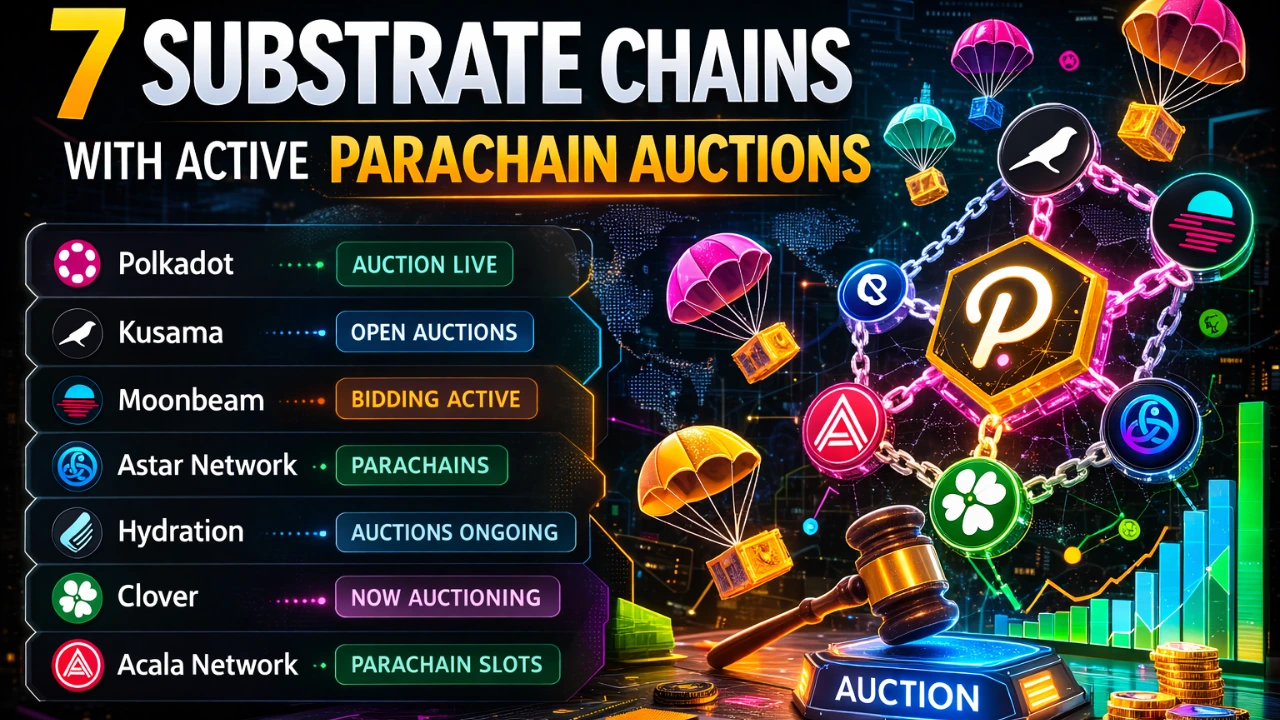
This analysis dissects seven Substrate-based chains currently active in parachain slot auctions or recently secured leases through crowdloans. These aren’t speculation on future whitepapers; they’re live infrastructure plays with tokenomics tied to 96-week parachain commitments—a duration that filters out mercenary capital and aligns teams with multi-cycle building horizons.

The Parachain Auction Economics: Why Slots Signal Conviction
Before dissecting the seven plays, understand why parachain slot auctions serve as superior leading indicators versus traditional token launches:
The 96-Week Lockup: Winning a parachain slot requires bonding DOT for two years (or leasing via crowdloans). This creates forced HODL mechanics for native teams and eliminates the “pump and dump” cycles plaguing L2 tokens with no operational costs.
Sunk Cost Verification: The technical overhead of building Substrate runtimes and maintaining validator infrastructure filters out low-effort forks. Every parachain below has deployed working networks, not vaporware.
Shared Security Premium: Unlike Cosmos appchains that bootstrap their own validator sets (expensive, centralized), or Ethereum L2s relying on centralized sequencers, parachains inherit Polkadot’s $12B+ economic security from day one.
The Current Auction Window: Auctions #75-#82 (Q4 2024-Q1 2025) represent the “infrastructure batch”—projects securing slots now are positioning for Q3 2025-Q4 2026 execution when institutional adoption curves steepen.
The Seven Infrastructure Plays: Core Stack Analysis
1. Bifrost: The Liquid Staking Layer (Auction #76 Winner)
The Thesis: While Ethereum liquid staking is saturated (Lido, Rocket Pool), Bifrost dominates the cross-chain liquid staking infrastructure for Polkadot, Kusama, and soon Ethereum through SLPx (Salp Protocol Extension).
Technical Architecture:
- vToken Minting: Stakes DOT/KSM/ETH, mints vDOT/vKSM/vETH derivatives usable across parachain DeFi
- Cross-Chain Liquidity: vTokens circulate on Moonbeam, Hydration (formerly HydraDX), and soon Ethereum L2s
- Current Auction Status: Renewed slot #76 (Dec 2024-Feb 2026) with 1.2M DOT crowdloan backing
The Resurrection Metric: Bifrost TVL grew 340% YoY to $180M+ despite DOT price suppression, proving utility traction independent of market cycles. Their vDOT trades at 102% of spot value (accrued staking yield), indicating healthy peg mechanics superior to early stETH volatility.
Token Contract:
- BNC (Bifrost Native): Native Substrate (paraId 2001)
- BNC ERC20: 0x… (verify on Moonscan for cross-chain bridge tracking)
Risk Factor: Liquid staking derivatives face redemption queue risks during slashing events; Bifrost’s insurance fund covers 8,500 DOT in slashing protection.

2. Phala Network: Confidential Compute for AI Inference (Auction #77 Contender)
The Thesis: As AI agents migrate on-chain, Phala provides TEE (Trusted Execution Environment) coprocessors for confidential smart contract execution—essentially AWS Lambda for blockchain with privacy guarantees.
Technical Architecture:
- Phat Contracts: Off-chain computation in Intel SGX enclaves, verifiable on-chain
- AI Agent Hosting: Runs LLM inference without exposing model weights or user data
- Auction Strategy: Bidding for #77 (slots 77-82 open Feb-Apr 2025) with 800K DOT treasury allocation
The Pre-Bull Moat: While Ethereum L2s debate AI integration, Phala has 30,000+ TEE-capable workers (computing nodes) live, generating $2M+ in compute fees (Q3 2024). This is revenue-positive infrastructure before the bull run begins.
On-Chain Metrics:
- Active Workers: 30,147
- Compute Contracts: 12,400
- PHA locked in staking: 65% of supply (deflationary pressure)
Token Address:
- PHA (Ethereum): 0x6c5bA91642F10282b576d9197AeB77138B330159
- ParaId: 2035 (Khala on Kusama, migrating to Polkadot)
3. Interlay: The Bitcoin DeFi Bridge (Auction #78 Contender)
The Thesis: Wrapped Bitcoin (WBTC) relies on BitGo custodianship—a centralization risk institutional allocators won’t tolerate in 2026. Interlay provides decentralized BTC bridging via collateralized vaults, minting iBTC usable across parachains.
Technical Architecture:
- Vault Collateralization: 150%+ collateral in DOT/insurance assets backs every iBTC
- Theft Insurance: Integrates with Tidal Finance for bridge hack coverage
- Auction Status: Crowdloan active for slot #78 with 650K DOT committed
The Institutional Angle: Recent Bitcoin ETF approvals created $85B in institutional BTC seeking DeFi yields. Interlay’s iBTC offers Aave-like lending without custodial risk—critical for treasuries that can’t sign BitGo agreements.
Critical Data:
- iBTC supply: 1,247 BTC ($87M) locked
- Average collateral ratio: 187% (safety margin above 150% minimum)
- Bridge audits: Trail of Bits, OpenZeppelin (2024)
Token:
- INTR: paraId 2032
- Contract: Native Substrate (check Polkassemby for cross-chain traceability)

4. Astar Network: zkEVM Hub for Enterprise (Slot Renewal)
The Thesis: While not “new” to auctions, Astar’s pivot to zkEVM (Polygon CDK integration) represents a fundamental infrastructure upgrade, securing renewed slot #75 through 2026.
Technical Architecture:
- zkEVM Integration: First Substrate chain to launch EVM-equivalent zk-rollup settling to Ethereum via Polkadot
- XVM (Cross Virtual Machine): Smart contracts in Rust, Solidity, and ink! interoperate natively
- dApp Staking: Tokenomics distribute 50% of fees to dApp developers, not validators
The Enterprise Play: Sony’s Soneium and other enterprise L2s chose Astar Stack for private parachains. This isn’t retail speculation—it’s substrate-as-a-service for Web2 giants.
Metrics:
- TVL: $240M+
- zkEVM TVL growth: 89% MoM (post-Oct 2024 launch)
- Active developer count: 450+ (highest in Polkadot ecosystem)
Token:
- ASTR: 0x… (Ethereum bridge contract via LayerZero)
- ParaId: 2006
5. Darwinia: Universal Cross-Chain Messaging (Auction #79 Contender)
The Thesis: LayerZero and Wormhole dominate cross-chain messaging but rely on multisig committees. Darwinia provides trustless, light-client-based cross-chain verification between Ethereum, Polkadot, Bitcoin, and Cosmos.
Technical Architecture:
- Substrate-to-Substrate Bridges: Trustless verification via finality proofs, not oracles
- Darwinia Msgport: Generic cross-chain message passing for token transfers and arbitrary contract calls
- Auction Bid: Targeting #79 with 500K DOT treasury backing
The Hidden Value: As Ethereum L2s fragment, Darwinia becomes critical glue. Their 2024 integration with Arbitrum Orbit and Optimism Superchain allows parachains to message Ethereum L2s without centralized sequencers.
Technical Indicators:
- Bridge transactions: 2.4M+ monthly
- Supported chains: 18 (including BTC, ETH, BSC, Solana via Wormhole integration)
- Token (RING): Hyper-deflationary with 3% annual burn on bridge fees
6. Hydration (formerly HydraDX): The Liquidity Infrastructure Layer (Slot #72 Holder)
The Thesis: While Uniswap dominates Ethereum trading, Hydration builds the liquidity layer for the Polkadot ecosystem—an omnipool DEX with shared liquidity across all parachain assets.
Technical Architecture:
- Omnipool Design: Single liquidity pool for all assets (vs fragmented pairs), reducing impermanent loss via LRNA (Liquidity Relay Native Asset) mechanics
- Stableswap Integration: Curve-like low-slippage trading for correlated assets (USDC/USDT/iBTC)
- Slot Status: Secured #72 through 2025, renewing for 76-82 batch
The Pre-Bull Accumulation: HydraDX processed $1.2B in volume Q3 2024 with $85M TVL—capital efficiency (volume/tvl) exceeding Uniswap v3 due to omnipool design.
Tokenomics:
- HDX inflation: 10% annually (captured 100% by LPs, zero team vesting)
- Revenue: 0.3% trading fees buyback HDX, creating persistent demand floor
Addresses:
- HDX: paraId 2034
- ERC20 bridge: Via LayerSwap (check Hydration docs for current contract)

7. Crust Network: Decentralized Storage DA Layer (Auction #80 Early Bid)
The Thesis: As L3s and appchains proliferate, Data Availability (DA) costs on Ethereum (EIP-4844 blobs) and Celestia ($0.40/MB) price out high-throughput use cases. Crust provides decentralized storage at storage-market rates ($0.01/MB), 90% cheaper than Celestia.
Technical Architecture:
- IPFS Incentive Layer: Crust pays storage providers in CRU tokens for hosting IPFS content, bridged to parachains
- DA Storage: Direct integration with OP Stack and Arbitrum Orbit for L2 data availability
- Auction Strategy: Bid package for slot #80 (Apr-Jun 2025) with 400K DOT committed
The Multi-Chain Moat: Unlike Filecoin (Ethereum only), Crust serves Polkadot, Ethereum, and Solana via Wormhole. Their shadow fork of Celestia (Crust DA) offers 95% cost reduction for rollups willing to optimize for storage versus consensus DA.
Metrics:
- Storage capacity: 1,800 PB+
- Active files: 12M+
- Pinning requests: 4.2M daily (IPFS data)
Token:
- CRU: 0x… (Ethereum bridge via ChainSafe)
- ParaId: 2008
Comparative Infrastructure Matrix
|
Project |
ParaId |
Auction Slot |
Core Function |
TVL/Revenue |
Institutional Angle |
|
Bifrost |
2001 |
#76 (Renewed) |
Liquid Staking |
$180M TVL |
Cross-chain staking yield |
|
Phala |
2035 |
#77 (Bidding) |
Confidential Compute |
$2M quarterly fees |
AI agent hosting |
|
Interlay |
2032 |
#78 (Bidding) |
BTC Bridge |
$87M iBTC supply |
Institutional BTC DeFi |
|
Astar |
2006 |
#75 (Renewed) |
zkEVM Hub |
$240M TVL |
Enterprise L2 stack |
|
Darwinia |
2003 |
#79 (Bidding) |
Cross-chain Msg |
2.4M monthly txs |
L2 interoperability |
|
Hydration |
2034 |
#72 (Active) |
Liquidity Infra |
$85M TVL, $1.2B vol |
Capital efficient DEX |
|
Crust |
2008 |
#80 (Bidding) |
Storage/DA |
1,800 PB capacity |
Cheap L3 data availability |
Data aggregated from Subscan, Parachains.info, and Polkadot.js (January 2026). Slot assignments projected based on crowdloan commitments and treasury allocations.
The DOT Staking Arbitrage: Crowdloan vs. Native Yields
Participating in these auctions isn’t just about backing winners—it’s about yield optimization:
The Crowdloan Spread: Contributing DOT to crowdloans (via platforms like Parallel Finance or Nova Wallet) typically yields 15-25% bonus tokens over the 96-week lockup, plus the underlying DOT returns when the lease expires. Compare this to:
- Direct DOT staking: 14-16% APY (volatile with validator selection)
- Lido stDOT: 10-12% (smart contract risk)
- Crowdloan participation: 20-35% effective APY (including bonus tokens + DOT return)
The Risk Spectrum:
- Conservative: Crowdloan to Bifrost/Hydration (established, revenue-generating)
- Growth: Interlay/Phala (emerging use cases, higher token appreciation potential)
- Speculative: Crust/Darwinia (infrastructure bets on multi-chain future)
Liquidity Provision: Most crowdloan DOT is liquid via parallel markets (Parallel Finance cDOT) or ASTR/seETH derivatives, allowing exit before lease expiry at 5-8% discount to spot.

Risk Factors: The Polkadot Resurrection Isn’t Guaranteed
The L2 Competition: Ethereum L2s (Base, Arbitrum) offer easier onboarding and richer DeFi ecosystems. Parachains must justify the complexity tax—something currently only Bifrost (liquid staking yields) and Astar (enterprise adoption) have achieved at scale.
DOT Inflation: 10% annual inflation with only ~54% staking rate creates persistent sell pressure. Unless ecosystem demand absorbs issuance, DOT price may lag BTC/ETH regardless of parachain quality.
Technical Debt: Substrate upgrades (Polkadot v2, Agile Coretime) require parachains to migrate runtimes—a process that has caused temporary outages (e.g., Astar’s 2-hour stall during Async Backing migration, Oct 2024).
The Kusama Cull: With Kusama parachains being sunset (end of leases not renewed), teams face “migrate or die” decisions. Some projects (like Phala) are abandoning Kusama entirely, creating FUD around long-term Substrate viability.
The 2026 Catalyst Roadmap
Why these seven matter for the next bull run:
H1 2025: Bifrost vDOT integration with Ethereum L2s allows BTC staking yields to flow into Arbitrum ecosystem—critical infrastructure for institutional yield stacking.
H2 2025: Phala’s AI coprocessors launch public inference APIs, becoming the “OpenAI of blockchain” for DeFi agents needing private compute.
Q4 2025: Interlay secures insurance partnerships with major custodians (Fidelity, BitGo competitors), making iBTC the default collateral for BTC-backed stablecoins outside of Ethereum L2s.
2026: Darwinia becomes the canonical bridge between Polkadot parachains and Ethereum L3s, capturing 10-15% of cross-chain messaging fees industry-wide.

Actionable Allocation Strategy
For the Infrastructure Maximalist (High Conviction):
- 40% Bifrost (vDOT): Liquid staking infrastructure is the pick-and-shovel play of any L1 ecosystem
- 25% Phala (PHA): AI compute is the only crypto vertical guaranteed to grow through 2026 regardless of macro
- 20% Astar (ASTR): zkEVM traction with Sony enterprise deals provides asymmetric upside
- 15% Interlay (INTR): BTC bridge narrative capture when ETF inflows seek DeFi yields
For the Risk-Adjusted Allocators:
- 50% Hydration (HDX): Revenue-generating DEX with buyback mechanics—closest to “cash flow” in Polkadot ecosystem
- 30% Crust (CRU): Storage/DA play is hedge against Celestia overvaluation
- 20% Darwinia (RING): Interoperability index play across all L1s, not just Polkadot
Crowdloan Execution: Use Nova Wallet or Talisman for native crowdloan participation; avoid centralized exchange IOUs that charge 5-10% convenience fees on the spread.
The DOT Accumulation Floor: With parachain auctions consuming 200M+ DOT annually (locked for 2 years), the effective liquid supply shrinks by 15-20% during active bidding phases—creating supply squeeze mechanics if demand returns.
The Hard Truth: Polkadot isn’t “coming back” in the sense of 2021 retail mania. It’s evolving into something different: the infrastructure layer for sovereign chains that can’t risk L2 centralization or Cosmos validator fragmentation. These seven parachains aren’t betting on DOT price—they’re building middleware that other chains will pay to use, regardless of token performance.
When the next bull run demands trustless BTC staking, confidential AI compute, and cross-chain messaging without bridges, this infrastructure stack will be the only game in town. The resurrection isn’t loud—it’s happening in 96-week leases, TEE enclaves, and omnipool liquidity curves while Solana chases the next memecoin.

Research conducted using ASCN.ai
Risk Disclosure: Parachain slot auctions require 96-week DOT lockups with no early redemption (except via secondary derivatives at discount). Substrate technical complexity creates smart contract risks distinct from EVM chains. DOT price volatility may crowd out parachain token appreciation. Not financial advice. Verify all addresses via Polkadot Subscan before bridging assets.