How Warsh, Lagarde, AI, debt and shadow leverage could define the next macro regime
The most important macro story of 2026 is not simply whether the Federal Reserve cuts, holds or hikes. It is that the operating system of central banking is being rewritten in real time.
For nearly two decades, markets lived inside a world built after the global financial crisis. Central banks did not merely set interest rates. They managed expectations, suppressed volatility, expanded balance sheets, backstopped sovereign-debt markets and trained investors to believe that every major drawdown would eventually meet policy support.
That era is not dead, but it is being narrowed.
The new regime is less about rescue and more about credibility. Less about forward guidance and more about reaction functions. Less about asset-price support and more about inflation discipline. Less about commercial banks as the only source of systemic risk and more about hedge funds, private credit, repo markets, leveraged ETFs, stablecoins, tokenized Treasuries and AI infrastructure finance.
For investors, this is a profound shift. The old question was, “When will the Fed pivot?” The better question now is, “How much of the old central-bank put still exists, and what price will markets have to pay before it returns?”
The current policy map
The world’s major central banks are no longer moving in one clean direction.
The Federal Reserve held the federal funds target range at 3.50% to 3.75% in June 2026 and reaffirmed its policy of maintaining ample reserves in the banking system. Kevin Warsh is now Fed chair, having taken office on May 22, 2026, with a chair term running to May 2030 and a Board term running to January 2040.
The ECB has moved differently. In June, it raised its three key policy rates by 25 basis points, citing inflation pressure from the Middle East war and projections showing headline inflation averaging 3.0% in 2026, 2.3% in 2027 and 2.0% in 2028.
The Bank of England is in a holding pattern, but not a comfortable one. Its Monetary Policy Committee voted 7 to 2 in June to hold Bank Rate at 3.75%, while two members voted to raise it to 4%.
Canada is caught between weak growth, energy shocks and trade uncertainty. The Bank of Canada held its overnight rate at 2.25% in June, while noting that the Middle East conflict and supply-chain disruptions were weighing on global growth and pushing up inflation.
Markets are therefore not facing a synchronized easing cycle. They are facing a fragmented policy regime, where the Fed is credibility-focused, the ECB is energy-shock-sensitive, the Bank of England is divided, and Canada is trying not to overreact to inflation in a soft economy.
That matters because asset prices are still rich in several places. As of July 1, 2026, Bitcoin was trading near $60,038, Ethereum near $1,617, SPY near $747, QQQ near $728, GLD near $373, and USO near $103.
That is the tension. Risk assets are still behaving as if liquidity remains available. Central banks are talking as if liquidity will no longer be granted casually.
The death of spoon-fed markets
Forward guidance was born as crisis medicine. After 2008, central banks wanted to convince households, businesses and markets that policy would stay easy long enough to repair balance sheets. After 2020, they used guidance again to prevent a pandemic shock from becoming a depression.
But crisis tools have side effects. Guidance can become a promise. A promise can become a constraint. A constraint can make central bankers late.
The problem is not that guidance never worked. It did. The problem is that markets learned to treat central-bank communication as a substitute for their own risk analysis. Investors did not just price earnings, inflation or credit risk. They priced the expected kindness of the next press conference.
The next regime is different. Central bankers still want to be understood, but they do not want to be trapped. They want markets to understand the framework, not front-run the decision.
This is why the language around “data dependence” has changed. It is no longer a vague slogan. It is a legal and psychological escape route from the policy promises of the past.
When a central bank refuses to give forward guidance, it is still sending a message. The message is that the market must carry more uncertainty itself.
The direct implication is higher risk premia over time. Not necessarily every day. Not necessarily in a straight line. But structurally, assets that depended on low volatility, predictable easing and balance-sheet expansion should command less generous valuations.
That includes long-duration technology, speculative crypto, private credit, venture capital, leveraged real estate and any strategy that quietly assumes the central bank will absorb the left tail.
The Warsh doctrine
Kevin Warsh is not easily reduced to “hawk” or “dove.” The better description is institutional reformer with a market-discipline bias.
His public record and disclosures suggest a worldview shaped by the financial crisis, Wall Street, asset management, corporate governance, conservative economic institutions and the belief that the Fed became too expansive after 2008. His official biography confirms he previously served as a Fed governor from 2006 to 2011 before returning as chair in 2026.
Warsh’s doctrine appears to rest on five ideas.
First, inflation credibility is the anchor of independence. If the Fed looks politically obedient or tolerant of above-target inflation, it loses the moral basis for autonomy.
Second, interest rates should be the main instrument of monetary policy. A large balance sheet is not neutral. It influences asset prices, changes market incentives, blurs the line between monetary and fiscal policy, and may encourage politicians to outsource difficult choices to central banks.
Third, volatility is not always an enemy. A market that is never allowed to clear becomes more fragile. Suppressed volatility can encourage leverage, crowding and lazy risk management.
Fourth, the Fed needs better data. Traditional macro indicators are often lagged, revised, survey-based and poorly suited to an economy being transformed by AI, platform work, digital payments, real-time supply chains and fast-changing capital expenditure cycles.
Fifth, the Fed must restore a narrower identity. The larger the Fed’s mandate feels in practice, the more political the institution becomes. A central bank that is expected to solve inequality, climate risk, employment dislocation, sovereign debt stress, banking instability, private-credit opacity and asset-market crashes becomes too powerful to remain uncontroversial.
The market implication is not permanent tightening. It is conditional liquidity. Warsh may cut if inflation falls and growth cracks. He may backstop a genuine systemic crisis. But investors should not expect the same eagerness to soothe every correction.
Lagarde’s Europe is a different machine
Christine Lagarde’s doctrine is not the same as Warsh’s. Europe’s problem is not only inflation. It is institutional design.
The eurozone has one central bank, many fiscal authorities, incomplete capital-market integration, uneven banking systems, different debt burdens and a chronic shortage of scalable risk capital. That makes ECB policy inherently political, even when it is legally independent.
Lagarde’s repeated emphasis on accountability and independence reflects this architecture. The ECB cannot simply act like a national central bank. It must constantly defend why a single monetary policy fits economies with different growth rates, debt dynamics, wage systems and political pressures.
That is why Europe’s growth answer increasingly revolves around capital markets union, venture capital, banking resilience and a common financial architecture. Lagarde has argued that Europe needs deeper capital markets to connect savings with productive investment and strengthen resilience in a fragmenting world.
This is the key difference between the Fed and the ECB. The Fed is trying to narrow and discipline the monetary machine. The ECB is trying to preserve monetary credibility while pushing Europe to complete the financial machine around it.
For investors, the eurozone risk is not just rates. It is whether Europe can convert savings into innovation before AI widens the productivity gap with the United States.
The balance sheet is the real policy battlefield
Interest rates get the headlines. Balance sheets shape the regime.
A rate increase changes the price of money. A balance-sheet expansion changes the quantity, maturity, collateral structure and psychological availability of money. That is why QE became so powerful after 2008. It was not merely a technical purchase program. It was a message that central banks were willing to underwrite the financial system through asset prices.
The coming debate is whether that tool should return to the emergency box.
This is where the policy shift becomes material for markets. If central banks keep balance sheets large, abundant liquidity remains part of the market’s foundation. If they shrink them too quickly, repo markets, bank reserves, Treasury liquidity and leveraged sovereign-bond trades can become unstable. If they redesign them, the result may be a more targeted system of standing facilities, repo tools and narrow liquidity support rather than broad asset purchases.
The BIS has made the risk explicit. Its 2026 Annual Economic Report warns that high public debt, inflation shocks, financial fragilities and the AI boom are testing resilience. It also highlights the rising role of non-bank financial institutions in advanced-economy sovereign debt markets.
This creates a dangerous triangle: governments need to issue more debt, hedge funds and non-banks are increasingly important buyers and traders of that debt, and central banks are less willing to act as permanent shock absorbers.
That triangle is the hidden fiscal-financial regime of the 2020s.
The new leverage map
The next systemic event may not begin in a bank.
The financial system has spent 15 years pushing risk into less visible places. Banks are better capitalized than before 2008, but leverage migrated into hedge funds, private credit, insurance-linked products, family offices, structured ETFs, repo trades and off-balance-sheet financing channels.
The FSB has already identified leverage in non-bank financial intermediation as a financial-stability risk and has recommended that authorities improve monitoring and policy tools. Its workplan selected leveraged trading strategies in sovereign-bond markets as an early focus because of their relevance to financial stability.
Private credit is another pressure point. The FSB warned in May 2026 that the sector’s complexity, leverage and interconnectedness could amplify stress in adverse scenarios.
The lesson is simple. Markets are not safer because banks are safer. Risk has not disappeared. It has changed address.
The next “subprime” may not look like subprime. It may look like a Treasury basis trade. It may look like a private-credit valuation gap. It may look like an AI data-center financing chain that depends on cheap debt and heroic demand assumptions. It may look like a stablecoin liquidity spiral. It may look like a leveraged ETF rebalance into a falling market.
This is why central banks are talking about financial stability even when banks look healthy.
AI is now a monetary variable
AI is no longer just a technology theme. It is now part of the central-bank reaction function.
The bullish version is clear. AI raises productivity, accelerates scientific discovery, improves logistics, reduces service-sector costs, strengthens margins and allows economies to grow faster without generating the same inflation pressure. In that world, central banks can tolerate stronger demand because supply is expanding too.
The bearish version is also clear. AI triggers an investment boom before the productivity payoff arrives. Data centers, chips, memory, power grids, cooling systems, land, skilled labor and capital equipment become bottlenecks. Equity markets price perfection. Debt markets finance capacity that may not earn adequate returns. If expected AI profits disappoint, the capex cycle reverses and the asset-price damage spills into credit.
The BIS has warned that AI optimism has supported easy financial conditions, but that the same optimism may be masking fragilities. Recent reporting on the BIS Annual Economic Report highlighted risks from high public debt, AI-linked financial exuberance and leveraged finance structures.
This is the central paradox. AI may be genuinely transformational and still produce a bubble. Railroads changed civilization and bankrupted investors. The internet changed everything and still delivered the dot-com crash. The question is not whether AI matters. It does. The question is whether the current capital structure around AI can survive the gap between narrative and cash flow.
For monetary policy, AI creates a dangerous ambiguity. If growth is strong because productivity is improving, cutting rates too early may be unnecessary. If growth is strong because AI capex is overheating demand, cutting rates may be inflationary. If AI replaces labor faster than new jobs are created, inflation may fall but political instability may rise.
Central banks will not solve that in a model. They will discover it in real time.
Stablecoins, tokenization and the official-sector counterattack
Crypto investors often assume that stablecoin growth is a win for digital assets. It is, but only partially.
Stablecoins have proven that the market wants programmable dollars, instant settlement and internet-native finance. But the official sector is not preparing to surrender money creation to offshore issuers and private liquidity networks.
The BIS has argued that stablecoins display some promise for faster programmable payments, but in their current form fall short on key monetary properties and could create macro-financial stability risks if widely adopted.
The likely destination is not a total stablecoin ban. It is regulated tokenized money. Bank deposits, tokenized reserves, permissioned wholesale ledgers, compliant settlement networks and cross-border payment systems will increasingly compete with open stablecoin rails.
For Bitcoin, this is mixed. A more digitized monetary system may increase awareness of non-sovereign assets. But if stablecoin regulation tightens liquidity, crypto trading conditions may become more cyclical and more dependent on regulated dollar plumbing.
For Ethereum and DeFi, the opportunity is settlement infrastructure, tokenized assets and collateral markets. The risk is that official tokenization captures the institutional use case while public DeFi remains treated as speculative, retail-heavy and compliance-sensitive.
The future of crypto liquidity will be shaped less by ideology and more by collateral rules.
Public disclosures and influence, without conspiracy
A serious influence analysis does not require conspiracy. It requires understanding networks, incentives and institutional sociology.
Warsh’s public financial disclosure and ethics materials matter because they show a deep professional history across finance, advisory work, investment vehicles and elite economic networks. His OGE disclosure lists his nominee report for Fed chair and member of the Board of Governors, while his ethics agreement supplement committed him to divest interests in the iShares S&P/TSX 60 Index before assuming duties and to avoid matters directly and predictably affecting that fund until divestiture.
That does not prove improper influence. It does suggest a worldview shaped by capital markets rather than academia alone. A central banker with that background may be more sensitive to market functioning, balance-sheet distortions, private leverage and the moral hazard of perpetual rescue.
Lagarde’s influence map is different. It is legal, political, European and multilateral. ECB declarations of interest provide formal transparency around senior officials, while Reuters reported earlier in 2026 on scrutiny of Lagarde’s BIS-related remuneration, noting that Reuters could not independently verify the underlying Financial Times report.
Bailey’s influence map is regulatory and global. The Bank of England’s public register covers senior officials and policy committee members, while Bailey also serves as FSB chair and has spoken on cross-border payments and financial stability.
Macklem’s world is shaped by Canada’s trade exposure, commodity sensitivity, housing stress and dependence on US economic conditions. The Bank of Canada’s June decision explicitly cited Middle East conflict, energy prices, supply-chain disruptions and US trade-policy uncertainty.
The proper conclusion is not that individuals are secretly controlled by financial interests. The better conclusion is that each central banker carries a different institutional biography. Warsh sees moral hazard and balance-sheet excess. Lagarde sees political fragmentation and the need for European capital formation. Bailey sees systemic plumbing. Macklem sees trade, energy and household stress.
Policy is made by models, but doctrine is shaped by biography.
Political pressure is the shadow mandate
Central-bank independence is strongest when inflation is low, growth is stable and fiscal policy is credible. It becomes fragile when inflation hurts households, debt-service costs rise, elections intensify and governments want cheaper borrowing.
That is the world central banks now inhabit.
The politics are not subtle. Governments want growth. Voters want lower prices. Bond markets want fiscal discipline. Equity markets want liquidity. Banks want stability. Crypto wants monetary skepticism. Private credit wants calm default cycles. AI companies want cheap capital and permissive regulation.
Central banks cannot satisfy all of them.
This is why inflation credibility has become politically useful. A central bank that can say “we are defending price stability” has a clearer democratic defense than one that appears to be managing asset prices. Independence survives when the public believes the central bank is doing a narrow job, not secretly choosing winners.
The irony is that central banks became more powerful by rescuing markets. Now they may have to become more restrained to protect that power.
What this means for assets
Bitcoin
Bitcoin’s long-term thesis improves in a world of fiscal stress, politicized money and distrust of institutions. But the short-term liquidity thesis becomes more complicated. A Fed that is more cautious with balance-sheet expansion is not automatically bullish for crypto.
Bitcoin can rally on institutional adoption, sovereign concerns and stablecoin growth. But it can still fall sharply in a dollar-liquidity shock, especially if leveraged crypto positions are funded by the same risk appetite supporting AI equities and private credit.
The core view: Bitcoin remains a strategic hedge against monetary disorder, but tactically it is still a high-beta liquidity asset.
Ethereum and DeFi
Ethereum’s future depends on whether public blockchains become trusted settlement infrastructure or remain treated as speculative outer rails. Tokenization is bullish for the category, but official-sector tokenization may favor permissioned systems, regulated bank liabilities and compliance-heavy networks.
The best DeFi assets will be those that serve real collateral, settlement, liquidity and risk-management functions. Narrative-only tokens are vulnerable in a regime where central banks tolerate less speculative excess.
AI equities
AI remains the strongest structural growth theme in global markets. But investors must separate three things: useful technology, profitable deployment and valuation discipline.
The first is obvious. The second is uneven. The third is fragile.
If AI capex delivers productivity quickly, mega-cap technology can justify premium valuations. If capex becomes a competitive arms race with uncertain returns, the market will eventually punish duration-heavy AI stories.
The most dangerous phrase in this cycle may be “this time is different.” It is different technologically. It may not be different financially.
Bonds
Sovereign bonds face a more complex regime than simple inflation forecasting. The supply of debt is large, fiscal politics are difficult, non-bank leverage is more important, and central banks are less eager to expand balance sheets.
That points to higher term premia over time, even if recession scares periodically drive yields lower.
Long bonds can still rally in a growth shock. But investors should not assume every bond-market dysfunction will be met with unlimited QE.
Gold and commodities
Gold benefits from fiscal anxiety, geopolitical fragmentation, central-bank credibility risk and real-rate uncertainty. Its role is no longer only inflation hedge. It is institutional hedge.
Oil remains the most direct channel between geopolitics and central-bank policy. Energy shocks can force tighter policy even when growth is soft. That is especially dangerous for Europe and emerging markets.
Copper, uranium, natural gas and power-linked commodities sit at the intersection of AI, electrification, defense spending and infrastructure bottlenecks.
Private credit
Private credit is the cleanest test of the low-volatility era. It grew in a world of low rates, yield hunger, bank retrenchment and confidence in private marks. It has not yet been tested by a full modern cycle of refinancing stress, higher defaults, valuation pressure and bank pullback from fund financing.
The risk is not that private credit is “bad.” The risk is that it is opaque, interconnected and slower to mark pain.
Banks
Banks are better capitalized than before 2008, but they are not isolated from the new risk map. They finance funds, warehouse collateral, provide repo, face deposit competition and remain exposed to commercial real estate, sovereign duration and credit cycles.
The winners will be banks with strong deposit franchises, disciplined credit exposure and access to regulatory-favored tokenization or payment infrastructure.
The 30 to 90 day view
The next quarter is likely to be noisy. Markets will remain hypersensitive to inflation data, energy prices, AI earnings, labor-market strength and central-bank language. The Fed is unlikely to reward markets with easy guidance. The ECB may pause if energy pressures fade, but it will keep inflation credibility front and center. The Bank of England remains on alert. Canada remains trade-sensitive.
The likely result is rotation rather than collapse. AI leaders stay supported, but breadth may remain fragile. Bitcoin can trade well if dollar liquidity is stable, but it remains vulnerable to sharp de-risking. Gold remains useful as a portfolio hedge. Oil remains a geopolitical policy variable.
The 6 to 12 month view
Over the next year, the bigger story will be whether AI productivity shows up in realized margins, wages, output and inflation data. If it does, markets can digest higher rates better than expected. If it does not, investors will start questioning whether the AI capex boom pulled forward too much demand.
The second story will be balance-sheet doctrine. Any sign that the Fed wants to make its balance sheet structurally smaller, or rely more on targeted facilities rather than broad asset purchases, will alter how markets price tail risk.
The third story will be non-bank leverage. Regulators are not waiting for a crisis to map private credit, repo leverage and sovereign-bond trades. That means the next phase of regulation may land outside banks first.
The 2027 to 2030 regime
By the end of the decade, the monetary system may look very different.
Central banks will use more real-time private-sector data. Payments will become more tokenized. Stablecoins will either become more regulated or lose institutional relevance. Tokenized bank deposits and wholesale settlement rails will challenge parts of public crypto infrastructure. Balance sheets will remain large by historical standards, but politically harder to expand. Sovereign debt markets will require more explicit liquidity architecture. AI will either validate a higher-productivity world or leave behind one of the most expensive overinvestment cycles in modern history.
The winners will be investors who understand plumbing, not just narratives.
The losers will be those who assume every cycle ends with the same rescue.
The proprietary macro conclusion
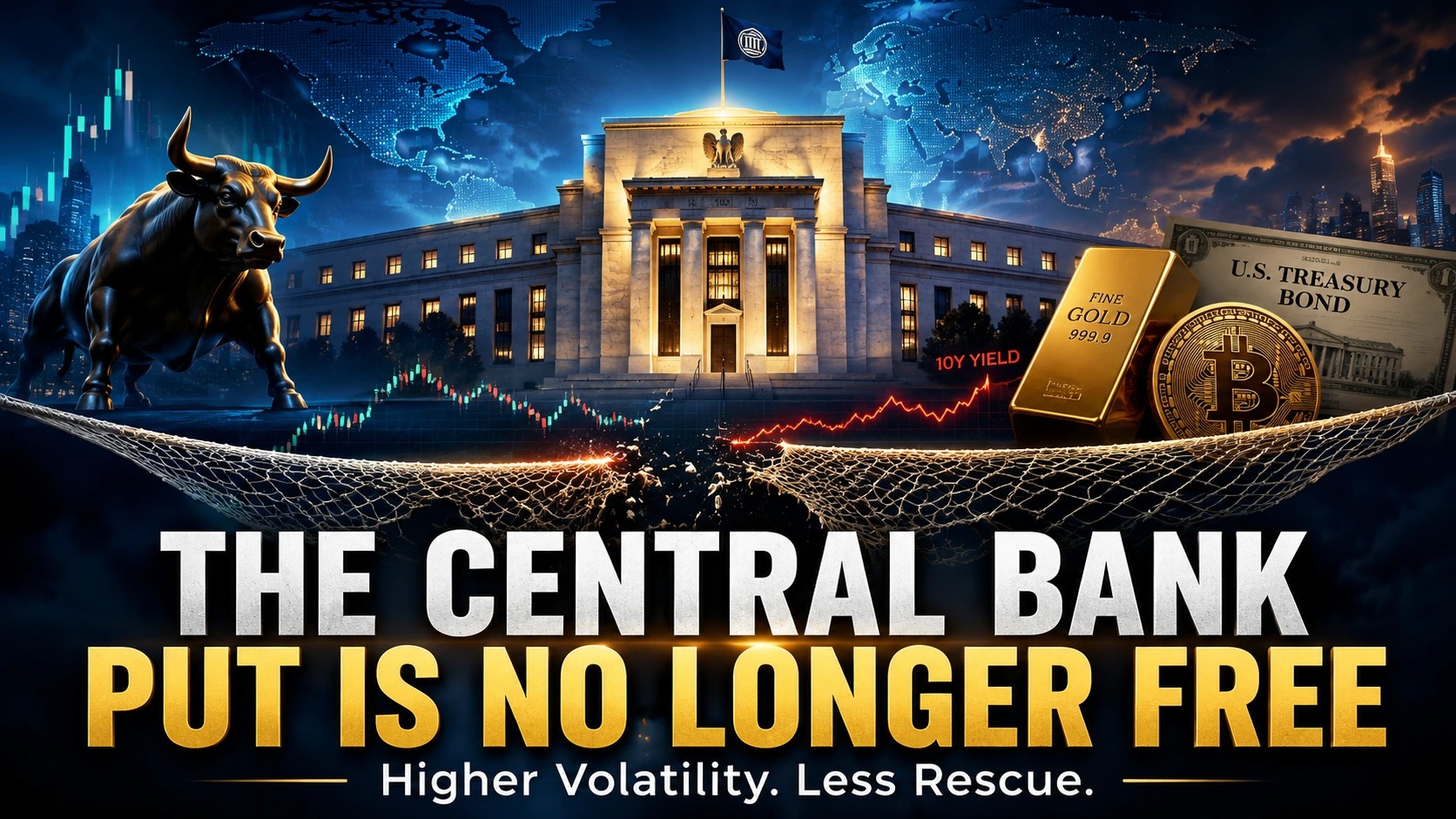
The central-bank put is not gone. It is being repriced.
In the old regime, markets believed central banks wanted to prevent volatility. In the new regime, central banks may accept volatility to restore credibility.
That single change touches everything.
It changes how Bitcoin trades. It changes how AI multiples are valued. It changes how private credit is marked. It changes how sovereign bonds absorb issuance. It changes how gold behaves. It changes how stablecoins are regulated. It changes how investors should think about liquidity itself.
The next macro cycle will not belong to those who simply guess the next rate move. It will belong to those who understand the new hierarchy of policy priorities.
First, price stability.
Second, financial-system resilience.
Third, institutional independence.
Fourth, controlled innovation.
Fifth, growth.
That order is the story.
Markets are still priced for a world where central banks whisper comfort. The new central bankers are preparing a world where markets must listen harder, price risk more honestly, and stop assuming that every correction is someone else’s problem.
This is not the end of the bull market. It is the end of the free insurance policy.
Disclaimer: This article is research and market analysis, not financial advice. Investors should conduct their own due diligence and consider their own risk tolerance before making financial decisions.