Why the $20B restaking ecosystem is entering its “slashing activation” phase—and how to navigate the yield oasis before the penalties begin.
The EigenLayer Effect: When Yield Meets Guillotine
The “EigenLayer Effect” has transformed Ethereum staking from a passive 3-5% yield instrument into a leveraged infrastructure play generating 8-15% APY through “restaking.” By redeploying staked ETH and Liquid Staking Tokens (LSTs) to secure external networks—Actively Validated Services (AVSs)—restakers compound yields while assuming multiplicative slashing risks.
EigenLayer pioneered this mechanic, amassing $15B+ TVL and launching EigenDA as its flagship data availability service. But EigenDA represents only one vector of the restaking thesis. Beyond data availability, a new cohort of protocols has emerged with verifiable, objective slashing conditions—cryptographic penalties (1-100% of stake) for faults like double-signing, downtime, or oracle manipulation.
These aren’t theoretical risks. While many AVSs currently operate in “rewards-only” mode to bootstrap liquidity, the slashing mechanisms are live in code, awaiting activation as networks mature. When triggered, a single AVS fault could cascade across multiple services, burning 32 ETH per validator or wiping LST collateral.
This analysis dissects six restaking protocols beyond EigenDA that have deployed real slashing architectures—not just marketing promises—followed by a granular risk/reward audit of the two dominant Liquid Restaking Tokens (LRTs): ether.fi and Swell.
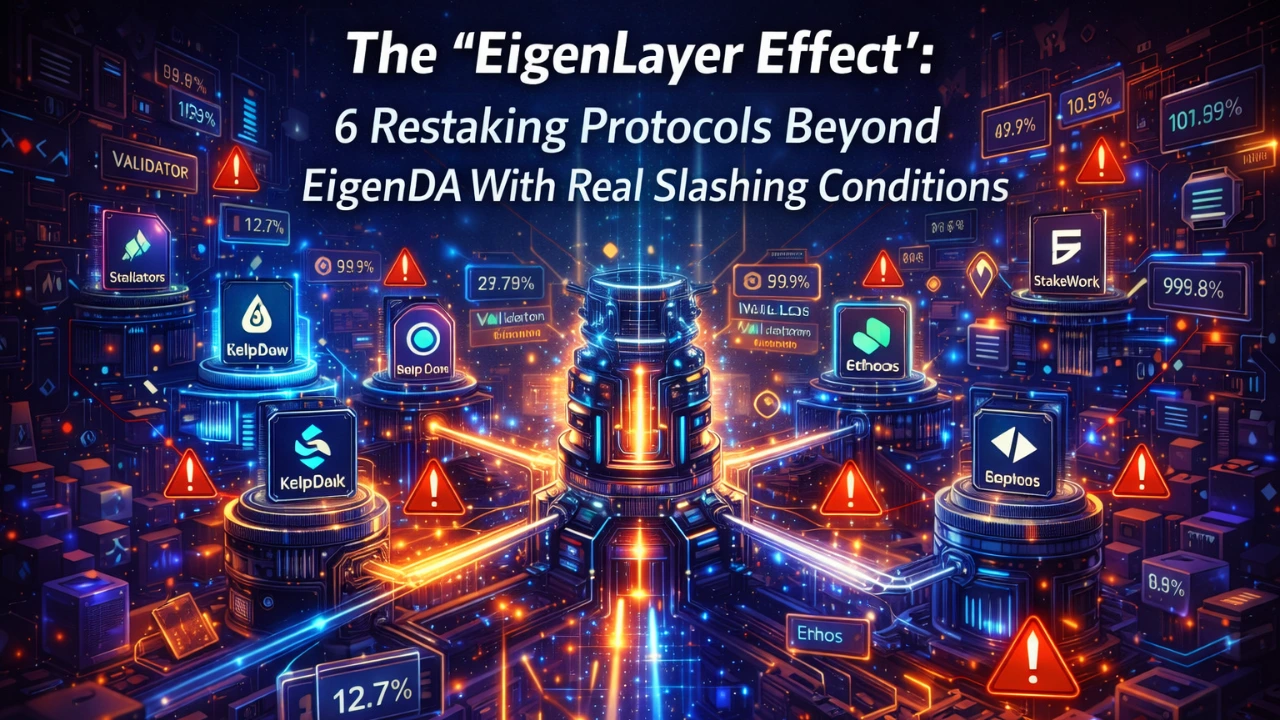
The Six Slashing-Enabled Protocols Beyond EigenDA
The following platforms enable multi-asset restaking (ETH, LSTs, stablecoins) while exposing operators and restakers to objective slashing conditions tied to service-specific faults. These represent the sharp edge of the EigenLayer Effect—maximal yield with maximal accountability.
Protocol | Type | Key Features | Slashing Conditions | TVL/Status | Risk Profile |
Symbiotic | Multi-asset restaking | Cross-chain security; flexible vaults for diverse collateral | Per-service: downtime, double-signing; resolver-enforced slashing | $500M+ (Live) | High – Multi-asset correlation risk |
Karak | Universal restaking | ETH/stables for Distributed Secure Services (DSS); cross-chain validation | Operator failures in validation/tx; objective cross-chain proofs | $300M+ (Live) | Medium-High – Diverse asset exposure |
Renzo | LRT on EigenLayer | ezETH token; restakes ETH/LSTs across AVSs | AVS-inherited: misbehavior per service (liveness faults) | $1B+ (Queued rollout) | Medium – LST composability risk |
Puffer Finance | EigenLayer LRT | pufETH; validator tickets mitigate direct slashing | Underlying AVS operators slashable; pufETH protected via ticket buffer | $1.7B (Live) | Low-Medium – Indirect slashing exposure |
Kelp DAO | EigenLayer LRT | rsETH for ETH/LST restaking (stETH, etc.) | Full AVS slashing: downtime/double-sign across opted-in services | $1B+ (Live) | Medium – Broad LST support increases correlation |
Mellow LRT | Symbiotic-based | Curated strategy vaults; permissionless LPing | Symbiotic resolvers slash for faults; vault-specific penalties | $116M (Live) | Medium – Curated operator risk |
Slashing activation varies by protocol—many currently operate reward-first with penalties queued for 2025-2026 activation. Correlation risk remains the critical variable: a single AVS fault could cascade across multiple opted-in services simultaneously.

Deep Dive: Swell vs. ether.fi Risk/Reward Audit
While the table above maps the infrastructure layer, retail and institutional capital primarily accesses restaking through Liquid Restaking Tokens (LRTs)—receipt tokens representing restaked positions that remain liquid in DeFi. ether.fi and Swell represent the two dominant LRT architectures, each with distinct risk/reward profiles as they deploy capital into the slashing-enabled protocols above.
The Reward Architecture: Yield vs. Scale
Metric | ether.fi | Swell | Market Implication |
TVL | $7.83B | $300M | ether.fi offers deeper liquidity; Swell higher upside volatility |
Est. APR | 4.6% (ETH staking + AVS + ETHFI) | 3.86% (Native restaking + SWELL rewards) | ether.fi captures more AVS fees at scale |
Chains | 6 (Ethereum, Arbitrum, Base, etc.) | 2 (Ethereum, Swellchain) | ether.fi diversifies regulatory/geo risk |
Asset Support | ETH, BTC LSTs (eBTC), multi-LST | ETH-focused (rswETH) | ether.fi broader collateral; Swell concentrated |
Native Token | ETHFI | SWELL | Both offer governance + incentive yields |
Unique Edge | Self-custody keys (non-custodial staking) | Aggressive airdrops + OP Stack Swellchain | ether.fi: security-first; Swell: growth-first |
ether.fi operates as the institutional standard—with $7.83B TVL across six chains, it offers the deepest liquidity for eETH (its LRT) and supports multiple underlying assets including Bitcoin LSTs. Its 4.6% APR reflects both Ethereum consensus yields and AVS fee aggregation across 12+ services. The protocol allows stakers to retain validator keys while delegating operations, reducing custody trust assumptions.

Swell, conversely, trades scale for agility. With $300M TVL, it targets yield chasers through aggressive SWELL token emissions and airdrop campaigns. Its rswETH token focuses exclusively on Ethereum restaking but offers exposure to Swellchain—an OP Stack L2 that captures additional sequencer revenue. The lower APR (3.86%) is offset by speculative token upside, suited for early adopters tolerant of shallower liquidity.
The Risk Vector: Slashing, Liquidity, and Correlation
Restaking introduces multiplicative slashing risk: restakers face penalties from Ethereum consensus (standard slashing) plus AVS-specific slashing (double-signing, liveness failures, oracle manipulation). The following matrix breaks down the specific vulnerabilities:
ether.fi Risk Profile:
Risk Vector | Severity | Mitigation | Activation Likelihood |
AVS Slashing | Medium | Diversified operator set; 12+ AVSs reduce single-point-of-failure | Medium (scales with AVS maturity) |
Liquidity Risk | Low | Deep $7.83B TVL; eETH widely integrated in Aave, Curve, Pendle | Low (exit liquidity abundant) |
Correlation Risk | High | Multi-AVS exposure means cascading slashing possible | High (correlated fault scenarios) |
Smart Contract | Low-Medium | Multiple audits; $1B+ TVL battle-tested | Low (mature codebase) |
Key Custody | Low | Non-custodial design; stakers retain withdrawal keys | N/A (user-controlled) |
Swell Risk Profile:
Risk Vector | Severity | Mitigation | Activation Likelihood |
AVS Slashing | Medium-High | Concentrated exposure to high-yield AVSs | Medium (aggressive AVS selection) |
Liquidity Risk | Medium | $300M TVL shallow vs. ether.fi; potential exit pressure during slashing events | Medium (lower maker depth) |
L2 Sequencer Risk | Medium | Swellchain (OP Stack) introduces sequencer failure/downtime vectors | Medium (L2-specific faults) |
Smart Contract | Medium | Newer codebase; rapid feature deployment | Medium (immaturity risk) |
Token Volatility | High | SWELL emissions create sell pressure; airdrop recipients dump | High (inflationary mechanics) |
The Slashing Reality: Tail Risk Scenarios
While no mass slashing events have occurred (as of Q1 2026), the mechanics are live in code. Consider the correlation cascade scenario:
- An oracle AVS (e.g., Chainlink competitor) experiences a consensus fault, slashing 5% of staked ETH
- ether.fi operators running this AVS face penalties across all AVSs they secure (correlated slashing)
- eETH holders see immediate redemption value drop as underlying collateral is burned
- Swell’s rswETH faces similar impairment if overlapping operators are affected

Quantified Risk: Models suggest 1-10% annual loss probability from slashing across a diversified AVS portfolio. For a 32 ETH validator restaked across 5 AVSs, a double-signing fault could result in 10x base slashing (32 ETH base + 32 ETH per AVS) = 160 ETH total loss in extreme scenarios.
Risk/Reward Verdict:
- ether.fi offers superior risk-adjusted returns (4.6% APR, deep liquidity, self-custody) for institutional allocations ($100K+). The risk premium scales linearly with TVL—larger pools absorb individual slashing events without depeg.
- Swell provides higher speculative alpha (airdrops, Swellchain growth) but requires tolerance for 2-5x higher volatility. Suitable for smaller allocations ($5K-$50K) where liquidity constraints are manageable.
Actionable Strategy: Restaking in the Slashing Era

For Institutional/Conservative Allocation:
- 70% ether.fi (eETH): Maximize liquidity and custody control; stake via Bybit for integrated LRT access
- 20% Puffer Finance (pufETH): Utilize validator ticket buffer to isolate slashing risk
- 10% Symbiotic: Diversify into multi-asset restaking (stables + ETH) via OKX vaults
For Aggressive Yield/Growth:
- 50% Swell (rswETH): Capture SWELL airdrops and Swellchain sequencer yield
- 30% Kelp DAO (rsETH): Access diverse LST restaking (stETH, ETHx) with moderate slashing exposure
- 20% Karak: Deploy stablecoin collateral into DSS for uncorrelated yield (though note higher smart contract risk)
Critical Risk Management:
- Slashing Insurance: Monitor protocols like Nexus Mutual or Unslashed for AVS-specific coverage (currently limited but expanding)
- Operator Diversification: Ensure restaked capital spreads across >10 operators; single-operator concentration amplifies slashing probability
- Exit Liquidity: Maintain 20% of restaked position in liquid eETH/rswETH; do not lock 100% in illiquid vaults
- Slashing Activation Alerts: Subscribe to EigenLayer AVS status pages—when slashing activates (transition from “rewards only” to “enforced”), reduce leverage immediately
Conclusion: The Sharpening Knife
The EigenLayer Effect bootstrapped a $20B security marketplace by offering yield without immediate penalty. That grace period is ending. As the six protocols above activate slashing conditions in 2025-2026, restaking will transition from “yield farming” to “infrastructure underwriting.”
ether.fi and Swell represent the bifurcation of this market: scale versus speculation, custody versus convenience. The 15% APY headlines obscure the 10% tail risk of correlated slashing. Diversify operators, monitor AVS activation timelines, and treat restaking not as passive income, but as leveraged infrastructure exposure.
The yield is real. So are the guillotines.

Research conducted using ASCN.ai
Risk Disclosure: Restaking involves multiplicative slashing risks beyond standard Ethereum staking. AVS slashing conditions are complex and vary by service; correlation risks mean single faults can cascade across multiple protocols. Past APRs (4.6%, 3.86%) do not guarantee future yields. LRTs (eETH, rswETH) may depeg from underlying collateral during mass slashing events. Verify all token contracts via official protocol documentation before bridging assets. Not financial advice.