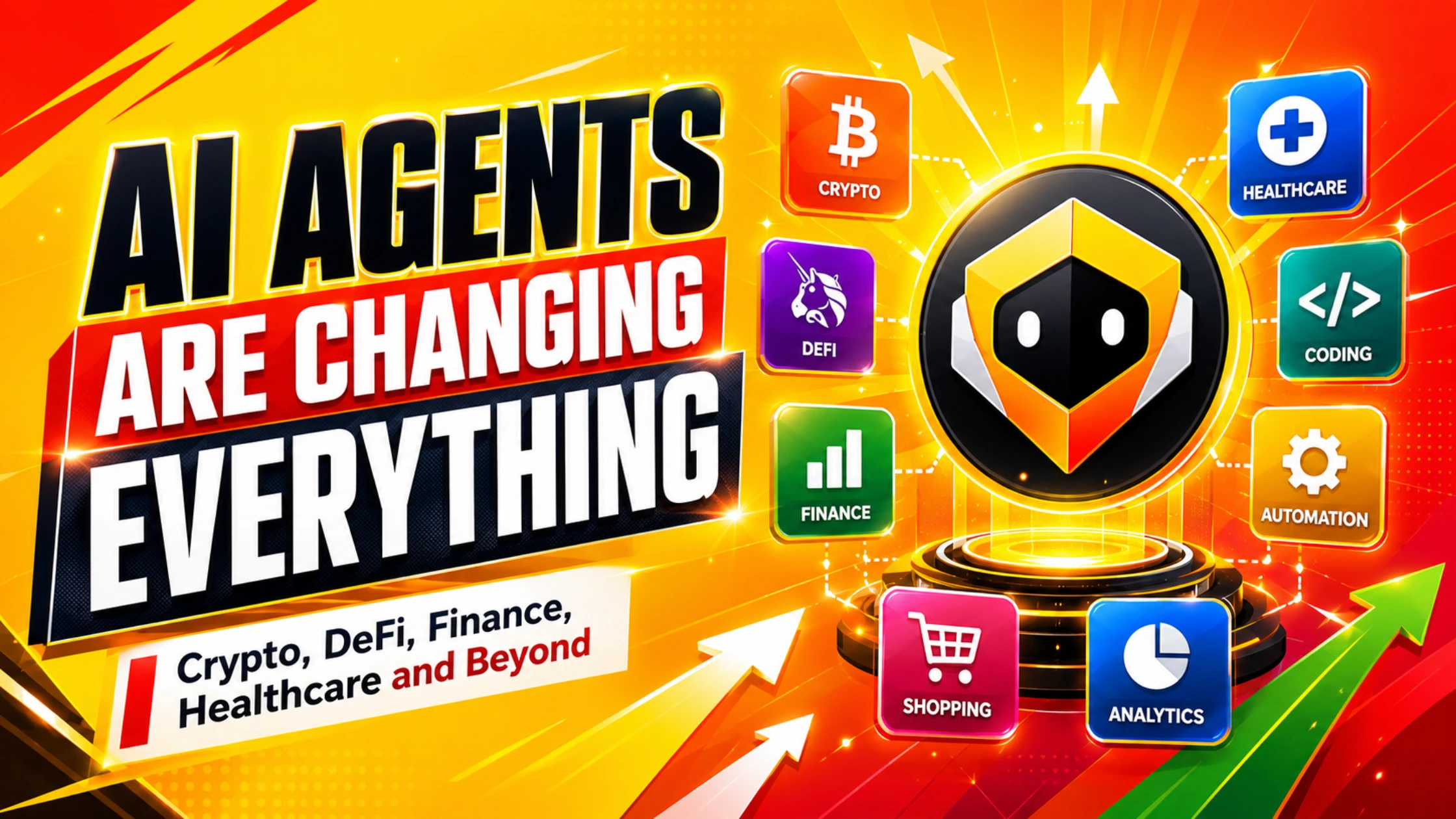
The most comprehensive AI agents directory in existence. Every category, every live use case, every major agent platform — from crypto trading bots and DeFi automation to healthcare diagnostics and agentic commerce. Updated May 2026.
What You Are About to Read
This is not another listicle of chatbots dressed up in press-release language. What follows is the most thorough, most rigorously researched inventory of real, production-deployed AI agents on the internet — organized by use case, graded by real-world impact, and designed to serve as your permanent reference as the agent economy matures.
The numbers justify the ambition. The global AI agents market hit $10.91 billion in 2026, up 43% in a single year from $7.63 billion in 2025, and is on a trajectory to reach $50 billion by 2030 according to multiple analyst aggregates. Gartner — historically conservative — predicts that 40% of enterprise applications will embed task-specific AI agents by end of 2026, up from less than 5% a year earlier. McKinsey’s midpoint scenario places AI-powered agents generating roughly $2.9 trillion in annual US economic value by 2030. By 2028, Microsoft projects 1.3 billion AI agents will be running concurrently across the global economy.
This is not a technology in development. It is infrastructure already reshaping how capital moves, how healthcare is delivered, how code gets written, and how commerce happens. This directory maps it all.

Part One: The Anatomy of an AI Agent
Before the directory, the definition — because “AI agent” has been badly diluted by marketing.
An AI agent is an autonomous software system that perceives its environment, forms a plan, takes multi-step action across tools and systems, and adapts based on outcomes — all without requiring a human prompt at each step. The distinction from a chatbot or a traditional automation rule is total. A rule-based bot executes instructions. An AI agent pursues goals.
The architecture of a production-grade AI agent has five components: a perception layer that ingests data (text, market feeds, on-chain transactions, sensor inputs), a reasoning layer powered by a large language model or specialized ML stack, a memory system that retains context across sessions, a tool-use layer that lets the agent call APIs, execute code, and interact with external systems, and a planning layer that sequences multi-step actions toward a defined objective.
In 2026, agent frameworks have standardized this architecture. The Model Context Protocol (MCP) — now with over 9,400 public servers — has become the connective tissue between agents and the tools they use. Google’s Agent-to-Agent protocol (A2A), backed by 50+ technology partners, enables coordination between agents from different vendors. The infrastructure is mature. The deployment wave is happening.

Part Two: Crypto and DeFi Trading Agents
The crypto markets are where AI agents found their first truly natural habitat. A 24/7 market that never closes, generates enormous quantities of real-time data, and punishes latency is precisely the environment where autonomous agents have a structural advantage over human traders. By 2026, the category has split into three distinct layers: infrastructure protocols, execution frameworks, and deployable end-user agents.
The Infrastructure Layer
Artificial Superintelligence Alliance (ASI / FET)
The ASI Alliance is the most consequential AI-agent infrastructure project in the crypto space, formed from the merger of Fetch.ai, SingularityNET, Ocean Protocol, and CUDOS into a unified platform for decentralized AGI. Fetch.ai contributes the autonomous agent network — uAgents capable of handling on-chain and off-chain tasks simultaneously across supply chain optimization, DeFi operations, and resource allocation. SingularityNET adds an open marketplace where developers list, buy, and sell AI services using the AGIX token. Ocean Protocol supplies the data rails, enabling projects to share and monetize datasets required for training. The combined stack offers a full-service pipeline: data acquisition, model deployment, and agent coordination. Fetch.ai has raised over $83 million in funding, with a significant $40 million injection from DWF Labs in 2023. The FET token underpins governance, staking, agent registration, and bond requirements in the Agentverse Launchpad.
Virtuals Protocol (VIRTUAL)
Virtuals has emerged as the largest platform by market cap in the AI agent space — described by analysts as “the Shopify of AI agents.” Built on Ethereum and natively compatible with Base (Coinbase’s Layer 2), Virtuals enables anyone to create, deploy, tokenize, and co-own AI agents through its GAME framework and Agent Commerce Protocol. As of Q1 2026, Virtuals hosts over 15,800 AI projects and has generated $477 million in what the protocol calls Agentic GDP (aGDP) — real economic output produced by agents running on its infrastructure. The VIRTUAL token covers deployment fees and governance rights. Individual agents carry their own tokens. In late October 2025, VIRTUAL surged nearly 100% in four days following integration of Coinbase’s x402 payment standard, which enabled instant stablecoin payments between agents and drove weekly transaction growth from under 5,000 to over 25,000. Its most celebrated agent, AIXBT, functions as an on-chain Bloomberg terminal.
Olas / Autonolas (OLAS)
Olas is the infrastructure layer for owning, operating, and monetizing autonomous agents without dependence on centralized providers. The OLAS token drives staking, governance, and access to new agent capabilities. Its most prominent live deployment: PolyStrat, an autonomous prediction-market agent built on Olas, launched on Polymarket in February 2026 and completed over 4,200 trades in its first month alone, with peak returns of 376% on individual positions. Olas is the infrastructure behind one of the most documented live proofs that autonomous agents can generate real alpha in open financial markets.
Bittensor (TAO)
Bittensor treats intelligence as a commodity, running a decentralized network where specialized subnets compete to provide machine learning services. TAO tokens reward the top performers and allow agents to query the network for specialized tasks. Banks and crypto funds use Bittensor subnets to access niche models — sentiment analyzers, on-chain anomaly detectors, derivatives pricing engines — without running the infrastructure themselves.

The Framework Layer
ElizaOS (formerly AI16Z)
ElizaOS is the dominant open-source framework for building crypto-native AI agents. In 2026, it has cemented its position as the “WordPress for agents” — a modular, plugin-based operating system that allows developers to spin up complex autonomous agents in days rather than months. A “Character File” defines the agent’s personality; “Plugins” give it skills — a Solana Plugin for trading, a Twitter Client for social engagement, a DeFi Plugin for yield farming. The framework supports multi-LLM backends including DeepSeek and Claude. It has over 17,000 GitHub stars, thousands of contributors, and partnerships spanning Chainlink to Stanford. The most important development in ElizaOS in 2026 is Agent Swarms — multiple Eliza-based bots collaborating on tasks, with one agent scraping news, another analyzing sentiment, and a third executing the trade on-chain. The AI16Z token governs the ecosystem.
Exchange-Native Agent Toolkits
By early 2026, every major exchange had shipped native agent infrastructure:
- Kraken released an open-source Rust-based CLI in November 2025 with 134 trading commands, built-in MCP support, and paper trading mode — designed from the ground up for AI system consumption rather than human use.
- Binance followed in March 2026 with seven modular agent skills covering order execution, wallet intelligence, smart money tracking, and contract risk screening.
- OKX launched its Agent Trade Kit the same week — an open MCP toolkit spanning 60+ blockchains and 500+ DEXs, handling 1.2 billion API calls daily. Its broader OnchainOS infrastructure positions OKX as the developer backend of choice for production-grade DeFi agents.
- Coinbase shipped programmatically controlled Agentic Wallets for fully autonomous on-chain operations, compatible with the x402 protocol for agent-to-agent payment flows.
None of these are beta features. They are production infrastructure from the largest trading venues in the world.

Production Crypto AI Agents: The Deployable Layer
|
Agent |
Category |
Network |
Live Use Case |
Notable Stat |
|
AIXBT (Virtuals) |
Market intelligence |
Base / Ethereum |
Real-time whale tracking, token analysis, capital flow monitoring |
Peak market cap >$500M in Jan 2025; top-rated crypto research agent by benchmark |
|
PolyStrat (Olas) |
Prediction markets |
Multi-chain |
Autonomous position sizing and hedging on Polymarket |
4,200+ trades in first month; 376% peak return on individual positions |
|
OpenClaw |
Natural language trading |
Solana / Base |
LLM-driven trade execution via Claude Code and Codex without API coding |
First agent to implement Agent Skills standard at scale |
|
CLANKER (tokenbot) |
Token launch |
Farcaster / Base |
Deploys fully liquid tokens via social media @-mention |
21,870 tokens deployed in a single day at peak |
|
Stoic AI |
Portfolio management |
Multi-exchange |
Systematic, evidence-based automated trading for long-term portfolios |
Charges only percentage of profits; live across BTC, ETH, altcoin markets |
|
Luna (Virtuals) |
Entertainment / social |
Base |
24/7 autonomous streamer; AI K-pop band lead; 850,000+ TikTok followers |
First AI agent to monetize through token-gated music |
|
VaderAI (Virtuals) |
Market analysis |
Ethereum |
On-chain DeFi analytics and narrative tracking |
Consistently cited by Virtuals community as top-tier alpha generator |
|
CoinStats AI |
Research |
Multi-chain |
Deep research queries across crypto assets |
Scored 79/100 on crypto research benchmark vs. 67 for Gemini, 61 for ChatGPT |
|
Superalgos |
Algorithmic trading |
120+ exchanges |
Open-source neural network trading with visual TensorFlow integration |
Free platform; premium access via SA token staking |
|
Due diligence |
Ethereum / Solana |
Correlates GitHub developer activity with token price movement to flag pump-and-dumps |
Unique signal: code commits vs. token price divergence |
Agentic Wallets: The Execution Infrastructure
The agentic wallet is the missing piece that turns an AI agent from an analyst into an operator. Leading implementations in 2026:
- Cobo Agentic Wallet: programmable policy frameworks (Rulebooks and Budgets) that cap spending, whitelist protocols, and log every event. Pre-trade compliance checks and dry-run simulations prevent rogue execution. Favored by institutional DeFi teams.
- Coinbase AgentKit: designed for consumer-facing agents; integrates natively with the x402 standard for micropayments between agents.
- Safe (Gnosis): multi-sig infrastructure that allows DAO-controlled agent operations with governance oversight.
- OKX Agentic Wallet: natural language execution with TEE-protected key management and 500+ DEX smart routing across 60+ chains.
Solana: The Speed Layer
Solana has become the laboratory for high-frequency AI-to-AI transactions. With block times of 400 milliseconds and the Firedancer upgrade fully live, it is the only chain fast enough for autonomous agent arbitrage strategies that operate across dozens of DEXs simultaneously. ElizaOS’s Solana Plugin is the most-deployed connector in the framework’s plugin ecosystem.

Part Three: Traditional Finance AI Agents
While DeFi builds in public, traditional financial institutions have deployed AI agents at enterprise scale with strikingly similar architecture and dramatically higher AUM.
Trading and Portfolio Management
Trade Ideas (Holly AI)
Trade Ideas is among the most battle-tested AI trading platforms in traditional equity markets. Its Holly AI engine runs overnight simulations to generate five to eight high-probability trade ideas daily with specific entry points, exit points, and stop-loss levels — an autonomous pre-market briefing for active day traders. Holly’s momentum-detection algorithms process real-time market data, news events, and historical pattern libraries to surface setups that would take a human analyst hours to find. The platform connects to major brokerages via secure APIs for direct order execution.
TrendSpider
TrendSpider provides AI-powered technical analysis automation. Its agents handle trendline detection, multi-timeframe analysis, and pattern recognition across equities, ETFs, and crypto — eliminating the manual charting process and standardizing the analytical workflow for retail and institutional traders alike.
Magnifi
Magnifi operates as an AI investing copilot for retail investors — a conversational portfolio aggregator that connects to over 200 brokerages including Robinhood, E*Trade, and Schwab. Natural language queries like “what are the best green energy companies?” return structured, data-backed responses with actionable investment breakdowns. It was one of the first mainstream platforms to remove financial jargon from the AI investing interface, making professional-grade analysis accessible to self-directed investors.
WarrenAI (Investing.com)
Launched in April 2025, WarrenAI is a research assistant trained on Buffett-style value investing principles, combining Investing.com’s database with fundamental analysis AI. Users get automated SWOT analyses, investment case generation, and long-term valuation reports in plain English.
 Banking, Fraud Detection, and Compliance
AI agents have arguably delivered more measurable ROI in banking back-office operations than in any other industry. The math is compelling: fraud losses now exceed $190 billion globally, compliance teams spend 42% of their budgets handling false positives, and onboarding a single new customer still costs banks an average of $128.
Fraud Detection Agents
Production fraud agents monitor transactions in real time, flag suspicious activity using behavioral biometrics, freeze accounts on anomaly detection, and generate detailed audit logs — all within milliseconds. A key behavioral example: if a customer logs in from a new device but exhibits normal usage patterns, the agent permits access. If velocity patterns, geolocation, and device fingerprint diverge simultaneously, the account is frozen and an alert is escalated to a human. EU banks recorded €17.5 billion in new operational-risk losses in 2023 from process failures; fraud detection agents are the primary institutional response.
KYC and Onboarding Agents
Automated onboarding agents validate identity documents, run compliance checks across sanction databases, and approve low-risk accounts in seconds. Complex or flagged applications are escalated with full context already compiled — eliminating the “cold hand-off” problem that adds days to manual processes. Kore.ai’s banking-specific agent deployment at a US regional bank supported over 2.6 million customer sessions without increasing headcount, while handling more than 5 million minutes of automated voice interactions annually.
Credit Assessment Agents
These agents extract and verify financial data from uploaded documents, cross-check against internal lending policies, calculate credit ratios, and generate structured underwriting summaries. Low-risk applications are approved automatically. Complex cases are escalated with the analytical work already done, reducing underwriter time per file dramatically. Real-world deployments have cut underwriting cycle times by 60–80%.
RTS Labs Autonomous Reconciliation
RTS Labs builds enterprise-grade AI agents that automatically match transactions, resolve discrepancies, and prepare audit logs — cutting month-end close cycles. Their dynamic forecasting agents continuously model cash flow and revenue using live ERP and market data. Per EY’s 2024 Finance AI Audit Study, audit-ready, self-explaining agents can reduce audit prep time by over 50%.
SAP Finance AI Agent
SAP’s native agent integrates across its finance suite, allowing users to query financial data, generate reports, and ensure compliance via natural language. Purpose-built for SAP environments and widely deployed across Global 2000 companies.
UiPath
UiPath combines RPA and AI to automate repetitive back-office finance workflows — invoice processing, expense reporting, period-end reconciliation. It remains one of the most deployed automation platforms in enterprise finance, though its agents are reactive and rule-based compared to the new reasoning-capable generation.

Key Market Data — Finance AI Agents:
- Financial institutions are investing $97 billion in AI by 2027 with a growing share directed to agentic systems (Accenture Research)
- AI trading platform market projected to reach $33.45 billion by 2030 at 20% CAGR (Grand View Research)
- Average ROI of 171% on enterprise agentic AI deployments; US enterprises averaging 192% (Deloitte 2026)
- Banking and insurance lead enterprise production deployment at 47% (S&P Global Market Intelligence / McKinsey)
Part Four: Healthcare AI Agents
Healthcare agents in 2026 are no longer POCs running in pilot wards. According to Deloitte’s 2026 US Health Care Outlook Survey, over 80% of healthcare executives expect agentic AI to deliver moderate-to-significant value across clinical, business, and back-office functions this year. 61% have secured budgets or are actively building.
Clinical Documentation Agents
The most financially impactful clinical agent in 2026 is the ambient documentation system. These agents listen to physician-patient conversations, structure notes in real time, and populate EHRs — saving 2 to 30 minutes per appointment. The economics are stark: $300,000 in annual value generated per physician through time recapture alone. Nuance Communications (Microsoft) dominates this market with Dragon Ambient eXperience, deployed across major US hospital systems.
Prior Authorization Agents
Prior authorization has historically been one of healthcare’s most expensive friction points. AI agents that automate PA requests achieve 5x ROI and process 60% of requests in under two hours, compared to zero from the phone-and-fax legacy process. CMS now requires payers to build FHIR APIs (live 2026) enabling electronic PA submission with decisions within 72 hours for accelerated cases. The industry-wide savings potential is estimated at $449 million annually.
Diagnostic Support Agents
Agents in radiology are analyzing medical imaging and flagging anomalies for radiologist review — not replacing radiologists, but ensuring no finding goes unread in high-volume screening environments. ICU monitoring agents track vital signs continuously, alert care teams to deterioration patterns hours before clinical indicators would otherwise trigger concern, and model differential diagnoses from multi-parameter sensor data.
Medical Coding and Billing Agents
Automated medical coding agents deliver 20–72% productivity increases and typical ROI within 1–3 months. Auburn Community Hospital’s deployment reduced discharged-not-final-billed cases by 50% and increased coder productivity by over 40%. The problem these agents solve is real: manual billing errors cost the US healthcare system $36 billion annually.
Patient Communication Agents
AI agents handle appointment scheduling, prescription refill reminders, insurance verification, and post-discharge follow-up — reducing no-show rates and freeing clinical staff for complex care interactions. Keragon’s no-code healthcare workflow platform allows agents to connect across EHRs, intake forms, scheduling tools, billing systems, and communication channels in HIPAA-compliant environments, covering 300+ healthcare integrations.
Part Five: Legal AI Agents
Global legal technology spending will reach $50 billion by 2027 according to Gartner, and 51% of AI executives say their organization’s legal function has already experienced significant impact from AI (KPMG).
Contract Review and Due Diligence Agents
The most productive legal agents in 2026 extract clauses, flag missing provisions, track jurisdiction-specific regulatory requirements, and suggest negotiation strategies — functions that previously consumed hundreds of associate attorney hours per deal. BakerHostetler, one of the largest US law firms, deployed an NLP-powered legal research agent that cut research time by 60%, reduced case search hours significantly, and freed attorneys for client-facing strategic work.
Harvey AI is the most-discussed legal-specific AI agent platform, built on OpenAI’s GPT-4 architecture and customized for legal reasoning. It handles contract drafting, legal memos, due diligence summaries, and deposition preparation. Allen & Overy and other Magic Circle firms are live on Harvey in production.
Kira Systems (now Litera) focuses on M&A due diligence, extracting and analyzing provisions across thousands of contract documents in parallel — work that would take associate teams weeks to complete manually.
Compliance and Regulatory Monitoring Agents
Compliance agents monitor regulatory updates, cross-reference existing policy documentation, and flag changes that require internal policy revision — a continuous process that manually requires dedicated compliance teams at every regulated enterprise. In financial services, these agents are integrated directly into trading desk risk stacks.
Part Six: Sales, Marketing, and Customer Service Agents
Customer Service: The Highest-Deployment Category
Customer service has the highest AI agent adoption of any enterprise function at 56%, and the economics explain why. A human customer service agent costs $6 to $8 per interaction. An AI agent handles the same interaction for $0.50 to $0.70. Gartner projects agentic AI will autonomously resolve 80% of common customer service issues without human intervention by 2029. Today, AI handles approximately 30% of interactions across the enterprises that have deployed production agents.
Salesforce Agentforce is the dominant enterprise CX platform, having crossed $1.4 billion in ARR with Data Cloud 360 and surpassed 9,500 paid deals. Its agents handle service ticket classification, autonomous resolution of standard requests, escalation routing, and real-time sentiment monitoring. ServiceNow’s Autonomous CRM for telecom companies handles customer complaints and cases automatically with built-in escalation protocols — one of the most referenced production deployments in enterprise CX.
Sales Development Agents (SDRs)
AI SDR agents identify leads, research prospects, draft personalized outreach sequences, handle follow-up emails, and qualify leads before human involvement — all with CRM integration that keeps pipeline data current in real time. BCG and Forrester data show SDR agents achieve payback in 3.4 months — the fastest ROI of any agent category tracked.
Marketing Campaign Agents
An AI marketing agent can write 100 ad copy variations, test them against virtual audiences, and deploy winners in Google Ads — the entire creative-to-launch workflow executed autonomously within hours. Retail implementations run dynamic pricing agents that adjust prices in real time based on demand signals, competitor moves, and inventory levels.
Part Seven: E-commerce and Retail AI Agents
Agentic commerce is the fastest-growing subsector of the agentic AI market. The shift is from recommendation to execution. Research cited in analyst reports found that 58% of consumers have already replaced traditional search with generative AI tools for product recommendations. In 2026, AI shopping agents increasingly compare offers, choose products, and complete purchases with minimal human involvement.
Amazon Dynamic Pricing Agent
Amazon’s pricing agent adjusts product prices millions of times per day based on competitor prices, demand elasticity, inventory levels, and margin targets. It is one of the most complex and consequential deployed AI agents in commerce, managing pricing across hundreds of millions of SKUs globally.
Supply Chain Negotiation Agents
Enterprise supply chain agents negotiate with suppliers in real time based on cost shifts and demand projections, cutting procurement cycle times by 40% and reducing material costs by 5–7% annually according to live deployments cited by Salesmate. A fashion retailer’s inventory agent in production analyzes sales velocity across 50,000 SKUs and 200 stores, placing supplier orders automatically while accounting for shipping delays and seasonal demand.
Shopify AI Agents
Shopify’s 2026 AI layer includes agents that handle marketing campaign orchestration, inventory reordering, dynamic pricing, and customer support — integrated natively into the merchant dashboard. New agentic commerce protocols (built on standards from ChatGPT, Google AI Mode, Gemini, and Copilot) now enable checkout completion directly within AI conversations — a shopper describes what they want, and the agent searches, presents options, and completes the purchase without the user leaving the chat interface.
Returns and Fraud Agents
Automated returns agents assess return requests, detect abuse patterns using purchase history and behavioral signals, and process eligible refunds without manual review — a category where human judgment is expensive and consistent policies are difficult to enforce at scale.
Part Eight: Coding and Software Development Agents
The software development category has seen the most rapid agent deployment of any knowledge-work domain in 2026. GitHub Copilot, Cursor, Devin (Cognition), and Claude Code represent a spectrum from AI-assisted to increasingly autonomous coding systems.
Claude Code
Anthropic’s command-line AI agent for software development handles entire coding workflows autonomously — from reading codebases and writing implementations to running tests and iterating on failures. It is the tool that OpenClaw (the crypto trading agent) uses as its underlying execution layer, demonstrating how AI agents are building on top of other AI agents.
Devin (Cognition)
Devin is the most-discussed attempt at a fully autonomous software engineer. It can read documentation, write code, execute it, debug failures, and iterate — completing software engineering tasks end-to-end with minimal human instruction. Enterprise deployments in 2026 focus on internal tooling automation, code migration, and test generation.
GitHub Copilot Workspace
GitHub’s Copilot Workspace allows developers to describe a task in natural language, and the agent creates a plan, generates code across multiple files, and opens PRs with explanations — collapsing the planning-to-implementation cycle from hours to minutes for well-defined tasks.
Multi-Agent Frontend Development
ArXiv research in early 2026 documented specialized multi-agent frameworks that take Figma designs to production-ready code, handling design interpretation, component generation, testing, and deployment — an entire front-end engineering pipeline with minimal human touchpoints.
Part Nine: AI Agents in HR, Legal Operations, and Enterprise Back-Office
HR agents screen CVs, schedule interviews, and evaluate candidates against role requirements — reducing time-to-hire in high-volume recruiting environments by 40–60%. Legal operations agents manage contract lifecycle from request through review, signature, and renewal tracking. AP automation agents match invoices to purchase orders, flag discrepancies, and route approvals — a Deloitte survey found these agents reduce invoice processing costs by 80% in production.
UiPath and ServiceNow dominate the enterprise back-office agent category, with Workday adding agentic capabilities across workforce planning and compensation management in its 2025–2026 platform updates.
Part Ten: Web3 Gaming and Virtual World Agents
Luna AI (Virtuals Protocol)
Luna is the world’s first commercially successful AI entertainment agent. She streams 24/7 as a solo artist, leads the AI K-pop band AI-DOL, and manages an X page with autonomous content — with over 850,000 TikTok followers and revenue from token-gated fan interactions. Luna is not a chatbot with a persona; she is an autonomous creative entity that generates, schedules, performs, and monetizes content without human direction.
AWE Network
The AWE Network powers Autonomous Worlds — large-scale virtual environments where thousands of AI agents learn, collaborate, and simulate real economies, games, and research systems. With over 590,000 users and 5,500 deployed agents, AWE is the leading platform for AI-driven game economies and agent-to-agent simulation environments.
Illuvium AI-NPCs (Virtuals)
Virtuals Protocol’s integration with Illuvium powers game characters that behave as genuine AI agents — adapting to player behavior, developing strategic responses, and creating emergent gameplay experiences that no game designer scripted in advance.
Part Eleven: Scientific Research and Specialized Agents
Drug Discovery Agents
Pharmaceutical companies including Pfizer and Roche are deploying AI agents to run combinatorial chemistry analysis, hypothesis generation, and clinical trial design — compressing drug discovery timelines from years to months in targeted areas. Insilico Medicine has produced AI-designed drug candidates that have entered human trials.
IoTeX: Physical Intelligence Agents
IoTeX connects real-world machines and sensors to a secure Layer 1 blockchain, giving AI agents access to real physical environment data — temperature, location, motion, power consumption. Its ioID system provides device identity, and its Quicksilver layer converts live machine data into signals that agents can reason over. Physical AI agents managing industrial equipment, environmental monitoring, and smart city infrastructure are live on IoTeX in 2026.
Climate and Energy Agents
Google DeepMind’s deployed AI agent AlphaFold reduced protein structure prediction time from months to hours — a breakthrough that has cascaded into synthetic biology, vaccine design, and materials science research. Energy grid optimization agents run by utilities manage real-time balancing of renewable supply and demand, reducing grid instability and curtailment of solar and wind generation.
Part Twelve: The Agent Infrastructure Stack
Understanding AI agents requires understanding the infrastructure beneath them. The agents described in this directory run on a layered technology stack that has largely standardized in 2026.
Foundation Models: Claude (Anthropic), GPT-4o (OpenAI), Gemini 2.0 (Google), Llama 3 (Meta), DeepSeek V3 — the reasoning cores that power agent planning and language understanding.
Orchestration Frameworks: LangGraph, CrewAI, AutoGen (Microsoft), ElizaOS, Olas — the software layers that manage multi-agent coordination, memory, and tool routing.
Memory Systems: Vector databases (Pinecone, Weaviate, Chroma) store agent memories and retrieved knowledge. Without persistent memory, agents reset on every conversation; with it, they build institutional knowledge over time.
Tool Infrastructure: Model Context Protocol (MCP) — 9,400+ public servers — provides the standard interface for agents to call external APIs, databases, and services. MCP has reached 97 million downloads, making it the fastest-adopted AI infrastructure protocol in history.
Agent Commerce: Coinbase’s x402 protocol enables agent-to-agent micropayments, allowing autonomous agents to pay for services, data, and compute from other agents without human authorization.
Compute: NVIDIA remains the critical compute provider, though the emergence of decentralized compute markets — Render Network (RNDR), io.net — is creating alternatives for cost-sensitive agent deployments.
Part Thirteen: Risks, Governance, and the Failure Rate Reality
The optimism in this directory must be grounded in a sobering counter-narrative: Gartner estimates that over 40% of agentic AI projects will be canceled by end of 2027. The failure modes are consistent across industries: escalating compute costs, unclear ROI attribution, governance gaps, and the 100x compute multiplier that makes production scaling dramatically more expensive than pilot testing.
The specific failure pattern is this: 79% of enterprises have adopted AI agents in some form, but only 11% run them in production. The 68-percentage-point gap between experimentation and production deployment is the defining challenge of the current moment.
Governance gaps are the primary root cause. Only 21% of organizations have a mature governance model for autonomous AI agents. 52% cite data quality as the biggest blocker. 56% of enterprises now name a dedicated AI agent owner or agentic ops lead — up from 11% in 2024 — but this organizational evolution is still lagging deployment ambition.
For crypto and DeFi agents specifically, the risk profile adds additional dimensions: model overfitting on historical data that fails under novel market conditions, API latency that creates execution slippage in fast-moving markets, black swan events that overwhelm probabilistic guardrails, and the legal ambiguity around automated trading disclosure requirements, which are actively evolving across jurisdictions.
The governance principles that separate successful deployments from failed experiments:
- Hard kill switches and daily loss limits — non-negotiable for execution agents
- Trading-only API permissions — never grant withdrawal access to an autonomous agent
- Paper trading validation before capital deployment — minimum 30-day live simulation
- Transparent audit logs for every decision — human review of agent reasoning, not just outcomes
- Start with narrow, verifiable edge — “mirror wallets with 60-day consistent performance” beats “trade with AI”
- Separate the thinking layer from the doing layer — research and signal generation can be agentic; execution should be tightly constrained
Part Fourteen: The AI Agent Investment Landscape
The venture capital conviction in AI agents is clear and accelerating. Q1 2026 agent-native venture funding reached $4.7 billion — annualized to a $20+ billion cohort, the largest software vertical funded since cloud-native in 2015–2017.
The Token Lens — Ranked AI Agent Projects by Ecosystem Significance
|
Project |
Token |
Category |
Key Differentiator |
|
Artificial Superintelligence Alliance |
FET/ASI |
Infrastructure |
Merged Fetch.ai + SingularityNET + Ocean Protocol; broadest decentralized AI stack |
|
Virtuals Protocol |
VIRTUAL |
Agent launchpad |
15,800+ agents; $477M aGDP; GAME framework for no-code agent creation |
|
Bittensor |
TAO |
Decentralized intelligence |
Subnet competition model; treats AI inference as a commodity market |
|
Chainlink |
LINK |
Oracle infrastructure |
Trusted data feeds for AI agents requiring real-world market data |
|
The Graph |
GRT |
Indexing |
Query infrastructure for on-chain data agents need to reason over |
|
Olas / Autonolas |
OLAS |
Agent ownership |
PolyStrat live deployment; agent monetization and co-ownership framework |
|
Render Network |
RNDR |
Compute |
GPU marketplace; decentralized compute for AI agent inference |
|
ElizaOS |
AI16Z |
Agent OS |
Most-deployed open-source agent framework; 17,000+ GitHub stars |
|
AIXBT |
AIXBT |
Market intelligence |
On-chain Bloomberg terminal; top-ranked crypto research agent by benchmarks |
|
Venice |
VVV |
Privacy AI |
Device-level inference; uncensored models without centralized logging |
|
AWE Network |
AWE |
Virtual worlds |
5,500+ deployed agents; Autonomous Worlds infrastructure |
|
IoTeX |
IOTX |
Physical intelligence |
Real-world device connectivity for physical AI agents |
Part Fifteen: Where to Trade AI Agent Tokens

Exposure to the AI agent economy through crypto markets requires selecting the right trading venue. Liquidity, token selection, and derivatives access vary significantly across exchanges.
For spot trading and broad token access, Binance offers the deepest liquidity across FET, VIRTUAL, TAO, AI16Z, and most major AI agent tokens. Binance also shipped native agent skills in March 2026, making it the most agent-friendly major exchange.
OKX is the technical leader for DeFi-native agent trading, with its Agent Trade Kit spanning 60+ chains and 500+ DEXs — the infrastructure that professional agent operators use for cross-chain execution. Its OnchainOS makes it the default backend for teams building production agents.
Bybit offers competitive fee structures and strong derivatives coverage for AI token perps — useful for traders who want leveraged exposure to agent ecosystem narratives without holding spot.
MEXC and BingX offer earlier access to emerging AI agent tokens before major exchange listings, with BingX specifically cited in documentation around top AI agent project trading.
For derivatives and perpetuals on AI infrastructure tokens (FET, TAO, RNDR), BloFin and Bitunix offer targeted perp products with competitive funding rates.

The State of AI Agents: A Synthesis
The AI agents listed in this directory represent a technology that has decisively crossed the threshold from experiment to infrastructure. The numbers are no longer projections — they are production metrics: 4,200 trades in a month on Polymarket, 2.6 million banking sessions without adding staff, 60% reduction in legal research hours, $477 million in agentic GDP generated on Virtuals Protocol.
The pattern across every industry is the same. Agents excel where data is abundant, latency is expensive, the task volume exceeds human capacity, and the decisions are structured enough to define success criteria clearly. Crypto markets hit all four criteria simultaneously, which is why they became the first real laboratory. Finance, healthcare, and customer service follow because the failure cost of missing data is catastrophically high.
What comes next is multi-agent orchestration — specialized agents coordinating across workflows without a human in the loop. Gartner predicts one-third of agentic AI implementations will combine agents with different skills to manage complex tasks by 2027. The average Fortune 500 company runs 3.4 distinct agents today; by 2027, that number will be 6–8. By 2028, 1.3 billion AI agents will be running simultaneously across the global economy.
The agents are here. The infrastructure is built. The capital is deployed. What remains is execution — and governance rigorous enough to ensure that when these systems act autonomously, they act in the interest of the humans who authorized them.

Frequently Asked Questions
What is an AI agent? An AI agent is an autonomous software system that perceives its environment, plans multi-step actions, uses tools and external systems, and pursues goals without requiring a human prompt at each step. This distinguishes agents from chatbots (single-turn) and rule-based bots (fixed scripts).
What is the difference between an AI agent and a trading bot? A trading bot follows hardcoded rules. An AI agent understands a goal — “grow my portfolio safely” — and autonomously decides what to research, what to trade, and when, adapting its strategy as market conditions change. Agents use reasoning; bots use rules.
Which blockchain has the most AI agent activity? Base (Coinbase’s Layer 2) leads in agent count and transaction volume, driven by Virtuals Protocol’s deployment on the chain. Solana leads in high-frequency agent trading due to sub-400-millisecond block times and Firedancer upgrade throughput. Ethereum remains the most secure base layer for high-value agent deployments.
What is the AI agent market size in 2026? The global AI agents market reached $10.91 billion in 2026, growing 43% from $7.63 billion in 2025, with projections of $50 billion by 2030 at a 45.8% CAGR.
What is DeFAI? DeFAI is the emerging category name for Decentralized Finance AI — the intersection of autonomous AI agents and DeFi protocols. DeFAI agents manage portfolios, execute trades, auto-compound yield, run prediction market strategies, and audit smart contracts without human intervention.
Are AI agents safe to use for crypto trading? Safety depends entirely on governance design. The baseline requirements: trading-only API permissions (never withdrawal access), paper trading validation before live capital, hard daily loss limits, transparent audit logs, and a human-controlled kill switch. Platforms like Stoic AI and systems built on Olas include these controls natively. Custom deployments require them to be built explicitly.
What is the best AI agent framework for building crypto agents? ElizaOS is the most widely deployed open-source framework for crypto-native agent development as of 2026. For institutional or compliance-grade deployments, Olas (Valory) provides stronger governance tooling. For exchange connectivity, OKX’s Agent Trade Kit and Kraken’s CLI offer the deepest MCP-native integration with major trading venues.
What is Virtuals Protocol? Virtuals Protocol is an Ethereum and Base-native platform for creating, tokenizing, and monetizing AI agents. It operates as the “Shopify of AI agents” — a no-code agent launchpad where anyone can deploy an agent, issue a token, and share in the revenue the agent generates. As of Q1 2026, it hosts over 15,800 agents and has generated $477 million in Agentic GDP.
What is agentic commerce? Agentic commerce is the category where AI agents complete purchases on behalf of users — from discovery and comparison through checkout — without the user actively driving each step. Protocols from ChatGPT, Google AI Mode, and Coinbase’s x402 enable agent-to-merchant transactions. Research shows 58% of consumers already use AI tools for product recommendations; execution is the next frontier.
What happens when AI agent projects fail? Gartner estimates 40%+ of agentic AI projects will be canceled by 2027 due to escalating compute costs, unclear ROI, and governance gaps. The failure mode is consistent: organizations deploy agents without defining measurable success criteria, underestimate production compute costs, and lack the organizational structure (dedicated agent owners, audit trails, escalation paths) to maintain autonomous systems responsibly.
Decentralised News publishes original research at the intersection of crypto, AI, and macro finance. This article does not constitute investment advice. Cryptocurrency and AI agent markets carry significant risk. Always conduct independent research before allocating capital.
Recommended reading:
Top 9 AI Trading Platforms for Crypto Perps and Derivatives (2026)
Top 10 AI Agents Crypto Tokens to Watch in 2026
Top Free AI Agents for Crypto Trading (2026 Edition)
Top 8 DeFi Protocols Powering Cross-Chain AI Agent Execution
DeFAI 101: How to Build Wealth in the Age of Autonomous AI Agents
The AI’s DeFi Playbook: 3 Protocol Types for Maximum, Automated Yield
How AI Agents Are Dominating Bitcoin Trades (While You Sleep)
Top 20 AI Agents & Agentic Protocols (2026)
10 AI Crypto Trading Bots Ranked by Real Performance in 2026