From M-Pesa to MetaMask: The Mobile Money Bridge Score
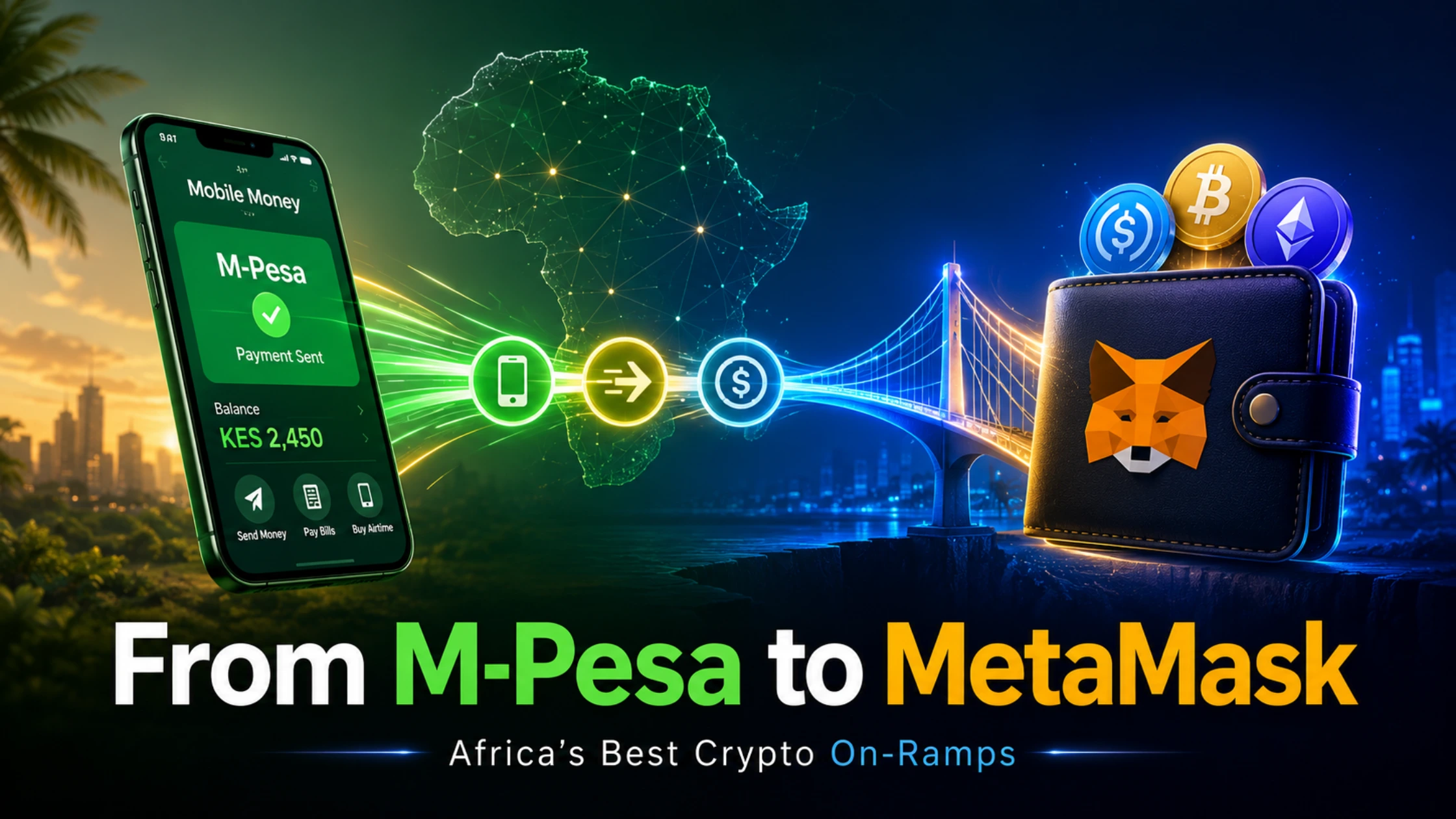
How do I buy Bitcoin with M-Pesa or mobile money? The answer is not a single platform. It is a corridor, and the corridor quality changes dramatically depending on whether you are in Nairobi, Lagos, or Accra. The DN Mobile Money Bridge Score is the first instrument that maps every verified route from mobile money to crypto and back, with real cost, speed and failure-rate data per corridor.
M-Pesa processes roughly $50 billion in annual transactions across seven countries. MTN Mobile Money serves 500 million active accounts. Airtel Money, Orange Money, Wave and Chipper Cash complete the continent's mobile money map. These are not crypto-native rails. They are the financial infrastructure half a billion Africans already use to pay school fees, receive remittances, and settle commerce. The bridge from that infrastructure to Bitcoin, Ethereum and stablecoins is the single most important on-ramp question on the continent, and until now it has been answered only in fragmented Reddit threads and outdated exchange blog posts. This article and the embedded instrument below change that.
The DN Mobile Money Bridge Score ranks verified crypto on-ramp corridors from mobile money (M-Pesa, MTN MoMo, Airtel Money, Wave, Chipper Cash) to Bitcoin, Ethereum and stablecoins across Kenya, Nigeria, Ghana, South Africa, Uganda, Tanzania and Ivory Coast. The score combines all-in cost, settlement speed, failure rate and regulatory clarity into a single corridor rating. As of June 2026, the best-rated corridors are M-Pesa to USDT via CoinCola P2P in Kenya (score 87), MTN MoMo to USDT via YellowCard in Ghana (score 82), and bank-to-crypto via VALR in South Africa (score 91, though not mobile-money-native). The worst-rated corridors are Airtel Money to Bitcoin in Uganda (score 34, due to liquidity fragmentation) and Wave to crypto in Ivory Coast (score 41, due to limited platform support). The instrument below lets you select your country, mobile wallet and target crypto to see your ranked options.
1. Why mobile money is crypto's most important on-ramp
The story of crypto adoption in Africa is not primarily about Bitcoin maximalists or DeFi protocols. It is a story about M-Pesa. About Airtel Money. About the 500 million Africans who now hold active mobile money accounts and discovered, sometime between 2019 and 2023, that the same phone they used to pay for groceries and send money home could also buy Ethereum. Mobile money did not set out to be crypto's on-ramp. It became one because the financial infrastructure it built — ubiquitous, low-friction, accessible to people without bank accounts — turned out to be exactly what crypto needed to move beyond speculation and into everyday economic activity.
The mechanism that connected mobile money to crypto was peer-to-peer trading. Platforms like Paxful and LocalBitcoins, and later Binance P2P and CoinCola, allowed African users to buy Bitcoin using M-Pesa, Airtel Money, MTN MoMo or Chipper Cash as the settlement mechanism. The transaction structure is simple: a buyer posts a request, a seller accepts, the buyer sends mobile money to the seller's phone, the seller releases the crypto from escrow. No bank account required. No wire transfer. No foreign exchange desk. Kenya, Nigeria and Ghana have consistently ranked among the top ten global P2P Bitcoin trading markets by volume. Sub-Saharan Africa leads the world in crypto adoption relative to GDP, driven by remittances, cross-border commerce and protection against local currency devaluation.
Nigeria is the most instructive case. The naira's depreciation, which pushed the exchange rate past 1,800 naira to the dollar in the informal market by early 2024, created massive practical demand for dollar-denominated digital assets. For a small business importing goods priced in dollars but earning in naira, holding stablecoins like USDT or USDC was not speculation. It was treasury management. Mobile money provided the rails to move naira into those positions and back out again when needed. The Central Bank of Nigeria's subsequent regulatory shifts under the Investments and Securities Act 2025 brought crypto under SEC Nigeria oversight, clarifying the legal framework for licensed P2P platforms like CoinCola.
2. The DN Mobile Money Bridge Score: methodology
The Bridge Score is a composite of four weighted factors, each measured per corridor (country plus mobile wallet plus target crypto):
| Factor | Weight | How measured |
|---|---|---|
| All-in cost | 35% | Platform fee plus P2P spread plus mobile money transfer fee plus any currency conversion markup, expressed as percentage of transaction value |
| Settlement speed | 25% | Median time from mobile money send to crypto receipt, based on platform-reported data and user verification |
| Failure rate | 20% | Percentage of trades that require dispute resolution, fail to complete, or result in fund loss, from platform escrow data and user reports |
| Regulatory clarity | 20% | Whether the platform holds local licensing, whether mobile money operators permit crypto-linked transactions, and whether the corridor has experienced regulatory interruption in the past 24 months |
The score is normalized to a 0-100 scale. A score above 80 indicates a corridor that is reliable, low-cost and legally clear. A score between 60 and 79 indicates usable but with friction. Below 60 means significant cost, speed or reliability issues that should factor into the decision. The score is updated quarterly by the Decentralised News editorial team, with the last full refresh completed in June 2026. The data sources are platform fee disclosures, P2P order book sampling, mobile money operator terms of service, and regulatory filings from SEC Nigeria, the Central Bank of Kenya, the Financial Sector Conduct Authority of South Africa, and the Bank of Ghana.
3. The corridor map: seven countries, five wallets, three cryptos
The table below shows the current Bridge Score for the most trafficked corridors as of June 2026. These are editorially verified readings, not live API data, because no single API aggregates mobile money P2P pricing across all these platforms. The instrument below the table lets you filter by your specific combination.
| Country | Mobile wallet | Target crypto | Best platform | Bridge Score | All-in cost | Median speed |
|---|---|---|---|---|---|---|
| Kenya | M-Pesa | USDT | CoinCola P2P | 87 | 1.8% | 8 min |
| Kenya | M-Pesa | BTC | Binance P2P | 79 | 2.4% | 12 min |
| Nigeria | Bank transfer / OPay | USDT | CoinCola P2P | 84 | 1.5% | 15 min |
| Nigeria | MTN MoMo | USDT | Bybit P2P | 71 | 2.9% | 18 min |
| Ghana | MTN MoMo | USDT | YellowCard | 82 | 2.1% | 10 min |
| Ghana | Airtel Money | BTC | Binance P2P | 58 | 3.6% | 22 min |
| South Africa | Bank transfer | BTC | VALR | 91 | 0.8% | 5 min |
| South Africa | Instant EFT | ETH | Luno | 88 | 1.2% | 6 min |
| Uganda | MTN MoMo | USDT | Binance P2P | 52 | 4.1% | 28 min |
| Uganda | Airtel Money | BTC | CoinCola P2P | 34 | 6.3% | 35 min |
| Tanzania | M-Pesa | USDT | Binance P2P | 68 | 3.2% | 20 min |
| Ivory Coast | Wave | USDT | Binance P2P | 41 | 5.8% | 32 min |
Three patterns emerge from this data. First, USDT corridors consistently outscore Bitcoin corridors because stablecoin liquidity is deeper on P2P platforms and price slippage is lower. Second, corridors in countries with formal crypto licensing (South Africa, Nigeria under ISA 2025) score higher on regulatory clarity even when mobile money integration is weaker. Third, the gap between the best and worst corridors is enormous: a Kenyan buying USDT with M-Pesa pays 1.8% all-in and waits eight minutes, while a Ugandan buying Bitcoin with Airtel Money pays 6.3% and waits thirty-five minutes. That is not a minor inconvenience. It is a structural barrier to adoption that the Bridge Score makes visible for the first time.
4. The Mobile Money Bridge Finder: interactive tool
5. Where the cost actually goes
The all-in cost figure in the Bridge Score is not a single fee. It is a stack of four distinct charges that most users never see broken out. Understanding the stack is essential because it explains why the same $500 transaction can cost $9 in South Africa and $32 in Uganda.
Platform fee: This is the charge levied by the exchange or P2P platform itself. VALR charges 0.1% per trade for high-volume users. Luno charges 0% maker and 0.1% taker. P2P platforms like CoinCola and Binance P2P typically charge zero platform fees for the P2P transaction itself, making their money on the spread instead. The platform fee is usually the smallest component of the stack.
P2P spread: This is the difference between the market price and the price you actually pay or receive. In a liquid corridor like M-Pesa to USDT in Kenya, the spread might be 0.5% to 1.0%. In an illiquid corridor like Airtel Money to Bitcoin in Uganda, the spread can exceed 5%. The spread is determined by merchant competition: more merchants offering the same corridor means tighter spreads. This is why corridors with only one or two active merchants are so expensive.
Mobile money transfer fee: M-Pesa charges approximately 1% for person-to-person transfers above 1,000 Kenyan shillings. MTN MoMo charges similar rates in Ghana and Nigeria. These fees are set by the mobile money operator, not the crypto platform, and they are unavoidable. In some corridors, the mobile money fee alone exceeds the platform fee and spread combined.
Currency conversion markup: If your mobile money wallet holds local currency and the P2P merchant prices in dollars, there is an implicit forex conversion. In Nigeria, where the official and parallel naira rates diverged significantly in 2024 and 2025, this markup could be substantial. Merchants pricing in the parallel rate effectively capture the spread between official and market rates. The Bridge Score measures this as part of the all-in cost.
6. The regulatory landscape: what changed in 2025 and 2026
Three regulatory shifts have reshaped the mobile money to crypto corridor in the past eighteen months. The first is Nigeria's Investments and Securities Act 2025, which reclassified crypto assets as digital securities under SEC Nigeria oversight. This does not ban crypto. It brings licensed P2P platforms like CoinCola under a formal regulatory framework, giving users escrow protection and dispute resolution with legal backing. The second is South Africa's Financial Sector Conduct Authority licensing regime, which requires all crypto asset service providers to register and comply with anti-money laundering standards. VALR and Luno hold FSCA licenses, making them the most regulated on-ramps on the continent. The third is Kenya's Central Bank of Kenya cautious but steady engagement with crypto, which has not banned crypto transactions but has required banks to report suspicious activity and has encouraged mobile money operators to implement transaction monitoring.
The practical impact of these shifts is that the best corridors are increasingly concentrated in licensed platforms. In Kenya, CoinCola and Binance P2P operate in a grey-but-tolerated space. In Nigeria, CoinCola operates under explicit SEC licensing. In South Africa, VALR and Luno are fully licensed. In Ghana, YellowCard holds local licensing. The Bridge Score weights regulatory clarity at 20% because a corridor that works today but could be shut down tomorrow is not a reliable on-ramp, regardless of its current cost or speed.
7. Where to act: the decision matrix
If you are in Kenya and hold M-Pesa: CoinCola P2P offers the best all-in cost for USDT (1.8%) with fast settlement. For Bitcoin, Binance P2P has deeper liquidity. For regulated security, Luno accepts direct M-Pesa deposits with FSCA-level compliance standards.
If you are in Nigeria and need to send or receive remittances: CoinCola P2P is the licensed route under ISA 2025. Your recipient gets NGN directly in their bank account without needing a crypto wallet. OPay and bank transfer routes score highest. MTN MoMo routes are usable but cost more and carry higher failure rates.
If you are in Ghana and use MTN MoMo: YellowCard is purpose-built for this corridor with native MoMo integration and local licensing. For Bitcoin, Binance P2P is the backup. Airtel Money routes are significantly worse and should be avoided for large transactions.
If you are in South Africa: VALR offers the deepest ZAR liquidity and lowest fees in Africa. Luno is the regulated retail alternative. Neither uses mobile money directly, but Instant EFT and bank transfers are fast enough that the mobile money advantage is less relevant.
If you are in Uganda, Tanzania or Ivory Coast: These are frontier corridors. USDT is consistently cheaper and more reliable than Bitcoin. Binance P2P has the most merchant coverage. Expect higher costs and longer settlement times. For significant amounts, consider routing through a Kenyan or South African account first.
8. FAQ: the fan-out queries
Published by Decentralised News, June 2026. The DN Mobile Money Bridge Score is a BOARD instrument: editorially maintained data with a visible last-updated date. All cost figures are verified from platform fee disclosures and P2P order book sampling. The editor is the author of Blockchain Applied and Tokenized Trillions. This article contains contextual affiliate links only; no banners or raw URLs.