Worried about AI layoffs in 2026? Here’s a practical survival stack using cash, stablecoins, Bitcoin, exchanges, wallets, and income rails to protect yourself before the next shock.
For years, white-collar professionals were told a comforting story: study hard, get the right role, climb the ladder, and your income will keep compounding. That story is breaking down.
The AI era is not just threatening repetitive factory work or low-skill admin tasks. It is moving directly into the territory of analysts, designers, consultants, marketers, developers, support teams, legal assistants, and operations staff. Even people who still have jobs can feel the ground shifting under them. A role may still exist, but one person with the right tools may soon do what three used to do.
That is why this article is not about panic. It is about building a survival stack.
Not a fantasy. Not a “quit your job and ape into meme coins” fantasy. Not an ideological sermon. A real, practical, modern financial stack built for workers who understand one brutal truth: if your income can be disrupted faster than ever, your money system must become more resilient than ever.
The old model was simple: salary in, bills out, savings in a bank, maybe a pension, maybe an index fund, and hope.
The new model is different: multiple financial rails, multiple forms of liquidity, multiple access points, multiple ways to earn, save, hedge, and move.
That is the AI layoff survival stack.
What this feels like right now
It feels like reading another story about AI replacing roles you thought were safe and pretending it does not apply to you. It feels like noticing that the smartest people in your industry suddenly sound uncertain. It feels like keeping your monthly salary but losing confidence in its future. It feels like inflation nibbling at your cash, global tension driving costs higher, and a quiet sense that one bank account, one employer, and one fragile savings plan are no longer enough.
That feeling is not irrational. It is a signal.
The people who act early will not necessarily be the smartest. They will be the ones who accept that financial optionality now matters as much as professional skill.

Three reader archetypes this article is for
1. The anxious high-performer
You earn well, work hard, and have always assumed competence would protect you. Now AI tools are making your output easier to replicate. You are not broke, but your confidence in the future is slipping.
2. The overworked middle manager
You have a mortgage, kids, subscriptions, and responsibilities. You do not have time to become a full-time trader, but you know you need better financial flexibility than a salary and a savings account.
3. The quietly ambitious builder
You are less afraid than alert. You can see the shift coming. You want to turn this disruption into an edge by building a more modern personal treasury before everyone else realizes they need one.
The core idea: build 7 financial rails, not one fragile life
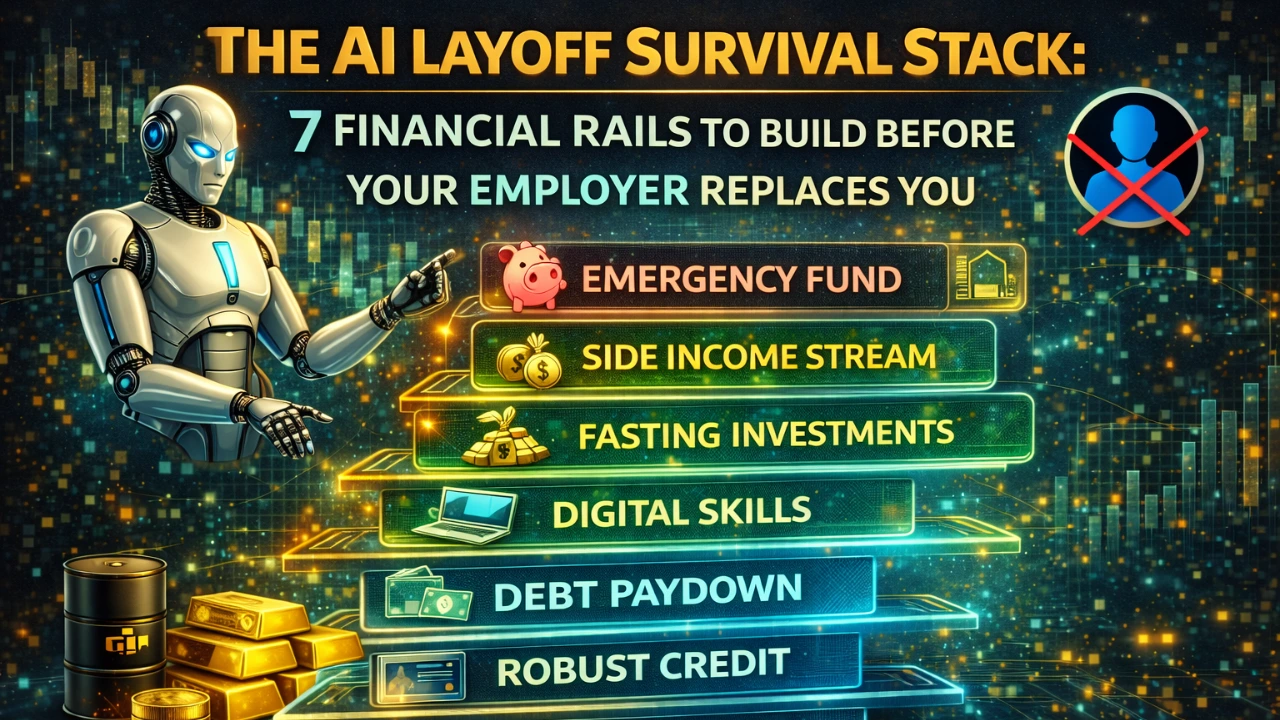
The survival stack is built on seven rails:
- Emergency cash rail
- Stablecoin liquidity rail
- Bitcoin or hard-asset upside rail
- Exchange access rail
- Self-custody rail
- Income expansion rail
- Market opportunity rail
These are not seven separate lives. They are seven layers of resilience.
Rail 1: Emergency cash rail
Before you do anything clever, build boring resilience.
You need accessible local-currency cash for the things crypto does not solve well: rent, groceries, utilities, immediate obligations, and life admin. If you lose your job, the first priority is not maximizing yield. It is preserving breathing room.
A useful rule for most readers is this: keep at least part of your emergency reserve in plain cash or your most liquid local bank account. This is your “sleep at night” buffer. It exists so you do not have to liquidate risk assets during stress.
Crypto is not a substitute for immediate household liquidity. It is a complement.
Rail 2: Stablecoin liquidity rail
This is where your financial system starts becoming more modern.
Stablecoins can function as a second liquidity layer: a digital cash rail that is faster, more portable, and often more flexible than relying only on one bank. For readers dealing with inflation risk, banking friction, or simply wanting global access, this matters.
A stablecoin allocation can serve several purposes:
- emergency mobility
- optional savings diversification
- faster cross-border transfers
- dry powder for opportunities
- a bridge between traditional cash and digital finance
For many beginners, the easiest first step is to open an exchange account that supports easy stablecoin access and transfers. Platforms such as Binance using code CPA_00SXKU7IO9, Bybit with code 46164, MEXC with code 16yJL, OKX with code 2136301, and Luno for users who want a simpler on-ramp can all serve different parts of this role depending on region and goals.
The point is not loyalty to one platform. The point is building access.

Rail 3: Bitcoin or hard-asset upside rail
Once your immediate liquidity is handled, you need exposure to upside.
Why? Because a survival stack is not just about surviving loss. It is about not getting left behind while the financial system evolves. If AI compresses labor value over time, ownership matters more. Bitcoin remains, for many readers, the cleanest digital asset expression of long-term monetary optionality.
That does not mean go all in. It means consider a controlled allocation. A stack with no upside rail may protect you in the short term but leave you underexposed to one of the biggest wealth migration themes of the era.
For readers who want simple recurring buys and strong liquidity, Kraken, Binance, OKX, and Bybit are sensible starting points. For more advanced hedging later, Deribit can become relevant once you understand options and risk management. Newcomers should not start there.
Rail 4: Exchange access rail
This is where many people make their first strategic mistake: they open one exchange account and assume that is enough.
It is not.
Your exchange rail is not just where you trade. It is where you access liquidity, stablecoins, recurring buys, transfers, copy trading, derivatives, and sometimes even yield products. You should think in terms of function.
A strong survival stack often includes:
- one primary mainstream exchange
- one secondary alternative exchange
- one instant swap or off-ramp option
A beginner might choose Luno or Kraken as a simpler base, then add Bybit, Binance, or OKX for broader functionality. An intermediate reader might add Blofin using code Decentralised, Bitunix with code 17hy, or BingX with code F8XN1D if copy trading or more active tools matter. For simple exchange flexibility, ChangeNOW and SideShift can be useful utility layers.
Redundancy is not paranoia. It is preparedness.

Rail 5: Self-custody rail
If you are serious about resilience, at some point you need a custody layer that is yours.
This does not mean moving everything off exchanges immediately. It means understanding that exchange convenience and self-custody serve different purposes. Exchanges are excellent for access and execution. Self-custody is for sovereignty, long-term storage, and reducing dependence on a single platform.
That is where devices such as Ledger, CoolWallet Pro, and KeepKey come in. For a reader building a true AI-era survival stack, a hardware wallet is not a luxury gadget. It is part of a mature treasury setup.
A practical path is simple:
- learn on exchange
- build confidence
- move part of longer-term holdings to self-custody
- keep only what you actively use on trading platforms

Rail 6: Income expansion rail
This is the rail that separates “survival” from “adaptation.”
If AI is going to pressure your salary, you cannot only focus on preserving money. You need at least one additional way to generate it.
That could mean:
- affiliate publishing
- freelance consulting
- AI-enhanced side services
- copy trading with disciplined sizing
- strategy content
- education products
- remote crypto-native work
- carefully managed algorithmic trading tools
Some readers will benefit from simple automation tools like Pionex, 3Commas, Coinrule, or Cryptohopper, but only after they understand that no bot removes risk. Bots amplify process, not intelligence. The best use case for these tools is structure and discipline, not magical returns.
This rail matters because the future belongs to people with at least one income source that is not fully dependent on one company payroll.

Rail 7: Market opportunity rail
This is the optional rail. It is not mandatory, and it is where many people blow themselves up.
If you have stable liquidity, a cash buffer, exchange access, some custody knowledge, and expanding income options, then selective market opportunity can become part of your stack. This might include:
- copy trading
- low-risk recurring buys
- basis or hedging education
- cautious exposure to derivatives
- structured trading workflows with risk caps
For copy trading and accessible execution, platforms like BingX, Bybit, Blofin, Bitget, and Phemex can make sense depending on your experience. For advanced users, Deribit, GMX, Drift, Aevo, Paradex, GRVT, and SynFutures may fit more specialized needs. But this rail only belongs on top of the first six. Never below them.

Fastest path to action in the next 15 minutes
If you do nothing else today, do this:
- Calculate how many months you could survive if your salary stopped tomorrow.
- Open one primary exchange account for stablecoin access and recurring buys.
- Open one secondary exchange account for redundancy.
- Write down a target emergency fund amount.
- Decide what percentage of your savings should remain in local cash, stablecoins, and long-term upside assets.
- Bookmark one hardware wallet for later setup if you are not ready today.
- Create one income-expansion idea that AI cannot fully replace yet.
A simple beginner route could look like this:
- Open Luno or Kraken for simple onboarding
- Add Binance or Bybit for broader tools
- Learn stablecoin basics
- Set a recurring Bitcoin buy
- Research Ledger for long-term storage
- Avoid leverage until you can explain liquidation risk in plain English
That is already more strategic than the vast majority of workers.

Featured snippet table: The 7 rails of the AI layoff survival stack
|
Rail |
Purpose |
Best For |
Common Mistake |
|
Emergency cash rail |
Immediate household survival |
Bills, rent, groceries |
Putting all savings into volatile assets |
|
Stablecoin liquidity rail |
Fast, portable digital liquidity |
Diversification, transfers, dry powder |
Treating stablecoins as risk-free |
|
Bitcoin upside rail |
Long-term asymmetric exposure |
Wealth preservation and upside |
Buying too much before building a cash buffer |
|
Exchange access rail |
Market access and liquidity |
Buying, selling, transferring, learning |
Relying on only one platform |
|
Self-custody rail |
Long-term control of assets |
Serious savers and long-term holders |
Moving funds off exchange before learning basics |
|
Income expansion rail |
Reduce salary dependence |
Side income and AI-era resilience |
Thinking investment alone solves income risk |
|
Market opportunity rail |
Controlled growth and tactical exposure |
Copy trading, recurring buys, advanced strategies |
Starting with leverage before building foundations |
Decision matrix: what kind of stack do you need?
If your main fear is job loss in the next 6 months
Prioritize:
- emergency cash
- stablecoin rail
- primary and secondary exchange access
- income expansion rail
De-prioritize:
- advanced derivatives
- aggressive altcoin speculation
- bots you do not understand
If your main fear is inflation and currency weakness
Prioritize:
- cash buffer
- stablecoins
- Bitcoin allocation
- hardware wallet education
De-prioritize:
- overtrading
- chasing high-yield schemes
- complex DeFi too early
If your main fear is missing upside while staying safe
Prioritize:
- recurring Bitcoin buys
- exchange redundancy
- small opportunity sleeve
- risk-defined learning
De-prioritize:
- all-in entries
- random influencers
- unverified “AI trading systems”
The old financial model assumed your employer was stable, your bank was sufficient, and your future income would rise in a straight line. The new model assumes none of that. In the AI age, resilience is not built by optimism. It is built by optionality.
If one paycheck is your whole system, you do not have a financial strategy. You have a dependency.
The winners of the next decade may not be the best paid. They may be the best prepared.
Mistakes that cost people money
The AI layoff survival stack only works if you avoid the traps.
The first trap is treating crypto like a rescue fantasy. If you are financially stressed, reckless speculation will not save you. It will magnify pressure.
The second trap is opening accounts without understanding why. Do not collect exchanges like trophies. Each one should serve a purpose: access, redundancy, tools, or cost efficiency.
The third trap is skipping emergency cash because stablecoins feel more modern. Technology does not remove the need for plain old liquidity.
The fourth trap is confusing copy trading with guaranteed success. Following another trader is still risk. A bad risk manager is still bad even if their interface looks polished.
The fifth trap is ignoring custody. Keeping everything on one platform forever may be easy, but convenience is not the same as resilience.
The sixth trap is starting with leverage. If your main concern is job fragility, adding liquidation risk is the opposite of survival.
The seventh trap is postponing action because you want the perfect setup. Perfection is expensive. Preparedness is usually built one layer at a time.
Who should not do this
This article is not telling everyone to become a trader.
You should not pursue the full survival stack in an aggressive way if:
- you are struggling with basic debt and cannot yet build even a small emergency reserve
- you are prone to compulsive trading behavior
- you are looking for a shortcut to replace disciplined financial planning
- you cannot tolerate volatility at all
- you are unwilling to spend time learning custody, risk, and security basics
For some readers, the right move is very modest:
a cash reserve, one exchange account, a tiny recurring buy, and no trading at all.
That is still a better stack than most people have.
Who this is for and who it is not for
This is for:
- professionals who suspect their role may become less secure
- salaried workers who want a stronger money system
- beginners who want practical crypto utility, not hype
- readers who value resilience more than excitement
- people building long-term optionality
This is not for:
- gamblers looking for quick returns
- readers unwilling to manage even basic security
- people seeking illegal evasion or risky shortcuts
- those who think a YouTube guru is a treasury strategy
Beginner
Start simple. Open one trusted on-ramp and one backup account. For many readers, that means beginning with Kraken, Luno, or Binance, then adding Bybit or OKX for broader functionality later. If you use Binance, apply code CPA_00SXKU7IO9. If you choose Bybit, use code 46164. The goal is not to trade today. The goal is to build access before you need it.
Intermediate
If you already understand the basics, strengthen your stack with redundancy and function. Add a secondary platform like Blofin using code Decentralised, Bitunix with 17hy, or BingX with F8XN1D if copy trading or strategy diversification matters. Then define your split between local cash, stablecoins, and long-term upside.

Advanced
If you are already comfortable with custody and execution, refine your stack rather than overcomplicate it. Keep core liquidity on reliable venues, store long-term holdings in self-custody with Ledger or CoolWallet, and only use advanced platforms like Deribit, GMX, Drift, Aevo, or Paradex for clearly defined strategies. Your edge is not complexity. It is disciplined structure.

Suggested stack examples by user type
The cautious beginner
- 3 to 6 months local cash target
- 10 to 20 percent of liquid savings in stablecoins
- small recurring Bitcoin buy
- 1 primary exchange, 1 backup exchange
- no leverage
- hardware wallet research phase only
The balanced professional
- 4 to 8 months emergency liquidity across cash and stablecoins
- recurring buys into Bitcoin and selective majors
- 2 exchange accounts plus a swap utility
- partial self-custody
- one side income experiment
- limited copy trading or automation only after core stack is built
The advanced operator
- diversified liquidity across cash, stablecoins, and exchanges
- self-custody for strategic holdings
- risk-defined trading sleeve
- optional derivatives for hedging, not thrill-seeking
- multiple income rails
- documented treasury rules
FAQ
What is the AI layoff survival stack?
It is a practical financial resilience system designed for people worried about salary fragility in the AI era. It combines cash, stablecoins, Bitcoin or upside assets, exchange access, custody, extra income paths, and cautious market participation.
How much should I keep in cash versus crypto?
That depends on your income stability, household costs, and risk tolerance. Most people should start with enough local cash for short-term expenses before adding stablecoins or volatile assets.
Are stablecoins safe?
They can be useful, but they are not risk-free. The point is not blind trust. The point is using them deliberately as one layer in a broader system.
Do I need multiple exchanges?
Usually yes, if you are serious about access and redundancy. One for primary use and one backup is a sensible approach for many readers.
Should beginners use copy trading?
Only carefully, with small size and clear risk limits. It is a tool, not a guarantee.
Do I need a hardware wallet?
Not on day one, but serious long-term holders should understand self-custody and eventually consider a device like Ledger, CoolWallet, or KeepKey.
Should I start trading derivatives to make up for layoff risk?
No. If your motivation is fear and urgency, leverage is usually the wrong first move. Build your foundations first.
Start Here — Build Your Crypto Infrastructure Safely
You don’t need to use everything at once.
Professionals reduce risk by having access to multiple rails so they are never dependent on a single platform.
Below is a simple, practical setup used by many experienced traders and investors.
1) Your Fiat Gateway (Primary Access)
Best starting point for deposits & withdrawals
Binance — reliable onboarding, deep liquidity, global coverage
👉 sign up
Why open this:
- Move from bank → crypto easily
- Convert large amounts efficiently
- Emergency exit capability
2) Your Trading Execution Venue (Fast & Flexible)
Best for active trading and broad market access
MEXC — huge altcoin selection & low trading friction
👉 sign up
Why open this:
- Trade markets not listed elsewhere
- Better execution during volatility
- Lower dependence on a single exchange
3) Your Advanced Tools & Derivatives Platform
Best for leverage, hedging and professional execution
Bybit — strong order controls & derivatives infrastructure
👉 sign up
Why open this:
- Proper stop loss tools
- Hedging capability
- Strategy flexibility
4) Your Yield & Passive Income Layer
Best for structured products and capital efficiency
Gate.com — structured yield & automated earning tools
👉 sign up
Why open this:
- Earn on idle capital
- Diversify platform risk
- Access structured strategies
5) Your Altcoin & Ecosystem Expansion Layer
Best for early market access and wide listings
KuCoin — broad token ecosystem
👉 sign up
Why open this:
- Access emerging markets
- Portfolio diversification
- Redundancy if one platform restricts access
Why This Structure Matters
Using one exchange creates a single point of failure.
Using multiple rails creates:
- Liquidity redundancy
- Faster reaction ability
- Lower operational risk
- Greater opportunity access
You don’t need large capital to start — you just need prepared infrastructure.
Practical Next Step
Open accounts gradually and verify them before you need them.
Most people only prepare during stress —
professionals prepare before it.
(Decentralised News provides infrastructure education, not financial advice. Always use proper security practices.)