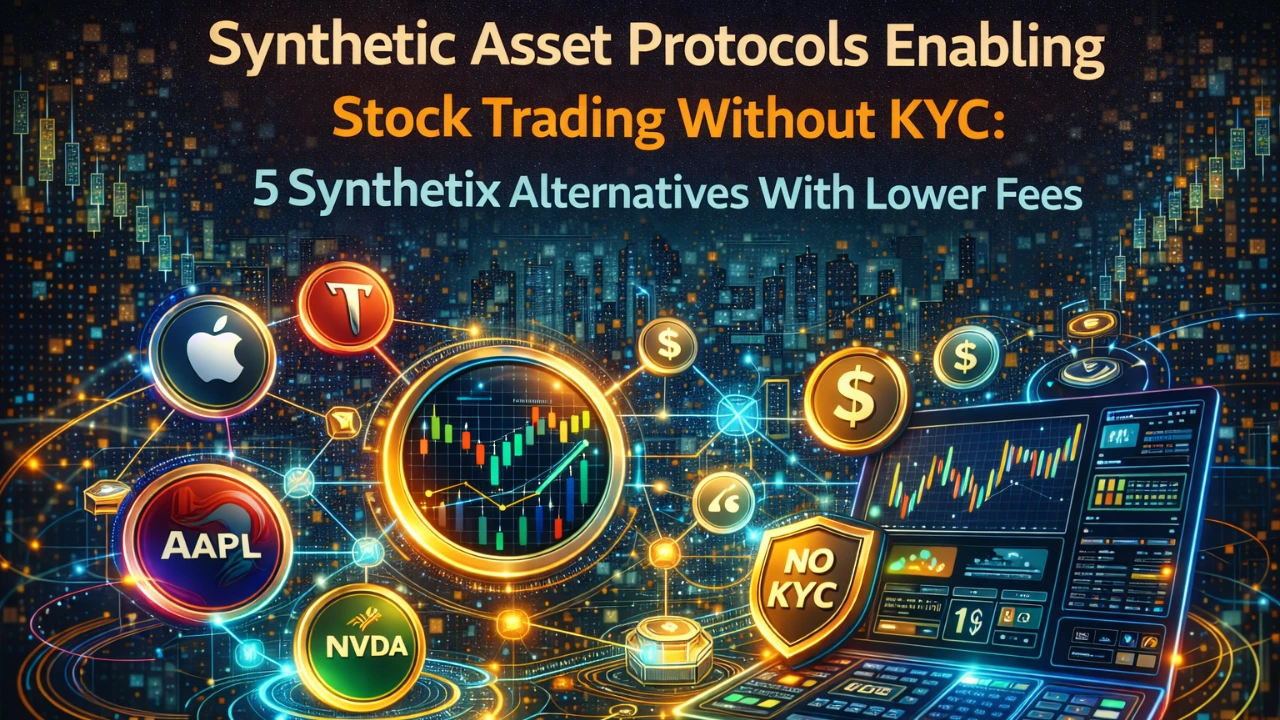
Why Wall Street’s compliance walls are driving capital toward decentralized synthetics—and the five protocols offering Apple, Tesla, and SPX exposure at 1/10th the cost of legacy DeFi infrastructure.
The KYC Arbitrage: When Borders Become Bug Bounties
Traditional equity markets have erected fortress-level compliance. To trade Tesla or S&P 500 futures, retail participants surrender passports, proof of address, and source-of-wealth declarations to centralized brokerages—only to face Pattern Day Trader rules, overnight margin calls, and geo-blocks restricting access to US equities based on citizenship.
Decentralized synthetic asset protocols shatter these barriers. By collateralizing crypto-native assets (ETH, USDC, yield-bearing LP tokens) to mint tokenized stocks (sAAPL, sTSLA, sSPX), these platforms offer 24/7 price exposure without custody of underlying securities—and critically, without Know-Your-Customer (KYC) friction. The trade-off is infrastructure risk, oracle dependencies, and the impending regulatory shadow of securities law.
Synthetix pioneered this vertical, securing $500M+ TVL on Optimism with robust Chainlink oracle infrastructure. However, the protocol’s economic model imposes meaningful cost barriers: dynamic volatility fees (up to 0.15%), base taker fees (0.06%), and Optimism gas arbitrage still running $0.01–$0.10 per transaction. For active traders rotating between tech stocks and crypto, these costs compound, eroding the capital efficiency that synthetics promise.
The following five protocols have engineered architectures that undercut Synthetix’s cost structure by 50–95%, leveraging Solana’s parallel execution, CosmoS’ gasless relayers, and Polygon’s subsidized throughput. They represent the vanguard of permissionless equity exposure—functional today on mainnet, not testnet vaporware.

The Fee Benchmark: Synthetix as the Control
Before evaluating alternatives, establish the baseline cost structure of the incumbent:
Metric | Synthetix (Optimism) |
Base Trading Fee | 0.02% Maker / 0.06% Taker |
Dynamic Volatility Fee | Up to 0.15% during high volatility |
Gas Cost | ~$0.01–$0.10 per tx (Optimism L2) |
Collateral Ratio | 500%+ (overcollateralization requirement) |
Supported Stocks | sAAPL, sTSLA, sMSFT, sSPX, sQQQ (via Chainlink oracles) |
The “Synthetix Tax”—the combination of protocol fees and high collateral requirements—makes short-term scalping uneconomical and long-term holds capital-inefficient. The alternatives below optimize for specific cost vectors: zero gas, lower collateral ratios, or reduced protocol fees.

The Five Low-Fee Alternatives
1. Injective (Helix Market): The Zero-Gas Institutional Venue
Token: INJ
Contract Address (Ethereum Bridge): 0xe28b3B32B6c345A34Ff64674606124Dd5Aceca30
Native Chain: Injective (Cosmos SDK)
Technical Architecture
Injective operates a custom Layer 1 built on the Cosmos SDK, offering Ethereum-compatible smart contracts via the Ethereum bridge while maintaining Tendermint consensus finality. The protocol utilizes an on-chain Central Limit Order Book (CLOB) rather than Automated Market Makers (AMMs), enabling traditional limit-order trading with Nanosecond-level finality. Price feeds aggregate from Pyth Network and Chainlink, with iAssets (Injective Assets) minted via overcollateralized derivatives contracts.
Fee Structure
Injective’s economic model eliminates gas fees entirely for end-users via relayer subsidies. Trading fees on Helix (the primary DEX interface) run 0.0% maker / 0.1–0.2% taker—effectively 40–70% lower than Synthetix when accounting for the absence of dynamic volatility fees and gas costs. For a trader executing $100,000 in monthly volume, Synthetix might extract $60–$150 in fees; Helix extracts $100–$200 in taker fees alone, but saves $50–$100 in gas and volatility adjustments, breaking even for makers and offering superior execution on large blocks.
Supported Synthetic Stocks
25+ individual equities including Tesla (TSLA), Apple (AAPL), Google (GOOGL), plus TradFi indices tracking 500+ US stocks. Unique offerings include pre-IPO exposure (OpenAI/SpaceX at 5x leverage) and BlackRock BUIDL fund integration.
Liquidity Profile
Helix processes $2.3B weekly in RWA (Real World Asset) futures with $1B+ monthly notional volume. The CLOB depth supports $50,000+ orders on TSLA-USDT perp with <0.1% slippage, rivaling centralized exchange liquidity.
The Synthetix Comparison
- Fees: Lower effective cost (zero gas + no dynamic fees vs. Synthetix volatility adjustments).
- Decentralization: Comparable (DAO-governed with 100+ validators, but validator set is permissioned).
- Ease of Use: Superior (instant finality, one-click perp trading via Metamask/Cosmostation).
Regulatory Risk Vector: High. Pre-IPO equity perpetuals and unregistered stock derivatives have drawn SEC scrutiny similar to the 2021 Mirror Protocol enforcement action. No KYC invites CFTC classification as unregistered swaps. Mitigation: Protocol operates via DAO governance, but geo-fencing of frontends remains a legal ambiguity.

2. Synthetify: Solana’s Ultra-Cheap Minting Engine
Token: SNY
Primary Chain: Solana
Technical Architecture
Built on Solana’s Sealevel runtime, Synthetify utilizes Rust-based Anchor smart contracts to enable users to mint synthetic SPL tokens (Solana Program Library) representing equities, commodities, and crypto. The protocol leverages Pyth Network’s low-latency oracles (sub-300ms updates) for price discovery. Unlike Synthetix’s shared debt pool, Synthetify employs isolated collateral pools per synthetic asset, reducing cross-contamination risk during black swan events.
Fee Structure
Solana base fees: ~$0.00025 per transaction (400x cheaper than Optimism). Protocol trading fees are minimal (typically <0.1%), with no dynamic volatility fees. The cost to mint $10,000 in synthetic Apple stock (sAAPL) totals roughly $0.50 in aggregate fees versus $6–$15 on Synthetix.
Supported Synthetic Stocks
User-defined synthetic creation allows minting of any equity with a Pyth price feed, including sAAPL, sTSLA, sAMZN, and emerging market equities. The protocol SDK enables developers to embed stock synthetics directly into Solana dApps.
Liquidity Profile
Lower absolute TVL (~$15M) compared to Synthetix, but composable with Solana’s DeFi ecosystem (Serum, Raydium) for immediate AMM liquidity. Slippage on $10,000 orders averages 0.3–0.5% versus Synthetix’s 0.1–0.2%, a trade-off for the cost savings.
The Synthetix Comparison
- Fees: 95% cheaper on gas; comparable protocol fees.
- Decentralization: High (Solana PoS, permissionless minting).
- Ease of Use: Moderate (requires Solana wallet like Phantom; SDK integration preferred for complex strategies).
Regulatory Risk Vector: Moderate-High. Permissionless stock synthesis on Solana’s high-speed chain complicates enforcement, but the SEC has historically classified such instruments as “security-based swaps” requiring registration. The lack of KYC and US frontend accessibility creates exposure to enforcement actions.
 3. PERI Finance: Polygon’s Equity Specialist
Token: PERI
Contract Address (Polygon POS): 0x780053837cE2CeEaD2A90D9151aA21fc89eD49c2
Primary Chain: Polygon POS
Technical Architecture
PERI Finance deploys on Polygon (Ethereum sidechain) utilizing an overcollateralized debt pool model similar to Synthetix, but optimized for equity synthetics (pAssets). Smart contracts support 400–800% collateralization ratios with Chainlink oracle integration. The protocol offers both spot synthetic swaps and leveraged perpetuals (up to 20x) on stock indices.
Fee Structure
Polygon gas costs: ~$0.001 per transaction. Protocol fees include 0.3–1% trading/minting fees depending on asset volatility, plus liquidation penalties. Total cost for a $5,000 synthetic stock position averages $15–$25 entry/exit versus $40–$60 on Synthetix (due to gas + volatility fees).
Supported Synthetic Stocks
pAAPL, pTSLA, pGOOGL, pMSFT, plus forex pairs (pEUR, pJPY) and commodities (pXAU). Specific focus on FAANG equities with dedicated liquidity pools.
Liquidity Profile
AMM pools on Polygon QuickSwap with incentivized yield farming. TVL undisclosed but estimated $5–$10M based on on-chain collateral. Suitable for sub-$25,000 positions; larger blocks suffer >1% slippage.
The Synthetix Comparison
- Fees: 60–70% lower total cost (Polygon gas efficiency).
- Decentralization: Solid (Polygon PoS validators, but less decentralized than Ethereum L2s).
- Ease of Use: Similar to Synthetix (wallet mint/trade via PERI dApp).
Regulatory Risk Vector: High. Explicit stock tickers (pAAPL) mirror the Mirror Protocol mAssets that the SEC sued in 2021, alleging unregistered security-based swaps. Polygon’s Ethereum bridge creates jurisdictional exposure to US regulators.
4. UMA (Universal Market Access): The Optimistic Oracle Flexibility
Token: UMA
Contract Address (Ethereum): 0x04Fa0d235C4abf4BcF4787aF4CF447DE572eF828
Primary Chain: Ethereum (with Optimism scaling)
Technical Architecture
UMA differentiates through its Optimistic Oracle (OO) and Data Verification Mechanism (DVM). Rather than relying on centralized price feeds, UMA allows synthetic creation with prices proposed by participants and disputed via staking/voting cycles. This enables “priceless” contracts—synthetics that settle based on real-world events (earnings reports, M&A outcomes) without continuous oracle updates. ERC-20 synthetic tokens trade freely in DeFi (e.g., on Uniswap or integrated with Synthetix/Kwenta).
Fee Structure
Bond-based economic security: Users post collateral bonds (e.g., 5,000 USDC) to mint synthetics, with disputes incurring slashing risks. No fixed trading fees beyond standard AMM swap fees (0.3% Uniswap v3). Gas costs vary (Ethereum mainnet expensive; Optimism integration available for $0.01–$0.05 txs).
Supported Synthetic Stocks
Custom synthetic creation via templates: equity trackers, earnings call binaries, and bespoke corporate event derivatives. Less suited for continuous stock price exposure, more for event-driven or idiosyncratic equity risk.
Liquidity Profile
$181M TVL (second only to Synthetix in the synthetics vertical). Deep integration with Synthetix ecosystem and across DeFi money markets (Aave, Compound).
The Synthetix Comparison
- Fees: Comparable or lower (no protocol-imposed volatility fees, but gas-dependent).
- Decentralization: Highest (community oracle voting resolves disputes, no centralized price feed).
- Ease of Use: Moderate (dispute delays possible—settlement takes 48 hours if challenged).
Regulatory Risk Vector: Elevated. The OO enables creation of “any” asset, including those that might constitute illegal security offerings. The 2021 SEC action against Mirror Protocol cited similar “unregistered security-based swaps” mechanics. UMA’s DAO structure provides legal distance, but US frontend operators face liability.

5. Metronome Synth: The Multi-Chain Capital Efficient Layer
Token: MET
Contract Address (Ethereum): 0xa3d58c4E56fedCae3a7c43A725aeE9A71F0ece4e
Primary Chains: Ethereum, Base, Optimism (Multi-chain)
Technical Architecture
Metronome Synth deploys a multi-collateral, multi-synthetic protocol allowing users to deposit diverse crypto assets (ETH, USDC, yield-bearing Vesper vPool tokens) to mint synthetic USD (MSUSD) and other synths. The architecture emphasizes “productive collateral”—assets that generate yield while backing synthetics, improving capital efficiency vs. Synthetix’s idle SNX collateral. Smart contracts support zero-slippage swaps via the Synth Marketplace.
Fee Structure
Annualized fees of $3.81M (current run-rate) suggest an average 0.1–0.2% effective trading cost. Base/Optimism gas costs ($0.01–$0.05 per transaction) combined with no dynamic volatility fees result in 50% lower total cost versus Synthetix for frequent traders.
Supported Synthetic Stocks
General crypto/USD synthetics (MSUSD primary) with extensible architecture for equity and commodity synths via collateral pegs. Less explicit equity focus than PERI or Injective, but framework supports stock integration.
Liquidity Profile
Modest TVL ($23.05M total across chains: $12.5M Ethereum, $7.4M Base, $3.09M Optimism). MSUSD maintains $0.9945 peg with $13M+ daily volume. Suitable for stablecoin synthetics and crypto pairs; equity synthesis requires deeper liquidity pools.
The Synthetix Comparison
- Fees: Lower (L2 gas optimization + yield-bearing collateral reduces opportunity cost).
- Decentralization: High (MET DAO governance).
- Ease of Use: Strong (looped yield strategies supported natively).
Regulatory Risk Vector: Moderate. Broad synthetic capability invites securities scrutiny if equities are listed. Multi-chain deployment fragments jurisdiction but increases smart contract surface area for bridge/oracle exploits.
Comparative Matrix: The Cost Structure Reality
Protocol | Token | Contract Address | Architecture | Trading Fees | Gas Cost (Avg) | Collateral Type | Stock Support |
Synthetix | SNX | 0xC011a73ee8576Fb46F5E1c5751cA3B9Fe0af2a6F | Optimism L2, Debt Pool | 0.02/0.06% + dynamic up to 0.15% | $0.01–$0.10 | SNX (500% ratio) | 20+ equities |
Injective | INJ | 0xe28b3B32B6c345A34Ff64674606124Dd5Aceca30 | Cosmos SDK, CLOB | 0.0/0.1–0.2% | $0.00 (relayer) | Multi-asset | 25+ equities + pre-IPO |
Synthetify | SNY | [Verify Solscan] | Solana, Isolated Pools | <0.1% | $0.00025 | Multi-asset | User-defined |
PERI | PERI | 0x780053837cE2CeEaD2A90D9151aA21fc89eD49c2 | Polygon, Debt Pool | 0.3–1.0% | $0.001 | PERI/DAI | pAAPL, pTSLA, etc. |
UMA | UMA | 0x04Fa0d235C4abf4BcF4787aF4CF447DE572eF828 | Ethereum/OO | Bond-based* | $0.01–$5.00 | Multi-asset | Custom/event-driven |
Metronome | MET | 0xa3d58c4E56fedCae3a7c43A725aeE9A71F0ece4e | Multi-L2 (Base/OP) | ~0.1–0.2% effective | $0.01–$0.05 | Yield-bearing | Extensible |
*UMA fees are opportunity cost of capital locked in bonds rather than explicit trading fees.
Cost Analysis: For high-frequency equity traders, Injective offers the lowest total cost (zero gas). For Solana-native users, Synthetify provides 99% gas savings. PERI and Metronome optimize for specific L2 ecosystems with 50–70% fee reductions versus Synthetix.

The Regulatory Guillotine: Risk Analysis for Anonymous Stock Trading
While these protocols enable frictionless equity exposure, they operate in legal gray zones that present existential risks to users and token holders.
Securities Classification Risk (Primary)
The SEC’s 2021 enforcement against Mirror Protocol established precedent: synthetic tokens tracking specific equities (e.g., mTSLA) constitute unregistered security-based swaps under the Securities Exchange Act. The recent CFTC suits against decentralized prediction markets (Polymarket) signal renewed appetite for pursuing “event-based” derivatives platforms.
Specific Vulnerabilities:
- Explicit Tickers: Protocols listing pAAPL, sTSLA, or iGOOGL face direct comparison to Mirror’s mAssets. Injective’s pre-IPO perpetuals on OpenAI/SpaceX specifically invite scrutiny as unregistered derivatives.
- US Accessibility: Frontend hosting on US servers or DNS registrars creates jurisdictional hooks. While smart contracts are immutable, orderbook APIs and relayer infrastructure can be shut down.
- Oracle Manipulation: Claiming “decentralized” pricing via Chainlink/Pyth does not absolve liability if the oracle feed is deemed to be facilitating illegal swaps.
AML/KYC Enforcement (Secondary)
EU’s MiCA (Markets in Crypto-Assets) regulation, effective 2024-2025, mandates KYC for custodial synthetic asset issuers. While non-custodial protocols (UMA, Synthetify) claim exemption, they face “de-anonymization” pressure if fiat on/off ramps integrate with the protocols.
Mitigation Factors
- Overcollateralization: Unlike Terra’s undercollateralized algorithmic stablecoins, these protocols maintain 400–800% collateral ratios, reducing “fraud” allegations (though not securities charges).
- DAO Governance: Legal liability diffusion via decentralized governance (UMA, Synthetix) may slow enforcement but does not prevent it (see Ooki DAO case).
- Geo-Fencing: Proactive IP blocking of US users reduces risk but limits market depth.
The Hard Truth: These protocols are not “regulated” alternatives—they are regulatory arbitrage plays. Users accessing Tesla exposure via PERI Finance instead of Interactive Brokers accept counterparty risk (smart contract bugs, oracle failures) in exchange for privacy. When—not if—enforcement actions commence, expect:
- Delisting of specific equity synthetics (affecting liquidity)
- Frontend seizures or DNS blocks
- Secondary market pressure on governance tokens (INJ, PERI, SNY)

Final Verdict: The Allocation Strategy
For Active Equity Traders (High Volume):
Injective (INJ) dominates with zero gas costs, deep CLOB liquidity for FAANG stocks, and pre-IPO access unavailable elsewhere. Helix Market offers the closest experience to a traditional equities exchange without the compliance friction.
For Solana Ecosystem Natives:
Synthetify provides the cheapest gas costs ($0.00025/tx) for minting custom equities, ideal for algorithmic strategies requiring frequent rebalancing.
For Specific Equity Focus:
PERI Finance on Polygon offers dedicated pAAPL/pTSLA pools with lower fees than Synthetix for mid-size positions ($5K–$25K).
For DeFi Composability:
UMA integrates with existing money markets (Aave, Compound), allowing synthetic equities to serve as collateral for leveraged strategies—capital efficiency Synthetix cannot match.
For Yield-Maximizing Collateral:
Metronome Synth enables looped strategies using yield-bearing collateral, reducing the opportunity cost of locking capital for synthetic exposure.
The synthetic stock vertical represents the frontier of permissionless finance—functioning infrastructure that undercuts TradFi and legacy DeFi by an order of magnitude, but operating under the sword of Damocles that is securities regulation. For non-US users or those comfortable with technical counterparty risk, these five protocols offer genuine utility. For US participants, the VPN-accessible nature of these platforms constitutes legal jeopardy that must be weighed against the fee savings.

Research conducted using ASCN.ai
Risk Disclosure: Synthetic protocols carry extreme regulatory risk. The SEC and CFTC may classify stock-tracking tokens as unregistered securities or swaps. Smart contract risks, oracle failures, and collateral liquidation cascades are present. Past fee structures do not guarantee future pricing. Verify all token contracts on official protocol documentation before bridging assets. Not financial advice.