Market Structure | Survivor Analysis | July 2026
The Survivor Shortlist: Where Capital Concentrates After the Altcoin Extinction, and the Twelve Tokens the Flow Data Says Are Already Being Chosen
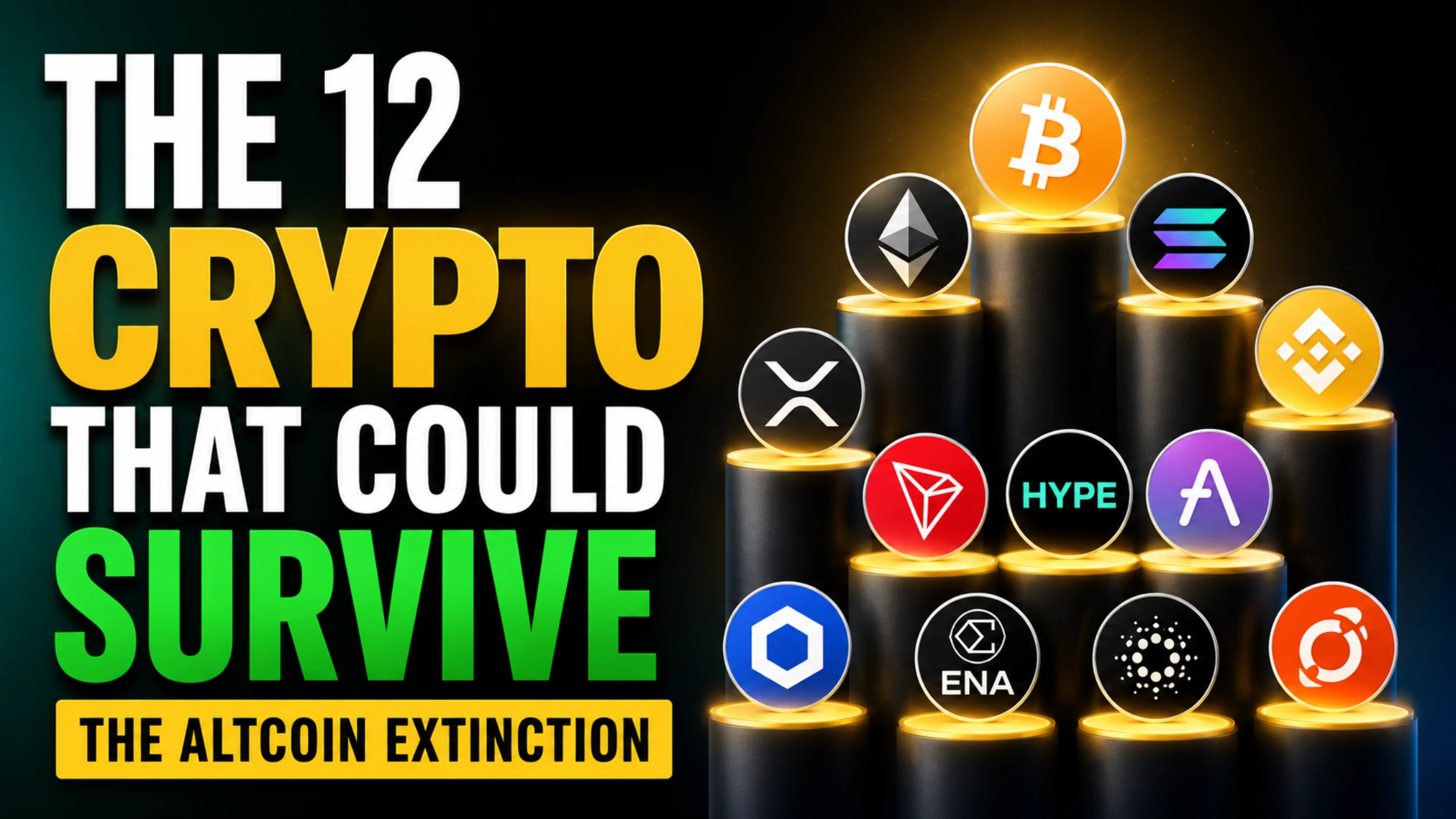
DN's Altcoin Extinction Index established that with 37+ million tokens competing for a roughly $485 billion rotation pool, more than 99.9% of tokens cannot mathematically reclaim prior highs, and that any recovery must concentrate into a narrow survivor cohort. This follow-up maps where that concentration is already observable in verified flow and revenue data as of July 2026. The rotation is empirical, not theoretical: in a single May 2026 week, CoinShares recorded nearly $1 billion exiting Bitcoin funds while XRP products drew $67.6 million, Solana $55.1 million, and TON, DOGE, and Chainlink products also attracted capital; XRP spot ETFs gathered over $1.3 billion in their first month with a record 55-day inflow streak; US spot Solana ETFs posted their strongest month of 2026 in May with zero outflow days and over $1 billion AUM; and spot Hyperliquid ETFs took $111 million of inflows in late June while Bitcoin and Ethereum funds bled. On the revenue screen, Hyperliquid crossed $1.02 billion cumulative protocol revenue with a roughly $840 million annualised run rate and 97-99% of fees routed to HYPE buybacks; Aave runs weekly buybacks against roughly $7.5 million in weekly fees; Pump.fun generated about $459 million in twelve-month revenue with 50% to buybacks; Render produced $38 million in monthly DePIN revenue in January 2026; and Bittensor completed its first halving in December 2025 with roughly 70% of supply staked and a Grayscale spot ETF decision expected August 2026. On the infrastructure screen, Solana's RWA value hit a record $3.4 billion with $16 billion in stablecoins onchain, the XRP Ledger briefly flipped Solana in ex-stablecoin RWA value after 277% thirty-day growth, Ethereum retained RWA dominance near $14.9 billion, and Ethena deployed $1 billion across new Solana money markets within days. The DN Survivor Screen introduced here scores twelve assets, BTC, ETH, SOL, BNB, XRP, TRX, HYPE, AAVE, LINK, ENA, TAO, and RENDER, across four structural survival criteria (liquidity and access, supply discipline, external demand, category tailwind) on a 0-100 scale, ships a self-scoring mode for auditing any holding, and documents the concentration evidence. Model analysis, explicitly not financial advice.
The DN Altcoin Extinction Index ended with a population statement: recovery capital must concentrate, and the long tail cannot be saved. This article answers the question that conclusion forces, which is where, specifically, the concentration is going, and it answers with flows and revenues rather than narratives, because the most under-reported fact of mid-2026 is that the concentration has already begun and is visible in the data. While headlines fixated on Bitcoin's record ETF outflow streaks, capital was not leaving crypto so much as being re-sorted inside it: into second-wave ETFs, into the handful of protocols that generate nine-figure real revenue, and into the rails that institutions are actually settling assets on. What follows is a category-by-category forensic pass over the ten concentration destinations the Extinction Index identified, the verified evidence for each, and the DN Survivor Screen, a scored, auditable instrument covering twelve assets that clear the structural survival criteria. One sentence before any of it: this is structural analysis of which assets can attract concentrating capital, not a prediction that any of them will go up, and it is not financial advice.
Venture investor Anand Iyer put the 2026 mood plainly in February: the frothy period is over, and "now it's about figuring out where the real strength lies." The survivor trade is exactly that exercise, run with numbers instead of vibes.
— Anand Iyer, Canonical Crypto, via CoinDesk, February 2026.The Rotation Is Already Visible: The Flow Evidence
Concentration is not a forecast; it is in the weekly fund-flow prints. In the week reported May 19, 2026, CoinShares recorded nearly $1 billion leaving Bitcoin funds while XRP products absorbed $67.6 million and Solana products $55.1 million, with TON, Dogecoin, and Chainlink products also net positive, a pattern CoinShares' own research head read as investors seeking selective exposure beyond the two majors rather than exiting the asset class. The second-wave ETF complex is the clearest conduit: US spot XRP ETFs amassed more than $1.3 billion in their first month with a 55-day consecutive-inflow streak, described as record-breaking across asset classes, while XRP exchange reserves sat at a seven-year low near 1.7 billion tokens. US spot Solana ETFs posted their strongest monthly inflows of 2026 in May, with zero outflow days and AUM crossing $1 billion. And in late June, spot Hyperliquid ETFs, live only since May, drew $111 million of weekly inflows during the same window Bitcoin and Ethereum funds bled, with two funds accumulating over $137 million. This is the Extinction Index's concentration mechanism operating in real time: the pool is not growing, it is choosing.
The Revenue Screen: Protocols That Pay Their Own Way
The second concentration magnet is real revenue, because fee-generating protocols carry a bid that does not depend on sentiment. The category's outlier is Hyperliquid: cumulative protocol revenue crossed $1.02 billion by late June 2026 with an annualised run rate near $840 million, ranking fourth among all crypto platforms by weekly fees at $15.9 million, on TVL climbing toward $5.75 billion, and with 97 to 99% of fees routed mechanically into HYPE buybacks via the Assistance Fund, an engine that had already repurchased tens of millions of tokens and led HYPE to a June all-time high above $73 while the broader market made 21-month lows. The honest caveat belongs in the same sentence: Forbes documented quarterly buybacks falling roughly 40% across two quarters into Q1 2026 because buyback capacity is a function of cyclical trading volume, meaning the mechanism amplifies both directions. Below Hyperliquid sits a widening buyback cohort: Aave, with roughly $7.5 million in weekly fees and a weekly buyback program running since April 2025, trading near $86 after a 15% week; Pump.fun, second by twelve-month revenue at roughly $459 million with 50% routed to PUMP buybacks; PancakeSwap in the same revenue-backed cluster; and dYdX allocating 25% of net fees to buybacks that are then staked. The pattern across all of them is the Extinction Index's external-demand criterion made visible: cash flow, not rotation, setting the floor.
The Rails Screen: Where Institutions Are Actually Settling
The third magnet is infrastructure carrying institutional settlement, because assets that clear real-world value inherit demand from outside crypto's speculative loop entirely. Ethereum remains the RWA anchor with roughly $14.9 billion in tokenized real-world assets, the default issuance layer for institutional tokenization and the base for purpose-built extensions like Converge, the Securitize and Ethena institutional L2. Solana's claim is velocity: RWA value hit a record $3.4 billion on July 2, 2026, onchain stablecoin supply passed $16 billion, the network captured roughly 97% of cumulative tokenized-equity spot trading volume, and the Alpenglow consensus overhaul targeting 150-millisecond finality is slated for mainnet in Q3, the specific property that matters for the machine-speed settlement the agentic economy requires. The XRP Ledger supplied 2026's surprise: ex-stablecoin RWA value briefly flipped Solana in February after 277% thirty-day growth, backed by $1.9 billion in ninety-day RWA inflows, a closed SEC case, and the RLUSD stablecoin giving the ledger institutional collateral. Tron remains the quiet giant of the stablecoin rails category as the dominant settlement chain for USDT transfer volume, a utility fee stream that persists through every sentiment regime, while Ethena demonstrated the demand side of synthetic-dollar rails when its new Solana money markets absorbed $400 million within 24 hours and $1 billion within days. Chainlink threads through all of it as the oracle and interoperability layer that RWA issuance on every one of these chains depends on, which is precisely why LINK products appeared alongside XRP and SOL in the May rotation inflows.
The AI and DePIN Screen: Scarcity Meets a Real Customer
The fourth magnet is the AI infrastructure cohort, where the Extinction Index's screens apply most brutally because the category mixes genuine cash-flow assets with pure narrative. The distinguishing test, as the better 2026 analysis frames it, is whether removing the token breaks the product. Bittensor passes structurally: a 21 million hard cap with its first halving completed December 2025 (daily issuance cut from 7,200 to 3,600 TAO), roughly 70% of supply staked, 128+ live subnets, quarterly network revenue estimated near $43 million, Grayscale raising TAO to 43% of its AI fund and filing a standalone spot ETF with a decision expected around August 2026, and a +47% year-to-date print in April while the broad market bled, though its emissions-funded miner incentives keep it on the inflationary side of the ledger until demand outruns issuance. Render passes on revenue: roughly $38 million in monthly network revenue in January 2026, second among all DePIN protocols, with NVIDIA Blackwell-class hardware onboarded and a burn-and-mint model that converts usage into supply reduction. NEAR anchors the agentic-infrastructure claim, one of the few majors to rally during April 2026's geopolitical stress on AI-agent positioning. The category's structural tailwind is the one this publication has argued across the Agentic Economy cluster: if autonomous agents transact, they transact on crypto rails, and the compute and inference layers those agents consume are what TAO and RENDER meter.
The Majors: Boring, Correct, and Still the Center of Gravity
None of the above displaces the top of the pyramid; it orbits it. Bitcoin at roughly $1.18 trillion remains the monetary-base asset of the entire thesis, the direct expression of the Denominator Illusion argument, down 53% from its high while its claim on global money halved, with whales absorbing 270,000+ BTC in late June at extreme-fear sentiment. Ethereum at roughly $237 billion is simultaneously the RWA settlement anchor, the stablecoin base layer, and the second ETF complex, priced at levels last seen when its institutional footprint was a fraction of today's. BNB retains the deepest exchange-adjacent utility moat with continuous burn mechanics, and XRP has converted from litigation discount to regulatory-clarity premium, one of the few assets with an explicit non-security status, an ETF complex setting inflow records, and a functioning RWA ledger underneath it. In Extinction Index terms, these are the assets for which the liquidity and access criterion is simply maxed: every new wrapper, mandate unlock, and sovereign or corporate treasury allocation reaches them first.
DN Survival Score = Liquidity & Access (0-25) + Supply Discipline (0-25) + External Demand (0-25) + Category Tailwind (0-25). Scores are this model's structural assessment of each asset's capacity to attract concentrating capital per the DN Altcoin Extinction Index framework, calibrated to the verified July 2026 evidence documented in this article. They are NOT price predictions, return forecasts, or investment recommendations. Tap any row for the evidence.
Score honestly: check the token's actual unlock schedule, actual fee data (DefiLlama, Token Terminal), and actual venue depth before assigning points. Pair a low score with the ATH Reclaim Auditor in the DN Altcoin Extinction Index to see what recovery would cost. A high self-score is a hypothesis, not a guarantee.
How to Use the Shortlist Without Fooling Yourself
Three disciplines keep this framework honest. First, the shortlist is a screen, not a portfolio: clearing the structural criteria means an asset can attract concentrating capital, not that it will, and position sizing should still assume any single name can halve, because in this market every one of them has. Second, watch the criterion that degrades: Hyperliquid's buyback shrinks with volume, Bittensor's scarcity is only as good as subnet demand growth, Solana's fee burn remains weak against its issuance, and XRP's flow engine is young enough that its first sustained outflow streak is untested, so the Screen's scores are dated July 2026 and should be re-run, not remembered. Third, pair the screens: an asset scoring high here while the DN's ETF Flow Signal confirms a multi-week inflow trend into its wrapper is the framework's strongest configuration, while a high score against confirmed outflows means the structural case is being offered at a discount, which is information, not instruction.
On execution, the shortlist is deliberately exchange-friendly: every one of the twelve trades with depth on the major venues, which is the liquidity criterion working as intended. Bybit and OKX cover the full twelve with deep spot and perpetual books, including HYPE, TAO, and ENA, where venue selection materially affects fills; Binance remains the deepest global book for the majors and BNB's native venue; South African readers can build the rand-denominated core on VALR. And because a survivor thesis is by definition multi-year, the standing rule from the Extinction Index applies with more force, not less, to assets you actually expect to hold: the core belongs in self-custody on a Ledger, with only the trading sleeve on-venue.
What This Analysis Does Not Claim
Structural survival and near-term price are different claims. An asset can survive the extinction and still spend years below its highs; Bitcoin itself is the standing example, down 53% from October 2025 while its structural case strengthened. The Screen says nothing about timing.
Every criterion cited has a documented failure mode. Buyback engines contract with volume (Hyperliquid's fell ~40% in two quarters), ETF flows reverse (Bitcoin's did, at record scale), emissions can outrun demand (Bittensor's structural risk), and RWA league tables reshuffle monthly (XRPL flipped Solana in one month). The scores embed these caveats but cannot eliminate them.
Selection bias is real. Twelve assets that look structurally strong in July 2026 are not the twelve that will look strongest in 2028; some of today's survivors will be displaced by assets that do not exist yet, which is exactly what the Extinction Index's launch data implies. Re-run the screen; do not frame it.
The Bottom Line: The Market Is Already Voting. Read the Ballots, Not the Noise.
The Extinction Index proved that recovery must concentrate; this article shows the concentration mid-flight. A billion dollars rotated out of Bitcoin funds in a single May week and into XRP, Solana, TON, and Chainlink wrappers rather than out of the asset class. A perpetuals exchange crossed a billion dollars of cumulative real revenue and recycled essentially all of it into its own token. Record RWA value settled on three different chains in the same quarter, a synthetic-dollar protocol absorbed a billion of deployments in days, and the scarcest AI network in crypto halved its issuance into a pending ETF decision. None of this required altseason, and none of it reached the long tail, which is the entire point: the capital that survives an extinction does not spread, it selects. The DN Survivor Screen exists so that selection can be examined with explicit, dated, adjustable criteria, and its most practical output is the discipline it imposes: know why an asset clears the screen, know which criterion is weakest, and know what you will do when the data changes, because it will.
Frequently Asked Questions
Per CoinShares fund-flow data from May 2026, XRP products drew $67.6 million and Solana products $55.1 million in a single week during which nearly $1 billion exited Bitcoin funds, with TON, Dogecoin, and Chainlink products also net positive. XRP spot ETFs gathered over $1.3 billion in their first month with a record 55-day inflow streak, US spot Solana ETFs crossed $1 billion AUM with their strongest month in May 2026, and spot Hyperliquid ETFs drew $111 million in late-June weekly inflows. The pattern indicates selective rotation within crypto rather than exit from it.
The DN Survivor Screen scores assets 0-100 across four structural criteria derived from the DN Altcoin Extinction Index: Liquidity & Access (venue depth, ETF and wrapper eligibility), Supply Discipline (emissions, unlocks, buybacks), External Demand (fees and non-speculative usage), and Category Tailwind (RWA, stablecoin, AI, and institutional-access exposure), each worth 25 points. The July 2026 edition scores twelve assets: BTC, ETH, SOL, BNB, XRP, TRX, HYPE, AAVE, LINK, ENA, TAO, and RENDER. Scores are a structural model assessment, explicitly not price predictions or financial advice.
Hyperliquid leads with over $1.02 billion in cumulative protocol revenue and an annualised run rate near $840 million as of late June 2026, with 97-99% of fees routed into HYPE buybacks. Pump.fun ranks second by twelve-month revenue at roughly $459 million with 50% directed to buybacks. Aave generates roughly $7.5 million in weekly fees alongside a weekly buyback program, Render produced about $38 million in monthly DePIN revenue in January 2026, and Bittensor's network revenue was estimated near $43 million quarterly. Revenue-backed tokens with buyback mechanics have measurably outperformed the broad altcoin market through the 2026 drawdown.
It is real but cyclical. The Assistance Fund routes 97-99% of protocol fees into open-market HYPE purchases, an engine backed by over $1 billion in cumulative revenue. The documented caveat: quarterly buybacks fell from roughly $317 million in Q3 2025 to $192 million in Q1 2026, about 40%, because buyback capacity scales with trading volume, which contracts in drawdowns. The mechanism amplifies gains when volumes are high and withdraws support precisely when holders most want it, which is why the DN Survivor Screen scores HYPE strongly on external demand while flagging volume dependence as its weakest link.
Ethereum dominates with roughly $14.9 billion in tokenized RWA value and remains the institutional issuance default. Solana leads on velocity: record $3.4 billion RWA value as of July 2, 2026, over $16 billion in onchain stablecoins, and roughly 97% of cumulative tokenized-equity spot volume. The XRP Ledger briefly flipped Solana in ex-stablecoin RWA value in February 2026 after 277% thirty-day growth and $1.9 billion in ninety-day inflows. Chainlink supplies the oracle and interoperability layer this issuance depends on across all of these chains, and Base holds roughly $2.2 billion as the retail-distribution layer.
Supply structure and institutional pipeline. TAO carries a Bitcoin-style 21 million hard cap and completed its first halving in December 2025, cutting daily issuance from 7,200 to 3,600 TAO, with roughly 70% of circulating supply staked. The network runs 128+ live subnets with quarterly revenue estimated near $43 million, and Grayscale raised TAO to 43% of its AI fund while filing a standalone spot ETF with a decision expected around August 2026. The balancing risk: miner incentives remain emissions-funded, so the scarcity case depends on subnet demand growing faster than issuance.
That is a personal financial decision this publication cannot make for you, and the Screen is not a sell list. The disciplined use of the framework is to score any holding honestly on the four criteria, check its actual unlock schedule and fee data on DefiLlama or Token Terminal, run its recovery cost through the ATH Reclaim Auditor in the DN Altcoin Extinction Index, and then decide with sized-for-total-loss expectations whether it is a structural position or a lottery ticket. Both can rationally exist in a portfolio; the failure mode is holding lottery tickets while believing they are structural positions.
Because structural survival and current price are different claims. Bitcoin at roughly $1.18 trillion, down 53% from its October 2025 high, saw whales accumulate over 270,000 BTC in late June 2026 at extreme-fear sentiment, and remains the asset every new wrapper, mandate, and treasury allocation reaches first. Ethereum at roughly $237 billion anchors $14.9 billion of RWA issuance and the stablecoin base layer. Per DN's companion Denominator Illusion analysis, both trade at sharply reduced shares of the global money supply versus their peaks, which the concentration framework reads as the structural case strengthening while price weakened.
Directly: the Extinction Index established the population-level arithmetic, that 37+ million tokens competing for a roughly $485 billion rotation pool forecloses broad recovery and forces capital to concentrate, and this article maps the destinations using verified flow, revenue, and settlement data. The Extinction Index answers "how many survive"; the Survivor Screen answers "what survival structurally requires and which assets currently exhibit it." Together with the DN Denominator Terminal, which frames the macro case for the asset class's aggregate upside, they form a single framework: bullish denominator, brutal internal selection, concentrated survivors.
Embed grant: The DN Survivor Screen may be reproduced with attribution to decentralised.news.
DN-INTERNAL links to resolve: DN Altcoin Extinction Index, DN Denominator Terminal, DN ETF Flow Signal, DN Cycle Position Clock.
Sources: CoinShares weekly fund flows via CoinDesk (May 2026), CoinMarketCap and CoinPedia Hyperliquid revenue reporting (Jun 2026), Forbes Hyperliquid buyback analysis (May 2026), DefiLlama protocol fees, CoinGape revenue-backed token analysis (Jul 2026), DWF Labs token buyback research (Feb 2026), Solana Foundation ecosystem roundup (May 2026), CoinMarketCap Solana updates (Jul 2026), 21Shares XRP outlook (Jan 2026), CryptoSlate XRPL RWA data via RWA.xyz (Feb 2026), KuCoin XRP and AI-crypto analyses (2026), CoinStats Bittensor analysis (Jun 2026), SpotedCrypto AI guide with Grayscale filing data (Apr 2026), LBank RWA chain breakdown (Feb 2026), Analytics Insight Bittensor revenue estimate (May 2026).
As of: July 2026. NOT FINANCIAL ADVICE. Survival Scores are model outputs reflecting structural criteria, not recommendations to buy, sell, or hold any asset. Crypto assets are volatile; drawdowns exceeding 50% are historically routine. Verify all figures against live data before acting.