The South African Crypto Arbitrage Blueprint: How to Profit from Rand Price Discrepancies
Last Updated: July 2026 | Reading Time: 12 minutes
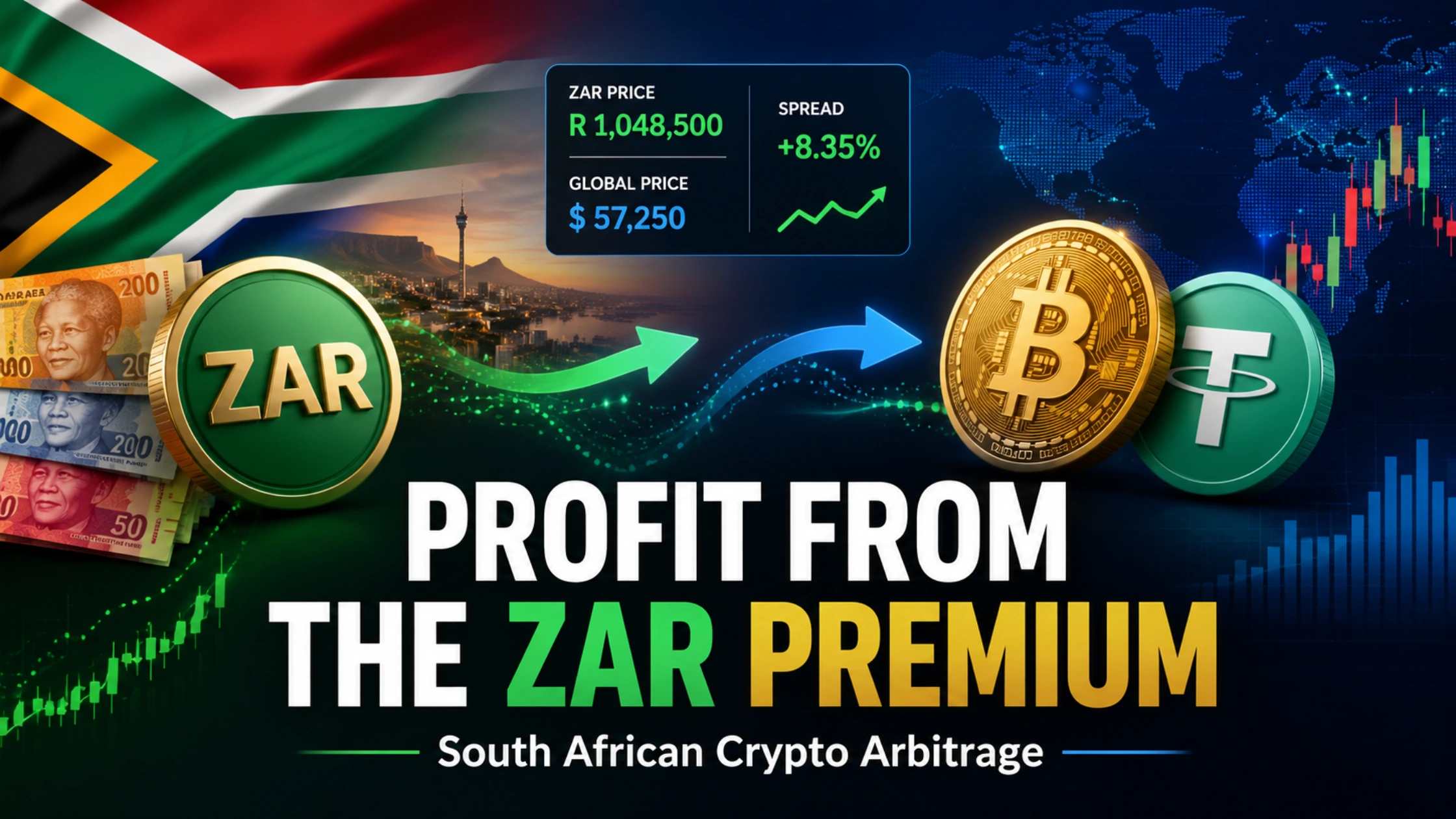
If you’ve ever bought Bitcoin in Johannesburg and noticed the price looked different from what your cousin in London was seeing, you weren’t imagining things. The South African Rand (ZAR) consistently trades at a premium against USD-denominated crypto markets — and that gap is where disciplined traders build real, repeatable profits.
This isn’t about guessing which way Bitcoin moves next. It’s about exploiting a structural inefficiency that has existed for years: the persistent price differential between ZAR-denominated crypto pairs on local exchanges and USD-stablecoin pairs on global platforms.
By the end of this guide, you’ll understand why this premium exists, how to execute the full arbitrage loop safely, and why VALR has become the dominant on-ramp for South African arbitrageurs who need speed, low fees, and reliable ZAR liquidity.
Why Rand-Denominated Pairs Create Arbitrage Windows
The ZAR/crypto premium isn’t random. It’s driven by three structural forces that aren’t going away anytime soon:
Capital Controls and FX Liquidity Constraints
South Africa’s exchange control regulations limit how much ZAR can flow offshore without Reserve Bank approval. While individuals have a R1 million annual discretionary allowance and a R10 million foreign capital allowance, the friction of moving large sums through formal banking channels creates a natural bottleneck. When demand for USD-denominated crypto outstrips the available offshore liquidity, the local price adjusts upward.
This isn’t a bug — it’s a feature of emerging market finance. Similar premiums exist in Nigeria (where the Naira premium can hit 15-20%), Argentina (where the “crypto dollar” trades far above official rates), and Turkey. South Africa’s more sophisticated banking infrastructure keeps the premium tighter — typically 1.5% to 4% — but that spread is still extractable with the right setup.
Local Exchange Liquidity Depth
South African exchanges like VALR process significant ZAR volume, but their order books are naturally thinner than global giants. A R5 million buy order on a BTC/ZAR pair moves the price more than the same notional on Binance‘s BTC/USDT book. This slippage creates the premium on the buy side — and an opportunity on the sell side if you can source cheaper USD-denominated BTC elsewhere.
Demand-Supply Imbalance in the Local Market
South Africa has one of the highest crypto adoption rates in Africa, driven by a combination of tech-savvy youth, distrust of traditional banking (fueled by decades of systemic inequality), and a growing remittance corridor. When local demand spikes — during Rand volatility, political uncertainty, or global crypto bull runs — the premium widens. Arbitrageurs who are already set up can capture this expansion in real time.
The bottom line: The ZAR premium is structural, not speculative. It doesn’t require predicting Bitcoin’s price direction. It requires speed, capital efficiency, and the right exchange infrastructure.
Setting Up Your Local Fiat On-Ramp: Why VALR Dominates for ZAR Arbitrage
Every arbitrage loop starts with ZAR. You need to move South African Rands into the crypto ecosystem fast, cheaply, and reliably. This is where most would-be arbitrageurs get stuck — and where VALR has built a meaningful moat.
Instant ZAR Deposits via Bank Transfer
VALR integrates directly with South Africa’s major banks (Standard Bank, FNB, ABSA, Nedbank, Capitec) through immediate EFT and PayFast rails. Deposits typically clear within minutes during banking hours, and the platform processes them automatically without manual intervention. For arbitrage, speed matters: a 24-hour deposit delay can erase a 2% premium if global markets move against you.
Zero-Fee ZAR Deposits and Competitive Trading Fees
Unlike international exchanges that charge 1-3% for card deposits or SWIFT transfers, VALR offers zero-fee ZAR deposits via bank transfer. Their trading fees start at 0.1% for makers and 0.2% for takers — competitive with global standards and significantly cheaper than legacy local brokers who still charge 1%+ per trade.
For arbitrageurs running volume, these basis points compound. A 2% gross premium becomes 1.7% net after VALR’s fees — still highly attractive on a weekly cycle.
Deep ZAR Liquidity and Tight Spreads
VALR’s BTC/ZAR and ETH/ZAR order books are the deepest in South Africa. On a typical weekday, the BTC/ZAR spread sits between 0.05% and 0.15% — tight enough that you can enter and exit large positions without significant slippage. This matters because arbitrage is a game of precision: you need to know your entry price before you commit capital on the other side of the trade.
Regulatory Compliance and SARS Reporting
VALR is licensed by the Financial Sector Conduct Authority (FSCA) as a financial services provider. This isn’t just a compliance checkbox — it means your ZAR deposits are held in segregated accounts, the exchange undergoes regular audits, and your transaction history is structured for SARS reporting from day one. For arbitrageurs who intend to scale, operating through a regulated local entity reduces long-term regulatory risk.
Pro tip: If you’re new to VALR, use the referral code VAZP2TAW when signing up. New users often receive fee discounts or trading credits that improve your net arbitrage margin in the first 90 days.
International Execution Venues: Where to Source Cheap USD-Stablecoin Crypto
Once you’ve bought crypto with ZAR on VALR, you need a global venue to sell it at a higher USD price — or vice versa, depending on which direction the loop runs. The three platforms that matter for South African arbitrageurs are Binance, KuCoin, and OKX.
Binance: The Liquidity King
Binance processes more daily crypto volume than the next ten exchanges combined. Their BTC/USDT and ETH/USDT order books are impossibly deep — you can move $1 million notional with minimal slippage. For arbitrageurs, this means predictable execution prices.
Binance also offers:
- P2P ZAR trading for direct ZAR/USDT conversion (useful for closing loops without bank transfers)
- Low withdrawal fees on BEP-20 networks (BSC)
- Sub-account architecture for separating arbitrage capital from long-term holdings
The downside: Binance has faced regulatory pressure in multiple jurisdictions. While they remain operational for South African users, keep withdrawal limits and verification tiers in mind. Sign up with referral CPA_00SXKU7IO9 for fee discounts.
KuCoin: The Altcoin Arbitrage Playground
KuCoin lists over 700 trading pairs, including many altcoins that trade at exaggerated premiums on local exchanges. While BTC and ETH arbitrage is competitive, altcoin arbitrage — think SOL, AVAX, MATIC — can yield 3-8% premiums on thin local books.
KuCoin’s strengths for SA arbitrageurs:
- No mandatory KYC for basic trading (though KYC unlocks higher limits)
- KuCoin P2P with ZAR support for direct fiat off-ramping
- Spot-margin and futures markets for hedging directional risk during the transfer window
Use referral code CX8QMK4M when registering.
OKX: The Institutional-Grade Alternative
OKX has invested heavily in its API infrastructure and institutional tooling. For arbitrageurs running automated strategies, OKX’s V5 API offers:
- Unified account mode — spot, margin, futures, and options collateral pooled
- Sub-5ms WebSocket latency from Singapore servers
- Comprehensive portfolio margin for capital-efficient hedging
OKX also supports ZAR P2P trading and has competitive maker fees (0.08%). Sign up with code 2136301 for new-user benefits.
The 3-Step Loop: Buy ZAR → Convert to USDT → Sell on Global Book
Here’s the mechanics of a typical ZAR arbitrage cycle. We’ll use BTC as the example asset, but the same logic applies to ETH, SOL, and other liquid cryptos.
Step 1: Buy BTC with ZAR on VALR
Deposit ZAR via instant EFT on VALR. Place a market or limit buy order on the BTC/ZAR pair. Let’s say you buy 1 BTC at R1,200,000.
Cost basis: R1,200,000 + 0.2% taker fee = R1,202,400
Step 2: Transfer BTC to Your Global Exchange
Withdraw BTC from VALR to your Binance, KuCoin, or OKX deposit address.
Critical consideration: Use the Bitcoin network (on-chain) or a fast L2. On-chain BTC transfers typically confirm in 10-60 minutes depending on network congestion. During this window, the BTC/USD price can move against you. For faster settlement, consider:
- Lightning Network (where supported)
- Wrapped BTC on BSC (if both exchanges support it)
- Stablecoin conversion first — buy USDT on VALR, transfer USDT via TRC-20 (cheap and fast), then buy BTC on the global exchange
Transfer cost: ~R50-200 depending on network and amount
Step 3: Sell BTC for USDT on Global Book
Once your BTC arrives, sell it on the BTC/USDT pair. At a 2.5% ZAR premium, the global BTC price would be equivalent to ~$66,667 (assuming $65,000 spot and ZAR/USD at 18.5 with premium).
Gross proceeds: $66,667 worth of USDT
Step 4: Convert USDT Back to ZAR (Optional)
You now hold USDT. You can:
- Sell USDT for ZAR on VALR’s P2P market (if the premium persists)
- Withdraw USDT to a ZAR-friendly off-ramp like VALR or Luno
- Hold USDT and wait for the premium to widen before converting (carry trade approach)
The Math on a R1.2M Cycle
Table
Line Item | Amount |
ZAR Deposit | R1,200,000 |
VALR Buy Fee (0.2%) | -R2,400 |
Network Transfer | -R150 |
Global Sale (2.5% premium) | +R30,000 equivalent |
Global Exchange Fee (0.1%) | -R1,200 |
P2P/USDT Conversion Spread | -R3,000 |
Net Profit | ~R23,250 (1.94%) |
On a weekly cycle, that’s roughly R93,000/month on R1.2M capital — a 93% annualized return before tax. In practice, premiums fluctuate and not every cycle clears 2%, but the structural opportunity is real.
Tax Implications for SA Residents: SARS Reporting
The South African Revenue Service (SARS) has sharpened its focus on crypto transactions. As of 2026, crypto arbitrage profits are taxable — but how they’re taxed depends on your classification.
Capital Gains vs. Revenue Income
If you execute arbitrage occasionally (fewer than 10 trades per month, holding periods exceeding a few days), SARS may classify your profits as capital gains. The inclusion rate is 40% of the gain, taxed at your marginal rate — effectively a maximum of ~18% on the full gain.
If you’re running arbitrage as a primary or regular income source, SARS will likely classify it as revenue income — taxed at your full marginal rate (up to 45%). This is the default assumption for active arbitrageurs.
What You Need to Track
SARS requires detailed records of:
- Date and time of each trade
- ZAR value of crypto at acquisition and disposal
- Fees and commissions paid (deductible)
- Network transfer costs (deductible)
- Exchange where each leg executed
VALR provides downloadable CSV transaction histories that include timestamps and ZAR valuations. For global exchanges, you’ll need to use a tool like Koinly (code: 243E6A3F) to aggregate and convert USD-denominated trades to ZAR equivalents using SARS’s prescribed exchange rates or daily spot rates.
Provisional Tax Obligations
If your arbitrage profits exceed the tax threshold, you’ll need to register as a provisional taxpayer and make two payments per year (August and February). Failure to do so triggers penalties and interest.
Recommendation: Engage a crypto-specialist accountant early. The cost of professional tax structuring (R5,000-15,000/year) is trivial compared to the cost of a SARS audit or penalties.
Risk Management: What Can Go Wrong and How to Prevent It
Arbitrage is marketed as “risk-free.” It isn’t. Here are the real risks and how to mitigate them.
Slippage and Execution Risk
Your calculated 2% premium can evaporate if:
- VALR’s spread widens during your buy execution
- The global price drops during your transfer window
- Your sell order executes at worse than expected due to thin global books
Mitigation: Use limit orders on both legs. Pre-calculate your minimum viable premium (accounting for all fees) and set alerts. Don’t chase marginal opportunities.
Transfer Time Risk
Bitcoin confirmations take 10+ minutes. Ethereum L1 takes 12+ seconds. During volatile markets, prices can move 1-2% in minutes.
Mitigation:
- Use stablecoin transfers (USDT TRC-20 confirms in ~3 minutes, costs ~$1)
- Consider Lightning Network for BTC
- Hedge directional exposure with a small futures position on Bybit or OKX during the transfer window
Counterparty Risk
Exchanges can freeze withdrawals, experience technical issues, or worse. FTX taught us that even “reputable” platforms can fail.
Mitigation:
- Never keep more than 20% of arbitrage capital on any single exchange
- Withdraw profits to self-custody weekly
- Use hardware wallets like OneKey (code: 46Z9TD) for long-term storage
- Monitor exchange health via proof-of-reserves reports and social sentiment
Regulatory Risk
SARS could change crypto tax treatment. The FSCA could impose new exchange regulations. Capital controls could tighten.
Mitigation: Stay compliant from day one. Use regulated local platforms like VALR. Maintain clean records. The arbitrageurs who survive regulatory shifts are the ones who didn’t cut corners.
Opportunity Cost
Your capital is tied up during the arbitrage loop. If crypto enters a parabolic bull run while your funds are in transit, you miss upside.
Mitigation: Size your arbitrage capital as a fixed percentage of total crypto holdings. Don’t arbitrage with your entire stack — keep core positions in cold storage.
Getting Started: Your First Arbitrage Cycle
Here’s a practical checklist to execute your first loop this week:
- Open and verify accounts on VALR (local ZAR), Binance (global liquidity), and KuCoin (altcoin opportunities). Use the referral codes for fee discounts.
- Deposit a test amount — R10,000 is enough to learn the mechanics without meaningful risk.
- Execute a full loop — Buy BTC on VALR, transfer to Binance, sell for USDT, convert USDT back to ZAR via P2P.
- Time each step — Document deposit speed, transfer confirmation time, and execution slippage.
- Calculate true net profit — Include every fee, spread, and transfer cost. Most beginners overestimate their edge by 30-50%.
- Scale gradually — Only increase capital after 5+ successful loops with consistent profitability.
Final Thoughts
South African crypto arbitrage isn’t a get-rich-quick scheme. It’s a structural market inefficiency that rewards capital, speed, and discipline. The ZAR premium has existed for years and will likely persist as long as South Africa maintains exchange controls and a vibrant local crypto market.
The traders who profit consistently aren’t the ones with the best predictions — they’re the ones with the best infrastructure. VALR for fast ZAR on-ramps. Binance, KuCoin, and OKX for deep global liquidity. And a relentless focus on shaving basis points off every cost in the loop.
The premium is there. The tools are available. The only question is whether you’ll build the system to capture it.
Ready to start? Open your VALR account today for zero-fee ZAR deposits and instant EFT clearing. Use referral code VAZP2TAW to unlock new-user trading benefits.
Disclaimer: This article is for educational purposes only and does not constitute financial or tax advice. Crypto arbitrage involves real risks including capital loss, exchange failure, and regulatory changes. Consult a qualified financial advisor before deploying capital.