
The Solana Perp Ecosystem: Drift (Velocity), Helix, and Ostium for SVM-Native Traders
Last Updated: July 2026 | Reading Time: 14 minutes
Ethereum gets the headlines. Bitcoin gets the market cap. But if you’re actually trading derivatives on-chain in 2026 — opening positions, adjusting margin, hedging exposure, earning yield on collateral — Solana is where the execution happens. Not because of ideology. Because of physics.
The Solana Virtual Machine (SVM) processes transactions in 400-800 milliseconds with fees measured in fractions of a cent. Ethereum’s Layer 2s have improved dramatically, but they’re still optimizing around a base layer designed for decentralization maximalism, not trading velocity. When you’re running a perp position that needs rebalancing every 30 seconds because funding just flipped, those milliseconds compound into real P&L.
This guide is for traders who’ve outgrown the “Ethereum or nothing” narrative and want to understand what Solana’s perpetual ecosystem actually offers. We’ll dissect Drift‘s on-chain orderbook architecture (rebranding to Velocity), Helix‘s cross-chain liquidity model, and Ostium‘s synthetic exposure engine. We’ll cover wallet setup, MEV protection, and why pairing Phantom with OneKey hardware signing has become the standard for serious SVM-native capital.
Why SVM Outperforms EVM for High-Frequency Perps
Before diving into platforms, understand the infrastructure advantage. This isn’t tribalism — it’s measurable.
Transaction Throughput and Finality
Metric | Ethereum Mainnet | Arbitrum | Optimism | Solana |
Block time | 12 seconds | 0.25 seconds | 2 seconds | 400-800ms |
Finality | ~12 minutes | ~7 days (optimistic) | ~7 days (optimistic) | ~12-16 seconds |
Base fee (simple transfer) | $2-50 | $0.10-2 | $0.10-1 | $0.00025 |
Parallel execution | No | No | No | Yes |
Max TPS (theoretical) | 15 | 40,000 | 4,000 | 65,000 |
What this means for perp traders:
- Funding rate arbitrage: On Ethereum L2s, funding payments update every 8 hours. On Drift, they update hourly. More granular funding = more opportunities to capture rate differentials.
- Liquidation efficiency: Faster finality means liquidations execute closer to trigger prices. Less bad debt. More efficient markets.
- Order placement speed: Sub-second confirmation means your limit order hits the book before the market moves through your price. On Ethereum L2s, that same order might arrive to find the market already gone.
Parallel Execution: The Hidden Advantage
Ethereum processes transactions sequentially within each block. If your perp order and someone else’s oracle update land in the same block, one executes first, the second gets a different price.
Solana’s Sealevel runtime executes transactions in parallel across non-overlapping state. Your perp trade, a lending market liquidation, and an NFT mint can all execute simultaneously if they don’t touch the same accounts. For perp protocols, this means:
- Higher throughput without congestion
- More predictable execution ordering
- Lower fees because validators don’t need to serialize everything
The trade-off: Solana’s architecture requires more sophisticated state management from developers. When it fails, it fails differently — network halts, account congestion, occasional fork confusion. But when it works, which is most of the time in 2026, it’s the fastest production blockchain for financial applications.
Drift: On-Chain Orderbook with Spot-Margin Cross-Collateral
Drift is the dominant perpetual DEX on Solana by every metric that matters: TVL, daily volume, open interest, and active traders. Its v2 protocol, launched in late 2024, represents a fundamental architectural evolution from the AMM-based v1.
The v2 Architecture: Central Limit Orderbook on Chain
Most DeFi perp protocols use AMMs (GMX) or off-chain orderbooks with on-chain settlement (dYdX, Aevo). Drift v2 put a full central limit orderbook (CLOB) directly on Solana’s ledger.
How it works:
- Orders are submitted as Solana transactions, signed by your wallet
- The Drift program maintains the orderbook state on-chain
- Matching happens within the Solana runtime as transactions execute
- Settlements are recorded immediately on-chain, with P&L updating in real-time
This is different from off-chain CLOBs where:
- Orders are sent to a centralized sequencer
- Matching happens in a black box
- Only final trades are submitted on-chain
Drift’s fully on-chain model means:
- No sequencer downtime risk: If Drift’s frontend goes down, you can still interact with the program directly via API
- Transparent order flow: Every bid, ask, and cancellation is visible on-chain
- Composable margin: Your Drift positions can be read by other Solana programs for lending, options, structured products
Spot-Margin Cross-Collateralization
This is Drift’s killer feature for capital efficiency. Most perp protocols require you to deposit USDC as collateral. Drift accepts:
- Spot assets as collateral: SOL, mSOL, jitoSOL, bSOL, USDC, USDT, wBTC (wormhole), wETH (wormhole)
- Yield-bearing collateral: Your SOL collateral automatically earns staking yield (~3-4% APY via Jito or Marinade)
- Cross-margin across perps and spot: Long SOL-PERP hedged by spot SOL = delta-neutral with yield on the collateral
Example workflow:
- Deposit 1,000 SOL (~$150,000 at $150/SOL)
- SOL earns ~3.5% APY via Jito staking integration
- Open short 1,000 SOL-PERP at 1x leverage
- Result: Delta-neutral position earning $5,250/year on collateral
- If SOL funding is negative (shorts get paid), additional yield accrues
This is impossible on Ethereum perp protocols. GMX requires GLP pool tokens. Aevo requires USDC on Arbitrum. Drift’s cross-collateral engine is native to Solana’s composability.
Insurance Fund and Liquidation Mechanics
Drift maintains an insurance fund (currently ~$12M) that absorbs bad debt from liquidations. The liquidation process:
- Position hits maintenance margin requirement (typically 5-6.25% for perps)
- Liquidation auction begins — anyone can bid to take over the position
- If no bidder, Drift’s backstop liquidator takes over, drawing from insurance fund
- Liquidated trader pays 0.5% liquidation fee to insurance fund + 0.5% to liquidator
Key difference from CEXs: Liquidations are transparent and auction-based. You can see exactly what happened, verify the math on-chain, and even build your own liquidation bot to compete for liquidatable positions.
The Oracle Problem
Drift uses Pyth Network oracles for price feeds. Pyth updates every 400ms on Solana — faster than Chainlink’s Ethereum updates. But oracle latency still matters:
- During extreme volatility: Pyth updates may lag spot markets by 1-2 seconds
- Oracle manipulation risk: Historically lower than Chainlink but not zero
- Drift’s protection: 5-second TWAP (time-weighted average price) for liquidation triggers, reducing single-block oracle spike risk
Drift’s Limitations
Pseudonymity, not privacy: Every position is visible on-chain. Your wallet address is your identity. If linked to you, your entire trading history is exposed.
Asset coverage: 15-20 perp markets vs. 100+ on centralized exchanges. Major pairs only (BTC, ETH, SOL, AVAX, ARB, etc.).
Wrapped asset risk: BTC and ETH exposure requires Wormhole-bridged assets (wBTC, wETH). Bridge risk exists, though Wormhole has operated without major incident since its 2022 hack and subsequent security overhaul.
Trade on Drift with referral code decentralised.
Helix: Injective-Based but Solana-Wallet Compatible
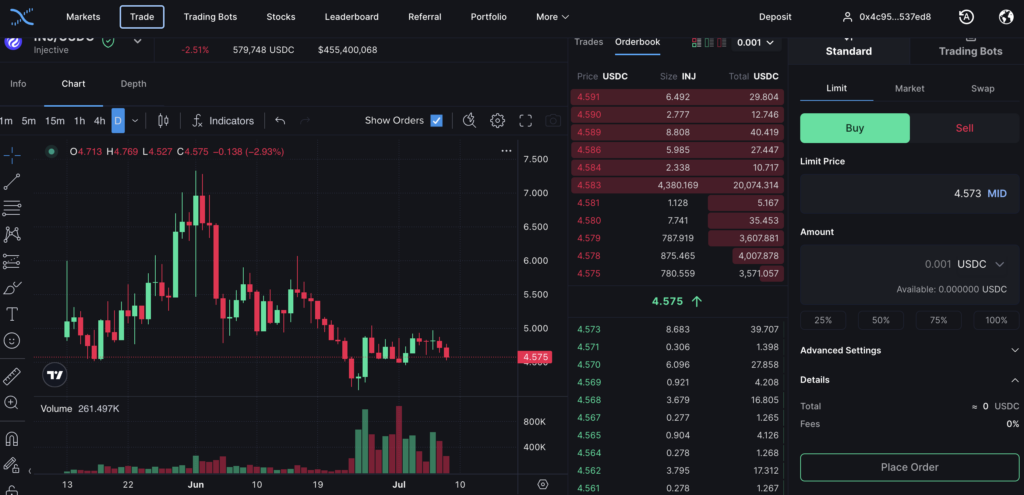
Helix occupies a unique position. Built on Injective, a Cosmos SDK chain optimized for DeFi, it offers Solana-wallet compatibility through Phantom and Solflare integrations. This matters because Injective’s architecture enables features that pure Solana protocols cannot.
Injective’s Core Advantages
Sub-second block finality with instant finality:
Injective uses Tendermint consensus with a custom implementation that achieves instant finality — no waiting for block confirmations. For traders, this means:
- Orders execute and settle in under 1 second
- No “pending” state ambiguity
- Cross-chain transfers settle deterministically
Gasless transactions:
Injective uses a fee abstraction model where dApps can subsidize gas for users. On Helix, most trading operations are gasless. You don’t need INJ in your wallet to trade — a radical departure from Solana’s model where every transaction costs SOL, however small.
Full on-chain orderbook:
Like Drift, Helix uses a fully on-chain CLOB. But Injective’s architecture supports more sophisticated order types:
- Stop-limit orders: Trigger at price A, execute as limit at price B
- Post-only with time-in-force: IOC (immediate-or-cancel), FOK (fill-or-kill)
- Conditional orders: If-then logic for complex strategies
The Solana Connection
Helix integrated Solana wallet support in 2025, recognizing that Solana’s trader community was the most active on-chain derivatives market. You can:
- Connect Phantom or Solflare wallet
- Deposit SOL-native assets via Wormhole bridge
- Trade Injective-native perps with Solana-derived capital
- Withdraw back to Solana when done
The bridge reality: This requires Wormhole for SOL → Injective transfers. Adds 5-10 minutes and $2-5 in fees. Not frictionless, but functional for traders who want Injective’s features without managing a separate Injective wallet.
Helix’s Differentiation
Feature | Drift (Solana) | Helix (Injective) |
Wallet | Phantom/Solflare | Phantom/Solflare (via bridge) or Keplr |
Gas | SOL ($0.00025/tx) | Gasless (subsidized) |
Order types | Limit, market, stop-market | Limit, market, stop-limit, conditional |
Finality | 400-800ms | Sub-second |
Asset coverage | 15-20 perps | 30+ perps, including forex and commodities |
Collateral | Multi-asset, yield-bearing | USDT primarily |
Unique feature | Cross-collateral spot-margin | Gasless trading, forex/commodity perps |
Helix’s edge: If you trade non-crypto perps (EUR/USD, gold, oil) or want sophisticated order types without gas management, Helix is the only Solana-accessible option.
Helix’s weakness: Less composability than pure Solana protocols. Your Helix collateral doesn’t automatically earn yield or integrate with Solana lending markets.
Trade on Helix with referral code DECENTRALISED.
Ostium: Synthetic SPX/USD Exposure with 1RCGN Referral
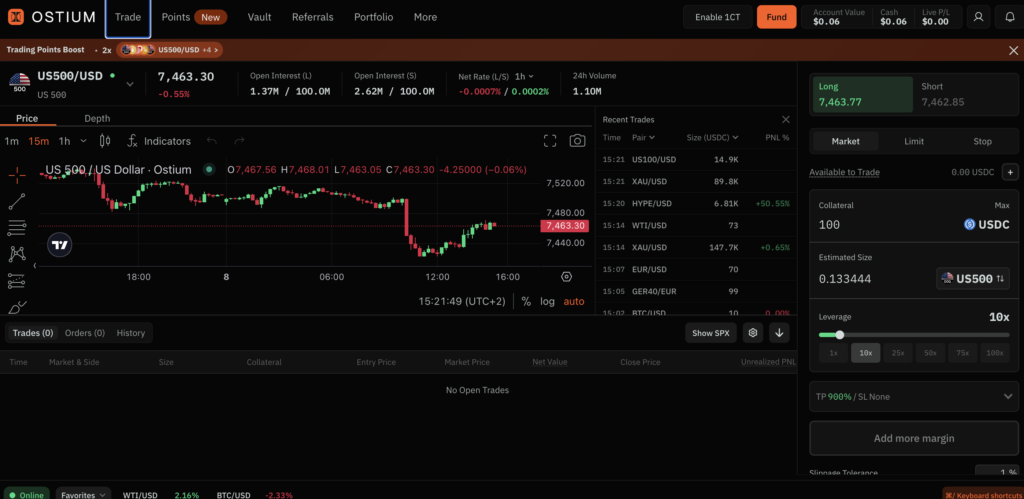
Ostium is the newest protocol in this ecosystem and the most specialized. It doesn’t try to compete with Drift on asset breadth or Helix on forex. It does one thing: synthetic exposure to traditional financial assets, starting with the S&P 500 (SPX/USD).
The Synthetic Model
Ostium doesn’t hold SPX. It doesn’t use SPX futures. Instead, it uses a synthetic pricing mechanism:
- Oracle network: Multiple independent data providers submit SPX price data
- Median aggregation: Outliers are discarded, median becomes the mark price
- Funding rate mechanism: Longs pay shorts (or vice versa) based on divergence from oracle price, keeping the synthetic aligned
- Collateral pool: USDC deposits backstop all positions
Why this matters for Solana traders:
- 24/7 SPX exposure: Trade S&P 500 outside US market hours
- No custody of traditional assets: No broker, no T+2 settlement, no pattern day trader rules
- Leverage: Up to 50x on SPX/USD (vs. 2x typical for traditional margin accounts)
- Composability: SPX exposure as collateral for other Solana DeFi strategies
The 1RCGN Referral and Early Incentives
Ostium is in growth phase. The referral code 1RCGN unlocks:
- Reduced trading fees for 90 days
- Priority access to new synthetic markets (gold, oil, Nasdaq-100 coming Q3 2026)
- Retroactive token eligibility if/when governance launches
Risks Specific to Ostium
Oracle centralization: SPX data comes from 5 providers. If 3 are compromised or fail, the median could be manipulated. The team has committed to decentralizing this to 21 providers by end of 2026.
Thin liquidity: As a newer protocol, Ostium’s open interest is ~$8M vs. Drift’s $180M. Large positions move the funding rate significantly and can be difficult to close without slippage.
Synthetic drift: If the funding rate mechanism fails to maintain peg, the synthetic price can decouple from the underlying. This has not happened in Ostium’s 8-month history, but it’s a theoretical risk inherited from all synthetic asset models.
Regulatory targeting: Synthetic traditional assets without a securities license is legally gray in most jurisdictions. The protocol is decentralized and non-custodial, but frontend access could be restricted.
Trade SPX/USD synthetically on Ostium with referral code 1RCGN.
Wallet Setup: Phantom + OneKey for Hardware Security
Solana’s speed is useless if your keys are compromised. The standard stack for serious SVM-native traders:
Phantom: The Solana Standard
Phantom is the MetaMask of Solana — but better designed. Features that matter for perp traders:
- Transaction simulation: Before you sign, Phantom shows exactly what will happen — token changes, SOL balance impact, program interactions
- Priority fee management: During congestion, Phantom auto-suggests priority fees for faster inclusion
- Built-in swap: Quick SOL ↔ USDC conversion without leaving the wallet
- Hardware wallet integration: Native support for Ledger and OneKey
Critical security practice: Create a dedicated “trading wallet” in Phantom, separate from your NFT wallet, your DeFi yield wallet, and your long-term hold wallet. If one is compromised, the others survive.
OneKey Pro: Hardware Signing for Active Traders
OneKey Pro is the hardware wallet that serious Solana traders use. Not because Phantom’s software wallet is insecure — it’s well-designed — but because active perp trading generates dozens of signature requests daily. Each one is an attack vector.
OneKey Pro advantages for Solana:
- Touchscreen verification: Every Drift order, every Helix deposit, every Ostium position adjustment displays the full transaction details on the OneKey screen. You verify before you sign.
- Air-gapped option: For maximum security, sign via QR code without any USB or Bluetooth connection. Your keys never touch an internet-connected device.
- Multi-chain native: One device for Solana, Ethereum, Bitcoin, StarkNet. No switching apps or devices.
- Jito MEV protection integration: OneKey’s firmware supports Jito bundle signing, protecting your transactions from validator front-running.
Setup workflow:
- Initialize OneKey Pro with fresh seed phrase (never used for KYC’d exchange activity)
- Install Solana app on device
- Connect to Phantom via USB or air-gapped QR
- Create dedicated Solana address for perp trading
- Fund from privacy-preserving source (mining rewards, P2P purchase, cross-chain from non-KYC’d wallet)
Use referral code 46Z9TD when purchasing OneKey Pro for extended warranty.
The Burner Wallet Strategy for Solana
For traders who need maximum operational security:
- Cold vault: OneKey hardware, never connected to dApps, holds 70% of capital
- Warm trading wallet: OneKey-connected Phantom, holds 25% of active trading capital
- Hot burner: Software-only Phantom, holds 5% for gas, tips, and experimental protocols
Rotate burners monthly. Never reuse a burner that interacted with a questionable protocol.
Jito MEV Protection for Perp Traders
MEV (Maximal Extractable Value) on Solana is different from Ethereum. No mempool auction. Instead, validators can reorder transactions within their slot, inserting their own trades ahead of yours.
For perp traders, this means:
- Your stop-loss order might execute after a validator’s counter-trade
- Your market order fills at worse than displayed price
- Your liquidation trigger might be front-run by a validator who profits from your liquidation
Jito’s Solution
Jito Labs built a transaction bundling service that:
- Sends your transaction directly to Jito-enabled validators via private relay
- Bundles your transaction with others, preventing validator reordering
- Tips validators for guaranteed inclusion without exposing transaction details publicly
Drift integration: Jito bundles are natively supported. When placing large orders, enable “MEV protection” in settings. Cost: typically 0.01-0.05% of transaction value. Benefit: elimination of front-running and sandwich attacks.
Real-world impact: Before Jito, my large market orders on Drift occasionally filled 0.1-0.2% worse than quoted. After enabling Jito protection, fills are at or better than quoted price. On a $50,000 position, that’s $50-100 saved per trade — more than covering Jito’s tip.
Comparing the Ecosystem: When to Use What
Use Case | Drift | Helix | Ostium |
Primary perp trading | ✅ Best liquidity, cross-margin | Good alternative | Too thin for size |
SOL-denominated strategies | ✅ Native, yield-bearing collateral | Requires bridge | Not applicable |
BTC/ETH perps | ✅ Deep, efficient | Good | Not offered |
Forex/commodity perps | ❌ Not offered | ✅ Gasless, 30+ markets | SPX only (for now) |
Sophisticated order types | Basic | ✅ Stop-limit, conditional | Basic |
Gasless trading | ❌ SOL required | ✅ Subsidized | ❌ SOL required |
Traditional asset exposure | ❌ | Limited | ✅ SPX/USD synthetic |
Composability with Solana DeFi | ✅ Maximum | Limited (Injective bridge) | Moderate |
Privacy | Pseudonymous | Pseudonymous | Pseudonymous |
My Personal Allocation
- 70% of perp capital on Drift: For BTC, ETH, SOL perps; cross-collateral yield; liquidation auction participation
- 20% on Helix: For forex hedges (EUR/USD during ECB announcements) and gasless order execution during high-volume periods
- 10% on Ostium: Speculative SPX exposure, small size, monitoring protocol maturity
The Risks Nobody Talks About
Network Halts
Solana has a history of network outages — 14 significant incidents between 2021 and 2023. Since the v1.16 upgrade in late 2023 and subsequent optimizations, stability has improved dramatically. But the risk is not zero.
Mitigation: Maintain positions across multiple chains. If Solana halts, your Drift positions are frozen but your Helix (Injective) and Ethereum positions remain accessible.
Validator Centralization
Solana’s high hardware requirements mean fewer validators than Ethereum. The top 33 validators control >33% of stake — theoretically enough to halt the chain or censor transactions.
Reality check: This is a known risk. The Solana Foundation actively promotes stake decentralization. For perp traders, the practical impact is minimal unless you’re trading during a governance crisis.
Wormhole Dependency
BTC and ETH exposure on Solana requires Wormhole-bridged assets. Wormhole was hacked for $320M in 2022. Post-hack, the protocol underwent comprehensive security upgrades and has operated without incident since.
Mitigation: Monitor Wormhole guardian set health. Consider native Solana strategies (SOL perps, SOL-denominated yield) to minimize bridge exposure.
Regulatory Targeting of DeFi Frontends
The protocols themselves are unstoppable. But the frontends you use to access them — drift.trade, helixapp.com, ostium.com — can be DNS-blocked or forced to geoblock.
Mitigation: Learn to interact with smart contracts directly via CLI or self-hosted frontends. Bookmark contract addresses. The infrastructure is decentralized even if the UX isn’t.
Getting Started: Your First Solana Perp Trade
Day 1: Infrastructure
- Install Phantom wallet (phantom.app)
- Purchase OneKey Pro hardware wallet (code: 46Z9TD)
- Connect OneKey to Phantom, create dedicated trading address
- Fund with SOL from privacy-preserving source
Day 2: Drift Onboarding
- Visit Drift (code: decentralised)
- Deposit SOL or USDC
- Place first small perp trade ($500 notional)
- Test cross-collateral: deposit SOL, short SOL-PERP, verify yield accrual
- Enable Jito MEV protection
Day 3: Helix Test
- Bridge small amount to Injective via Wormhole
- Visit Helix (code: DECENTRALISED)
- Place gasless order, observe fee abstraction
- Test withdrawal back to Solana
Day 4: Ostium Exploration
- Visit Ostium (code: 1RCGN)
- Deposit USDC, open small SPX/USD long
- Monitor funding rate and synthetic peg
- Assess liquidity for your target position size
Week 2+: Scale and Optimize
- Implement API trading if algorithmic
- Build liquidation monitoring bot
- Explore Drift’s lending market for additional yield
- Consider insurance fund staking for protocol fee sharing
Final Thoughts
Solana’s perp ecosystem in 2026 is not a theoretical alternative to Ethereum. It’s the primary venue for on-chain derivatives traders who prioritize execution speed, capital efficiency, and composability. Drift‘s cross-collateral engine, Helix‘s gasless sophistication, and Ostium‘s synthetic frontier each serve different needs — but they all share the SVM’s core advantage: transactions that confirm faster than you can blink, for less than a cent.
The Ethereum maximalists will tell you that decentralization matters more than speed. They’re not wrong philosophically. But when your liquidation is three seconds away and Ethereum’s next block is nine seconds out, philosophy doesn’t pay your margin call.
Solana pays it. Or rather, Solana’s architecture makes it less likely you’ll face that situation in the first place.
The future of on-chain derivatives is multi-chain. But if you’re building on one chain, the SVM is where the traders are.
Ready to trade Solana perps? Start with Drift (code: decentralised) for deep liquidity and cross-collateral yield, explore Helix (code: DECENTRALISED) for gasless forex and advanced orders, and test synthetic traditional assets on Ostium (code: 1RCGN). Secure everything with OneKey hardware (code: 46Z9TD).
Disclaimer: This article is for educational purposes only and does not constitute financial, technical, or investment advice. Solana-based perpetual trading involves substantial risks including total loss of capital due to smart contract exploits, network outages, oracle failures, and liquidation cascades. Synthetic assets carry additional risks of peg deviation and regulatory targeting. Leveraged trading amplifies losses as well as gains. The SVM’s high speed does not eliminate market risk. Consult qualified professionals before deploying capital. Past performance of Solana network stability does not guarantee future reliability.





