
What Is Risk Parity and How Do I Apply It to Crypto? The DN Risk-Parity Allocator for 2026
The allocation method hedge funds use to stop one volatile asset from dominating a portfolio's risk, now in two clicks, for crypto and beyond.
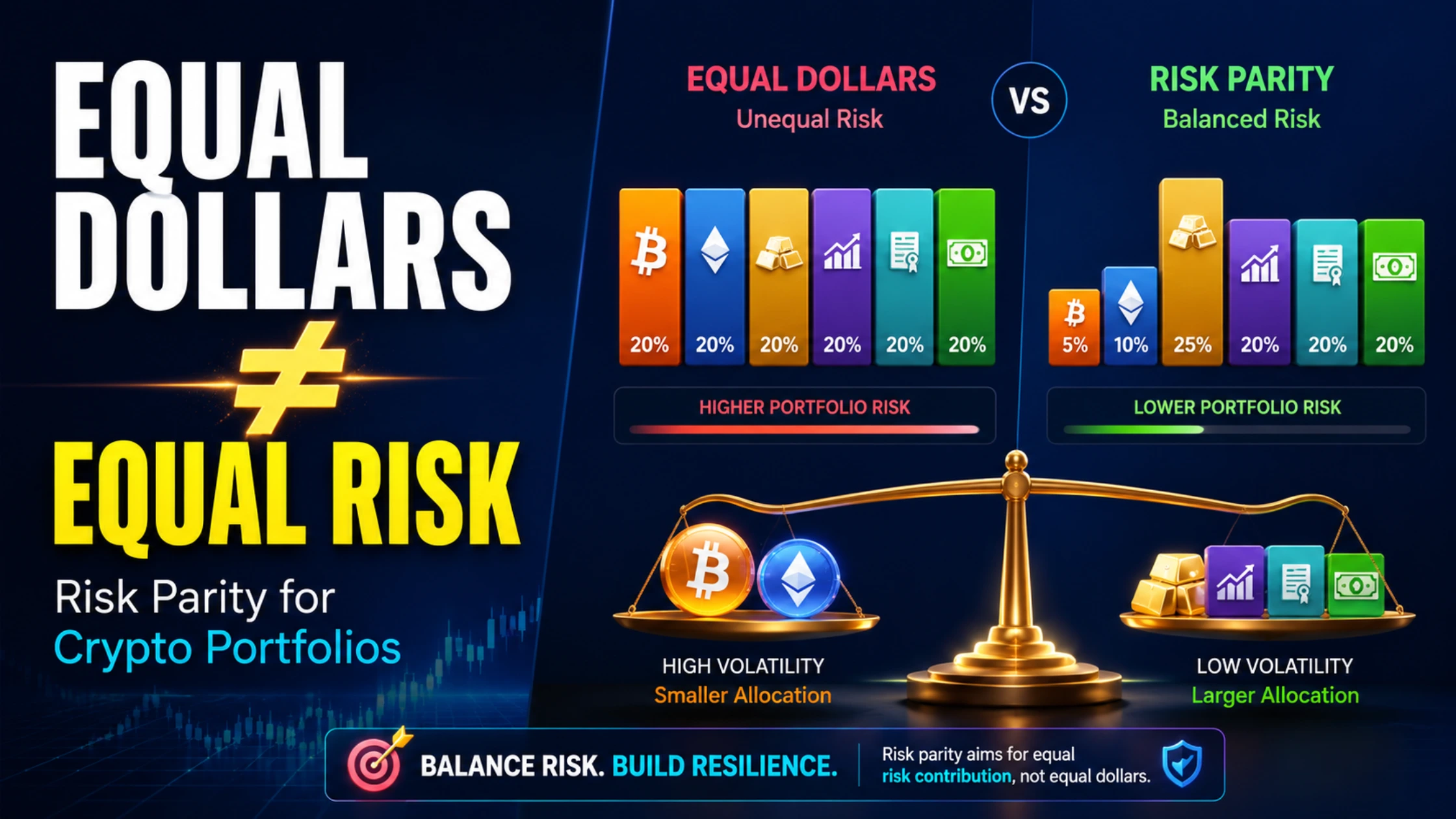
Risk parity is a portfolio method that allocates capital so each holding contributes the same amount of risk, rather than the same number of dollars. Because a volatile asset like Bitcoin carries far more risk per dollar than gold or bonds, an equal-dollar portfolio is secretly dominated by its most volatile holding. The simplest way to apply risk parity is inverse-volatility weighting: give each asset a weight proportional to one divided by its volatility, so lower-volatility assets get more dollars and higher-volatility assets get fewer. The allocator below builds this for any mix of crypto and traditional assets, shows that every holding then carries equal risk, and reports the DN Risk Concentration (how much of your total risk sits in one asset) before and after.
Most portfolios are built by dividing money evenly, or by gut feel, across a handful of assets. It feels balanced. It is not. If you split your capital equally between Bitcoin and gold, you have not built a balanced portfolio; you have built a Bitcoin portfolio with a gold garnish, because Bitcoin's volatility is several times gold's, and volatility is what actually drives your returns up and down. The dollars are equal, but the risk is wildly lopsided, and the day Bitcoin moves, your whole portfolio moves with it while the gold barely registers.
Risk parity is the institutional answer to this, the framework behind some of the largest funds in the world. Instead of equalizing dollars, it equalizes risk, sizing each position so that no single asset dominates the portfolio's fate. The method sounds complex, but its simplest and most robust form needs only one number per asset, its volatility, and a single line of arithmetic. This allocator does that arithmetic, for crypto alone or crypto blended with gold, equities and bonds, and shows you the result that equal-dollar investing hides.
…
Equal dollars is not equal risk
The hidden flaw in equal-dollar investing is that risk does not come in equal-sized units. A dollar in a low-volatility asset like bonds or gold contributes a small, steady amount of movement to your portfolio; a dollar in a high-volatility asset like a small-cap altcoin contributes many times more. When you split capital evenly, you are handing the volatile assets a megaphone and the calm ones a whisper. The portfolio's day-to-day fate, its drawdowns and its sleepless nights, are dictated almost entirely by the loudest one or two holdings.
The allocator makes this concrete with the DN Risk Concentration figure, the share of your total portfolio risk borne by its single largest contributor. In a typical equal-dollar mix of crypto and traditional assets, that number is often forty percent or more, meaning one asset alone drives nearly half your risk while you believed you were diversified across four or five. Diversification measured in dollars is an illusion; diversification measured in risk is the real thing, and the two are rarely the same portfolio.
The parity method
Risk parity fixes the imbalance by flipping the sizing logic. Instead of asking "how much money should each asset get?", it asks "how much risk should each asset contribute?" and answers: an equal amount. The simplest way to achieve this is inverse-volatility weighting, where each asset's weight is set proportional to one divided by its volatility. Calm assets, with low volatility, receive a large dollar weight; volatile assets receive a small one. The effect is that the product of weight and volatility, the rough measure of how much risk each position contributes, comes out the same for every holding.
risk contribution of i ∝ weight × volatility = equal for every asset
The allocator shows this directly in the risk-contribution strip: after applying parity, every asset's coloured segment is the same width, the visual proof that each now carries an equal share of the portfolio's risk. This is the genuine institutional method in its most transparent form. It uses only volatility, the most reliable and stable property of an asset, and it avoids the fragile guesswork of trying to forecast returns. The most sophisticated funds extend it with the full correlation matrix, but the inverse-volatility core captures the great majority of the benefit with none of the opacity.
The allocation
Reading the result often surprises people. A risk-parity portfolio that includes crypto will hold a relatively small dollar slice of Bitcoin and an even smaller one of any altcoin, with much larger weights in gold, equities or bonds if you include them. That is not a verdict that crypto is bad; it is the arithmetic of equal risk. Because crypto is so volatile, a small position contributes as much risk as a large position in a calm asset, so a small position is all parity needs. You still get full exposure to crypto's risk and return engine, just sized so it does not silently run the whole show.
The risk-appetite control then scales the whole thing to the level of volatility you can actually stomach. It sets a target portfolio volatility and holds the balance in cash, dialing the invested sleeve up or down to hit that target. This is why a pure-crypto risk-parity portfolio aiming for moderate volatility will hold a large cash buffer: crypto is simply too volatile to be fully invested at a low risk target, and the tool tells you that honestly rather than pretending otherwise. Adding traditional assets lowers the blended volatility and lets more of your capital stay invested for the same risk.
Execution and rebalancing
An allocation is only theory until it is built and maintained. Translate the percentages into positions on an exchange, buying each asset to its target weight and parking the cash buffer in a stable, liquid form. The crypto sleeve can be acquired and held on a major exchange; the traditional-asset weights, where you include them, belong in whatever brokerage or vehicle you already use. The point is to get the real portfolio to match the risk-balanced target, not to chase the exact decimal.
Risk parity is not set-and-forget, because volatilities drift and prices move the weights away from target over time. As an asset rises, it grows beyond its risk-balanced weight and quietly reintroduces the concentration you removed, so periodic rebalancing back to the parity weights is what keeps the portfolio honest. This is the natural home for automation: a portfolio bot can hold target weights and rebalance on a schedule or on drift thresholds without you watching the screen. Re-run the allocator whenever volatilities have changed materially, reset your targets, and let the rebalancing do the unglamorous work that makes the method actually pay off.
Frequently asked questions
What is risk parity and how do I apply it to crypto?
Risk parity allocates capital so each asset contributes equal risk, not equal dollars. To apply it to crypto, weight each asset by one divided by its volatility: because crypto is highly volatile, it receives a smaller dollar weight than calmer assets like gold or bonds, so no single coin dominates your risk. The allocator above does this for any mix of assets and shows the resulting balanced allocation and risk contributions.
What is the DN Risk Concentration?
It is Decentralised News's measure of how much of your total portfolio risk sits in a single asset, the risk share of your largest contributor. A high figure (often 40%+ in equal-dollar portfolios) means you are far less diversified than the dollar split suggests. Risk parity drives this number down toward an equal share per asset, which the tool shows before and after.
Why does my crypto get such a small weight?
Because it is volatile. Risk parity sizes positions by risk, and a small crypto position contributes as much risk as a much larger position in a calm asset. The small weight still gives you full exposure to crypto's risk and return; it simply stops crypto from secretly dominating the entire portfolio. It is a feature of the method, not a judgement on the asset.
Why does the tool hold so much cash?
The risk-appetite setting targets a level of portfolio volatility and holds cash to hit it without leverage. Crypto is so volatile that a pure-crypto portfolio must hold a large cash buffer to reach a moderate risk target. Including lower-volatility assets like bonds or gold reduces the blended volatility and lets more of your capital stay invested for the same risk.
Is inverse-volatility weighting real risk parity?
It is the standard simplified form, and it equalises risk contributions exactly when assets share similar correlations. Full risk parity also incorporates the correlation matrix between assets, which can shift weights further, but inverse-volatility captures most of the benefit transparently and is what most practical risk-parity calculators use. The tool is explicit about this simplification.
How often should I rebalance a risk-parity portfolio?
Periodically, because price moves push assets away from their risk-balanced weights and reintroduce concentration over time. Common approaches are calendar-based (monthly or quarterly) or drift-based (when a weight strays beyond a threshold). Re-run the allocator when volatilities have changed materially, and consider a portfolio bot to automate the rebalancing.
This tool and article are for educational and informational purposes only and do not constitute financial or investment advice. The allocator uses inverse-volatility weighting, a simplified form of risk parity, with representative and editable volatility inputs; it does not incorporate the full correlation matrix and its blended-risk figure is a conservative approximation. Outputs are illustrative and depend entirely on the inputs you provide. Asset volatilities change over time and past volatility does not predict future risk or return. Cryptocurrency is highly volatile and high-risk. Always do your own research and consider consulting a licensed financial professional. Decentralised News may earn a commission from services linked here at no additional cost to you.





