Real-World Assets | Tokenization | June 2026
The Redemption Friction Index: What "24/7 On-Chain Liquidity" Doesn't Tell You About Tokenized Treasury Funds
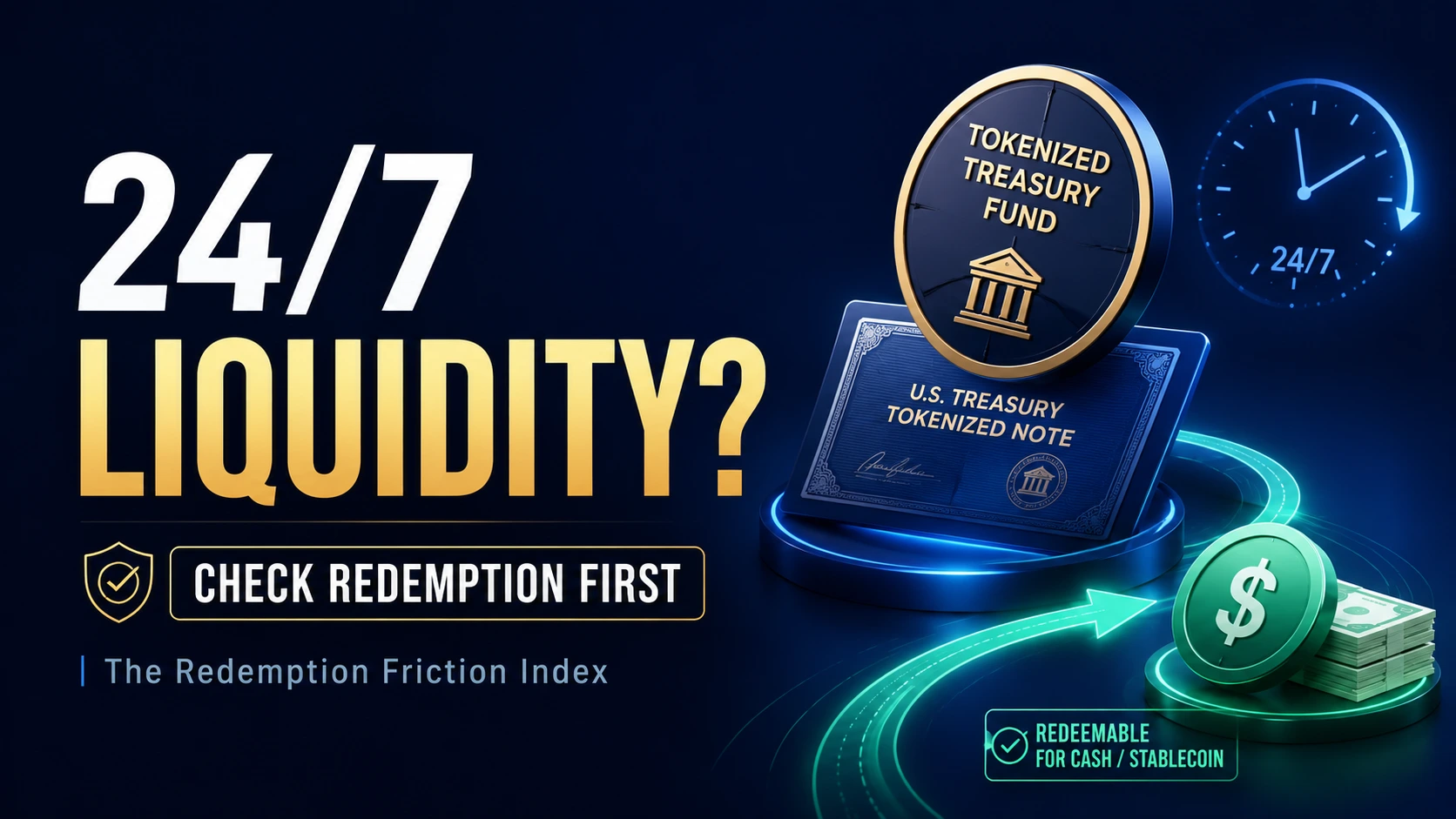
The tokenized Treasury fund category crossed $7 billion in on-chain assets in early 2026, and nearly every product in it markets itself on some version of "24/7 instant liquidity." That phrase describes the blockchain settlement layer, not the actual mechanics of converting a token back into cash, and the gap between the two is large, structural, and almost never disclosed in marketing copy. BlackRock's BUIDL fund, the category's $2.5 billion leader, has two entirely different redemption paths under the same fund: a native path through Securitize with a $250,000 minimum and a daily 3:00 p.m. cutoff that ultimately depends on BlackRock selling underlying Treasuries in the traditional market, and a Circle-built instant path that pays out USDC immediately but draws from a separate, finite reserve pool that Circle must periodically replenish by redeeming BUIDL itself through the slower native path. Ondo's OUSG offers genuine 24/7 instant redemption to USDC, but caps instant capacity at $50 million globally per 24-hour period, after which redemptions fall back to standard settlement. Ondo's USDY markets a $500 minimum that sounds maximally retail-accessible, while the token itself cannot be minted into a transferable form until 40 to 50 days after the initial deposit, a friction point that exists before redemption even becomes possible. Franklin Templeton's BENJI, by contrast, offers a $20 minimum with no redemption fee and processes redemptions daily through a 1940 Act-registered mutual fund structure, trading instant-settlement speed for genuine regulatory simplicity. This article forensically compares the actual redemption mechanics of seven major tokenized Treasury products against their marketed liquidity claims and introduces the DN Redemption Friction Index, a scoring framework built from each issuer's own documentation rather than its marketing language.
Every tokenized Treasury fund's homepage says some version of the same thing: instant, 24/7, on-chain liquidity. The category has grown from roughly $850 million two years ago to more than $7 billion in assets today specifically because that promise is genuinely compelling against a traditional money market fund's cutoff times and settlement delays. The promise is also, in the literal sense, true about exactly one part of the product: the token itself can move between wallets at any hour, on-chain, without asking anyone's permission. What that promise quietly elides is whether converting that token back into cash, the only moment the promise is actually tested, works the same way.
It usually doesn't, and the gap between the two is not a minor technicality. It is the single most consequential fact about any tokenized RWA product for an institutional treasury manager deciding how much of a balance sheet to park in one, and it is reliably the fact that does not appear in the first three paragraphs of any product's marketing page. This article reads the actual redemption documentation, not the marketing copy, for seven of the category's largest products, and the result is a comparison that the category's own TVL and yield rankings, which dominate existing RWA coverage, never surface.
"Redemption mechanics matter more than headline yield."
— Eco Support, tokenized Treasury fund comparison methodology, May 2026.The Same Fund, Two Redemption Products: BlackRock's BUIDL
BUIDL is the clearest demonstration that "is this fund redeemable instantly" is not actually a yes-or-no question, because BlackRock's $2.5 billion fund runs two structurally different redemption paths simultaneously, and which one an investor experiences depends entirely on how they exit, a distinction the headline "instant redemption" framing common across BUIDL coverage does not make.
The native path runs through Securitize, BUIDL's transfer agent. An investor redeeming through this path transfers tokens to a designated address, the tokens are burned, and BlackRock sells the corresponding underlying Treasury holdings in the traditional market to generate the cash. Redemptions process once daily, with a 3:00 p.m. cutoff, and the minimum redemption size is $250,000, a figure that alone puts this path out of reach for the overwhelming majority of potential users regardless of any other friction.
The second path runs through Circle. Circle established a dedicated reserve pool, originally seeded with $100 million in USDC held in a separate externally owned account, specifically to let BUIDL holders convert to USDC instantly, around the clock, without waiting for BlackRock's daily cycle. This is the path that generates the "instant redemption" headlines. What the headline framing omits is that the instant path is not BlackRock guaranteeing instant liquidity; it is Circle fronting liquidity from a separate, finite pool, and Circle periodically has to replenish that pool by redeeming BUIDL itself, through the slow native path, exchanging the tokens for cash and minting new USDC to refill the reserve. The instant experience an individual user has is real. It is also contingent on a buffer that someone else has to keep topped up through the exact slow mechanism the instant path was built to avoid.
The Capped-Instant Pattern: Ondo's OUSG and the $50 Million Ceiling
Ondo's OUSG fund offers what is, on its own documentation, a genuinely strong redemption product: a $5,000 minimum for instant transactions, redemption processed against the fund's live net asset value, and same-day USDC settlement around the clock. The structural detail that the "24/7 instant" framing alone does not convey is that this instant capability has an explicit, published ceiling. Ondo's own documentation states that the amount any user can instantly mint or redeem in a given 24-hour period is capped, with the specific figure disclosed on Ondo's site and widely reported at $50 million globally per day across all users combined, not per user. Redemption requests beyond that daily capacity, or any non-instant redemption generally, fall back to a standard process with a $50,000 minimum and multi-day settlement, handled by contacting Ondo's support desk directly rather than through the automated instant flow.
This is not a criticism of OUSG specifically; Ondo discloses the cap directly and states it intends to raise the limit over time. It is, however, the exact structural pattern the marketing language across the category obscures: "24/7 instant redemption" is true up to a capacity ceiling that exists precisely because instant redemption is expensive to guarantee at unlimited scale, and the ceiling only becomes visible to a user the moment aggregate daily redemption demand across the entire user base, not just their own request, happens to be high. A treasury manager moving a large, time-sensitive position is the user most likely to discover the cap exists, and the most likely to discover it at the worst possible moment.
The Headline Minimum That Isn't the Real Friction: Ondo's USDY
USDY is marketed with a $500 minimum, a figure positioned to read as maximally retail-accessible relative to the $5 million-plus qualified-purchaser minimums that gate BUIDL and OUSG. The figure is accurate and also not the actual friction point in the product, which sits earlier in the process than redemption and is rarely given equivalent prominence.
Per Ondo's own published FAQ, an investor depositing funds for USDY receives a Temporary Global Certificate as proof of investment, not a transferable token. The actual USDY tokens are not minted and delivered until 40 to 50 days after the deposit date, a restricted period Ondo's documentation attributes to compliance requirements under applicable US securities regulations. The investor does begin earning yield from the first day of deposit, which is a genuine and disclosed benefit. But the token itself, the instrument that the entire "instant, transferable, on-chain" framing of tokenization applies to, does not exist in a form the holder can move, trade, or use as DeFi collateral for between five and seven weeks after the money has already left their account. Redemption, once tokens are minted, is itself a five-business-day process under normal circumstances, not instant. The $500 minimum is real. The structural friction that actually matters, a measured-in-weeks gap between deposit and the token becoming usable at all, sits upstream of redemption entirely and is the more consequential fact for anyone evaluating the product against a true 24/7 claim.
The Redemption Mechanics Snapshot, June 2026
| Product | Headline Min. | Actual Redemption Path | Guaranteed or Capped/Best-Effort |
|---|---|---|---|
| BUIDL (Circle path) | Varies by size | Instant USDC via Circle reserve pool | Capped by reserve pool depth |
| BUIDL (native path) | $250,000 min. | Daily 3pm cutoff, BlackRock sells underlying | Best-effort, market-dependent |
| Ondo OUSG | $5,000 instant | Instant USDC up to $50M/24hr global cap | Capped, then falls back to T+ settlement |
| Ondo USDY | $500 | 40–50 day mint delay, then 5-day redemption | Slow at both entry and exit |
| Franklin Templeton BENJI | $20 | Daily processing via Benji app, no fee | Predictable, 1940 Act-registered |
| Hashnote USYC | $100,000 min. | Same-day USDC during US market hours | Guaranteed within stated window |
| Superstate USTB | Qualified purchaser | Processed each US business day | Predictable, direct T-bill holding |
Read across that table and the pattern the category's TVL and yield rankings never surface becomes immediately visible: the products that sound most similar in marketing language ("instant," "24/7," "on-chain liquidity") sit on genuinely different points of a guaranteed-to-best-effort spectrum, and in BUIDL's case, a single fund occupies two different points on that spectrum simultaneously depending on which redemption door an investor walks through.
Score = sum of four answers (0–2 each, max 8) × 12.5. A high score means the product's actual redemption mechanics, not its marketing language, support fast, low-minimum, low-cost, guaranteed exit. This is a structural evaluation aid built from issuer documentation, not investment advice; redemption terms change and should be re-verified against current issuer documentation before relying on any score.
Scores use the same four-question methodology as the scorer above, applied to each product's own published redemption documentation as of June 2026. BUIDL appears twice because the fund's two redemption paths, native and Circle-instant, score differently under the same methodology; this is the central finding of this article, not a data error. Re-verify against current issuer documentation before relying on any single score.
The same fund, the same underlying Treasury holdings, two redemption products with a 37.5-point gap between them on the same 0–100 scale. Most coverage of BUIDL's "instant redemption" describes only the right-hand card. The structural risk an investor actually carries depends on knowing both exist, and on understanding that the right-hand path's speed is contingent on the left-hand path continuing to function as its refill mechanism.
Why the Gap Matters More As the Category Grows
None of the friction documented above makes any of these products bad, and this article is not arguing that any of them is. BENJI's daily-only processing is a perfectly reasonable tradeoff for a product that, in exchange, offers a $20 minimum and a registered 1940 Act fund structure that USDY and OUSG's private-fund wrappers don't carry. USDY's 40-to-50-day minting delay is disclosed, by Ondo, in its own FAQ; this article did not have to dig for it. OUSG's $50 million daily cap is published on Ondo's own site. The problem this article is identifying is not concealment. It is that none of this structural detail is in the comparison content that dominates how the category gets discussed, which remains overwhelmingly organized around total value locked and headline APY, both of which are genuinely consensus-priced metrics that every dashboard already tracks.
The gap matters more as the category scales specifically because the use case is shifting. Early tokenized Treasury adoption was largely DeFi-native: protocols parking idle stablecoin reserves, using the tokens as collateral, treating redemption speed as a technical curiosity rather than a load-bearing assumption. As the category's institutional share grows, and as more treasury managers and DAOs treat these products as a genuine cash-management tool rather than a yield experiment, the redemption mechanics stop being a technical curiosity and become the exact thing a CFO needs to understand before sizing a position, the same way understanding a money market fund's settlement cycle has always mattered to anyone who might actually need the cash on a specific day. For DN's own institutional-adoption coverage, this connects directly to the broader question of which RWA products are built for genuine treasury use versus which are built primarily for DeFi composability with redemption mechanics that happen to work fine until the day a large, time-sensitive redemption actually tests them.
What This Index Does Not Claim
Redemption terms change. Ondo has stated publicly that it intends to raise OUSG's instant-redemption capacity over time, and several products in this category have adjusted minimums and processing windows multiple times since launch. The figures in this article reflect each issuer's documentation as of June 2026 and should be re-verified against current terms before any decision.
The DN Redemption Friction Index measures disclosed mechanics, not counterparty or credit risk. A product can score well on this index while still carrying issuer-specific risks (reserve composition, custodian concentration, regulatory status) that this scoring framework does not address and that DN's separate Liability Disclosure Index and Banking Rail Concentration work cover instead.
This is not financial or investment advice. Minimum investment thresholds, accreditation requirements, and product availability vary by jurisdiction and investor type; consult the issuer's current offering documents and a qualified advisor before any allocation decision.
The Bottom Line: "Instant" Is a Claim About One Door, Not the Whole Building
The tokenized Treasury category's core pitch, that blockchain settlement removes the friction traditional money market funds carry, is genuinely true about the part of the system that lives on-chain. The part that lives off-chain, the actual conversion of a claim back into spendable cash, still runs through transfer agents, market-hours settlement, reserve pools that need replenishing, and compliance-driven minting delays, exactly the machinery tokenization was supposed to make irrelevant. BUIDL's two-path structure is the cleanest illustration available that "instant redemption" is frequently a claim about one specific door into a building that has several doors, each with a different lock. The Redemption Friction Index above does not argue that any of these products are mispriced or mismarketed. It argues that the door matters, that almost nobody currently asks which one a given headline figure describes, and that the gap between the marketed claim and the documented mechanic is exactly the kind of structural fact that determines whether a tokenized Treasury allocation behaves the way a treasury manager assumed it would on the one day that assumption actually gets tested.
Frequently Asked Questions
Redemption friction is the actual time, minimum size, fee, and certainty involved in converting a tokenized real-world asset claim back into cash or its stablecoin equivalent, as distinct from the on-chain tradability of the token itself. Most tokenized Treasury products market "24/7 instant liquidity," which accurately describes the blockchain settlement layer but often does not describe the actual redemption mechanics, which can involve daily cutoffs, capacity caps, multi-day settlement, or minting delays that exist entirely separately from the token's on-chain transferability.
BUIDL offers two separate redemption paths. The native path through Securitize requires a $250,000 minimum, processes once daily with a 3:00pm cutoff, and ultimately depends on BlackRock selling underlying Treasury holdings in the traditional market. A second path, built by Circle, allows instant 24/7 conversion to USDC, but this instant capability draws from a separate, finite reserve pool that Circle must periodically replenish by redeeming BUIDL through the slower native path. The "instant redemption" most coverage describes refers specifically to the Circle path, not the fund's native mechanics.
For amounts within the published capacity, yes. Ondo's OUSG offers a $5,000 minimum for instant transactions with same-day USDC settlement, but the instant capability is capped at a published limit, widely reported at $50 million globally per 24-hour period across all users combined. Redemption requests beyond that daily capacity, or any non-instant redemption, fall back to a standard process with a $50,000 minimum and a multi-day settlement window handled through Ondo's support desk.
The $500 figure is the minimum investment or redemption amount once tokens exist in transferable form. Per Ondo's own published FAQ, an investor depositing funds first receives a Temporary Global Certificate rather than a transferable token, and USDY tokens are not minted and delivered until 40 to 50 days after the deposit date, a restricted period Ondo attributes to compliance with applicable US securities regulations. The investor does earn yield from the first day of deposit, but the token itself is not usable, tradable, or redeemable until the minting delay completes.
Based on the four-factor methodology in this article (timeline, minimum size, fee disclosure, and guarantee certainty), Franklin Templeton's BENJI and Ondo's OUSG (within its instant-capacity ceiling) score highest among the products compared, for different reasons: BENJI trades instant settlement for a low $20 minimum, no redemption fee, and predictable daily processing through a registered 1940 Act fund; OUSG offers genuinely instant settlement with a low $5,000 minimum but carries a capacity ceiling that BENJI's structure does not have. Neither is unambiguously "best"; the right choice depends on whether redemption speed or minimum size matters more for a given use case.
A guaranteed redemption has a clearly stated processing window the issuer commits to meeting, such as Hashnote USYC's same-day settlement during US market hours. A best-effort or capacity-capped redemption, such as BUIDL's Circle-instant path or OUSG's instant tier, is fast under normal conditions but depends on a finite resource (a reserve pool, a daily capacity ceiling) that can be exhausted, at which point the redemption falls back to a slower process. Best-effort structures are not inherently worse, but they carry a risk dimension that a simple "instant" marketing claim does not convey.
The index scores four dimensions drawn from a product's own redemption documentation: how quickly a standard redemption actually pays out, the minimum redemption size relative to the minimum investment, whether fees are clearly disclosed and reasonable, and whether the advertised speed is guaranteed within a stated window versus best-effort with no disclosed ceiling. Each dimension scores 0 to 2, summing to a 0 to 100 scale. Products or fund paths with multiple structurally different redemption routes, such as BUIDL, are scored separately for each route rather than averaged into a single misleading figure.
No, and this is precisely the gap this article addresses. TVL measures how much capital a product has attracted, which is influenced by yield, distribution partnerships, and DeFi integration depth, none of which correlate reliably with how easily that capital can actually be withdrawn. BUIDL leads the category by AUM while running a native redemption path that scores significantly lower on this article's friction methodology than several smaller, lower-TVL competitors.
Embed grant: The DN Redemption Friction Index may be reproduced with attribution to decentralised.news.
Sources: Securitize/BlackRock BUIDL public documentation, Gate Learn "In-Depth Analysis of BlackRock's BUIDL Fund" (2026), Ondo Finance OUSG and USDY official documentation and FAQ (docs.ondo.finance), Eco Support "Top Tokenized Treasury Funds 2026" comparison (May 2026), Eco Support "How to Hold a Tokenized Money Market Fund Onchain 2026" (May 2026), Eco Support "BENJI Deep Dive 2026" (May 2026), Franklin Templeton FOBXX SEC EDGAR filing (CIK 0001782663), Hashnote/Circle USYC documentation, Superstate USTB fund documentation, rwa.xyz AUM and product data (Q1-May 2026 snapshots), CoinDesk reporting on BUIDL minimums (May 2026).
As of: June 28, 2026. Minimums, processing windows, capacity caps, and fee structures are subject to change at issuer discretion; verify current terms directly against each issuer's official documentation before relying on any figure in this article. Not financial, legal, or investment advice.