
Market Structure | Algorithmic Trading | June 2026
The Rate Limit Asymmetry Index: What Exchange API Documentation Doesn't Tell Retail Algo Traders
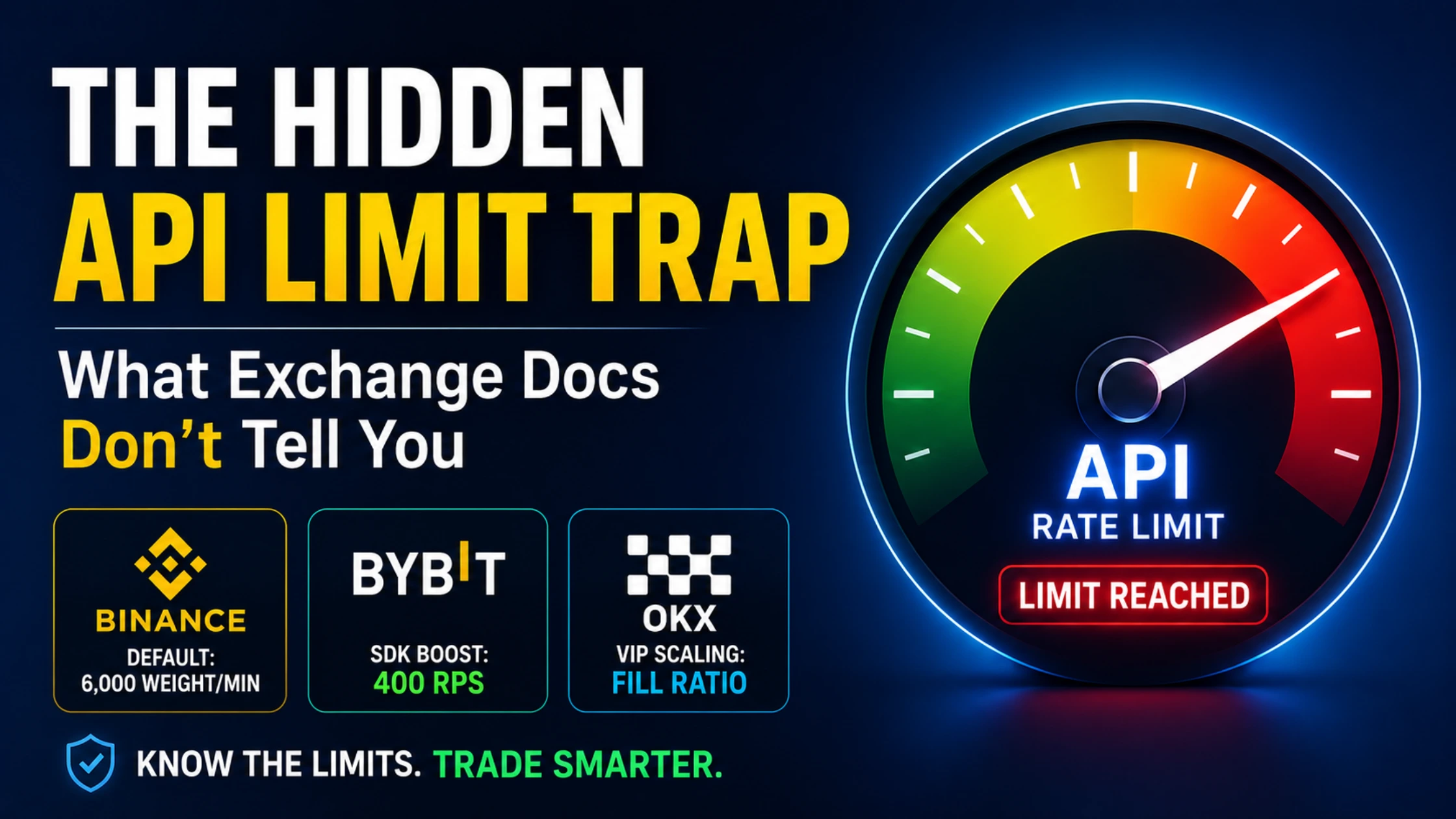
Every major crypto exchange publishes a documented API rate limit, and almost every retail algorithmic trader builds their strategy against that published number as if it were the actual ceiling. It frequently isn't. Binance's own documentation states that VIP and institutional traders can request elevated rate limits beyond the published default, but only by contacting an account manager directly, a manual, opaque process with no published formula, unlike its transparently tiered fee schedule. OKX runs the opposite pattern: its VIP rate-limit scaling is fully published and mechanically tied to a documented 7-day order fill ratio, making the tier gap real but genuinely transparent. Bybit presents the most striking case in the category: while its base published limit is 600 requests per 5 seconds per IP, a widely used third-party SDK for Bybit's API publicly advertises that it grants every user, regardless of account tier, a rate limit of 400 requests per second, explicitly marketed as higher than Bybit's highest VIP tier, available to any retail developer at zero cost. This means the entire VIP-tier rate-limit advantage that the published documentation implies can, for the specific case of this SDK, be circumvented by any retail developer willing to switch libraries, a structural fact that almost never appears in exchange comparison content built around headline numbers like requests-per-minute. This article forensically compares documented versus actual rate-limit enforcement across major exchanges and introduces the DN Rate Limit Asymmetry Index, a scoring framework built from each exchange's own technical documentation rather than its marketing language.
Every exchange comparison article aimed at algorithmic traders eventually arrives at the same table: requests per minute, weight per endpoint, WebSocket connection caps. These numbers are real, they are published, and they are also, on their own, close to useless for answering the question that actually determines whether a retail-built trading strategy survives contact with a live market: does the number in the documentation describe the limit a retail account will actually face, or does it describe a starting point that institutional and VIP accounts routinely exceed through mechanisms the documentation either glosses over or doesn't mention at all?
The honest answer, across the exchanges with the deepest published documentation, is that the published number is frequently a floor, not a ceiling, and the path from that floor to whatever a well-resourced account actually gets ranges from fully transparent and mechanically formulaic, in OKX's case, to manual and opaque, in Binance's case, to something stranger still: a publicly available, free third-party tool that lets any retail developer obtain a rate limit Bybit's own documentation implies should require VIP status to reach at all. This article reads the actual technical documentation, not the marketing comparisons, to map that asymmetry.
"Rate limits are raised to 400 requests per second, higher than the highest VIP tier. No action required."
— bybit-api Node.js SDK, official package documentation, 2026.Binance: A Published Default, an Unpublished Path to Anything Higher
Binance's published rate limits are genuinely detailed and, for the default tier, fully transparent. The spot API runs a weight-based system with a 6,000-weight-per-minute budget tracked per IP address, while the futures API runs a separate, independently tracked pool defaulting to 2,400 requests per minute per IP and 1,200 orders per minute per account. Binance's own documentation is specific down to individual endpoint costs: a kline request for up to 500 candles costs 2 weight, the same request for up to 1,000 candles costs 5, and the exchangeInfo endpoint costs a flat 20 weight regardless of how rarely the underlying data changes. This level of documented granularity is a genuine strength relative to less detailed competitors.
The asymmetry begins at exactly the point where a trader needs more than the default. Binance's own published guidance states plainly that institutional and VIP traders can request elevated rate limits, but the mechanism is to contact Binance support or a VIP account manager directly, with no published formula, no automatic threshold, and no documented schedule mapping a specific trading volume or VIP tier to a specific elevated weight ceiling. This stands in direct contrast to Binance's own fee schedule, which publishes exact VIP volume thresholds and exact resulting fee discounts down to the basis point. The fee ladder is a public, mechanical formula. The rate-limit ladder, for anyone above the default tier, is a private conversation whose outcome a retail trader has no way to benchmark against, anticipate, or compare to what another account at a similar volume actually received.
The Sharpest Case in the Category: A Free SDK That Beats Bybit's Own VIP Ceiling
Bybit's own published default is straightforward: 600 requests within a 5-second window per IP address for REST traffic, with a separate cap of 500 new WebSocket connections per 5-minute window. Bybit has also rolled out an institutional rate-limit framework, announced for an August 2025 rollout, introducing a centralized institution-level rate cap with flexible per-UID configuration aimed specifically at high-frequency trading clients, the kind of tiered institutional accommodation that is by now a standard pattern across the category.
What makes Bybit's case the single clearest illustration of structural rate-limit asymmetry in this entire comparison is not the institutional program. It is a widely used, official third-party Node.js, JavaScript, and TypeScript SDK for Bybit's own API, whose published documentation states, in plain language, that every API request made through the SDK is automatically subject to a rate limit of 400 requests per second, explicitly described by the SDK's own maintainers as higher than the highest VIP tier Bybit offers, available to any user at any account level, with no action required and no fee. The entire tiered structure that the published VIP and institutional programs imply, that higher throughput is something an account earns through volume or negotiates through an institutional relationship, does not hold against this specific, public, zero-cost technical substitution. A retail developer building a strategy against Bybit's documented 600-requests-per-5-second default, unaware that switching client libraries alone unlocks a materially higher ceiling than Bybit's own top VIP tier, is operating under a constraint that does not actually bind for anyone who has read the SDK's own README.
This is not a flaw exclusive to Bybit; it reflects how exchange rate limits are frequently enforced at the infrastructure layer in ways that don't map cleanly onto the account-tier language used in marketing and even in primary documentation. It is, however, exactly the kind of fact that a rate-limit comparison built only from published account-tier tables would never surface, and exactly the kind of fact a retail algorithmic trader most needs before concluding that a strategy is throughput-constrained at the documented default.
The Transparent Counter-Case: OKX's Published Fill-Ratio Formula
OKX runs the most fully disclosed tier-scaling mechanism among the exchanges compared in this article, and it is worth presenting as the category's positive benchmark rather than treating every tiered system as equivalently opaque. OKX's documentation specifies that for sub-accounts at VIP 5 and above, rate limit expansion is tied directly to a published, formulaic calculation: a 7-day fill ratio computed by dividing trading volume by a weighted count of new and amendment order requests, calculated separately at both the sub-account and master-account level, with a defined daily 8:00 UTC recalculation window and an explicit one-day grace period before any downgrade takes effect. None of this requires contacting a relationship manager to discover; it is published, mechanical, and independently verifiable by any developer willing to track their own fill ratio against OKX's documented thresholds.
The gap this article is built around still exists at OKX, just in a different and more transparent form: the rate-limit advantage genuinely concentrates toward VIP 5-and-above accounts with strong fill ratios, and a retail trader without that volume or that fill discipline faces a real, documented ceiling below what a qualifying account receives. The difference from Binance's pattern is that the gap, and the exact path to closing it, is published rather than gated behind a private conversation with no disclosed criteria. For a retail algorithmic trader specifically weighing which exchange to build infrastructure against, that documentation transparency is itself a meaningful selection criterion independent of fees or asset coverage: an exchange that publishes its scaling formula lets a trader actually plan a growth path, where an exchange that gates the same decision behind an undisclosed account-manager conversation does not. Traders evaluating OKX specifically for this reason can review current account terms here, alongside the published VIP fill-ratio documentation referenced above.
The Documented-Versus-Actual Snapshot, June 2026
| Exchange | Published Default | Path to Higher Limit | Disclosure Quality |
|---|---|---|---|
| Binance | 6,000 weight/min (spot) | Contact account manager, no published formula | Opaque above default |
| Bybit | 600 req/5s per IP | Free public SDK exceeds top VIP tier | Default published; SDK gap undocumented in account-tier terms |
| OKX | 20 req/2s (public data) | Published fill-ratio formula, VIP5+ | Fully published, mechanical |
Read across that table and the pattern this article is built to surface becomes clear: "documented rate limit" is not a single kind of fact across the category. It ranges from a number with a fully public path to anything higher, to a number that is real for most users but circumventable for free by anyone willing to read past the headline documentation, to a number whose ceiling is set in a private conversation a retail trader has no way to benchmark against.
Score = sum of four answers (0–2 each, max 8) × 12.5. A high score means the documented rate limit is a reliable, transparent description of what a retail account will actually face. This is a structural evaluation aid built from technical documentation, not investment or trading advice; rate limit policies change and should be re-verified against current documentation before relying on any score.
Scores use the same four-question methodology as the scorer above, applied to each exchange's own published technical documentation as of June 2026. A higher score means less asymmetry between the documented default and what a retail account actually experiences, not necessarily a higher absolute rate limit. Re-verify against current documentation before relying on any single score.
Bars are illustrative proportions, not directly comparable across exchanges (different rate-limit units and measurement windows). The point of this view is the shape of each gap and how it's closed, documented formula, free public workaround, or private negotiation, not the absolute heights.
Why This Gap Matters More Than the Headline Number
None of the exchanges named in this article are doing anything against their own terms of service, and this article is not arguing that any of them is acting in bad faith. Binance's account-manager-gated VIP rate limits are a completely standard relationship-banking pattern carried over from traditional finance. OKX's fill-ratio formula is a genuinely well-designed mechanism that rewards real liquidity provision over order-spam. The Bybit SDK case is, on the SDK maintainer's own account, simply a technical optimization made broadly available rather than withheld. The problem this article is identifying is not misconduct. It is that none of this structural detail is in the comparison content that actually reaches retail algorithmic traders, which remains organized almost entirely around a single headline number, requests per minute, presented as if it were a stable, comparable fact across exchanges, when in practice it describes three meaningfully different kinds of commitment depending on which exchange's documentation it came from.
The practical consequence compounds specifically for the audience least equipped to discover the gap on their own: a retail developer building a first algorithmic strategy is the trader most likely to architect rate-limit handling directly against the published default, the most likely to never discover that an account manager conversation, a fill-ratio threshold, or a different client library would have changed the entire constraint they spent weeks engineering around. A well-resourced market maker or institutional desk, by contrast, either already has the relationship-manager contact, already tracks fill ratio against a published formula, or already maintains a vetted internal client library, precisely because discovering and exploiting documentation gaps like these is part of what a dedicated infrastructure team is for. The asymmetry this article names is not just in the rate limits themselves; it's in who has the institutional knowledge to know the published number was never the real constraint.
What This Index Does Not Claim
Rate limit policies and SDK behavior change. Binance, Bybit, and OKX have each adjusted rate-limit structures multiple times over the past year, and third-party SDKs can change their behavior, lose maintenance, or be deprecated without notice. The specific figures in this article reflect each source's documentation as of June 2026 and should be re-verified before any reliance.
Using a third-party SDK carries its own risks independent of rate limits. This article's discussion of the bybit-api SDK's documented rate-limit behavior is not an endorsement or a security audit of that or any other third-party library; any trader evaluating a third-party SDK should independently assess its maintenance status, security practices, and terms before routing live trading through it.
This is not trading or investment advice. Rate limit architecture is one input among many in algorithmic strategy design; this article addresses documentation transparency specifically and does not evaluate strategy viability, execution quality, or any exchange's suitability for a given trading approach.
The Bottom Line: The Published Number Was Never the Whole Contract
Exchange rate-limit comparison content treats the documented requests-per-minute figure as if it were the complete and stable description of what an API actually allows, the same way MiCA licensing coverage treated "licensed" as a complete description of operational status, or tokenized Treasury marketing treated "instant redemption" as a complete description of exit mechanics. In each case, the headline figure is real and the structural gap behind it is the thing that actually determines outcomes for the reader least equipped to discover it unassisted. The Rate Limit Asymmetry Index above does not argue that any exchange's documentation is dishonest. It argues that "documented limit" currently describes three different kinds of commitment, fully transparent and formulaic, technically circumventable for free, or privately negotiated with no public benchmark, and that almost no comparison content currently tells a retail algorithmic trader which kind of commitment they're actually building a strategy against.
Frequently Asked Questions
Rate limit asymmetry refers to the gap between an exchange's documented, published API rate limit and the limit a real account actually experiences, which can differ based on account tier, VIP status, trading volume, or in some cases, simply which third-party client library or SDK a developer chooses to use. Most exchange comparison content treats the published limit as a stable, comparable fact, when in practice it can describe a hard ceiling, a starting point with an undisclosed path to something higher, or a number that a free public workaround can exceed entirely.
Per Binance's own published guidance, institutional and VIP traders can request an elevated rate limit beyond the default 6,000 weight per minute (spot) or 2,400 requests per minute (futures), but only by contacting Binance support or a VIP account manager directly. Unlike Binance's fee schedule, which publishes exact volume thresholds for each VIP tier, there is no published formula mapping a specific trading volume to a specific elevated rate limit ceiling.
Yes, according to the SDK's own published documentation. A widely used official Node.js, JavaScript, and TypeScript SDK for Bybit's API states that all API requests made through the SDK are automatically subject to a rate limit of 400 requests per second, which the SDK's maintainers explicitly describe as higher than Bybit's highest VIP tier, available to any user regardless of account level with no fee and no action required.
Based on the methodology in this article, OKX's rate-limit scaling for sub-accounts at VIP 5 and above is the most transparently documented among the exchanges compared, since it is tied to a published, mechanical 7-day fill-ratio formula with defined recalculation timing and grace periods, rather than requiring a private request with no disclosed criteria, which is how Binance's above-default rate limit increases are handled.
A retail developer building a first trading bot typically architects rate-limit handling directly against an exchange's published default, with no institutional knowledge of account-manager relationships, fill-ratio formulas, or SDK-level workarounds that better-resourced traders and institutional desks routinely use to exceed that default. This means the documented limit functions as a real constraint specifically for the audience least equipped to discover that it often isn't the actual ceiling.
This article does not make that legal determination for any specific exchange or SDK, and the specific case discussed (the bybit-api SDK) is presented by its own maintainers as a sanctioned technical optimization, not a circumvention technique. Any trader should independently review the relevant exchange's API terms of service and the SDK's own documentation before relying on a specific rate-limit behavior for live trading.
The index scores four dimensions drawn from an exchange's own technical API documentation: whether the path from the default rate limit to a higher one is published as a formula or requires a private request, how large the gap is between the default and the highest documented tier, whether a free, publicly documented technical workaround exists that lets a retail account exceed the default, and how much undisclosed discretion the exchange's documentation or terms reserve over enforcement. Each dimension scores 0 to 2, summing to a 0 to 100 scale, where a higher score means greater transparency rather than a higher absolute limit.
Embed grant: The DN Rate Limit Asymmetry Index may be reproduced with attribution to decentralised.news.
Sources: Binance Open Platform official API documentation (developers.binance.com), Binance Futures rate limit FAQ, VoiceOfChain Academy "Binance API Rate Limits Guide for Traders" (April 2026), Bybit API Documentation v5 rate limit rules (bybit-exchange.github.io), Bybit Announcement "Bybit enhances API rate limits for Institutional Traders" (Aug 2025 rollout notice), bybit-api npm package official documentation, OKX API guide and VIP rate limit documentation (okx.com/docs-v5), GitHub community technical breakdowns of OKX and Bybit rate limit architecture (2026), GitHub Docs REST API rate limit documentation (cross-industry reference pattern), Datawallet "Best Crypto Exchanges for API Trading" (Dec 2025).
As of: June 28, 2026. Documented rate limits, tier thresholds, and third-party SDK behavior are subject to change without notice; verify current documentation and SDK status directly before relying on any figure in this article. Not trading or investment advice.