
On-Chain DEX Arbitrage: How to Read Price Gaps Before Bots Close Them
The DEX Price Gap Alert System: How to Check Arbitrage Before You Trade.
Every time you spot a DEX price gap, a bot already saw it first. This guide explains MEV and front-running, then gives you an interactive checklist to evaluate whether an arbitrage opportunity has actually survived bot competition.
On-Chain DEX Arbitrage 2026 — Reading Mempool Data to Find Price Gaps Before They Close
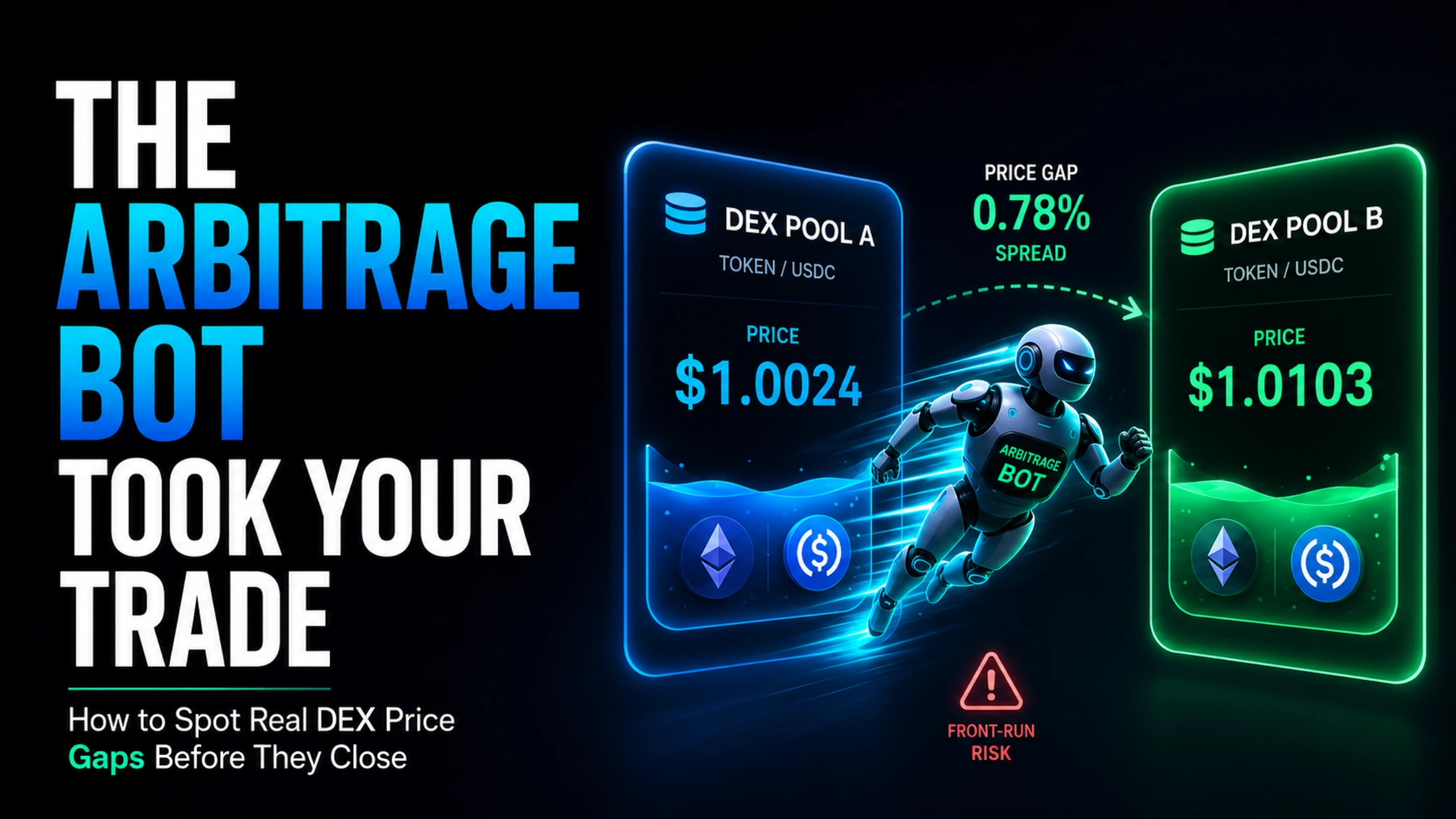
The arbitrage bot took your trade. This is not a metaphor — it is the literal sequence of events that happens to almost every retail trader who spots a price gap between two DEX pools, calculates the profit, submits a transaction, and watches it fail or land after the gap has already closed. Understanding why this happens, and the narrow set of conditions where it does not, is the difference between wasted gas fees and a genuine edge.
What Actually Happens When You Submit an Arbitrage Transaction
Here is the sequence most retail traders do not see, because it happens in the twelve seconds between submitting a transaction and it landing on-chain.
You notice ETH trading at $3,200 on Uniswap and $3,212 on SushiSwap. You calculate the spread: 0.375%, large enough on a $20,000 trade to generate a meaningful profit after fees. You build the transaction, set your gas price, and hit submit.
Your transaction does not go directly into a block. It enters the mempool — a public, visible holding area where every pending transaction sits before being included in the next block. This is the critical detail. The mempool is public. Anyone running the right infrastructure can see your transaction the instant it appears, read exactly what it does, and react before it is confirmed.
Specialized bots, run by MEV (Maximal Extractable Value) searchers, monitor the mempool continuously. When your transaction appears showing an arbitrage between Uniswap and SushiSwap, a searcher’s bot can construct its own transaction that captures the same spread, attach a higher gas fee to incentivize the block builder to include it first, and have it confirmed in the same block before yours — or instead of yours. By the time your transaction executes, the price gap is already closed because the bot’s transaction closed it. Your trade either fails, executes at a worse price, or in the worst case (a sandwich attack) is used against you directly.
This is not a hypothetical edge case. This is the default outcome for any visible, profitable arbitrage opportunity on Ethereum mainnet and any high-liquidity chain in 2026.
MEV Explained Without the Jargon
MEV stands for Maximal Extractable Value — the additional value that can be extracted from a blockchain by controlling the order, inclusion, or exclusion of transactions within a block, beyond the standard block reward and transaction fees.
In practice, MEV is dominated by a small number of highly sophisticated participants running infrastructure that most retail traders cannot replicate:
Mempool monitoring at scale. Searchers run nodes that watch every pending transaction across multiple chains simultaneously, parsing the transaction data in real time to identify profitable opportunities — arbitrage, liquidations, and other extractable value.
Private transaction submission. Rather than submitting through the public mempool where competitors can see and react, sophisticated searchers use services like Flashbots to submit transaction bundles directly to block builders, bypassing public visibility entirely. This means the most competitive MEV searchers are not even visible in the mempool you might be watching.
Gas auction dynamics. When multiple searchers spot the same opportunity, they compete by offering increasingly higher gas fees to the block builder for priority inclusion — a process called a priority gas auction. The winner is whoever is willing to pay the most for that specific block slot, which means the profit margin on any visible opportunity compresses toward the gas auction cost.
Sandwich attacks, a particularly aggressive form of MEV, involve detecting a pending trade in the mempool, placing one transaction immediately before it (buying the asset, pushing the price up) and one immediately after (selling at the now-inflated price), profiting from the price impact of the victim’s own trade. This is why large DEX swaps without slippage protection routinely execute at worse prices than expected — not due to market movement, but due to a bot extracting value from the trade itself.
The economics of MEV searching are intense competition for a finite resource. Academic research and on-chain data analysis consistently show that the profitable margin on detectable arbitrage opportunities compresses to near the cost of the gas auction itself — meaning the actual economic winner is frequently the block builder or validator receiving the priority fee, not the searcher who spotted the opportunity.
Where Retail Traders Can Still Find Real Opportunities
The MEV competition described above is most intense on Ethereum mainnet and the highest-liquidity chains, where the financial incentive to build sophisticated bot infrastructure is greatest. This creates a predictable pattern: opportunity exists in inverse proportion to MEV infrastructure investment, which correlates with chain liquidity and bot competition.
Newer Layer 2 networks with growing but still-developing DEX ecosystems frequently have less mature MEV infrastructure. When a new chain launches with incentivized liquidity programs, the searcher infrastructure to exploit every arbitrage opportunity on that chain takes time to develop. In the gap between a chain’s liquidity growth and its MEV infrastructure maturity, retail-detectable opportunities can persist for longer than milliseconds.
Smaller, less-covered token pairs on established chains see less MEV bot attention because the absolute dollar value of arbitrage on a $50,000 liquidity pool is small relative to the infrastructure cost of monitoring it continuously. Bots prioritize high-liquidity pairs where the expected value of monitoring exceeds the infrastructure cost. Long-tail pairs fall below this threshold.
Cross-chain price discrepancies, distinct from same-chain DEX arbitrage, operate on a different timescale entirely. Bridge transfer times of minutes to hours mean the MEV infrastructure built for millisecond same-block arbitrage does not apply in the same way. This is covered in detail in our bridge arbitrage guide — a genuinely different opportunity category from the on-chain DEX arbitrage this article addresses.
New token launches create temporary price discovery windows where liquidity is still being established across multiple pools simultaneously. The window between launch and full MEV bot coverage of a new token’s trading pairs can offer brief retail-accessible opportunities, though this category also carries the highest risk of rug pulls and contract exploits.
The Three Data Sources You Need to Check Manually
Before evaluating any specific opportunity, you need current data from three sources. This tool does not connect to live APIs — it teaches you the manual verification process that should precede any on-chain arbitrage attempt, because verifying stale or cached data is one of the most common ways retail traders lose money on transactions that looked profitable five minutes earlier.
GeckoTerminal provides real-time DEX pool data across most chains, showing current price, 24-hour volume, and liquidity depth for any pool. This is your primary source for confirming a price discrepancy exists right now, not five minutes ago. Check the “Pool Info” tab for total liquidity — this number tells you how much your trade will move the price.
Dexscreener offers a similar live data view with a particular strength in showing multiple pools for the same token pair side by side, making cross-DEX comparison faster. Dexscreener’s transaction feed for a given pool also shows you recent trade sizes and their price impact, giving you a real-world sense of slippage at different trade sizes rather than relying on theoretical calculations.
The chain’s block explorer (Etherscan for Ethereum, Arbiscan for Arbitrum, BaseScan for Base, Solscan for Solana) lets you verify the actual current reserve balances in the liquidity pool contract directly, bypassing any caching delay that aggregator sites might have. For any opportunity above a few thousand dollars in size, checking the raw contract state before executing is the final verification step that protects against acting on stale data.
Use the Evaluation Checklist
The interactive tool below walks through the three questions that determine whether a spotted price gap is worth attempting. Answer honestly based on what you have actually verified across the three data sources above — the tool cannot check this for you, but it will tell you whether your answers support a go or no-go decision.
DEX Price Gap Evaluation Checklist
Verify your data on the three sources below, enter your trade numbers, then answer honestly. The tool gives you a go / no-go based on your real inputs.
Tool by Decentralised News · OKX Web3 · Bybit · deBridge
Why Each Checklist Question Matters
Is the spread large enough relative to total costs? The break-even spread on a same-chain DEX arbitrage needs to cover the DEX trading fee on both swaps (typically 0.3% each, 0.6% total), any slippage from your trade size, and gas. On Ethereum mainnet with moderate gas, this often means needing a spread above 1% before the trade is worth attempting — and a 1% spread on a major pair is rare enough that its mere existence should make you suspicious of why it has not already been closed.
Is pool liquidity deep enough? A price gap on a pool with $20,000 of liquidity will move dramatically against you the moment you trade $5,000 through it. The spread you see quoted assumes an infinitesimally small trade size. Your actual trade size determines your actual execution price, which is always worse than the quoted spread once you account for your own price impact. Pools need liquidity at least 10 to 20 times your intended trade size before the quoted spread bears any resemblance to your executed price.
Is gas cost a small fraction of the expected profit? On Ethereum mainnet, a same-chain arbitrage transaction with multiple swap legs can cost $15 to $80 in gas depending on network congestion. If your expected profit is $40, a congestion spike to $60 gas turns a profitable trade into a loss before you even account for the bot competition that might close the spread before your transaction confirms. The safety margin here needs to be generous — gas should ideally be under 20% of expected gross profit, not just below it.
The Honest Conclusion
For Ethereum mainnet and any high-liquidity chain, the realistic answer to “can I find profitable on-chain arbitrage as a retail trader” is: rarely, and when you do, the window is measured in single-digit seconds at most, competing against infrastructure you cannot match.
The more productive use of the underlying skill — reading on-chain data, understanding pool mechanics, evaluating spreads against costs — is applying it to opportunity categories where millisecond competition does not dominate. Bridge arbitrage, where transfer windows give you minutes rather than milliseconds. Newer chains where MEV infrastructure has not yet matured. Long-tail pairs that fall below the threshold of bot monitoring economics.
For traders who conclude after going through this analysis that on-chain DEX arbitrage is not where they want to spend their time and gas fees, the alternative is straightforward: OKX’s Web3 wallet gives you clean access to on-chain DeFi when you do want to interact with it, without needing a separate browser extension stack. For traders who decide the MEV risk and competition makes centralized exchanges the more rational venue for active trading, Bybit offers deep liquidity without the mempool visibility problem that defines on-chain trading — your CEX order is not broadcast publicly before execution the way an on-chain transaction is. And for genuine cross-chain opportunities where the bridge transfer window creates a retail-accessible edge, deBridge is the execution infrastructure covered in depth in our bridge arbitrage guide.
FAQ
What is MEV in crypto?
MEV stands for Maximal Extractable Value — the additional profit that can be captured by controlling the order or inclusion of transactions within a blockchain block. It includes arbitrage, sandwich attacks, and liquidations, executed by specialized searchers who monitor the public mempool or submit transactions privately to capture value before regular users’ transactions are confirmed.
Why did my arbitrage transaction fail or execute at a worse price than expected?
The most common cause is that an MEV bot detected your transaction in the public mempool, calculated that the same arbitrage was profitable, and submitted a competing transaction with a higher gas fee that got included first — closing the price gap before your transaction executed. A second common cause is that your trade size was too large relative to pool liquidity, causing slippage that ate into or exceeded your expected profit.
Can I protect my transactions from MEV bots?
Using a private transaction relay like Flashbots Protect (built into many wallets including MetaMask’s RPC settings) submits your transaction directly to block builders rather than the public mempool, preventing front-running bots from seeing and reacting to it before inclusion. This protects against sandwich attacks but does not create arbitrage opportunities that did not already exist — it only protects your existing transactions from being exploited.
Is on-chain arbitrage still profitable for anyone in 2026?
Yes, but predominantly for sophisticated MEV searchers running dedicated infrastructure rather than retail traders manually checking prices. Retail-accessible opportunities persist on newer chains with less mature bot infrastructure, on long-tail token pairs below the monitoring threshold of most searchers, and in cross-chain bridge arbitrage where transfer time windows are fundamentally different from same-block competition.
What chains have less MEV competition right now?
Generally, newer Layer 2 networks and chains with smaller but growing DEX ecosystems have less developed MEV infrastructure than Ethereum mainnet, Arbitrum, and Base. This changes constantly as bot operators expand coverage to new chains as liquidity grows, so any specific chain named here would likely be outdated within months. The durable principle — newer and smaller means less competition — is what to apply rather than a static list.
Should I just give up on on-chain arbitrage entirely?
The skills involved — reading pool liquidity, calculating real costs including slippage and gas, verifying data across multiple sources — are genuinely useful for evaluating any on-chain opportunity, including the ones that do work for retail traders, like bridge arbitrage and identifying genuine mispricings on newer or smaller chains. The conclusion is not that the skill is worthless, but that same-chain DEX arbitrage on major chains specifically is the wrong application of it for most retail traders.
Tools and platforms referenced: OKX Web3 Wallet — on-chain DeFi access · Bybit — CEX trading without mempool exposure · deBridge — cross-chain bridge arbitrage execution





