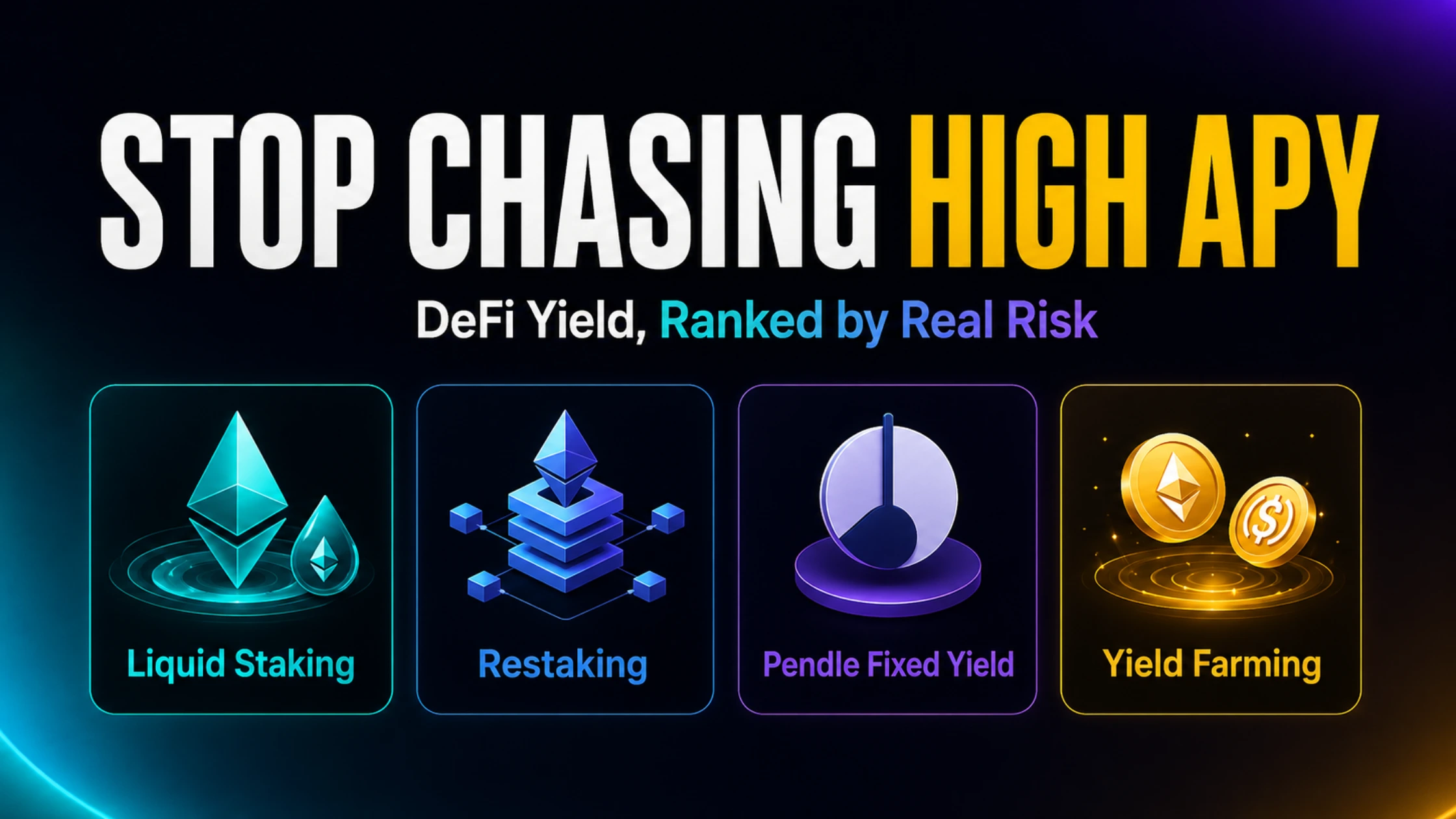
Liquid staking, restaking, Pendle fixed yield, and DeFi liquidity pools all promise yield on your crypto — but the risk profiles are nothing alike. This calculator ranks all four against your specific risk tolerance and capital.
Liquid Staking vs Restaking vs Yield Farming 2026 — The Risk-Adjusted Return Tool
A 3.5% liquid staking yield and a 9.5% Pendle fixed yield are not two points on the same risk curve — they sit in entirely different risk categories that happen to both be denominated in percentage terms. The tool below ranks four DeFi yield strategies side by side against your specific capital and risk tolerance, with a step-by-step execution guide for whichever one fits.
Why “Just Pick the Highest Yield” Is the Wrong Framework
Every yield comparison article in crypto eventually reduces to a table sorted by APY, implicitly suggesting that higher is simply better. This framing has caused more capital destruction in DeFi than any single exploit or hack, because it strips out the variable that actually determines whether a yield is good: what you are risking to earn it.
A 3.5% yield with near-zero smart contract risk and no possibility of impermanent loss is, for a risk-averse investor, a better position than a 15% yield carrying meaningful smart contract risk, IL exposure, and protocol dependency risk. The raw number says otherwise. The risk-adjusted reality says the opposite.
The four strategies compared below — liquid staking, restaking, Pendle fixed yield, and DeFi liquidity provision — sit at different points on a genuine risk spectrum, not just a yield spectrum. Understanding where each one sits, and where your own risk tolerance sits relative to them, is the actual decision that matters.
The Four Strategies, Explained Precisely
Liquid staking is the practice of staking ETH to a protocol like Lido in exchange for a liquid receipt token (stETH) that accrues staking rewards automatically while remaining tradeable and usable as collateral elsewhere. The yield comes from Ethereum’s protocol-level staking rewards — a function of network issuance and validator participation, not a third party’s lending spread or trading activity. Current yield sits at approximately 3.5% annually. This is the foundation-layer yield strategy: lowest risk, lowest yield, most battle-tested.
Restaking takes your already-staked ETH (or your stETH) and deposits it into EigenLayer, where it secures additional protocols called Actively Validated Services (AVSs) in exchange for additional yield on top of the base staking reward. You receive a Liquid Restaking Token (LRT) — such as eETH from ether.fi or ezETH from Renzo — representing your restaked position. The combined yield from base staking plus AVS rewards currently runs 5.5 to 7%. The additional yield comes with additional risk: a second layer of smart contracts, exposure to whatever AVSs your restaked capital is securing, and a slashing risk that did materialize in the KelpDAO incident.
Pendle fixed yield uses Pendle Finance’s yield-splitting mechanism to let you lock in a guaranteed APY on a yield-bearing asset until a fixed maturity date. Buying the Principal Token (PT) on Ethena’s USDe currently locks in approximately 9.5% fixed yield. The mechanism works by separating a yield-bearing token into a principal component (which you buy at a discount, redeemable at face value at maturity) and a yield component (sold to someone else who wants leveraged yield exposure). The fixed nature is the key feature: you know your exact return at entry, regardless of what happens to the underlying yield rate afterward. The risk is multi-layered — Pendle’s own contracts, the underlying Ethena synthetic dollar mechanism, and the illiquidity of capital locked until maturity.
DeFi liquidity provision means depositing two assets into an automated market maker pool — for example, ETH and USDC on Uniswap v3 — to earn a share of trading fees generated by swaps through that pool. Yields vary enormously based on pool selection, fee tier, and price range strategy, typically running 8 to 15% including any additional incentive token rewards. The defining risk that does not exist in the other three strategies is impermanent loss: when the price ratio between your two deposited assets changes, your position’s value diverges from simply holding the two assets separately, and that divergence can exceed the fees earned.
Use the Comparison Tool
Enter your capital and set your risk tolerance. The tool ranks all four strategies and recommends an allocation split.
Liquid Staking vs Restaking vs Pendle vs LP — Risk-Adjusted Comparison
Enter your capital and risk tolerance. The tool ranks all four strategies and recommends a personalized allocation split.
Blended portfolio summary
Tool by Decentralised News · Acquire assets on OKX · Bridge via deBridge
Reading the Risk Scores
Smart contract risk reflects the number of contract layers your capital passes through and the operating history of each. Liquid staking via Lido has the longest, cleanest track record of any DeFi protocol of comparable scale. Restaking via EigenLayer adds a second contract layer with a shorter operating history. Pendle adds its own contract layer on top of Ethena’s synthetic dollar mechanism. DeFi LP positions depend on the specific AMM’s contract history — Uniswap v3 is extremely battle-tested, but the position management layer (if using a third-party vault) adds risk.
IL exposure is binary in this comparison: liquid staking, restaking, and Pendle fixed yield carry zero impermanent loss because none of them involve holding two assets in a price-dependent ratio. DeFi LP is the only strategy in the table with IL exposure, and it can be substantial — a 50% price move in either direction on a standard Uniswap v3 ETH/USDC position can produce IL that exceeds several months of accumulated fees.
Liquidity matters as much as headline risk. Liquid staking and restaking tokens (stETH, eETH) are liquid and tradeable at any time, though restaking LRTs occasionally trade at a discount to their underlying value during stress events. Pendle PT positions are locked until maturity — selling early requires using the secondary market, which carries its own price risk. DeFi LP positions are generally withdrawable instantly, though withdrawing during a sharp price move locks in whatever IL has accrued at that moment.
Step-by-Step: How to Set Up Liquid Staking
- Acquire ETH on OKX if you do not already hold it.
- Connect a wallet (MetaMask, Rabby, or OKX Web3 Wallet) to Lido Finance’s app at lido.fi.
- Connect your wallet, select the amount of ETH to stake, and confirm the transaction. Network gas fee applies once, at deposit.
- Receive stETH in your wallet at a 1:1 ratio with your deposited ETH. The stETH balance increases automatically over time as staking rewards accrue — no further action needed.
- To exit, either sell stETH directly on a DEX (instant, subject to any minor price deviation from peg) or use Lido’s withdrawal queue to redeem 1:1 for ETH (typically a short wait, sometimes longer during high exit volume).
- Optional: deposit your stETH as collateral on Aave or into a Pendle PT position to layer additional yield on top of the base staking reward.
This is the lowest-friction entry point in the comparison and the one most beginners should start with before considering the other three.
Step-by-Step: How to Set Up Restaking
- Hold ETH or stETH. If starting from scratch, acquire ETH on OKX first.
- Choose a Liquid Restaking Token provider — ether.fi (eETH) and Renzo (ezETH) are the two largest by TVL.
- Deposit ETH or stETH directly through the provider’s app. You receive the LRT in return, representing your restaked position.
- The LRT automatically accrues both the base staking yield and the additional AVS reward yield. No manual claiming is typically required.
- Monitor which AVSs your restaked capital is securing — reputable providers publish this information, and it directly determines your slashing risk exposure.
- To exit, sell the LRT on a DEX (instant, subject to any discount to underlying value) or use the provider’s native withdrawal mechanism (slower, but redeems at full value).
Restaking is appropriate as a second step after liquid staking, once you understand the base mechanism and are comfortable taking on an additional contract layer for incremental yield.
Step-by-Step: How to Set Up Pendle Fixed Yield
- Acquire USDC or USDT on OKX.
- Bridge to the chain where your target Pendle market is deployed if not already on Ethereum — deBridge supports the major routes into Ethereum and its L2s.
- Convert your stablecoin to the underlying yield-bearing asset (e.g., USDe via Ethena’s app) if the Pendle market requires it, or use Pendle’s integrated swap if available directly on their interface.
- Go to the Pendle app, select the PT (Principal Token) market for your chosen asset and maturity date.
- Purchase the PT at its current discounted price. The discount-to-face-value relationship is what generates your fixed yield — you are locking in the exact return between now and maturity.
- Hold until maturity, at which point your PT automatically redeems for the full face value in the underlying asset. Selling before maturity is possible on the secondary market but introduces price risk based on prevailing rates at the time of sale.
Pendle fixed yield suits capital you can commit until a known maturity date and where you specifically value yield certainty over the optionality of liquid staking or restaking.
Step-by-Step: How to Set Up a DeFi Liquidity Position
- Acquire both assets for your chosen pair — for example, ETH and USDC — on OKX.
- Bridge to your target chain using deBridge if the pool you want is not on the chain where you hold your assets.
- Navigate to your chosen AMM (Uniswap v3 is the standard reference) and select the ETH/USDC pool.
- Choose a fee tier (0.05%, 0.3%, or 1% depending on the pair) and, for concentrated liquidity AMMs, a price range. A narrower range generates more fees per dollar deposited but requires more active management as price moves.
- Deposit both assets in the required ratio and confirm the transaction.
- Monitor the position regularly. If price moves outside your selected range, your position stops earning fees and is fully exposed to whichever single asset the price moved toward — at this point you need to either withdraw and redeposit at a new range, or accept the IL exposure.
This strategy requires the most active management of the four and is appropriate only once you are comfortable calculating and monitoring impermanent loss in real time.
FAQ
Which of these four strategies is safest for a beginner?
Liquid staking via Lido is the appropriate starting point. It has the longest operating history of any large-scale DeFi protocol, the simplest mechanism to understand, and zero impermanent loss exposure. Build comfort with this strategy before adding restaking, Pendle, or LP positions.
Can I run more than one of these strategies simultaneously?
Yes, and the comparison tool’s recommended allocation does exactly this — splitting capital across multiple strategies based on your risk tolerance rather than putting everything into the single highest-yielding option. A diversified approach across two or three of these strategies, weighted toward the lower-risk end, is how most sophisticated DeFi users structure their yield-bearing capital.
What is the actual difference between restaking risk and Pendle risk?
Restaking risk centers on slashing — if an AVS your capital secures behaves incorrectly, a portion of your restaked capital can be penalized. Pendle risk centers on the underlying asset’s mechanism (Ethena’s synthetic dollar model carries funding rate risk) plus illiquidity until maturity. Both add a layer of risk above base staking, but the nature of that risk is different: restaking risk is about validator behavior, Pendle risk is about the underlying yield asset’s stability and your capital’s liquidity until a fixed date.
Why does DeFi LP show the highest risk score despite sometimes having a similar yield to Pendle?
Impermanent loss is the differentiator. Pendle’s fixed yield is genuinely fixed once you enter — the number you see is the number you get at maturity, regardless of market movement. A DeFi LP position’s yield can be entirely offset or exceeded by IL if the price ratio between your two assets moves significantly, meaning the realized return is far less predictable even when the headline APY looks similar.
How often should I re-evaluate my allocation across these four strategies?
Quarterly is a reasonable cadence for most users. Yields shift as market conditions change — restaking AVS rewards fluctuate, Pendle fixed rates change with each new market that opens, and LP fee generation depends on trading volume. Re-running the comparison tool each quarter with updated numbers and reassessing your risk tolerance keeps the allocation aligned with current conditions rather than a snapshot from months earlier.
Execute these strategies: OKX — acquire ETH and stablecoins · deBridge — cross-chain access to Pendle and LP venues · Lido Finance (lido.fi) — liquid staking · Pendle Finance (pendle.fi) — fixed yield