
A practical 2027 guide to trading on gTrade using a crypto wallet. Learn how to connect a wallet, choose crypto or forex markets, set collateral and leverage, understand liquidation, use stop loss and take profit, and manage risk.
Summary
gTrade is a decentralized leveraged trading platform for traders who want wallet-based access to crypto, forex and other synthetic markets.
Instead of creating a normal centralized exchange account, traders connect a wallet, choose collateral, select a market, set leverage and open positions through smart contracts.
The official Decentralised News referral link is gTrade.
By 2027, the core appeal of gTrade is clear:
Self-custody.
No traditional exchange deposit.
Multi-asset leveraged markets.
On-chain execution.
Crypto and forex access from one interface.
Transparent trade parameters.
But the main risk is just as clear:
Leverage can destroy accounts quickly.
A trader can be correct on direction and still lose if the leverage is too high, the stop loss is poor, the liquidation price is too close or the position size is too large.
The best way to use gTrade is not to chase the highest leverage.
It is to use the platform with strict risk rules.
Trade small.
Use stop losses.
Respect liquidation.
Track every trade.
Never use your full wallet balance as trading capital.
Quick Answer
To trade on gTrade in 2027:
Open gTrade.
Connect a supported wallet.
Select the correct network.
Fund the wallet with supported collateral.
Choose a crypto, forex or other supported market.
Select long or short.
Enter collateral.
Choose leverage.
Review total position size.
Check price impact, spread and fees.
Check liquidation price.
Set stop loss and take profit.
Confirm the wallet transaction.
Monitor the trade.
Close manually or let your risk controls trigger.
Best beginner route:
Use a separate trading wallet, start with small collateral, trade BTC/USD or ETH/USD first, use low leverage, set a stop loss and avoid high-leverage forex or degen pairs until you understand the platform.
Use gTrade here:
Trade on gTrade.
Connect Wallet
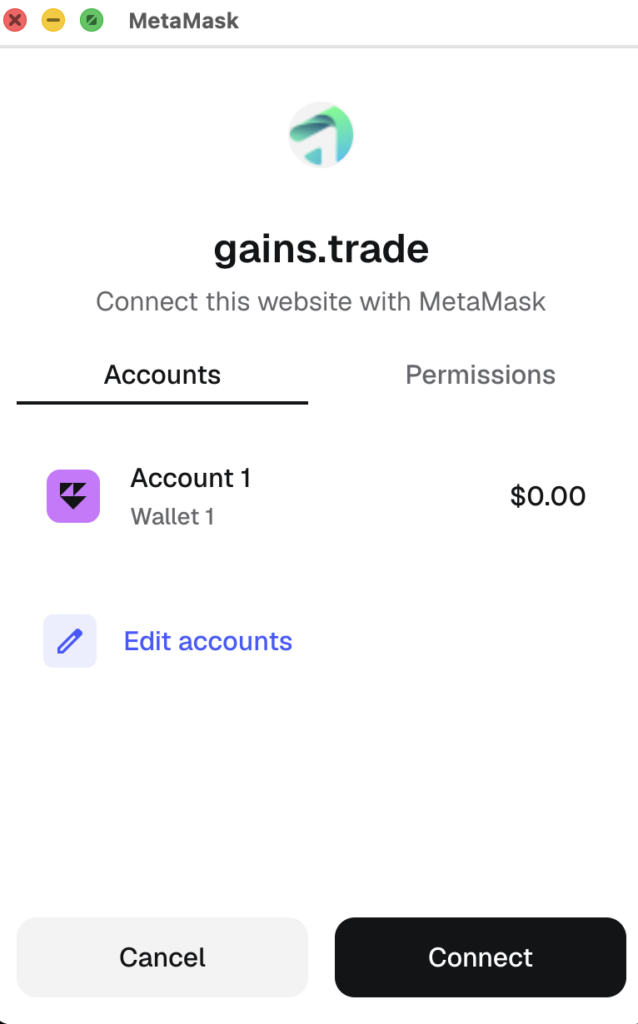
gTrade is wallet-based.
That means the first step is connecting a crypto wallet rather than creating a normal exchange account.
Go to gTrade.
Connect a supported wallet.
Choose the right network.
Make sure you have supported collateral.
Make sure you have gas for transactions.
Review wallet permissions.
A good gTrade setup uses a separate wallet.
Do not use the same wallet for:
Long-term holdings.
NFTs.
DeFi experiments.
Meme coin trading.
Leveraged trading.
Use a dedicated trading wallet.
Fund it only with the amount you are prepared to risk.
This is one of the simplest ways to reduce damage if something goes wrong.
Before connecting, check:
You are on the real site.
The wallet is on the correct network.
The wallet has supported collateral.
The wallet has gas.
You understand what you are signing.
You are not using a cold storage wallet for leveraged trades.
Wallet safety comes before trading strategy.
Choose Crypto or Forex Market
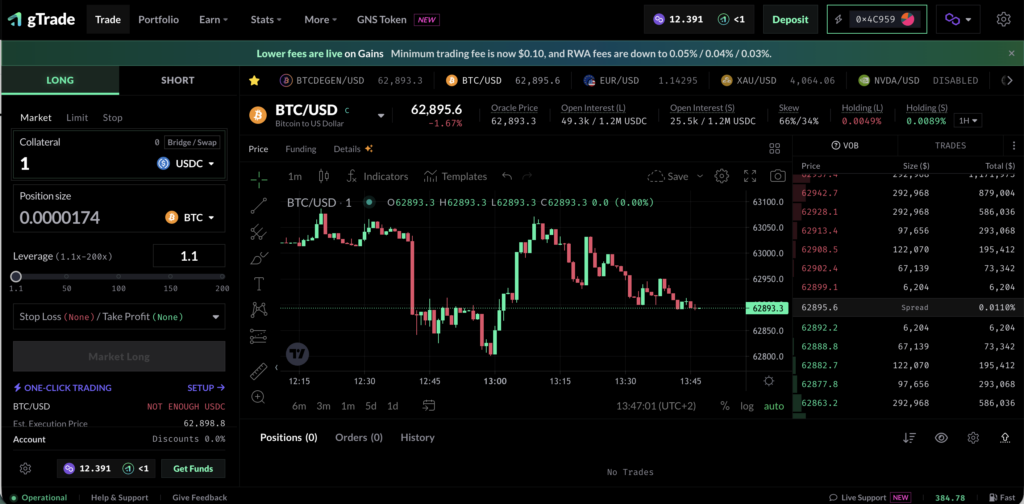
After connecting your wallet, choose the market.
gTrade is useful because it offers more than crypto-only trading.
Depending on current availability, users may access:
Crypto.
Forex.
Commodities.
Indices.
Selected stock markets.
Crypto
Crypto is usually the best starting point for users coming from Bitcoin, Ethereum or altcoin trading.
Popular beginner markets may include BTC/USD and ETH/USD.
Crypto can be volatile, so leverage should stay conservative.
Forex
Forex markets may include major currency pairs such as EUR/USD, GBP/USD or USD/JPY where supported.
Forex pairs often move less than crypto in percentage terms, but high leverage can make them dangerous.
A small forex move at high leverage can still create a major loss.
Commodities and indices
These markets are useful for macro traders who understand gold, oil, stock indices or other non-crypto assets.
Beginners should not trade macro markets just because they are available.
The rule is simple:
Only trade markets you understand.
A platform offering many markets does not mean you need to trade all of them.
Collateral
Collateral is the amount you commit to the trade.
It is the capital exposed to loss.
On gTrade, collateral may be supported in assets such as USDC, DAI, GNS or WETH, depending on network and current platform support.
Collateral is not the same as position size.
Position size equals collateral multiplied by leverage.
Example:
$200 collateral.
5x leverage.
$1,000 position size.
If the market moves against you, losses are measured against the leveraged exposure.
This means a small move can create a large effect on your collateral.
Before entering a trade, ask:
How much collateral am I using?
What is my position size after leverage?
What percentage of my wallet does this represent?
Could I lose the full collateral?
Do I have enough gas to close or adjust the trade?
Am I overexposed?
A responsible trader decides the risk before choosing the leverage.
Not after.
Leverage
Leverage is the most dangerous feature on gTrade.
It is also why many traders use the platform.
Leverage allows a small amount of collateral to control a larger position.
This can increase profits.
It can also increase losses.
A trade with 2x leverage has more room to move than a trade with 50x leverage.
A trade with 100x leverage can be destroyed by a tiny move.
The best leverage is the amount that matches the setup, stop loss and volatility of the market.
A practical guide:
Use 1x to 3x while learning.
Use 3x to 5x for cautious trades.
Use 5x to 10x only with experience.
Use above 10x only with precise risk controls.
Avoid extreme leverage unless you are a specialist.
Do not ask:
“What is the highest leverage I can use?”
Ask:
“What leverage keeps my liquidation price safely beyond my stop loss?”
That is the professional question.
Liquidation
Liquidation is the forced closing of a position when the loss becomes too large for the collateral.
The gTrade interface shows liquidation price.
This number matters.
A long position can be liquidated if price falls.
A short position can be liquidated if price rises.
The higher the leverage, the closer the liquidation price.
A good trade setup should have:
Entry price.
Stop loss.
Take profit.
Liquidation price.
Risk amount.
Position size.
Fee estimate.
Reason for trade.
Your stop loss should usually protect you before liquidation.
If your liquidation price is close to normal market noise, the trade is too aggressive.
A beginner should never open a trade without checking liquidation.
Liquidation is not just a number on the screen.
It is the point where discipline failed or volatility overwhelmed the setup.
Risk Controls
gTrade includes risk controls that traders should use seriously.
Stop loss
A stop loss helps close the trade if price moves against you.
Use it to define your maximum planned loss.
Take profit
A take profit helps close the trade if price reaches your target.
Use it to avoid watching a winning trade reverse.
Max slippage
Max slippage helps cancel a market order if price moves too far before execution.
Use it to avoid poor fills.
Position sizing
Do not risk too much collateral on one trade.
A common beginner mistake is using the right direction but the wrong size.
Separate wallet
Use a dedicated trading wallet.
Never keep your entire portfolio in the same wallet you use for leveraged trading.
Trade journal
Record every trade.
If you do not track your trading, you cannot improve it.
Risk controls do not make trading safe.
They make risk visible.
Visible risk is easier to manage.
Fees and Costs
gTrade traders should understand that fees are based on position size, not just collateral.
If collateral is $100 and leverage is 20x, the position size is $2,000.
Fees are calculated against the larger exposure.
Costs may include:
Opening fee.
Closing fee.
Spread.
Price impact.
Borrowing fees.
Gas fees.
Wallet transaction costs.
This matters because high leverage can make costs more meaningful.
A trade can be right on direction but still weak after fees if the target is too small.
Before opening, check:
Expected entry.
Spread.
Price impact.
Borrowing fee.
Opening cost.
Closing cost.
Gas cost.
Liquidation price.
Net risk.
Do not trade blindly.
The trade ticket is there to be read.
Step-by-Step gTrade Trading Flow
Step 1: Visit gTrade
Open gTrade.
Step 2: Connect wallet
Use a supported wallet on a supported network.
Step 3: Check collateral
Make sure your wallet has supported collateral and gas.
Step 4: Select market
Choose crypto, forex or another supported market.
Step 5: Choose long or short
Long means you expect price to rise.
Short means you expect price to fall.
Step 6: Enter collateral
Use a small amount while learning.
Step 7: Choose leverage
Start low.
Step 8: Review position size
Collateral multiplied by leverage creates exposure.
Step 9: Check liquidation
Make sure liquidation is not too close.
Step 10: Set stop loss and take profit
Plan the exit before entry.
Step 11: Confirm in wallet
Review the transaction before signing.
Step 12: Manage the trade
Monitor PnL, stop loss, take profit and liquidation.
Step 13: Close trade
Close manually or let your exit rules trigger.
Beginner Risk Framework
A simple gTrade beginner framework:
Risk only 0.5% to 1% of trading capital per trade.
Use low leverage.
Use one market at a time.
Trade only liquid markets.
Do not trade during major news at first.
Always use stop loss.
Avoid revenge trading.
Avoid adding to losing trades.
Withdraw some profits when profitable.
Keep a written trade journal.
Review every mistake.
The goal is survival.
Most leveraged traders fail because they overestimate their edge and underestimate position size.
The platform does not liquidate traders.
Bad risk decisions do.
Best Use Cases for gTrade
gTrade is best for:
Self-custodial leverage traders.
Crypto traders who want wallet-based perps.
Forex traders who want on-chain access.
Macro traders who want commodities or indices where available.
DeFi users who do not want centralized exchange custody.
Traders who understand smart contract risk.
Traders who use strict stop loss rules.
gTrade is not ideal for:
Beginners who do not understand leverage.
Users who cannot manage wallets safely.
People who trade emotionally.
Users who want guaranteed execution.
Traders who refuse to use stop losses.
Anyone using rent money, emergency funds or borrowed money.
gTrade is a tool.
It rewards discipline and punishes recklessness.
Final Verdict
gTrade is one of the strongest decentralized leveraged trading platforms for users who want wallet-based access to crypto, forex and other markets.
Use gTrade if you want self-custodial leveraged trading and understand wallet risk, collateral, leverage, liquidation and stop loss management.
Do not use gTrade casually.
The best 2027 approach is:
Use a separate wallet.
Start with small collateral.
Trade one liquid market.
Use low leverage.
Set stop loss and take profit.
Check liquidation before entry.
Read the fee and price impact details.
Journal every trade.
Avoid high leverage until you have consistent risk discipline.
gTrade gives traders access.
Risk management decides whether that access becomes opportunity or liquidation.
FAQ
What is gTrade?
gTrade is a decentralized leveraged trading platform from Gains Network that lets users trade crypto, forex and other markets from a connected wallet.
How do I start trading on gTrade?
Go to gTrade, connect a supported wallet, choose collateral, select a market, set leverage and risk controls, then confirm the trade in your wallet.
Do I need to deposit funds into gTrade?
gTrade is wallet-based, so users trade from a connected wallet rather than depositing into a traditional exchange account.
What markets can I trade on gTrade?
Depending on availability, gTrade supports crypto, forex, commodities, indices and selected stock markets.
What collateral does gTrade support?
Supported collateral may include USDC, DAI, GNS and WETH, depending on network and current platform support.
What is liquidation on gTrade?
Liquidation happens when price moves too far against your leveraged position and your collateral can no longer support the trade.
Is gTrade safe?
gTrade is self-custodial and on-chain, but that does not remove risk. Users still face leverage risk, smart contract risk, oracle risk, wallet risk, gas risk and user error.
Should beginners use leverage on gTrade?
Beginners should start with very low leverage and small collateral. High leverage is not suitable for new traders.
Can I trade forex on gTrade?
Yes, gTrade supports forex markets where available. Forex leverage can be high, so users must manage risk carefully.
What is the biggest mistake on gTrade?
The biggest mistake is using high leverage without checking liquidation price, stop loss, position size and fees.
18+ Educational Disclaimer
This article is for educational purposes only and does not constitute financial advice, investment advice, trading advice, tax advice, legal advice or a recommendation to use gTrade, Gains Network, leverage, forex, crypto derivatives or any trading strategy. Leveraged trading is high risk and can result in the loss of your entire collateral. Risks include liquidation, price volatility, smart contract risk, oracle risk, wallet errors, wrong network use, gas fees, failed transactions, stop loss execution risk, slippage, borrowing fees, platform changes, regulatory changes and user error. Crypto and leveraged trading are intended for adults aged 18 and over.