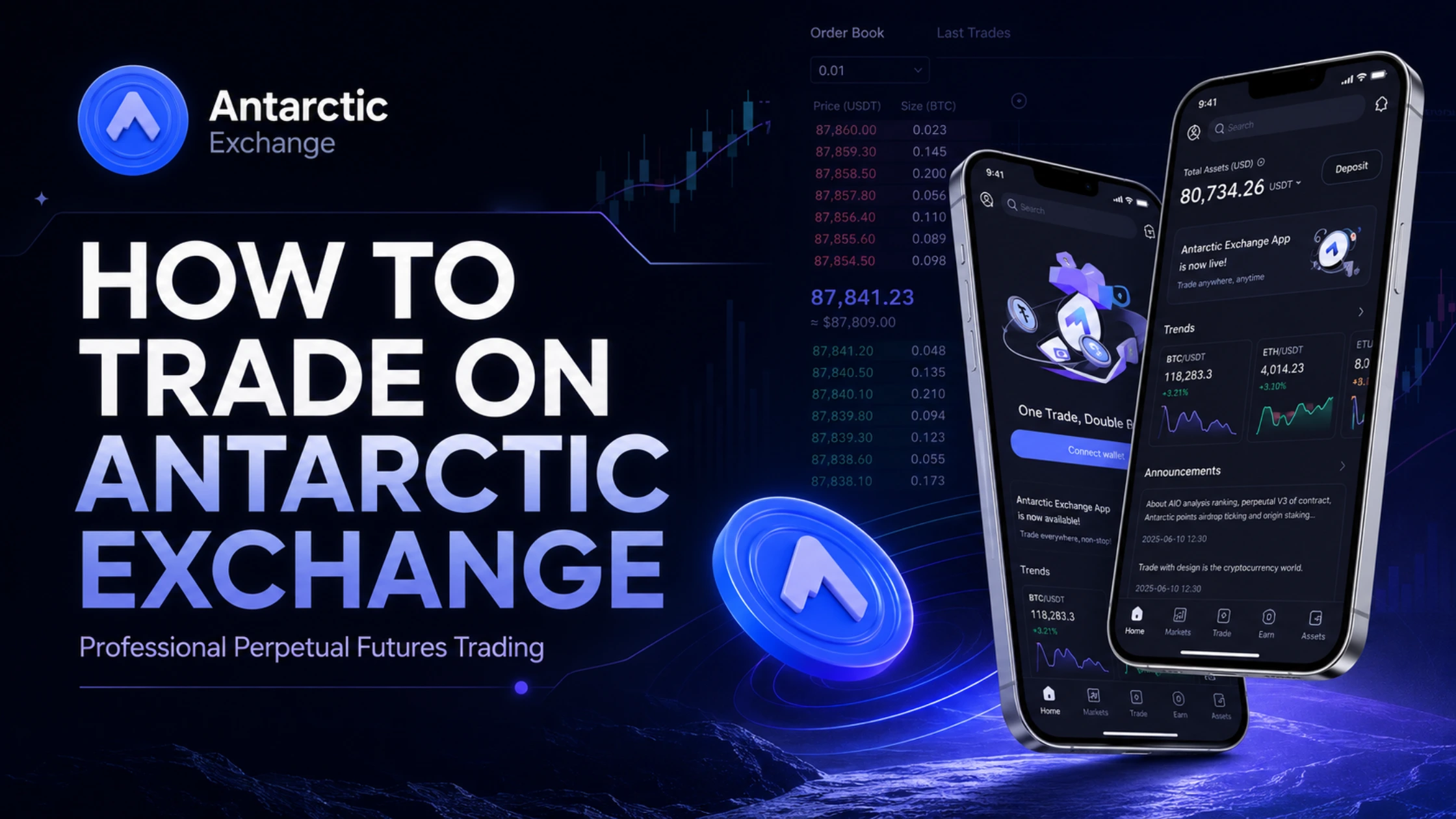
A practical 2027 guide to trading on Antarctic Exchange. Learn what AX offers, how to connect a wallet, deposit USDT, trade perpetual futures, use leverage, understand liquidation, manage ADL risk and build a safer trading process.
Summary
Antarctic Exchange, also known as AX, is a perpetual futures exchange designed for professional traders who want CEX-style performance with on-chain settlement and self-custody principles.
The official platform is Antarctic Exchange.
By 2027, the value proposition is clear:
Fast execution.
Low trading fees.
Wallet-based access.
USDT collateral flow.
Transparent rules.
On-chain settlement.
Professional perpetual futures markets.
Trader-aligned incentives.
But the risk is just as clear:
Antarctic is a leverage platform.
A trader can be correct on direction and still lose if position size, leverage, liquidation price, fees and stop-loss placement are wrong.
The best way to trade on Antarctic is to treat it like a professional derivatives venue, not a casino.
The right process is:
Connect wallet.
Deposit USDT.
Fund the trading account.
Choose one market.
Use low leverage.
Check liquidation.
Understand fees.
Use stop loss.
Track results.
Withdraw and test the full account lifecycle.
Antarctic gives traders infrastructure.
Risk management decides the outcome.
Quick Answer
To trade on Antarctic Exchange in 2027:
Open the official site.
Connect a supported wallet.
Choose a supported chain.
Deposit USDT into the funding account.
Transfer funds into the trading account.
Choose a supported perpetual futures market.
Select long or short.
Choose market or limit order.
Set margin and leverage.
Review position size.
Check maker or taker fee.
Check liquidation price.
Use stop loss and take profit where available.
Place the order.
Monitor margin, PnL and ADL risk.
Close the position according to your plan.
Best beginner route:
Use a separate trading wallet, deposit a small USDT amount, start with one liquid market, use low leverage, avoid aggressive trading frequency, test withdrawals and keep every trade recorded.
Use Antarctic here:
Trade on Antarctic Exchange.
What Antarctic Exchange Offers
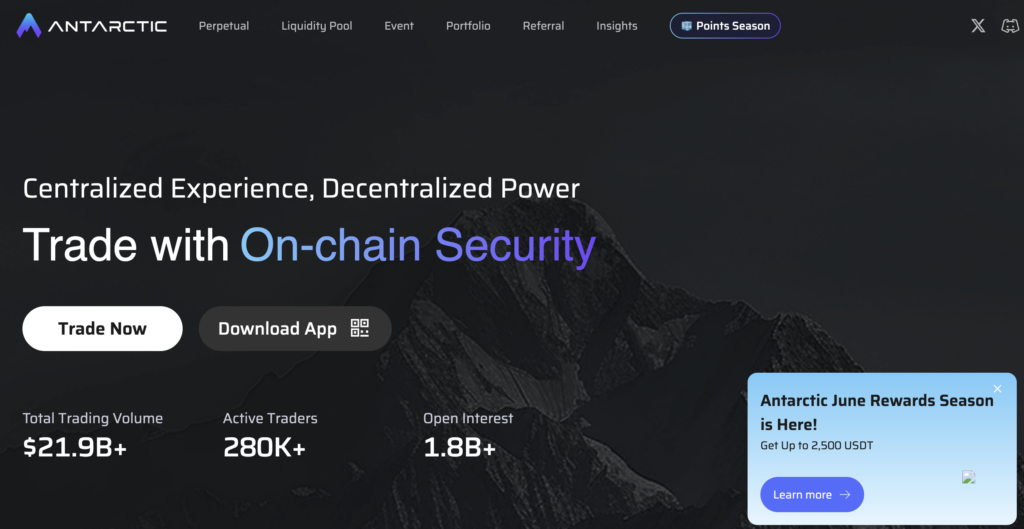
Antarctic Exchange offers perpetual futures trading for users who want professional crypto derivatives infrastructure.
It is built to reduce the gap between centralized exchange execution and decentralized trading principles.
The platform focuses on:
Institutional-grade execution.
Low fees.
Non-custodial settlement.
Rules-based market operations.
Deep liquidity.
Efficient price discovery.
Self-custody fund interaction.
Risk monitoring.
Trader-aligned incentives.
This makes Antarctic different from a simple DeFi swap platform.
A swap platform is for exchanging tokens.
A perp platform is for leveraged exposure.
That difference matters.
With perpetual futures, the trader does not own the underlying asset.
The trader holds a leveraged contract based on price movement.
That means every trade must be managed around:
Margin.
Leverage.
Liquidation.
Fees.
Market depth.
Position limits.
Risk controls.
Antarctic is best for traders who already understand the difference between spot and perps.
Beginners should learn slowly.
Connect Wallet
Antarctic is accessed through wallet connection.
Supported wallet methods may include MetaMask, OKX Wallet, Binance Wallet, Ledger and WalletConnect.
A safe connection process:
Go to Antarctic Exchange.
Confirm the official URL.
Connect a supported wallet.
Choose the supported chain.
Check wallet address.
Check gas balance.
Review permissions.
A serious trading setup should use a dedicated wallet.
Do not use:
A cold storage wallet.
A wallet holding NFTs.
A wallet used for random DeFi apps.
A wallet containing long-term holdings.
Use one wallet for trading.
Keep only trading capital in it.
This limits damage if a wallet mistake, malicious approval or trading error happens.
On-chain trading begins with wallet discipline.
Deposit USDT and Move Funds
Antarctic uses a funding account and trading account model.
The funding account holds deposited assets.
The trading account is where futures trading happens.
A clean process:
Connect wallet.
Select the correct chain.
Deposit USDT.
Wait for the funding account balance.
Transfer USDT into the trading account.
Confirm available trading balance.
Place trades only after the trading account is funded.
This matters because a user may see funds in one account but not have them available for trading until they are transferred correctly.
Before depositing, check:
Supported chain.
Supported token.
Minimum deposit.
Gas cost.
Deposit status.
Funding account balance.
Trading account balance.
Transfer limit.
Withdrawal process.
Antarctic documentation lists a 10 USDT minimum deposit and a 24-hour transfer limit from trading account to funding account.
Users should still check the live interface because limits can change.
Choose a Perpetual Futures Market
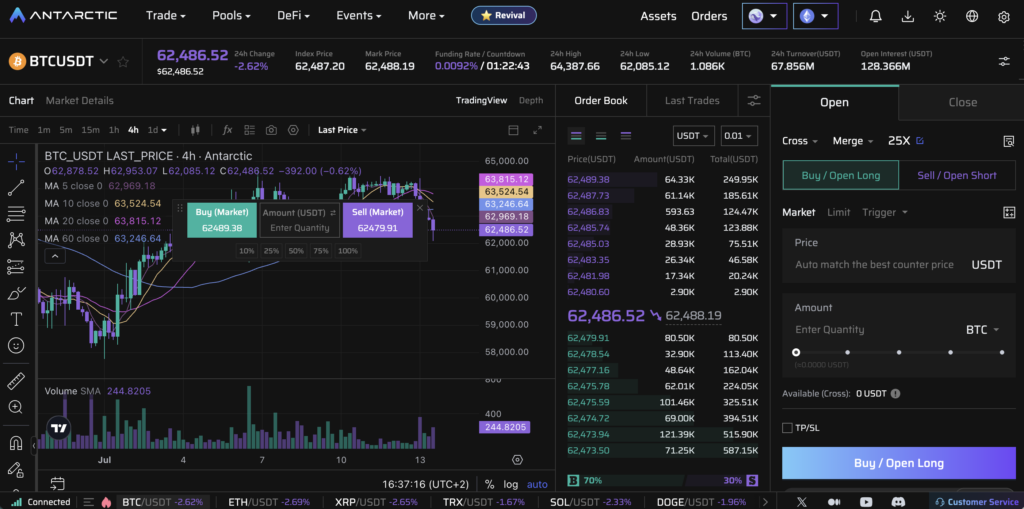
Antarctic is built around perpetual futures markets.
Perpetuals allow traders to go long or short without expiry.
They are useful for:
Directional trading.
Hedging.
Short-term strategies.
Momentum trading.
Market-neutral strategies.
Advanced derivatives setups.
Antarctic lists markets selectively.
That means the platform is not trying to list every token instantly.
The focus is liquidity quality, price integrity and platform stability.
Before choosing a market, check:
Is the market listed?
Is it liquid enough?
What is the spread?
What leverage is available?
Are there position limits?
Does the market move too violently?
Is the setup worth the fee?
Is the risk-to-reward clear?
Beginners should avoid the most volatile markets.
A highly liquid market with cleaner execution is better for learning than a thin market with dramatic candles.
Collateral and Margin
Collateral is the amount used to support a position.
On Antarctic, the current documented trading flow uses USDT.
Margin is the portion of your trading account allocated to a position.
Leverage turns margin into larger exposure.
Example:
You allocate 200 USDT.
You use 5x leverage.
Your exposure is roughly 1,000 USDT.
If the market moves against the trade, losses affect the margin.
If losses become too large, liquidation can occur.
Before trading, understand:
Available balance.
Margin used.
Position size.
Leverage.
Liquidation price.
Maker or taker fee.
Potential loss.
Potential gain.
Stop-loss level.
Take-profit level.
The professional order is:
Choose risk first.
Choose position size second.
Choose leverage last.
Most beginners do it backward.
That is why they get liquidated.
Leverage
Leverage is a tool.
It is not a strategy.
Antarctic may restrict position size when high leverage is selected on certain pairs.
That is a risk-control feature, not an inconvenience.
High leverage can create disorderly losses and increase platform risk.
A practical 2027 leverage framework:
1x to 3x for learning.
3x to 5x for cautious trades.
5x to 10x for experienced traders.
Above 10x only with strict risk controls.
Very high leverage only for specialists.
The main question is:
Where is liquidation relative to my stop loss?
If liquidation is closer than the stop loss, the trade is badly structured.
If a normal market wick can liquidate you, leverage is too high.
Use leverage to size a planned trade.
Do not use leverage to manufacture excitement.
Risk Controls
Antarctic combines trader tools with platform-level risk controls.
A trader should use both.
Stop loss
A stop loss defines the point where the trade idea is wrong.
It should protect the account before liquidation.
Take profit
A take profit helps close winning trades before emotion interferes.
Position sizing
Do not risk too much on one idea.
Use a fixed risk model.
Fee awareness
Maker and taker fees affect high-frequency and low-target trades.
Avoid abusive trading
Antarctic monitors activities such as wash trading, self-matching, exploitative automation and manipulation attempts.
Trade normally.
AML awareness
Large or unusual transfers may be reviewed.
Keep clean records and avoid suspicious flows.
Withdrawal planning
Test withdrawals before scaling capital.
A professional derivatives trader cares about exits before entries.
A beginner often cares only about entry.
Antarctic rewards the first mindset.
Liquidation and ADL
Liquidation is forced position closure after losses become too large for the margin.
ADL means auto-deleveraging.
In extreme conditions, if a liquidated position cannot be closed normally and risk buffers are insufficient, opposing positions may be reduced according to priority.
This is common risk architecture in leveraged markets.
Traders should understand:
Liquidation price.
Margin mode.
Leverage.
Insurance fund risk.
ADL priority indicator if shown.
Market volatility.
Stop loss.
Position concentration.
The best way to reduce liquidation and ADL exposure is to avoid excessive leverage and oversized positions.
A strong trader should not need liquidation to manage risk.
The stop loss should do that first.
Fees
Antarctic’s documentation lists maker and taker fees, with lower tiers for higher-volume users.
The base tier shown in the docs is:
0.05% taker.
0.02% maker.
Higher VIP levels can reduce fees based on 14-day trading volume.
Fees matter because perpetual futures traders often trade more frequently than spot investors.
If a trader scalps small moves, fees can erase the edge.
Before placing an order, check:
Order type.
Maker or taker status.
Position size.
Fee tier.
Spread.
Slippage.
Profit target.
Stop loss.
Net reward-to-risk.
The trade must be large enough in expected edge to justify the cost.
Otherwise, the platform earns while the trader churns.
Step-by-Step Antarctic Trading Flow
Step 1: Open Antarctic
Go to Antarctic Exchange.
Step 2: Connect wallet
Use a supported wallet connection method.
Step 3: Choose chain
Select a supported chain such as Arbitrum, Ethereum or BNB Chain where available.
Step 4: Deposit USDT
Deposit into the funding account.
Step 5: Transfer to trading account
Move funds into the trading account.
Step 6: Choose market
Select a supported perp pair.
Step 7: Choose long or short
Long for upside.
Short for downside.
Step 8: Choose order type
Use market for immediate execution.
Use limit for price control.
Step 9: Set margin and leverage
Start small and low.
Step 10: Review liquidation
Do not skip this.
Step 11: Add risk controls
Use stop loss and take profit where available.
Step 12: Place order
Review before confirming.
Step 13: Manage trade
Monitor PnL, margin and liquidation.
Step 14: Close trade
Exit according to your plan.
Step 15: Review
Record what happened and why.
Best Beginner Strategy
A simple 2027 Antarctic strategy:
Use one wallet for trading.
Deposit only risk capital.
Use one market.
Use one setup.
Use low leverage.
Use a stop loss.
Use a take profit.
Avoid revenge trading.
Avoid overtrading.
Avoid wash-like or self-matching behavior.
Track fees.
Test withdrawals.
Review every trade.
Do not trade only to earn incentives.
Do not increase size because of a winning streak.
The goal is consistency.
Not excitement.
Perpetual futures punish emotional traders faster than spot markets.
Final Verdict
Antarctic Exchange is a serious perpetual futures platform for users who want professional execution, low fees, transparent market operations and on-chain settlement.
Use Antarctic Exchange if you want a trader-focused perp venue built around execution quality, self-custody principles and market integrity.
Do not use Antarctic if you do not understand leverage.
The best 2027 approach is:
Dedicated wallet.
Small USDT deposit.
Clear transfer between funding and trading accounts.
One liquid market.
Low leverage.
Defined stop loss.
Defined take profit.
Checked liquidation price.
Fee-aware trading.
Clean records.
Tested withdrawal process.
Antarctic gives traders access to professional-style perps.
Risk control decides whether that access becomes a strategy or a liquidation event.
FAQ
What is Antarctic Exchange?
Antarctic Exchange, or AX, is a decentralized perpetual futures exchange designed for institutional-grade execution, low fees, non-custodial settlement and trader-aligned incentives.
How do I trade on Antarctic?
Connect a wallet, choose a supported chain, deposit USDT, transfer funds to the trading account, choose a perpetual futures market, set leverage and risk controls, then place an order.
What wallets can I use?
Antarctic supports wallet connection methods such as MetaMask, OKX Wallet, Binance Wallet, Ledger and WalletConnect where available.
Which chains does Antarctic support?
Antarctic documentation lists Arbitrum, Ethereum and BNB Chain as supported chains.
What collateral does Antarctic use?
The documented flow uses USDT deposits and trading-account funding.
What is the minimum deposit?
The docs list a 10 USDT minimum deposit, but users should always check the live interface before sending funds.
What are Antarctic’s fees?
The documented base tier is 0.05% taker and 0.02% maker, with lower fee tiers for higher 14-day trading volume.
What is liquidation?
Liquidation is forced closure of a leveraged position when margin can no longer support the loss.
What is ADL?
ADL, or auto-deleveraging, is a risk mechanism that can reduce opposing positions in extreme liquidation scenarios.
Is Antarctic safe for beginners?
Antarctic is a perpetual futures platform. Beginners should only use it with small size, low leverage and strict stop-loss rules.
18+ Educational Disclaimer
This article is for educational purposes only and does not constitute financial advice, investment advice, trading advice, tax advice, legal advice or a recommendation to use Antarctic Exchange, perpetual futures, leverage, crypto derivatives or any trading strategy. Perpetual futures trading is high risk and can result in the loss of your entire margin. Risks include liquidation, market volatility, smart contract risk, exchange-interface risk, wallet errors, wrong network use, transfer delays, funding-account mistakes, ADL, fee impact, slippage, risk-control restrictions, AML reviews, regulatory changes and user error. Crypto and leveraged trading are intended for adults aged 18 and over.