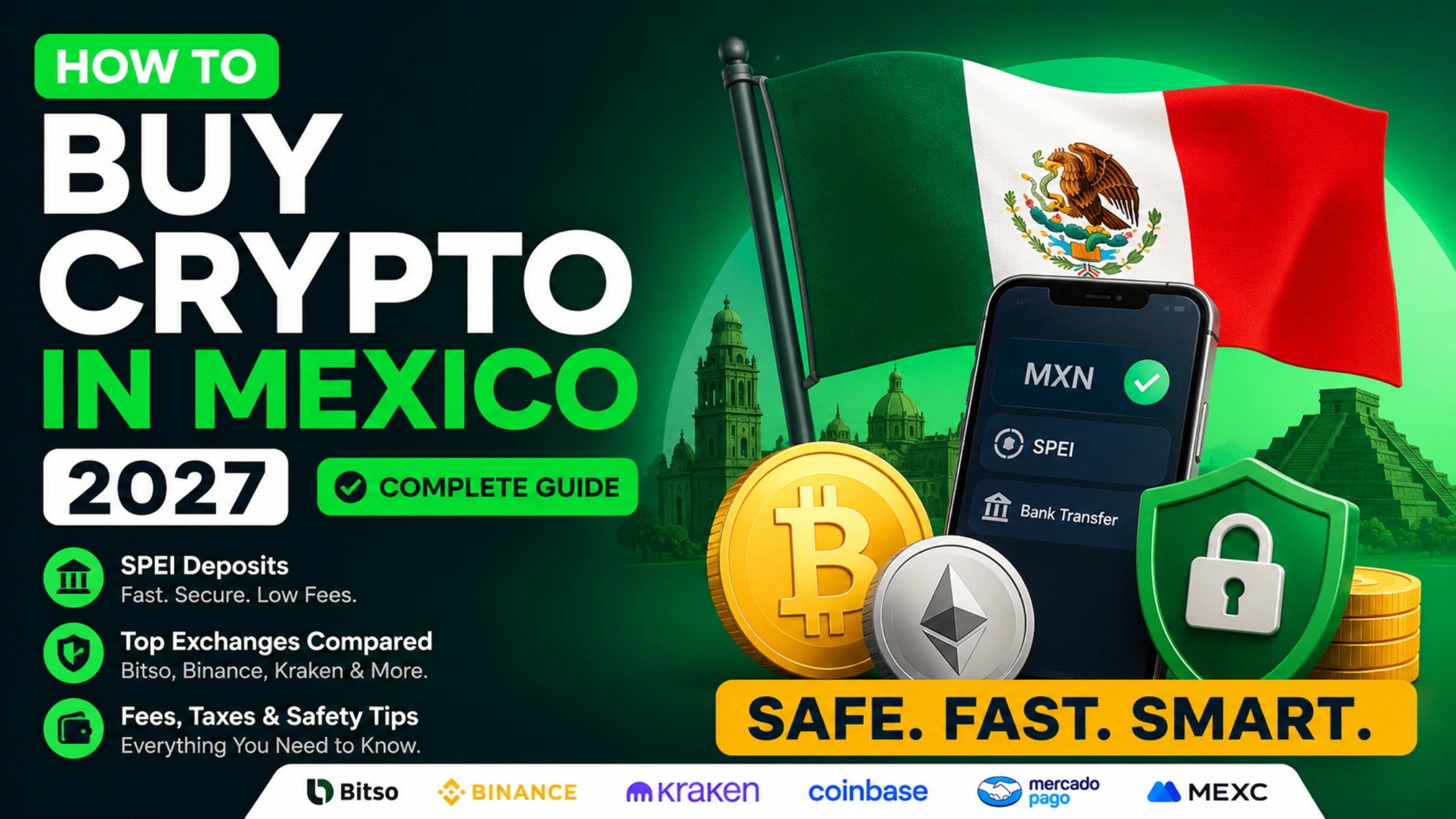
Learn how to buy crypto in Mexico in 2027 using SPEI, bank transfers and trusted exchanges. Compare Bitso, Binance, Kraken, Coinbase, fees, taxes and wallets.
Last verified: 15 July 2026
Affiliate disclosure: Some links in this guide are affiliate links. Decentralised News may earn a commission if you register or purchase through them, at no additional cost to you. Affiliate relationships do not determine rankings. Local payment support, platform eligibility, total costs, security, liquidity and suitability are considered first.
Summary
- Mexican residents can legally buy, hold, sell and transfer crypto assets, but cryptocurrencies are not legal tender and are not backed by Banco de México or the federal government.
- SPEI bank transfer is generally the best way to buy crypto in Mexico because it allows fast MXN deposits and is usually cheaper than card purchases.
- Bitso is our best overall local platform because it offers direct MXN balances, free SPEI deposits and withdrawals, Spanish-language support and a Mexico-focused user experience.
- Binance is our leading affiliate-supported option for low trading fees, broad asset selection and active trading.
- Kraken is a strong affiliate-supported choice for security-conscious users, but MXN deposits are automatically converted to USD and MXN withdrawals carry a percentage fee.
- Coinbase is available in Mexico and offers a beginner-friendly interface, but users should inspect the final purchase preview because fees vary by payment method, order size and market conditions.
- Mercado Pago is one of the simplest ways to buy small amounts of selected crypto directly from an existing payments account.
- Crypto exchange services offered outside Mexico’s traditional financial institutions may operate under a different legal framework from banks and regulated fintech payment institutions.
- Gains from selling crypto should be declared to the SAT. Mexico does not provide a simple universal “crypto tax rate” that applies to every investor or transaction.
- Exchange balances are not ordinary bank deposits and should not be assumed to have deposit insurance or government guarantees.
- Long-term holders should consider self-custody only after understanding seed phrases, wallet networks and irreversible blockchain transactions.
The Best Crypto Exchanges in Mexico for 2027
Platform | Best for | MXN funding | Indicative trading model | Crypto withdrawals | Main limitation |
Bitso | Best overall Mexican platform | Free SPEI deposits and withdrawals | Maker-taker fees starting at 0.60% maker and 0.78% taker for lower-volume MXN markets | Yes, for supported assets and networks | Entry-level MXN trading fees can be higher than global exchanges |
Best affiliate-supported option for low fees and altcoins | MXN deposits through supported SPEI services | Standard spot fees start at 0.10% maker and taker | Yes | Legal entity, payment provider and product eligibility should be checked separately | |
Best affiliate-supported option for security-focused users | Free SPEI deposits | Volume-based Kraken Pro maker-taker fees | Yes | MXN converts automatically to USD; MXN withdrawals cost 0.5% | |
Coinbase | Best global beginner interface | Approved Mexican payment methods, including supported bank and card options | Variable transaction fee and spread shown before confirmation | Yes, for eligible assets | Final purchase costs can be less predictable |
Mercado Pago | Easiest for small and occasional purchases | Existing Mercado Pago balance | App-based quoted purchase and sale price | Transfers available for supported assets | Limited crypto selection and fewer advanced trading tools |
Advanced altcoin access | Mainly card, third-party or crypto funding | Promotional and market-specific trading fees | Yes | Not the strongest primary MXN on-ramp and carries offshore-platform risk |
Our Verdict
The best route for most Mexican residents is:
- Open an account with a platform that expressly supports Mexico.
- Complete identity verification using accurate personal information.
- Deposit pesos through SPEI.
- Compare the actual exchange rate, spread and trading fee.
- Use an order-book interface where available.
- Buy Bitcoin, Ether, a stablecoin or another supported asset.
- Save the transaction record in MXN for tax purposes.
- Withdraw long-term holdings to a personal wallet after completing a small test transfer.
Bitso is the best overall local option because it is designed around Mexican pesos, local banking rails and Spanish-language support.
For affiliate-supported recommendations, Binance is the strongest choice for lower spot trading fees and broad asset access.
Binance referral code: CPA_00SXKU7IO9
Kraken is the better affiliate-supported choice for users who place greater weight on an established international trading venue and transparent SPEI funding.
Kraken referral code: QjZ0L3
Is Crypto Legal in Mexico in 2027?
Mexican residents can generally buy, sell, hold and transfer crypto assets.
Cryptocurrencies are not, however:
- Mexican legal tender
- Issued by Banco de México
- Guaranteed by the federal government
- Equivalent to insured bank deposits
- Automatically classified as regulated financial products
Banco de México states that virtual assets do not fulfil the traditional functions of money reliably and that financial institutions should not expose consumers directly to their risks. Its framework restricts customer-facing virtual-asset activity by banks and regulated financial-technology institutions unless the applicable authorisation requirements are satisfied.
Importantly, Banco de México also explains that these restrictions do not prevent companies outside the traditional financial-institution framework from providing services such as the purchase and sale of virtual assets. This distinction explains why Mexican residents can use crypto exchanges even though banks are generally not permitted to offer ordinary retail crypto accounts.
Crypto is not legal tender
A merchant can voluntarily accept Bitcoin or another crypto asset, but it is not required to do so.
CONDUSEF warns that people and businesses accepting virtual currencies act at their own risk because of price volatility, operational uncertainty and the possibility of financial loss.
Prices, contracts, invoices and tax records should ordinarily still be expressed in Mexican pesos where required.
Mexico’s Fintech Law and Crypto Exchanges
Mexico’s Fintech Law created a framework for electronic-payment institutions, crowdfunding institutions and certain innovative financial services.
It did not turn every crypto exchange into a licensed Mexican bank or regulated securities exchange.
This creates three distinct categories that users must not confuse:
1. Banks and regulated fintech institutions
These entities are supervised under Mexico’s financial laws. Their direct use of virtual assets is restricted and may require Banco de México authorisation.
2. Payment-service providers
A payment institution may provide the SPEI account or peso-transfer infrastructure connected to an exchange.
For example, Bitso’s Mexican SPEI infrastructure is connected through NVIO Pagos México, an electronic-payment institution authorised and supervised by the CNBV. This does not mean every crypto asset or trading service offered through the wider Bitso ecosystem has the same legal status as a regulated peso payment account.
3. Virtual-asset exchanges outside the financial-institution framework
Companies that professionally exchange, custody or transfer virtual assets may fall under Mexico’s anti-money-laundering rules as providers of a designated vulnerable activity.
The SAT identifies the habitual and professional exchange of virtual assets through electronic platforms, including custody and transfer services, as a vulnerable activity under Mexico’s anti-money-laundering framework.
Users should therefore avoid treating phrases such as “registered,” “regulated,” “authorised” and “licensed” as interchangeable.
The Best Ways to Buy Crypto in Mexico
1. SPEI Bank Transfer
SPEI is generally the best method for buying crypto in Mexico.
It offers:
- Direct deposits in Mexican pesos
- Near-real-time bank transfers
- Lower costs than most card purchases
- Broad availability through Mexican banks
- Transfer records that simplify reconciliation
- Better suitability for larger purchases
- Less foreign-exchange friction
Bitso lists MXN deposits and withdrawals through SPEI as free. Deposits are normally credited within 24 hours, although transfers often arrive much faster when banking and compliance checks are completed normally.
Kraken supports free MXN deposits through SPEI with a published minimum of MX$150 and processing of up to approximately 20 minutes. The deposited pesos are automatically converted to US dollars because Kraken does not retain an MXN cash balance for the customer.
Binance also provides MXN deposit instructions through supported SPEI payment infrastructure. Users should confirm the current payment provider, deposit limits, costs and account-name requirements inside the app before sending funds.
How to deposit through SPEI safely
Before transferring:
- Generate the CLABE inside the authenticated exchange account.
- Confirm the beneficiary and institution.
- Ensure your exchange profile is fully verified.
- Send funds from an account in your own legal name.
- Include the required reference.
- Start with a small test deposit.
- Save the SPEI receipt.
- Verify the credit before sending a larger amount.
Bitso advised users in 2026 to update saved CLABE information following changes to its SPEI infrastructure, illustrating why bank details should always be copied from the current account dashboard rather than reused indefinitely.
2. Debit or Credit Card
Cards are convenient but often cost more.
The final card-funded purchase may include:
- Card-processing fees
- Exchange trading fees
- A spread
- Foreign-exchange conversion
- Bank cash-advance charges
- International transaction fees
- A temporary withdrawal hold
The card issuer may also decline the purchase or request additional authentication.
Use cards only after comparing the final amount of crypto received with the result from a SPEI-funded trade.
3. Mercado Pago Balance
Mercado Pago allows Mexican users to buy and sell selected crypto assets from inside its app.
Its crypto service supports small purchases and includes Bitcoin and other selected assets. The platform also provides transfer functionality for supported crypto assets.
This route is most suitable for:
- Small first purchases
- Existing Mercado Pago users
- Buyers who value simplicity
- Occasional purchases
- Users who do not need advanced orders
It is less suitable for:
- Professional trading
- Large purchases
- Broad altcoin exposure
- Advanced charting
- Users seeking maximum control over execution
4. Peer-to-Peer Trading
P2P marketplaces connect buyers and sellers directly while the platform may hold the crypto in escrow.
P2P can support:
- SPEI
- Bank transfers
- Fintech accounts
- Digital wallets
- Other locally available payment methods
It also creates additional risks:
- Reversed payments
- Payments from third parties
- Stolen bank accounts
- Fake transfer receipts
- Off-platform communication
- Chargebacks
- Account freezes
- Money-laundering exposure
- Counterparty disputes
Never release crypto merely because a buyer sends a screenshot. Confirm that the money has been credited and is available in your own banking account.
Never agree to move the transaction outside the platform’s escrow process.
5. Transfer Crypto From Another Wallet
A person who already owns crypto can deposit it into a Mexican or international exchange.
Before transferring:
- Confirm the exact asset.
- Confirm the supported blockchain network.
- Check whether a memo or destination tag is required.
- Copy the address from the official application.
- Send a small test amount.
- Wait for confirmation.
- Save the transaction hash.
- Send the balance only after the test arrives.
Do not assume that USDT on Ethereum, Tron, Solana, Polygon or another network is interchangeable. Sending over an unsupported network can result in permanent loss.
6. Cash or Crypto ATMs
Some services allow crypto purchases with cash, but these routes may carry high spreads and fees.
Cash-based crypto purchasing also appears frequently in:
- Government impersonation scams
- Romance scams
- Fake investment schemes
- Extortion attempts
- Technology-support fraud
- Fake account-protection calls
No legitimate bank, government agency, police officer, tax authority or exchange representative should instruct a person to deposit cash into a crypto machine to secure an account or settle an urgent liability.
The Best Crypto Platforms in Mexico Reviewed
1. Bitso: Best Overall Mexican Crypto Platform
Bitso is the strongest overall choice for Mexican residents who want a direct peso on-ramp.
Why Bitso stands out
- MXN accounts
- Free SPEI deposits
- Free SPEI withdrawals
- Spanish-language interface
- Mexican banking integration
- Beginner purchase interface
- Bitso Alpha order-book trading
- Supported crypto withdrawals
- Regional focus across Latin America
- Business and payment infrastructure
Bitso’s exchange uses a maker-taker fee structure.
For MXN markets, the published entry tier for users trading less than MX$20,000 over 30 days was:
- Maker fee: 0.60%
- Taker fee: 0.78%
Rates decline at higher volume levels.
A market purchase of MX$10,000 at the entry taker rate could therefore generate a trading commission of approximately MX$78 before accounting for spread, slippage or a later blockchain withdrawal.
Bitso Alpha gives users more control over the order price than the simplified buy-and-sell interface.
Best for: Beginners, Mexican peso users, recurring buyers and users who prioritise local support.
Main limitation: Entry-level MXN trading fees are higher than Binance’s standard spot fee.
2. Binance: Best Low-Fee Affiliate-Supported Exchange
Referral code: CPA_00SXKU7IO9
Binance is our leading affiliate-supported option for Mexican residents seeking low spot trading fees, liquidity and broad asset selection.
Why Binance stands out
- MXN funding through supported SPEI services
- Broad spot-market selection
- Deep liquidity on major pairs
- Standard spot fees beginning at 0.10%
- Discounted fees when paid with BNB
- Limit, market and stop orders
- Recurring and conversion features
- P2P marketplace
- Crypto withdrawals to personal wallets
- Spanish-language interface
Binance’s published standard spot rate for a regular user was 0.10% maker and 0.10% taker. Paying eligible trading fees with BNB reduced the displayed rate to 0.075%.
A MX$10,000 equivalent spot trade at 0.10% would generate a trading commission of approximately MX$10, excluding funding fees, spread, slippage and withdrawal costs.
What to watch
Binance’s crypto platform, local fiat payment provider, P2P marketplace and individual products may operate under different entities and terms.
Users should confirm:
- Whether MXN deposits are currently available
- The identity of the SPEI provider
- Deposit and withdrawal limits
- Product eligibility
- Whether futures or other leveraged products are lawful and appropriate
- Current account terms
- Current token availability
Best for: Low-cost spot trading, active users, altcoin access and advanced order types.
Not ideal for: Someone who wants the simplest Mexican-first experience or assumes every Binance product has the same local regulatory status.
3. Kraken: Best Security-Focused Affiliate-Supported Option
Referral code: QjZ0L3
Kraken is a strong choice for Mexican users who want an established global exchange, professional trading tools and direct SPEI access.
Why Kraken stands out
- Free MXN deposits through SPEI
- Processing listed at up to approximately 20 minutes
- Kraken Pro order books
- Volume-based maker-taker fees
- Crypto deposits and withdrawals
- Advanced security controls
- Broad international market access
- Published funding instructions
Important MXN limitation
Kraken automatically converts deposited Mexican pesos into US dollars.
This creates an additional element that users must inspect carefully:
- The MXN-to-USD conversion rate
- The applied spread
- Trading-pair selection
- USD-to-MXN conversion when withdrawing
Kraken’s MXN withdrawal method uses SPEI, has a MX$150 minimum and carries a published fee of 0.5%.
A MX$10,000 withdrawal at 0.5% could cost approximately MX$50 before considering the currency-conversion rate.
Kraken revised its cross-platform fee-tier system in July 2026, so users should review the live Kraken Pro fee tier rather than relying on older comparison articles.
Best for: Security-conscious users, order-book traders and investors who want an international exchange with SPEI support.
Not ideal for: Users who want to hold a native MXN cash balance or make frequent low-cost peso withdrawals.
4. Coinbase: Best Global Beginner Interface
Coinbase permits eligible users in Mexico to buy supported crypto assets through approved payment methods.
Its Mexico purchase pages identify bank accounts, debit cards and wire transfers as possible funding methods, subject to account eligibility.
Why Coinbase stands out
- Familiar global brand
- Beginner-friendly interface
- Broad educational material
- Supported crypto withdrawals
- Simple recurring-purchase experience
- Strong US institutional ecosystem
- Wide selection of supported assets
Coinbase calculates the purchase fee at the time of the order. The cost can depend on location, payment method, order size, volatility and liquidity. The final charge appears in the preview before confirmation.
Best for: Beginners who want a polished global app and are willing to inspect each purchase preview.
Not ideal for: Buyers seeking the most predictable MXN fee schedule or the strongest direct SPEI integration.
5. Mercado Pago: Best for Small and Convenient Purchases
Mercado Pago allows users to purchase selected crypto assets without leaving the payments application.
It supports purchases from very small MXN amounts and provides crypto transfer functionality for supported assets.
Why Mercado Pago stands out
- Existing Mexican payments account
- Very low purchase minimum
- Simple interface
- Direct access from app balance
- Selected crypto transfers
- Suitable for first-time users
Main limitations
- Limited selection
- No full professional order book
- Less control over execution
- Fewer advanced trading tools
- Quoted price should be compared with exchange order books
Best for: Small, occasional purchases by existing Mercado Pago users.
Not ideal for: Large portfolios, professional trading or broad altcoin exposure.
6. MEXC: Best for Advanced Altcoin Access
Referral code: 16yJL
MEXC is relevant to Mexican traders seeking a wider selection of emerging crypto assets.
Mexico was not listed among MEXC’s expressly prohibited jurisdictions at the time of verification, although its prohibited-country list is non-exhaustive and can change.
MEXC markets 0% maker fees on qualifying spot activity, although taker fees, promotional conditions and pair-specific charges can differ.
Why MEXC can be useful
- Broad altcoin selection
- Early token listings
- Low or promotional trading fees
- Spot trading tools
- Crypto withdrawals
- High-intent appeal for experienced traders
Why it should not be the primary Mexican on-ramp
- MXN funding is less straightforward than Bitso or Binance
- Card and third-party gateways may cost more
- Local legal and consumer-protection recourse may be limited
- Small-cap tokens can be highly volatile
- Liquidity varies greatly between pairs
Best for: Experienced users acquiring specialist altcoins after funding through an established on-ramp.
Not ideal for: Beginners making their first peso-funded purchase.
How to Buy Bitcoin in Mexico Step by Step
The following example uses Binance because it is the leading affiliate-supported platform in this guide.
Step 1: Open the Official Account
Visit the Binance registration page.
Confirm:
- The domain is correct.
- The connection is secure.
- The page is not a paid imitation.
- The referral code is CPA_00SXKU7IO9.
- The platform still supports Mexican residents.
- The required MXN funding method is available.
Step 2: Complete Identity Verification
You may be asked for:
- Full legal name
- Date of birth
- Residential address
- Mobile number
- Government-issued identification
- CURP
- RFC
- Facial or liveness verification
- Occupation
- Source of funds
- Intended account activity
Use accurate information. Do not use another person’s bank account or identity.
Step 3: Protect the Account
Enable:
- Passkey or authenticator-based two-factor authentication
- Anti-phishing code
- Withdrawal address allowlist
- Device-management alerts
- Funding notifications
- Unique password
- Separate secure email account
Avoid relying on SMS alone when stronger authentication is available.
Step 4: Deposit Mexican Pesos
Select MXN and choose the supported SPEI option.
Before sending:
- Confirm the current beneficiary.
- Copy the CLABE from the official app.
- Check the minimum and maximum.
- Send from your own bank account.
- Include the required reference.
- Start with a test deposit.
- Retain the SPEI receipt.
Step 5: Select the Spot Market
Beginners should avoid:
- Leveraged tokens
- Margin trading
- Futures
- Options
- Copy trading
- High-yield products they do not understand
Choose the spot market for the intended asset.
Step 6: Compare Convert With Spot Trading
The Convert interface is simpler but may incorporate the cost into the quoted exchange rate.
The Spot interface provides an order book and clearer control over the execution price.
Compare both before buying.
Step 7: Place the Order
For a limit order:
- Choose the relevant pair.
- Enter the maximum price.
- Enter the amount.
- Review the fee.
- Submit the order.
- Wait for execution.
A limit order is not guaranteed to fill.
Step 8: Record the Transaction
Save:
- MXN deposited
- Crypto purchased
- Date and time
- Exchange rate
- Trading fee
- Transaction identifier
- Wallet address
- Withdrawal cost
- MXN market value
These records are essential for tax reporting.
Step 9: Consider Self-Custody
Long-term holders can consider transferring crypto to a Ledger hardware wallet.
Before withdrawing:
- Confirm the network.
- Confirm the address.
- Send a small test.
- Verify the test transaction.
- Keep the recovery phrase offline.
- Never share the recovery phrase.
How Much Does It Cost to Buy MX$10,000 of Bitcoin?
The true cost is:
Deposit fee + spread + trading fee + slippage + withdrawal fee
Example 1: Bitso Market Order
Using the published entry taker fee:
- SPEI deposit: MX$0
- MX$10,000 trade at 0.78%: approximately MX$78
- Spread and slippage: variable
- Bitcoin withdrawal: network-dependent
Estimated trading commission before withdrawal: MX$78.
Example 2: Bitso Limit Order
Using the entry maker fee:
- SPEI deposit: MX$0
- MX$10,000 qualifying maker trade at 0.60%: approximately MX$60
- Spread: market-dependent
- Withdrawal: network-dependent
The order must rest on the book and execute as maker liquidity to receive the maker rate.
Example 3: Binance Spot Trade
Using the published standard rate:
- SPEI deposit: check current provider
- MX$10,000 trade at 0.10%: approximately MX$10
- Spread and slippage: variable
- Crypto withdrawal: network-dependent
Paying eligible fees with BNB could reduce the displayed fee to approximately 0.075%, equivalent to MX$7.50 on a MX$10,000 trade.
Example 4: Kraken
Kraken’s complete cost can include:
- Free SPEI deposit
- MXN-to-USD conversion
- Kraken Pro trading fee
- Spread and slippage
- Crypto withdrawal fee
If the user later withdraws MX$10,000 through SPEI, the published 0.5% withdrawal fee would equal approximately MX$50.
Are Crypto Holdings Insured in Mexico?
Crypto assets should not be treated as insured bank deposits.
Bitcoin, Ether, stablecoins and other tokens are not backed by Banco de México or guaranteed by the federal government. SAT guidance also notes that virtual-asset operations do not represent ordinary currencies, financial services or financial products backed by financial institutions.
A platform may separately maintain:
- Crime insurance
- Custody insurance
- Cold-storage procedures
- Proof-of-reserves reporting
- Segregated customer accounts
- Contractual compensation arrangements
These measures do not provide the same protection as statutory bank-deposit insurance.
Crypto Taxes in Mexico
Profits from selling crypto should not be treated as tax-free merely because the asset is digital or held on an offshore exchange.
PRODECON has stated that a taxpayer who sells cryptocurrency at a gain must declare the profit to the SAT and pay the applicable tax.
Mexico does not currently provide one simple, comprehensive crypto-tax code covering every possible transaction.
The treatment may depend on:
- Whether the taxpayer is an individual or company
- Whether the activity is occasional or habitual
- Whether the transaction is a sale, exchange or payment
- Whether crypto is received as business income
- The taxpayer’s applicable regime
- Whether VAT is relevant
- The residency of the parties
- The supporting invoices and records
- Whether the transaction is conducted professionally
Transactions that may require tax analysis
- Selling crypto for MXN
- Selling crypto for USD
- Swapping Bitcoin for Ether
- Exchanging crypto for a stablecoin
- Spending crypto
- Receiving crypto for work
- Receiving staking or mining rewards
- Accepting crypto in a business
- Gifting or transferring ownership
- Trading frequently as a commercial activity
Buying and holding
Purchasing crypto and continuing to hold it generally does not itself produce a realised sale profit.
The investor should still retain the acquisition records because they establish the cost basis used when the crypto is later disposed of.
Crypto-to-crypto swaps
A swap should not automatically be treated as non-taxable merely because no pesos reach a bank account.
Mexican tax rules recognise exchanges and transfers of property as potentially relevant disposals. Taxpayers should document the MXN value of both assets at the time of the transaction and obtain professional advice.
Records to retain
Keep:
- Date and time
- Asset and quantity
- MXN value
- Acquisition cost
- Sale proceeds
- Trading fees
- Blockchain fees
- Exchange statements
- SPEI receipts
- Wallet addresses
- Transaction hashes
- Proof of transfers between personal wallets
- Invoices and business records
- Annual account exports
Tax software such as Koinly can help consolidate exchange and wallet data. Its calculations should be reviewed by a Mexican tax professional because generic crypto software may not apply Mexico’s legal classification correctly.
Tax warning: Crypto taxation in Mexico remains fact-specific. This guide does not determine whether a particular transaction falls under disposal-of-property income, business activity, VAT or another regime.
Anti-Money-Laundering Requirements
Professional virtual-asset exchange and custody services can constitute vulnerable activities under Mexico’s anti-money-laundering law.
Providers may be required to:
- Identify customers
- Verify beneficial ownership
- Retain transaction records
- Monitor activity
- Submit notices above applicable thresholds
- Respond to authority requests
- Implement compliance procedures
The SAT updated vulnerable-activity identification and reporting thresholds following amendments published in July 2025. Users should expect platforms to request additional information for high-value, unusual or linked transactions.
This does not mean every large transaction is suspicious.
It does mean users should be prepared to document:
- Salary or business income
- Sale of an asset
- Investment proceeds
- Inheritance
- Savings
- Source exchange
- Wallet ownership
- Purpose of transfer
Do not divide transactions solely to avoid compliance controls.
How to Store Crypto Safely
Leaving Crypto on an Exchange
Advantages:
- Easy trading
- Password recovery
- Customer support
- Convenient conversion to pesos
- Simpler portfolio display
Risks:
- Platform insolvency
- Account freeze
- Cyberattack
- Withdrawal restrictions
- Phishing
- Custodian failure
- Legal or banking disruption
Using a Personal Wallet
Advantages:
- Control of private keys
- Reduced exchange-counterparty exposure
- Direct blockchain access
- Portability between services
Risks:
- Lost recovery phrase
- Wrong address
- Wrong network
- Malicious smart contract
- Fake wallet application
- Physical loss
- No central recovery service
Recovery phrase rules
Never:
- Photograph it
- Email it
- Save it in cloud storage
- Enter it into a website
- Share it with support
- Give it to an adviser
- Send it through WhatsApp
- Type it into an unsolicited application
Anyone with the recovery phrase can control the wallet.
Crypto Scams Targeting Mexican Users
Fake Investment Platforms
The site shows fabricated profits but blocks withdrawals unless the victim pays a tax, insurance fee or liquidity charge.
WhatsApp and Telegram Advisers
A stranger offers trading signals, managed accounts or guaranteed returns and directs the user to an unknown exchange.
Romance Scams
The fraudster builds trust over weeks or months before recommending a fake crypto investment.
Exchange Impersonation
A caller claims that an exchange account is at risk and asks for:
- Password
- Verification code
- Screen sharing
- Remote access
- Seed phrase
- Crypto transfer
Legitimate support does not require a recovery phrase.
Fake SPEI Receipts
A counterparty sends an edited screenshot that appears to show payment.
Verify funds through your own bank account.
Government Impersonation
A caller pretends to represent:
- SAT
- Banco de México
- CONDUSEF
- CNBV
- Police
- Prosecutors
- A bank
The caller then demands an urgent crypto payment.
Mexico’s public-security authorities warn about volatility, fraud and other risks associated with crypto use, while CONDUSEF advises consumers not to provide financial information or make payments through links received by social media, messaging applications or unsolicited communications.
Frequently Asked Questions
What is the best crypto exchange in Mexico for 2027?
Bitso is the best overall Mexican platform because of its MXN support, free SPEI transfers and local user experience. Binance is our best affiliate-supported option for lower fees and broader market access.
What is the cheapest way to buy crypto in Mexico?
A free SPEI deposit followed by a low-fee spot order is normally cheaper than buying with a card. Binance generally has lower published entry-level trading fees than Bitso, but users must compare the complete quote and funding conditions.
Can I buy Bitcoin with SPEI?
Yes. Bitso, Binance and Kraken support SPEI-related MXN funding, subject to current account eligibility and provider conditions.
Is Bitcoin legal in Mexico?
Mexican residents can generally buy, hold and sell Bitcoin. It is not legal tender, government-backed money or an insured financial product.
Is crypto regulated in Mexico?
Parts of the ecosystem are regulated, including peso payment institutions, anti-money-laundering obligations and certain activities of financial institutions. Crypto trading itself does not operate under one comprehensive exchange-licensing system comparable to some other jurisdictions.
Is Bitso regulated in Mexico?
Bitso’s Mexican peso payment infrastructure is connected through NVIO Pagos México, an electronic-payment institution authorised by the CNBV. Users should distinguish that regulated payment service from the legal status of the crypto trading and custody services.
Is Binance available in Mexico?
Binance provides a Mexico-localised platform and MXN deposit instructions. Availability, payment providers and product access can change, so users should verify the current terms inside the account.
Does Kraken accept Mexican pesos?
Yes. Kraken supports MXN deposits through SPEI. The pesos are automatically converted to USD and cannot remain as an MXN cash balance.
Can I buy crypto through Mercado Pago?
Yes. Mercado Pago allows Mexican users to buy and sell selected crypto assets and transfer supported assets through its app.
Can I buy crypto with cash?
Cash purchases may be available through particular intermediaries or machines, but fees and fraud risks can be significantly higher. A verified SPEI transfer is normally safer and more transparent.
Can I buy crypto without KYC?
Major platforms serving Mexican residents generally require identity verification. Attempting to bypass KYC or use another person’s identity can violate platform terms and create legal and banking risks.
Is buying crypto taxable in Mexico?
Purchasing and holding crypto does not ordinarily represent a realised sale profit. Selling, swapping, spending or receiving crypto can create tax obligations depending on the facts.
Do I have to declare crypto profits to the SAT?
PRODECON has stated that gains obtained from selling cryptocurrency should be declared and the applicable tax paid.
Is exchanging Bitcoin for USDT taxable?
It may constitute an exchange or disposal requiring tax analysis even if no pesos are withdrawn. Record the MXN value and consult a qualified adviser.
Are crypto wallets legal in Mexico?
Personal crypto wallets are generally usable, but wallet transfers remain subject to tax, anti-money-laundering, sanctions and criminal-law considerations.
Is USDT the same as holding US dollars?
No. USDT is a privately issued stablecoin. It carries issuer, reserve, liquidity, blockchain, custody and platform risks and is not a Mexican bank deposit.
Should I leave crypto on an exchange?
Only balances needed for trading or short-term liquidity should remain exposed unnecessarily to exchange-counterparty risk. Self-custody can reduce platform risk but creates full responsibility for keys and transactions.
What is the minimum amount needed to buy Bitcoin?
Minimums differ by platform. Mercado Pago markets purchases from very small peso amounts, while most exchanges also allow fractional Bitcoin purchases.
Which exchange has the lowest fees in Mexico?
Binance publishes lower standard spot fees than Bitso’s entry-level MXN order book. The cheapest platform can still change after considering SPEI costs, spreads, conversion rates and withdrawal fees.
Methodology
Platforms were evaluated using:
- Availability to Mexican residents
- MXN and SPEI support
- Total deposit and trading costs
- Liquidity
- Order types
- Asset selection
- Crypto withdrawal support
- Custody and security controls
- Spanish-language experience
- Local payment integration
- Fee transparency
- Tax-record exports
- Regulatory disclosures
- Suitability for different users
No platform ranks first solely because it offers an affiliate programme.
Final Verdict
Mexico offers one of Latin America’s strongest combinations of local banking infrastructure and crypto-market access.
For most residents, the best purchase method is a direct SPEI transfer followed by a spot-market purchase.
Bitso remains the strongest overall local platform because it provides a Mexican-first experience, peso balances and free SPEI transfers.
Binance is the strongest affiliate-supported option for low trading fees, liquidity and altcoin selection.
Kraken is a compelling alternative for security-conscious users, although its automatic MXN-to-USD conversion and 0.5% peso withdrawal charge must be considered.
Coinbase offers a polished global interface, while Mercado Pago is particularly useful for small and convenient purchases. MEXC is better treated as a secondary altcoin venue than a primary Mexican peso gateway.
The final decision should be based on:
- SPEI support
- Complete transaction cost
- Platform eligibility
- Asset selection
- Withdrawal capability
- Custody preferences
- Tax records
- Security controls
- Customer support
Risk disclaimer: Crypto assets are volatile, speculative and capable of losing all their value. They are not Mexican legal tender and are not guaranteed by Banco de México or the federal government. Platform availability, fees, payment providers, tax rules and regulatory requirements may change before or during 2027. This guide is educational and does not constitute financial, investment, legal, accounting or tax advice. Verify current conditions and consult qualified Mexican professionals where appropriate. Never invest money you cannot afford to lose.