
A practical 2027 guide to trading on GMTrade, the Solana-based decentralized leveraged trading platform. Learn how to connect a wallet, choose markets, select collateral, use leverage, avoid liquidation, trade RWA markets and manage risk.
Summary
GMTrade is a decentralized leveraged trading platform built on Solana.
It gives traders wallet-based access to swaps, crypto perps and RWA markets through a fast Solana trading experience.
The official platform is GMTrade.
By 2027, GMTrade’s appeal is clear:
Solana speed.
Low transaction costs.
Wallet-based trading.
Swaps and leverage in one interface.
Selectable markets, pools and collateral.
RWA exposure across forex, equities and commodities where supported.
GT points, VIP discounts and referral incentives.
But the core risk is just as clear:
GMTrade is a leverage platform.
A trader can be right on direction and still lose if collateral, leverage, liquidation, funding fees, borrowing fees and stop-loss execution are misunderstood.
The best way to use GMTrade is to treat it like a serious derivatives platform.
Use a separate Solana wallet.
Start with small capital.
Keep SOL for gas.
Use low leverage.
Choose stablecoin collateral where available.
Check liquidation.
Set take profit and stop loss.
Understand fees.
Track every trade.
GMTrade gives speed.
Discipline decides the outcome.
Quick Answer
To trade on GMTrade in 2027:
Open a supported Solana wallet.
Fund it with SOL for gas.
Add supported collateral.
Open GMTrade.
Connect wallet.
Choose swap or leverage trading.
Select long or short.
Choose a crypto or RWA market.
Choose the pool.
Choose collateral.
Enter trade size.
Set leverage.
Review position size.
Check price impact.
Check funding and borrowing fees.
Check liquidation price.
Add take profit and stop loss.
Confirm the transaction.
Monitor the position.
Close manually or through planned risk controls.
Best beginner route:
Start with one liquid crypto market, use USDC collateral where available, use low leverage, set stop loss and avoid high-leverage RWA markets until you understand trading hours, overnight borrowing fees and market-specific volatility.
Use GMTrade here:
Trade on GMTrade.
What GMTrade Offers
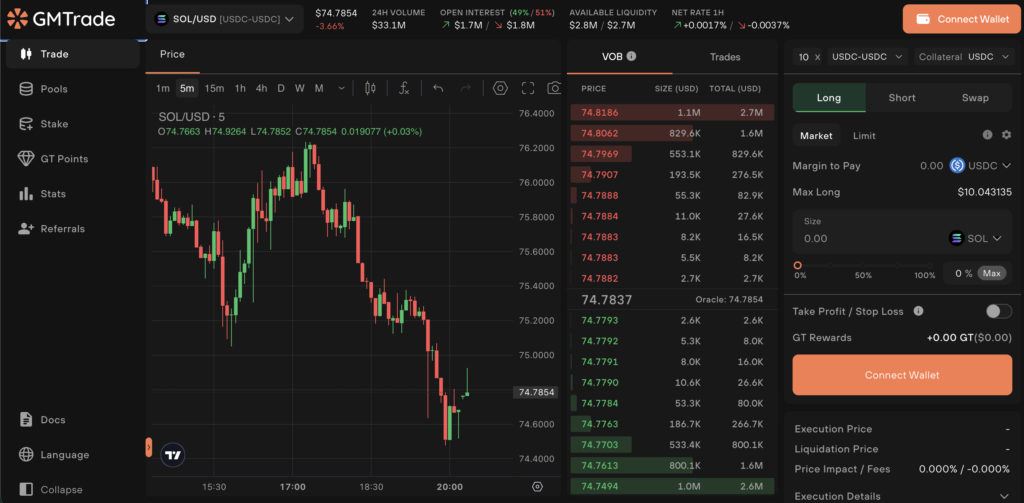
GMTrade offers decentralized leveraged trading on Solana.
It is designed for traders who want faster on-chain execution and lower transaction costs than many non-Solana DeFi venues.
GMTrade offers:
Solana wallet access.
Token swaps.
Long positions.
Short positions.
Crypto markets.
Forex markets.
Commodity markets.
Equity-style RWA markets.
Selectable pools.
Selectable collateral.
Limit orders.
Take profit and stop loss orders.
Funding fees.
Borrowing fees.
Price-impact mechanics.
GT points.
VIP fee discounts.
Referral fee discounts.
The platform is inspired by GMX V2-style mechanics, but adapted for a Solana trading experience.
That makes GMTrade attractive to traders who want DeFi perps without using a centralized futures account.
The main warning:
A decentralized interface does not make trading easy.
It only changes the infrastructure.
The trader still needs a plan.
Connect Wallet
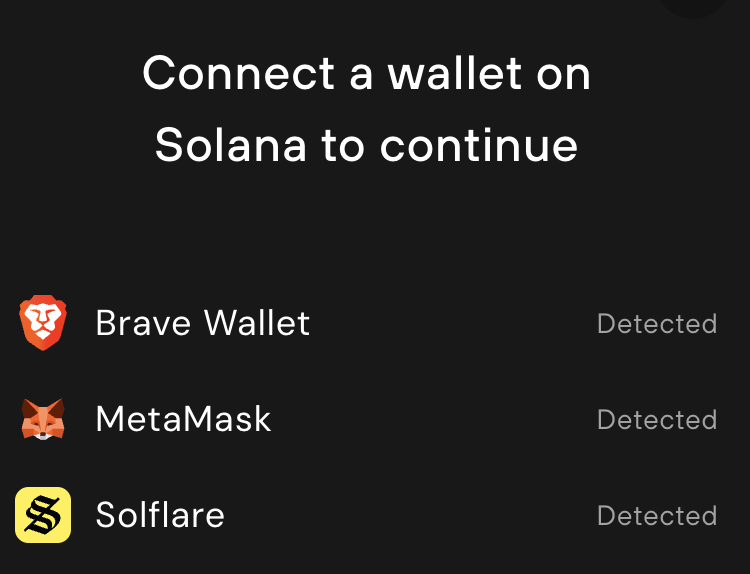
GMTrade starts with a Solana wallet.
Popular Solana wallets include Phantom, Solflare and Brave Wallet.
A good connection process:
Create a dedicated trading wallet.
Fund the wallet with SOL for transaction fees.
Add supported collateral.
Open GMTrade.
Click Connect Wallet.
Confirm the wallet connection.
Check the wallet address.
Check token balances.
Use a dedicated wallet because leveraged trading is high risk.
Do not use your long-term holding wallet.
Do not use a wallet full of NFTs or long-term assets.
Do not connect your main wallet to every new app.
A clean wallet setup reduces operational risk.
Before signing, check:
Website.
Wallet address.
Transaction type.
Token approval.
Gas fee.
Collateral amount.
A good trader protects the wallet before thinking about the chart.
Choose a Market
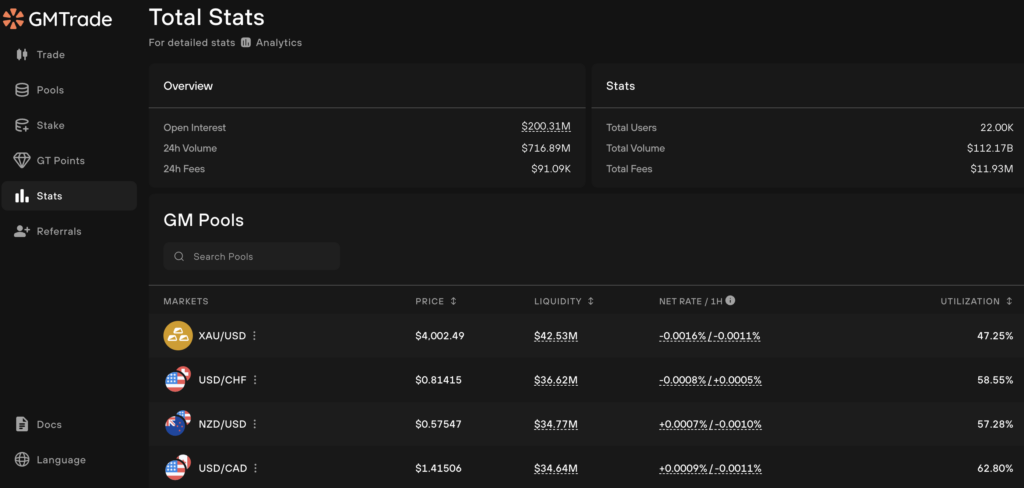
GMTrade allows users to choose the market they want to trade.
Markets may include crypto and RWA instruments.
Crypto markets
Crypto markets are usually best for beginners.
Examples may include major assets such as SOL, BTC or other supported pairs.
Crypto trades continuously and can be volatile.
Use low leverage.
Forex markets
Forex markets allow traders to take views on currency pairs.
They may offer high leverage, but that does not make them safer.
Small forex moves can still liquidate a highly leveraged trade.
Commodity markets
Commodity markets can include assets such as gold or oil where supported.
They respond to macro data, geopolitics, inventory reports and global demand.
Equity and stock-style markets
RWA equity markets can have trading hours and overnight risk.
Do not treat them like crypto markets.
When choosing a market, ask:
Do I understand this asset?
Is liquidity sufficient?
What is the spread?
What is the price impact?
What is the max leverage?
What are market hours?
What fees apply?
If you cannot answer those questions, reduce size or do not trade.
Select a Pool
GMTrade may show multiple pools for the selected market.
A pool is the liquidity and collateral environment behind the trade.
Different pools can affect:
Collateral options.
Liquidity.
Open interest.
Leverage limits.
Price impact.
Risk profile.
A market may have more than one pool.
For example, a BTC/USD or SOL/USD market may offer different pool structures depending on available collateral.
The pool matters because it can change trade conditions.
Before selecting a pool, review:
Available collateral.
Pool liquidity.
Current open interest.
Max leverage.
Price impact.
Warnings shown by the interface.
Do not ignore pool warnings.
If the interface warns that leverage is too high or market conditions are not suitable, adjust the trade.
Collateral
Collateral is the asset used to support a position.
On GMTrade, collateral choices may vary by market and pool.
A position may use stablecoin collateral such as USDC or non-stable collateral such as SOL or another supported asset.
Collateral choice affects risk.
Stablecoin collateral
Stablecoin collateral is usually easier for beginners because its value is intended to stay near one dollar.
This makes position risk easier to understand.
Non-stable collateral
Non-stable collateral can increase complexity because the collateral value moves with the market.
If collateral price changes, liquidation conditions can also change.
For example:
A SOL long using SOL collateral increases total SOL exposure.
A SOL short using SOL collateral may support more advanced hedging or delta-neutral strategies.
These are not beginner setups.
The safest beginner rule:
Use stablecoin collateral where available.
Learn non-stable collateral only after understanding liquidation.
Leverage
Leverage increases exposure.
It does not improve decision-making.
GMTrade may reduce the maximum allowed leverage in a pool as open interest grows.
This helps protect the liquidity pool from excessive risk and price-impact manipulation.
A good leverage framework:
1x to 3x for learning.
3x to 5x for cautious trading.
5x to 10x for experienced traders.
Above 10x only with strict risk controls.
Very high leverage only for specialists.
Do not choose leverage first.
Choose risk first.
A professional process:
Decide the trade idea.
Define invalidation.
Set stop loss.
Choose acceptable loss.
Calculate position size.
Then choose leverage.
Beginners often reverse the order.
That is how they get liquidated.
Liquidation
Liquidation is the forced closing of a position when losses and fees reduce collateral below the required level.
GMTrade’s liquidation calculation depends on collateral, losses, fees, position size and market settings.
Liquidation can become more dangerous over time because funding fees and borrowing fees can shift the liquidation price.
That means a position that looked safe at entry can become riskier later.
Before opening, review:
Entry.
Liquidation price.
Collateral.
Leverage.
Position size.
Funding rate.
Borrowing rate.
Price impact.
Stop loss.
Take profit.
A strong trade has stop loss before liquidation.
If liquidation is the first real exit, the setup is bad.
The goal is not to avoid being wrong.
The goal is to be wrong small.
Take Profit, Stop Loss and Limit Orders
GMTrade supports limit orders, take profit and stop loss orders.
These are important tools.
Limit orders
A limit order attempts to execute at a chosen trigger or price condition, but execution is not guaranteed.
Liquidity, mark price and max leverage limits can prevent execution.
Take profit
A take profit order closes the trade if price reaches the target.
This helps reduce emotional decision-making.
Stop loss
A stop loss order closes the trade if price moves against the position.
This helps reduce liquidation risk.
Important:
Trigger orders become market orders after triggering and may not execute exactly at the trigger price.
If you manually close a position, related trigger orders may remain open and may need to be cancelled.
A clean workflow:
Open trade.
Set TP/SL.
Monitor orders.
Cancel unused trigger orders.
Review position after every manual close.
Small admin mistakes can create future trading problems.
Fees and Costs
GMTrade traders should understand costs before trading.
Fees may include:
Open fees.
Close fees.
Swap fees.
Price impact.
Funding fees.
Borrowing fees.
Solana transaction fees.
The docs list basic open and close fees of:
0.004% or 0.006% of position size for forex markets.
0.010% or 0.012% of position size for commodity, stock and crypto markets.
Swap fees may be 0.05% or 0.07%.
Funding fees and borrowing fees can change over time.
This matters because fees are based on position size.
A small collateral amount at high leverage can create larger fee exposure than beginners expect.
Before opening, check:
Trading fee.
Price impact.
Funding rate.
Borrowing rate.
Swap cost.
Target distance.
Stop distance.
Net reward-to-risk.
Fees are not an afterthought.
They are part of the trade.
RWA Markets
GMTrade’s RWA markets are one of its most important features.
They allow leveraged trading across markets such as equities, forex and commodities where supported.
This makes GMTrade more than a crypto perp platform.
It becomes a Solana-based gateway to broader market speculation.
RWA markets may offer high leverage during trading hours.
Outside trading hours, leverage can be capped.
Borrowing fees may rise when markets are closed.
That means RWA trades require more planning than basic crypto trades.
Before trading RWA markets, check:
Is the market open?
What is maximum leverage now?
What is overnight borrowing cost?
What is spread?
What macro data is coming?
Is liquidity strong?
Could a gap occur?
A crypto trader should not assume stock-style markets behave like SOL.
Each asset class has its own rhythm.
ADL and Synthetic Market Risk
GMTrade may use ADL, or auto-deleveraging, in certain synthetic markets.
ADL can happen when pending profits exceed configured thresholds and the market needs to preserve solvency.
Profitable positions may be partially or fully closed.
This is a market-level risk control.
It helps ensure that markets can pay profits at the time of closing.
Traders should understand that ADL is different from normal liquidation.
Liquidation is about your losing position.
ADL is about market structure and solvency.
Before trading synthetic markets, ask:
Is this market fully backed or synthetic?
How much liquidity supports it?
Is open interest balanced?
Could ADL affect profitable positions?
Is position size appropriate?
DeFi perps require traders to understand the market, not just the chart.
GT Points, VIP and Referrals
GMTrade includes GT points and incentive mechanisms.
GT points are distributed to users who trade, provide liquidity and refer users.
GMTrade also includes VIP tiers that can reduce trading fees for users who hold more GT.
Referral systems can also provide fee discounts.
These incentives can be useful, but they should not drive bad trading.
Do not trade only to farm points.
Do not increase leverage to earn rewards.
Do not overtrade because fees are discounted.
Incentives should reduce costs for trades you already planned.
They should not create trades you would not otherwise take.
The market does not care about your points.
Risk comes first.
Best Beginner Strategy
A practical beginner strategy for GMTrade:
Use a dedicated Solana wallet.
Keep SOL for gas.
Use small collateral.
Choose USDC collateral where available.
Trade one liquid crypto market.
Use 1x to 3x leverage at first.
Set take profit.
Set stop loss.
Watch funding and borrowing fees.
Avoid RWA markets at first.
Avoid high leverage.
Cancel unused trigger orders.
Track every trade.
Do not overtrade for GT points.
The best GMTrade beginner is not the fastest trader.
It is the trader who survives the learning curve.
Final Verdict
GMTrade is a strong Solana-based decentralized leveraged trading platform for users who want fast wallet-based access to swaps, crypto perps and RWA markets.
Use GMTrade if you want Solana-native perps, flexible collateral, selectable pools, low transaction costs and exposure to crypto plus real-world markets.
Do not use GMTrade casually.
Leverage can liquidate positions quickly.
The best 2027 setup is:
Separate Solana wallet.
SOL for gas.
Small collateral.
Stablecoin collateral where available.
One liquid market.
Low leverage.
Clear stop loss.
Clear take profit.
Checked liquidation price.
Fee-aware trading.
Careful RWA market use.
No overtrading for points.
GMTrade gives traders speed.
Risk control decides whether that speed becomes precision or destruction.
FAQ
What is GMTrade?
GMTrade is a decentralized leveraged trading platform built on the Solana blockchain. It supports swaps, long and short positions, crypto markets and RWA markets.
How do I trade on GMTrade?
Connect a Solana wallet, make sure you have SOL for gas and supported collateral, select long or short, choose a market, pool and collateral, set leverage, review liquidation and confirm the transaction.
What wallet do I need?
You need a Solana wallet. GMTrade documentation mentions wallets such as Brave, Phantom and Solflare.
Do I need SOL?
Yes. You need SOL in your wallet to pay Solana transaction fees.
What markets does GMTrade support?
GMTrade supports crypto markets and RWA markets, including equities, forex and commodities where available.
What collateral can I use?
Collateral depends on the selected market and pool. Examples include WSOL and USDC.
What are GMTrade fees?
GMTrade lists basic open and close fees of 0.004% or 0.006% for forex markets and 0.010% or 0.012% for commodity, stock and crypto markets, plus other costs such as price impact, funding and borrowing fees.
What is liquidation?
Liquidation happens when losses and fees reduce collateral below the required level for a leveraged position.
Does GMTrade support stop loss and take profit?
Yes. GMTrade supports take profit and stop loss trigger orders, but execution is not guaranteed at the exact trigger price.
What is the biggest GMTrade mistake?
The biggest mistake is using high leverage without understanding collateral, liquidation, price impact, funding, borrowing, ADL and stop-loss behavior.
18+ Educational Disclaimer
This article is for educational purposes only and does not constitute financial advice, investment advice, trading advice, tax advice, legal advice or a recommendation to use GMTrade, leverage, perpetual futures, RWA markets, swaps, DeFi protocols or any trading strategy. Leveraged trading is high risk and can result in the loss of your entire collateral. Risks include liquidation, price volatility, smart contract risk, oracle risk, wallet errors, wrong network use, funding fees, borrowing fees, price impact, slippage, failed transactions, stop-loss execution risk, ADL, RWA market-hours risk, overnight fees, platform changes, regulatory changes and user error. Crypto and leveraged trading are intended for adults aged 18 and over.





