
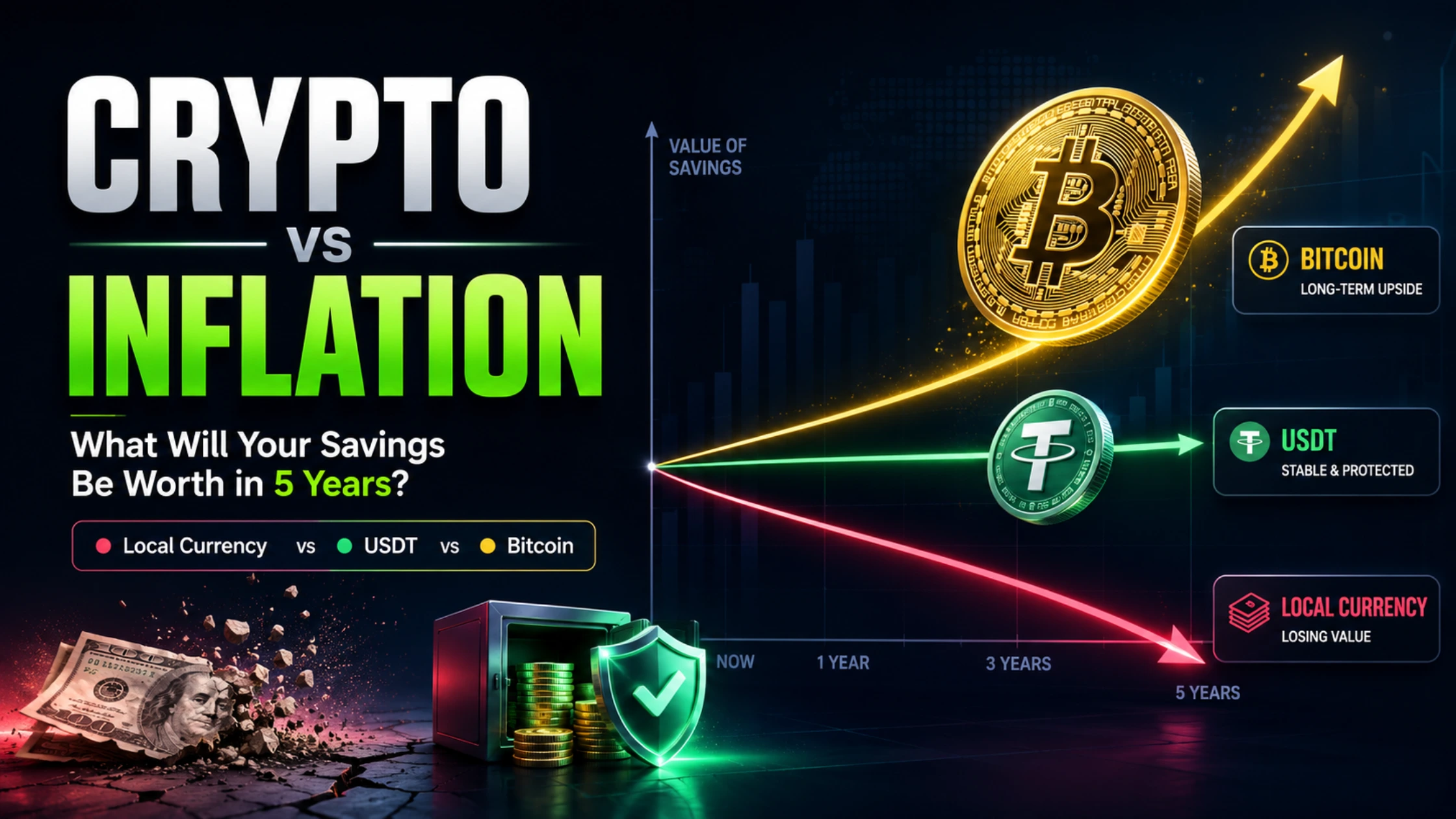
Your savings are shrinking whether you watch them or not. This calculator shows the real dollar value of your local currency in 5 years — and what it would be worth if you had moved into USDT or Bitcoin instead.
Inflation Is Eating Your Savings: This Crypto Calculator Shows the Real Cost
Five million Nigerian naira held in a bank account today is worth approximately $3,164 at the current exchange rate. At Nigeria’s current inflation rate, the same 5,000,000 NGN will have the purchasing power of roughly $1,100 in five years. The calculator below shows this trajectory for fifteen currencies, alongside what those same savings would be worth held in USDT or Bitcoin over the same period.
The Tax Nobody Voted For
Inflation is the most efficient wealth transfer mechanism ever devised. It moves purchasing power from people who hold their savings in local currency — overwhelmingly the middle class, the working poor, and anyone who does not have access to dollar-denominated assets — to governments that issue that currency and to the asset owners who hold things that appreciate with inflation.
It does this silently. Your bank balance does not change. The number of naira, lira, pesos, or birr in your account stays exactly the same. What changes is what those units buy — and in countries running double-digit inflation, the erosion is not a slow creep. It is a structural dismantling of everything you saved.
In Nigeria, a country that has experienced successive waves of naira devaluation alongside domestic inflation rates that touched 35% in early 2025, someone who held N5,000,000 in a savings account five years ago has watched its purchasing power fall by more than half in dollar terms — not because they spent the money, not because they made a bad investment decision, but because they held the currency their government issued.
This is not a Nigerian problem. It is a global problem concentrated in emerging markets. Argentina has been through multiple currency crises, with official inflation exceeding 100% annually at its peak. Turkey’s lira has lost more than 80% of its value against the dollar in five years. Lebanon’s pound has become functionally worthless. Sudan, Zimbabwe, Venezuela, Ethiopia, Ghana — the list of countries where holding local currency has been a losing strategy over any five-year horizon is long and growing.
The question is not whether this is happening. The data is unambiguous. The question is what people in these countries can do about it.

The Nigeria Case Study — 5,000,000 NGN
Let us work through the numbers concretely. A Nigerian professional who saved N5,000,000 — a meaningful sum representing perhaps two to three years of careful saving on a mid-income salary — holds what today?
At the current NGN/USD rate of approximately 1,580 naira per dollar, N5,000,000 is worth about $3,164. At Nigeria’s current official inflation rate of approximately 33% annually, and assuming the naira continues its historical pattern of depreciating against the dollar roughly in line with the inflation differential between Nigeria and the US, that $3,164 in real purchasing power declines to approximately $1,100 within five years.
The holder of N5,000,000 has not spent a single kobo. They have not made a single investment mistake. They have done everything a responsible saver is supposed to do. And their savings will have lost more than two-thirds of their real dollar value.
The same N5,000,000 converted to USDT on the day of saving maintains its dollar value. USDT erodes slightly in purchasing power as US inflation runs at approximately 3% annually — but the USDT holder still has approximately $2,700 in real purchasing power after five years, against the naira holder’s $1,100.
And the N5,000,000 converted to Bitcoin at a conservative historical appreciation rate sees a completely different trajectory. This is what the calculator below shows — and why the chart it generates is the most compelling financial argument for crypto adoption that any Nigerian, Argentinian, Turkish, or Ethiopian reader will ever see.

Why USDT Is the Dollar Without a Bank Account
USDT is the most widely held stablecoin in Africa and emerging markets not because of decentralisation ideology but because of simple financial rationality. For a person in Lagos, Nairobi, or Cairo who cannot open a US dollar account, cannot access US Treasury products, and cannot buy USD foreign exchange through official channels, USDT on the Tron network is a $1-pegged instrument they can hold in their phone, send across borders for $1 in fees, and receive from family abroad without touching a correspondent banking system.
The risk profile of USDT is not zero. Tether’s reserve transparency has been debated extensively. The GENIUS Act in the United States, passed in 2025, establishes regulatory requirements for stablecoin issuers that Tether will need to navigate. In a genuine crisis scenario, a USDT depeg cannot be entirely ruled out.
But for the person comparing USDT to holding naira, the relevant question is not whether USDT is perfect. It is whether USDT is better than the alternative. Against naira at 33% annual inflation, USDT does not need to be perfect. It only needs to hold its peg — which it has done for six years through multiple market crises — to represent a dramatically superior store of value.
USDC is arguably the more regulated alternative, particularly following the GENIUS Act’s compliance requirements. For users who can access it, USDC offers stronger regulatory backing. For users in Africa and EM markets where USDT has deeper P2P liquidity and wider exchange support, the practical choice is usually USDT.

Why Bitcoin Is the Long-Term Thesis
USDT preserves dollar purchasing power. Bitcoin is the proposition that dollar purchasing power itself is not the right benchmark — that the dollar, as a fiat currency managed by a government with $36 trillion in national debt, will itself lose real purchasing power over the coming decades, and that a fixed-supply asset with no issuing authority is the correct long-term reserve.
The Bitcoin case for emerging market savers is not primarily ideological. It is historical. Over every five-year window from its inception, Bitcoin has produced positive returns — dramatically positive in most cases. The five-year period from 2020 to 2025 saw Bitcoin rise from approximately $7,000 to over $100,000. Even someone who bought at the absolute peak of the 2021 bull market near $69,000 was in profit within the following three years.
Bitcoin is volatile. This is the honest counterargument and it is real. The path from $7,000 to $100,000 included an 80% drawdown in 2022 that took Bitcoin to $15,500. Someone who converted their savings to Bitcoin and then needed to use that money in November 2022 suffered a catastrophic loss of purchasing power. Bitcoin is not a liquid emergency fund. It is not appropriate for savings that may need to be accessed within 12 months.
But as a five-year savings vehicle for capital that does not need to be liquid — as a long-term store of value for people whose only alternative is a currency that loses 30% of its purchasing power every year — the historical case for Bitcoin is compelling in a way that applies differently to a Nigerian or Argentinian saver than it does to a US or European investor.
The US investor comparing Bitcoin to the S&P 500 is choosing between two assets that both rise in dollar terms over long periods. The Nigerian investor comparing Bitcoin to naira is choosing between a volatile asset with a demonstrated long-term upward trajectory and a currency with a demonstrated long-term downward trajectory.
The calculator below shows both scenarios with honest volatility ranges — not a single Bitcoin price prediction, but a bull, base, and bear case spread that reflects the real range of outcomes over five years.
Use the Calculator
Select your country, enter the amount you currently hold in local currency, and choose your time horizon. The three-line chart shows the diverging purchasing power trajectory across local currency, USDT, and Bitcoin.
Country-by-Country Snapshot
The calculator uses baked-in inflation and exchange rate data for fifteen countries, updated quarterly. Here is the current picture across the key markets:
Nigeria (NGN): 33% annual inflation. The naira has devalued approximately 70% against the dollar since 2020 following the CBN’s unified exchange rate policy. The P2P Bitcoin and USDT market in Nigeria is among the largest in the world by volume — testament to how many Nigerians have already reached this conclusion without a calculator.
Argentina (ARS): Inflation peaked above 200% annually in 2024 under the previous administration and has fallen sharply under Milei’s dollarisation push — but remains elevated. The blue-dollar parallel market premium illustrates how many Argentinians have been willing to pay for dollar access for years.
Turkey (TRY): 45% annual inflation despite multiple interest rate cycles from the TCMB. The lira has lost more than 80% of its value against the dollar since 2021. Istanbul has one of the highest concentrations of crypto ownership globally relative to population.
Zimbabwe (ZWG): The Zimbabwe Gold currency replaced the Zimbabwean dollar in 2024. Inflation remains elevated and the currency’s peg to gold has been tested. Zimbabwe’s history of hyperinflation — the 100 trillion dollar note era — makes it the most historically extreme example of currency failure in the dataset.
Ethiopia (ETB): The birr has devalued sharply since Ethiopia moved to a market-determined exchange rate in 2024. Inflation runs above 25% and access to foreign currency is severely restricted. Mobile-money infrastructure (Telebirr) is expanding but dollar access remains limited — creating a significant opportunity for USDT as a dollar proxy.
Ghana (GHS): Following the 2022 debt crisis and IMF bailout, the cedi has stabilised somewhat but continues to face structural inflation pressure. At its peak in 2022, GHS/USD lost more than 50% in a single year.
South Africa (ZAR): The most regulated and most dollar-accessible market in Sub-Saharan Africa. Inflation runs at 5% — manageable but still a meaningful long-term erosion. VALR and Luno both operate as FSCA-licensed exchanges, making crypto access straightforward and tax-compliant.
How to Actually Move From Local Currency to Crypto
The calculator shows the problem. Here is the practical solution by region:
Nigeria: Binance P2P and KCEX are the most accessible on-ramp options for converting naira to USDT through P2P trading. MEXC also operates P2P markets with naira support. Yellow Card provides a local on-ramp service converting naira directly to stablecoins. The process: register, complete KYC, initiate a P2P buy order for USDT, transfer naira to the seller’s local bank account, receive USDT in your exchange wallet.

South Africa: VALR is the largest South African crypto exchange by volume and FSCA-licensed, offering ZAR deposits and ZAR trading pairs for BTC, ETH, and USDT. Luno operates as the second major licensed option with strong mobile UX. Both accept EFT deposits from South African bank accounts with fast settlement.
Kenya, Ghana, Tanzania: Binance P2P supports M-Pesa integration for Kenyan users — USDT can be purchased directly with an M-Pesa payment. MEXC and Bitget both offer P2P markets with local payment method support across East Africa. Yellow Card operates as a local fiat-to-crypto service in Kenya and Ghana.
Argentina, Turkey, Global EM: Bybit operates globally and accepts P2P trades in local currencies for Argentina, Turkey, and most EM markets. MEXC has strong local currency support for Turkish lira and Argentine peso through its P2P desk.

The Custody Question — Who Holds Your Crypto After You Buy It
Buying crypto on an exchange and leaving it there is not a solution to the custody risk that a collapsing local currency represents. If the exchange fails — as multiple exchanges have — the crypto exposure compounds the local currency risk rather than replacing it.
Self-custody is the completion of the strategy. Moving purchased BTC or USDT off the exchange into a hardware wallet removes exchange counterparty risk and puts the user in genuine control of their savings.
Ledger hardware wallets (Ledger Flex and Ledger Nano X) are the most widely supported and best documented hardware wallet option. They support BTC, ETH, USDT, and hundreds of other assets with companion mobile apps suitable for users without desktop access.
CoolWallet is specifically designed for mobile-first users in markets without reliable desktop infrastructure. The credit-card form factor is durable, water-resistant, and pairs via Bluetooth with a mobile app — making it practical for users in markets where desktop computers are less common than smartphones.
OneKey is an open-source hardware wallet with a strong price-performance ratio, making it the most accessible hardware wallet option for users in EM markets where USD-priced hardware represents a significant cost relative to local income levels.
The setup for any hardware wallet is the same: generate the wallet, write down the 24-word seed phrase on paper and store it offline, transfer crypto from the exchange to the hardware wallet address. The crypto is then under your control and no third party failure can affect it.

FAQ
Why does USDT hold its value while local currencies lose theirs? USDT is backed by US dollar-denominated assets — primarily US Treasury bills and cash equivalents — held by Tether Limited. Its value is maintained by Tether’s commitment to redeem each USDT for one US dollar on demand. Local currencies lose value when governments print more money than the economy produces in goods and services. USDT does not face this risk because Tether cannot issue new USDT without receiving equivalent dollar collateral — unlike a central bank that can issue currency at will.
Is it legal to hold USDT or Bitcoin in Nigeria, Argentina, or Turkey? Legal status varies by country and has changed frequently. Nigeria’s SEC has moved toward a regulated crypto framework following the CBN’s earlier restrictions. In Argentina, crypto holdings are legal and widely practised. In Turkey, crypto is legal to hold and trade though it cannot be used as payment for goods. In no country on the calculator’s list is holding crypto for personal savings explicitly illegal, though trading regulations vary. Consult current local guidance before large transactions.
How do I convert USDT back to local currency when I need to spend it? The same P2P platforms used to convert local currency to USDT work in reverse. On Binance P2P or Bybit P2P, you initiate a sell order for USDT, a buyer transfers local currency to your bank account, and you release the USDT to them. The process typically completes within 15 to 30 minutes for active P2P markets. In South Africa, VALR and Luno support direct ZAR withdrawals to local bank accounts.
What is the risk of holding USDT long-term? The primary risks are Tether counterparty risk (Tether Limited’s reserves may not fully back outstanding USDT in a stress scenario), regulatory risk (USDT may face restrictions in specific jurisdictions), and smart contract risk for USDT held in DeFi protocols. For users comparing USDT risk to the risk of holding naira at 33% inflation or lira at 45% inflation, the relevant question is relative risk — on this comparison, USDT’s risks are considerably more manageable than the near-certain purchasing power erosion of the local currency alternative.
Should I put all my savings into Bitcoin? No. Bitcoin is appropriate as a long-term savings vehicle for capital that does not need to be accessed for at least two to three years, given its volatility. An emergency fund — three to six months of living expenses — should be held in something liquid and stable: local currency for immediate needs, USDT for medium-term dollar-denominated savings. Bitcoin is appropriate for the long-term savings layer above and beyond the emergency fund, sized according to your personal risk tolerance.
Get started: VALR (South Africa) · Luno (South Africa / Kenya / Nigeria) · KCEX · Binance P2P · MEXC · Bybit · Bitget · Self-custody: Ledger · CoolWallet · OneKey
Recommended reading:
Top 10 Crypto Tokens With the Best Tokenomics in 2026: Supply, Inflation & Value Accrual Explained
How To Build a Portfolio for Oil Shocks, Inflation, and Geopolitical Risk in 2026
The New Middle East Shock: Oil, Shipping, Inflation, and Your Portfolio
Bitcoin’s 2026 Supercycle: Will It Hit $150K Amid Global Inflation?
Financial Survival Strategy for High-Inflation Economies
Crypto Passive Income Projector 2026: How Long Until Your Portfolio Pays Your Rent?
Start Here — Build Your Crypto Infrastructure Safely
You don’t need to use everything at once.
Professionals reduce risk by having access to multiple rails so they are never dependent on a single platform.
Below is a simple, practical setup used by many experienced traders and investors.
1) Your Fiat Gateway (Primary Access)
Best starting point for deposits & withdrawals
Binance — reliable onboarding, deep liquidity, global coverage
👉 sign up
Why open this:
- Move from bank → crypto easily
- Convert large amounts efficiently
- Emergency exit capability
2) Your Trading Execution Venue (Fast & Flexible)
Best for active trading and broad market access
MEXC — huge altcoin selection & low trading friction
👉 sign up
Why open this:
- Trade markets not listed elsewhere
- Better execution during volatility
- Lower dependence on a single exchange
3) Your Advanced Tools & Derivatives Platform
Best for leverage, hedging and professional execution
Bybit — strong order controls & derivatives infrastructure
👉 sign up
Why open this:
- Proper stop loss tools
- Hedging capability
- Strategy flexibility

4) Your Yield & Passive Income Layer
Best for structured products and capital efficiency
Gate.com — structured yield & automated earning tools
👉 sign up
Why open this:
- Earn on idle capital
- Diversify platform risk
- Access structured strategies
5) Your Altcoin & Ecosystem Expansion Layer
Best for early market access and wide listings
KuCoin — broad token ecosystem
👉 sign up
Why open this:
- Access emerging markets
- Portfolio diversification
- Redundancy if one platform restricts access
Why This Structure Matters
Using one exchange creates a single point of failure.
Using multiple rails creates:
- Liquidity redundancy
- Faster reaction ability
- Lower operational risk
- Greater opportunity access
You don’t need large capital to start — you just need prepared infrastructure.
Practical Next Step
Open accounts gradually and verify them before you need them.
Most people only prepare during stress —
professionals prepare before it.
(Decentralised News provides infrastructure education, not financial advice. Always use proper security practices.)





