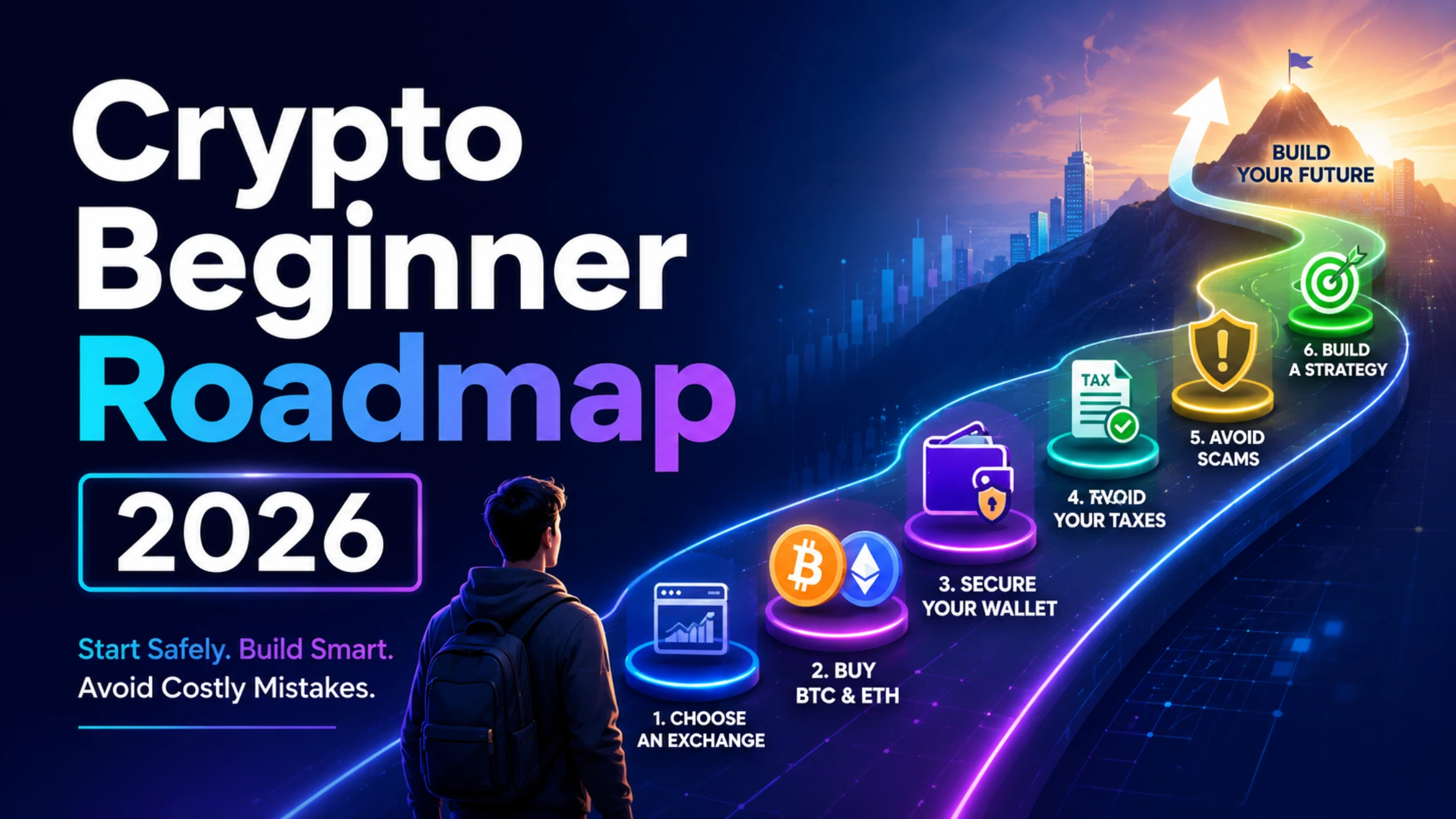
A complete beginner roadmap for crypto in 2026. Learn how to choose an exchange, buy Bitcoin or Ethereum, secure your wallet, track taxes, avoid scams and build a simple crypto strategy using Luno, VALR, Kraken, Bybit, Ledger, Koinly and TradingView.
Summary
The safest way to start with crypto in 2026 is not to chase meme coins, copy random traders or use high leverage.
The safest beginner roadmap is simple:
Choose a reputable exchange.
Buy Bitcoin or Ethereum first.
Move serious long-term holdings to a secure wallet.
Track every transaction for tax.
Avoid scams, fake apps and hype.
Build a clear strategy before buying altcoins.

For South African beginners, Luno and VALR are useful starting points because they support local rand access.
For global crypto exposure, Kraken is a strong security-focused exchange, while Bybit is better suited to active traders once they understand risk.
For self-custody, Ledger is one of the best-known hardware wallet options.
For tax tracking, Koinly helps users organize exchange and wallet transactions.
For charts, watchlists and price alerts, TradingView is one of the most useful tools for beginners and active traders.
The goal is not to get rich quickly.
The goal is to survive your first cycle without making permanent mistakes.
Quick Answer: The 2026 Beginner Crypto Roadmap
If you are starting from zero, follow this route.
Step 1: Open a beginner-friendly exchange account.
Step 2: Buy a small amount of Bitcoin or Ethereum.
Step 3: Learn how deposits, withdrawals and wallet addresses work.
Step 4: Set up strong account security.
Step 5: Move long-term holdings to a hardware wallet once your balance becomes meaningful.
Step 6: Track every trade, deposit and withdrawal for tax.
Step 7: Avoid scams, hype coins and high leverage.
Step 8: Build a written strategy before buying altcoins or trading futures.
A beginner does not need 50 coins.
A beginner needs a system.

Why Beginners Need a Roadmap in 2026
Crypto is easier to access than ever.
That is good.
It is also dangerous.
A beginner can open an exchange account, buy Bitcoin, trade altcoins, bridge tokens, use leverage and copy traders within one afternoon.
That speed creates risk.
Most new users do not lose money because crypto is too complicated.
They lose money because they move too fast.
They buy before learning.
They use leverage before understanding liquidation.
They send tokens to the wrong network.
They leave large balances on exchanges.
They ignore taxes.
They trust influencers.
They chase coins after they already moved.
The 2026 beginner roadmap is designed to prevent those mistakes.
Start small.
Learn the rails.
Secure your funds.
Track your records.
Only then increase complexity.
Step 1: Choose the Right Crypto Exchange
Your first exchange matters.
It is where you deposit money, buy crypto, learn fees, test withdrawals and build confidence.
For beginners, the best exchange is not always the one with the most coins.
It is the one you can understand.
Best beginner route for South Africans
If you are in South Africa, start with a local rand-friendly exchange.
Luno is one of the simplest options for new users who want to buy Bitcoin or Ethereum with rand. Luno’s South Africa fee page lists free normal withdrawals, while express withdrawals carry a fee. It also explains that South African users should avoid cash deposits because they are prohibited by Luno’s terms.
VALR is better for users who want a more advanced local exchange. VALR says it charges no monthly fees, no custody fees and no account opening fees, and its support page lists ZAR deposits via EFT as free.
A simple South African setup:
Use Luno if you want the easiest first experience.
Use VALR if you want more trading features and stronger local exchange functionality.
Use a global exchange later, once you understand crypto transfers.
Best global beginner route
Kraken is a strong global option for users who care about reputation, security and transparent reserves. Kraken says its Proof of Reserves lets clients verify that in-scope balances held on the exchange are backed by real assets in custody.
Bybit is better for users who eventually want active trading tools, futures, copy trading and deeper crypto market access. Bybit’s help center explains that spot and derivatives trading fees are charged based on filled order quantity or position value.
A beginner should not start on Bybit with leverage.
Use it first for spot trading and learning.
Then only explore futures once risk management is clear.

Step 2: Buy Bitcoin or Ethereum First
Your first crypto purchase should probably not be a meme coin.
It should not be a random token from a Telegram group.
It should not be a leveraged trade.
For most beginners, the first purchase should be Bitcoin or Ethereum.
Bitcoin is the oldest and most recognized crypto asset.
Ethereum is the largest smart contract ecosystem.
Neither is risk-free, but both are better starting points than low-liquidity altcoins.
A simple first-buy process:
Deposit a small amount of local currency into Luno, VALR or Kraken.
Buy Bitcoin or Ethereum.
Do not use your full savings.
Do not use borrowed money.
Do not buy because the price is pumping.
Write down the amount you bought, the date, the exchange and the reason.
Then stop.
Watch how the price moves.
Learn how the app works.
Learn how fees appear.
Learn how your emotions react.
The first purchase is not about getting rich.
It is about entering the market without making a reckless mistake.
Step 3: Learn Deposits, Withdrawals and Networks
Before buying altcoins, learn how crypto transfers work.
This is where many beginners make expensive mistakes.
A crypto withdrawal has three critical parts:
The asset.
The wallet address.
The network.
USDT on Ethereum is not the same as USDT on Tron, Solana, Arbitrum or BNB Chain.
ETH on Ethereum is not the same as ETH bridged to another network.
Sending the right coin to the wrong network can lead to delays, recovery fees or permanent loss.
Before sending crypto:
Copy the address carefully.
Check the first and last characters.
Match the network exactly.
Send a small test transaction first.
Wait for confirmation.
Only then send the larger amount.
A beginner should make their first withdrawal with a small amount.
It is better to pay one extra network fee than lose an entire balance.
Step 4: Secure Your Wallet
Once your crypto balance becomes meaningful, exchange storage is not enough.
Exchanges are useful for trading.
They are not ideal for storing your entire net worth.
This is where self-custody matters.

A hardware wallet such as Ledger stores private keys offline and gives users control over their assets. Ledger explains that even if a hardware wallet is lost, users can restore access with their Secret Recovery Phrase.
That recovery phrase is the real key.
If someone gets it, they can take your crypto.
If you lose it, you may lose access.
Basic wallet rules:
Never type your recovery phrase into a website.
Never store it in email.
Never save it in cloud notes.
Never send it to support.
Never take a screenshot.
Never share it with anyone.
Write it down offline.
Store it somewhere safe.
Consider a backup in a second secure location.
Use Ledger for long-term holdings once your balance is large enough to justify self-custody.
Keep small trading balances on exchanges.
Keep serious holdings under your own control.
Step 5: Track Taxes From Day One
Tax tracking is boring.
It is also essential.
Many beginners ignore taxes until they have hundreds of trades across several exchanges and wallets.
That creates a nightmare later.
In South Africa, SARS says normal income tax rules apply to crypto assets and affected taxpayers need to declare crypto gains or losses as part of taxable income. SARS also says taxpayers must declare crypto-related taxable income in the year it is received or accrued, and failure to do so may result in interest and penalties.
South Africa also implemented the Crypto Asset Reporting Framework on 1 March 2026, which SARS describes as a global standard designed to strengthen crypto-asset tax transparency.
That means recordkeeping is becoming more important, not less.
Use Koinly early.
Koinly’s South Africa guide explains that crypto may be subject to Income Tax or Capital Gains Tax depending on the transaction and intention.
Track:
Deposits.
Withdrawals.
Buys.
Sells.
Swaps.
Stablecoin conversions.
Airdrops.
Staking rewards.
Trading fees.
Wallet transfers.
Exchange exports.
Do not wait until tax season.
Export your records monthly.
The more active you become, the more valuable tax software becomes.
Step 6: Avoid Scams Before Chasing Gains
Every bull market creates new scams.
The scams change shape, but the pattern stays the same.
Someone promises easy money.
Someone creates urgency.
Someone says you are early.
Someone tells you not to miss out.
Someone asks you to connect your wallet.
Someone asks for your seed phrase.
Someone sends a fake support message.
Someone claims you won a giveaway.
Someone creates a fake exchange link.
Beginners need a scam filter before they need an altcoin portfolio.
Common crypto scams in 2026:
Fake airdrops.
Fake exchange apps.
Wallet drainer links.
Impersonator support accounts.
Telegram pump groups.
Fake staking dashboards.
Romance and investment scams.
Cloud mining schemes.
Fake presales.
Recovery scams after a previous scam.
The golden rule:
Nobody needs your recovery phrase.
No legitimate exchange support agent needs your wallet seed.
No real investment guarantees fixed high returns with no risk.
No influencer can guarantee a 100x coin.
No trading bot removes market risk.
Before connecting a wallet or sending money, slow down.
Search the official website.
Check the domain.
Check the social account history.
Check community warnings.
Ask what happens if you are wrong.
If you feel rushed, stop.
Step 7: Use TradingView Before You Trade
A beginner should not trade from emotion alone.
Charts are not magic, but they help you understand price, trend and volatility.
TradingView is one of the most useful tools for beginners because it lets you build watchlists, set alerts and track market conditions across assets.
TradingView says watchlists help users track assets they are most interested in from one place, including symbol details, news and customized views.
TradingView also says alerts can notify users about key market events, from simple price alerts to more advanced indicator-based alerts on Supercharts.
A beginner TradingView setup:
Create a Bitcoin watchlist.
Create an Ethereum watchlist.
Create a stablecoin watchlist.
Create an altcoin watchlist.
Set alerts instead of watching charts all day.
Mark major support and resistance levels.
Track Bitcoin dominance.
Track ETH/BTC.
Track total crypto market cap.
Do not stare at one-minute candles.
Beginners should use charts to reduce emotion, not increase it.
Step 8: Build a Simple Crypto Strategy
A crypto strategy does not need to be complicated.
It needs to be written down.
Before buying more than Bitcoin and Ethereum, answer these questions:
Why am I buying?
How much can I lose?
Is this a long-term hold or a trade?
What is my profit-taking plan?
What is my stop-loss plan?
What percentage of my portfolio is in one asset?
What will I do if the market falls 40%?
What will I do if the asset doubles?
Where will I store it?
How will I track taxes?
If you cannot answer those questions, you are not investing.
You are guessing.
A simple beginner allocation could look like this in principle:
Core holdings: Bitcoin and Ethereum.
Small learning allocation: selected altcoins.
Stablecoin reserve: cash-like crypto for opportunities.
No leverage until experienced.
No meme coins until risk is understood.
No single altcoin large enough to ruin the portfolio.
This is not a fixed financial recommendation.
It is a framework.
The point is to avoid making your entire portfolio dependent on one hype cycle.
Beginner Exchange Stack for 2026
A practical beginner stack could look like this:
Use Luno for a simple first crypto purchase.
Use VALR if you want stronger local rand trading features.
Use Kraken if you want a security-focused global exchange.
Use Bybit later if you want active trading tools, but avoid leverage as a beginner.
Use Ledger for self-custody.
Use Koinly for tax tracking.
Use TradingView for charts, watchlists and alerts.
This gives you the full beginner toolkit:
On-ramp.
Global exchange.
Wallet.
Tax software.
Market dashboard.
That is enough.
You do not need twenty apps.
You need a clean process.
What Beginners Should Avoid
Avoid futures trading in your first month.
Avoid using all your savings.
Avoid borrowing money to buy crypto.
Avoid coins promoted only by influencers.
Avoid copying traders without understanding drawdown.
Avoid storing recovery phrases online.
Avoid sending crypto without a test transaction.
Avoid buying because a coin is trending.
Avoid panic selling after normal volatility.
Avoid ignoring tax records.
Avoid treating exchanges like banks.
Avoid thinking “low price” means “cheap.”
A coin can trade at $0.00001 and still be expensive if the supply is huge.
Market cap matters.
Liquidity matters.
Tokenomics matter.
Your risk size matters most.
The Best Beginner Route by User Type
If you are completely new
Start with Luno.
Buy a small amount of Bitcoin.
Learn deposits and withdrawals.
Do nothing complicated for two weeks.
If you are South African and want stronger local features
Use VALR.
Deposit rand by EFT.
Buy BTC, ETH or stablecoins.
Learn withdrawals carefully.
If you want a global security-focused exchange
Use Kraken.
Focus on Bitcoin, Ethereum and major assets.
Keep long-term holdings in self-custody.
If you want to become an active trader
Use Bybit, but start with spot markets.
Learn order types.
Use small position sizes.
Do not start with leverage.
If you already have meaningful holdings
Buy a Ledger hardware wallet.
Move long-term holdings off exchanges.
Protect your recovery phrase.
If you have more than one exchange account
Use Koinly.
Track transactions early.
Avoid future tax chaos.
If you want to stop trading emotionally
Use TradingView.
Build watchlists.
Set alerts.
Stop chasing every candle.
A Simple 30-Day Beginner Plan
Days 1 to 3: Learn the basics
Read about Bitcoin, Ethereum, exchanges, wallets and seed phrases.
Open one exchange account.
Do not buy anything yet if you feel confused.
Days 4 to 7: Make your first small purchase
Deposit a small amount.
Buy Bitcoin or Ethereum.
Write down why you bought it.
Track the price without reacting.
Days 8 to 10: Learn withdrawals
Create or prepare a wallet.
Send a tiny test transaction.
Confirm the network and address.
Learn how blockchain confirmations work.
Days 11 to 15: Improve security
Enable app-based 2FA.
Use a unique password.
Add withdrawal protections if available.
Bookmark official exchange links.
Days 16 to 20: Set up tax tracking
Create a Koinly account.
Add your exchange.
Export or sync transaction history.
Label transfers correctly.
Days 21 to 25: Build a watchlist
Create a TradingView watchlist.
Add BTC, ETH and a few major altcoins.
Set alerts.
Do not overtrade.
Days 26 to 30: Write your strategy
Decide your monthly budget.
Decide your maximum risk.
Decide your long-term holdings.
Decide your profit-taking rules.
Decide what you will not trade.
The most powerful beginner skill is patience.
Final Verdict
The best crypto beginner roadmap for 2026 is simple.
Start with a trusted exchange.
Buy Bitcoin or Ethereum before chasing altcoins.
Learn deposits and withdrawals.
Secure your accounts.
Move long-term holdings to self-custody.
Track taxes from day one.
Use charts and alerts instead of emotion.
Avoid scams.
Build a written strategy.
For a simple first step, use Luno or VALR.
For a global exchange, consider Kraken.
For active trading later, consider Bybit.
For self-custody, use Ledger.
For tax tracking, use Koinly.
For charts and alerts, use TradingView.
Crypto rewards preparation.
It punishes carelessness.
Your first goal is not to find the next 100x coin.
Your first goal is to still be here after your first full market cycle.
FAQ
What is the best way to start crypto in 2026?
The best way to start is to open one reputable exchange account, buy a small amount of Bitcoin or Ethereum, learn how withdrawals work, secure your account and track every transaction for tax.
What is the best crypto exchange for beginners?

For South Africans, Luno is one of the easiest beginner options, while VALR offers stronger local trading features. Globally, Kraken is a strong option for users who care about security and transparency.
Should beginners buy Bitcoin or Ethereum first?
Most beginners should start with Bitcoin or Ethereum before buying smaller altcoins. They are still risky, but they are more established than most tokens.
Should beginners use Bybit?
Beginners can use Bybit, but they should start with spot trading. Futures, margin and leverage are not beginner products.
Do I need a hardware wallet?
You do not need a hardware wallet for a tiny first purchase, but once your crypto balance becomes meaningful, a hardware wallet like Ledger can improve long-term security.
What is the biggest beginner crypto mistake?
The biggest mistake is moving too fast. Beginners often buy too many coins, use leverage, ignore taxes, trust influencers or send crypto on the wrong network before learning the basics.
Do I need to pay tax on crypto in South Africa?
SARS says normal income tax rules apply to crypto assets and affected taxpayers need to declare crypto gains or losses as part of taxable income.
What tool can I use for crypto taxes?
Koinly is useful for importing exchange and wallet transactions, organizing records and preparing crypto tax reports.
What tool should I use for crypto charts?
TradingView is useful for charts, watchlists, price alerts and market tracking.
How much money should a beginner put into crypto?
Only invest money you can afford to lose. Start small, learn first and never use rent money, emergency savings or borrowed money for crypto.
Should beginners buy meme coins?
Not at first. Meme coins can be extremely volatile. Beginners should learn Bitcoin, Ethereum, wallets, transfers, fees and scams before trading meme coins.
Should I keep crypto on an exchange?
Keep only active trading funds on exchanges. Long-term holdings are usually better stored in self-custody once you understand wallet security.
18+ Educational Disclaimer
This article is for educational purposes only and does not constitute financial advice, investment advice, tax advice, legal advice or a recommendation to buy, sell, hold or trade any crypto asset. Crypto assets are volatile and you can lose money. Futures, margin and leverage trading are high-risk and can lead to rapid losses. Exchange rules, fees, verification requirements, tax rules and regional availability can change at any time. Always do your own research, use strong security, keep accurate records and speak to a qualified financial, tax or legal professional if needed. Crypto trading and investing are intended for adults aged 18 and over.