
Compare Bybit vs Binance for 2027. Learn which crypto exchange is better for beginners, futures trading, passive income, liquidity, fees, product range, safety and active crypto traders.
Summary
Bybit and Binance are two of the most important crypto exchanges for active traders heading into 2027.
The quick answer is simple.
Choose Bybit if you want a cleaner active-trading experience, strong futures tools, copy trading, trading bots, altcoin campaigns and a platform that feels built for serious crypto traders.
Choose Binance if you want the broader ecosystem, deeper product range, large spot market, Binance Earn, launch products, flexible tools and the most complete all-in-one crypto platform.
For many users, the best answer is not Bybit or Binance.
It is Bybit and Binance.
Use Binance for broad market access, spot liquidity, passive crypto products and ecosystem depth.
Use Bybit for futures, copy trading, active trading campaigns, clean execution and a more trader-focused interface.
Both platforms have strong products. Both also carry exchange risk, regulatory risk, cybersecurity risk and product availability differences by region. Always check your local access, current fees and account limits before depositing.
Quick Verdict
Best overall ecosystem:
Binance
Best active-trader experience:
Bybit
Best for beginners:
Binance, if you want the widest product ecosystem and more basic buy, sell and earn tools.
Best for futures traders:
Bybit, especially if you want a cleaner derivatives-first trading experience.
Best for passive crypto users:
Binance, because Binance Earn offers rewards on more than 180 cryptocurrencies according to Binance’s own product page.
Best for copy trading:
Bybit, especially for users who want a dedicated copy trading experience.
Best for users who want one exchange only:
Binance
Best for traders who already understand risk:
Bybit
Bybit vs Binance in One Sentence
Binance is the broader crypto super-app.
Bybit is the sharper active-trader exchange.
That is the real difference.
Binance is like a giant crypto financial marketplace. It has spot, futures, options, earn products, launch campaigns, bots, copy trading, payments, Web3 tools and a massive global ecosystem.
Bybit is more focused. It is especially strong for users who care about futures, speed, trader campaigns, copy trading, automation and a cleaner interface.
If you are investing casually, Binance will probably feel more complete.
If you are trading actively, Bybit may feel more natural.
Where Bybit Wins
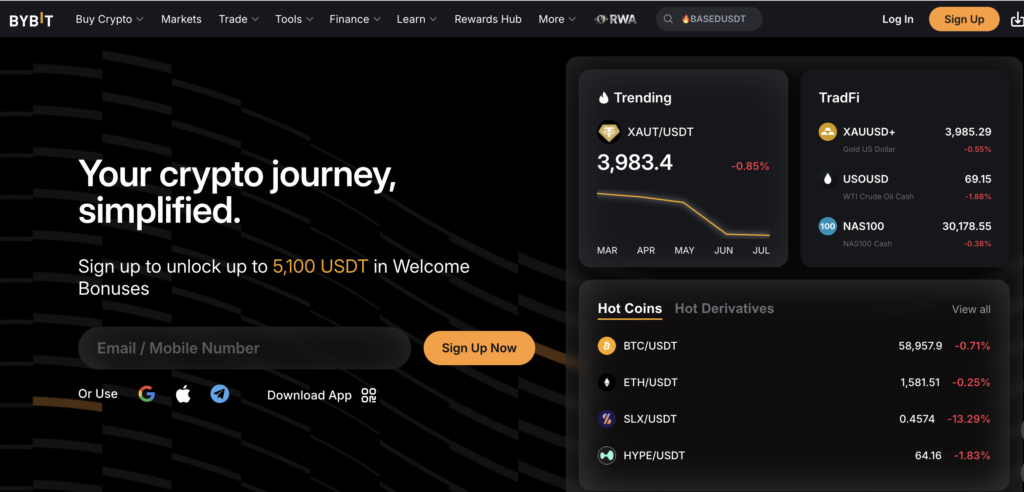
1. Bybit feels built for active traders
Bybit is one of the best exchanges for users who trade often.
The interface is clean. The trading screens are fast. The derivatives experience is strong. The platform is built around market movement, not just basic buying and holding.
That matters in a bull market.
When volatility rises, active traders need:
Fast charts
Clear order books
Reliable order placement
Futures markets
Copy trading
Trading bots
Campaigns and rewards
Good mobile execution
Simple account navigation
Bybit does this well.
Binance has many of the same tools, but its size can make the experience feel more crowded. Binance is more powerful as a total ecosystem. Bybit is often easier to use as a trading desk.
2. Bybit is excellent for futures traders
Bybit’s futures product is one of its core strengths.
For regular non-VIP users, Bybit’s trading fee page lists crypto spot fees at 0.1000% maker and 0.1000% taker, and perpetual and futures contract fees at 0.0200% maker and 0.0550% taker. Bybit also notes that actual fee rates can vary by region and account status, so users should always check their own fee page after verification.
That fee structure makes Bybit competitive for active derivatives traders.
But the bigger advantage is usability.
Bybit’s futures platform is simple enough for intermediate traders but advanced enough for serious users.
You can trade perpetual contracts, use margin controls, set stop losses, follow lead traders and automate parts of your strategy.
That does not mean futures trading is safe.
It means Bybit is one of the better platforms if you already understand leverage.
3. Bybit copy trading is easier to understand
Copy trading is one of Bybit’s strongest features.
Bybit’s copy trading page describes the product as a way to follow and copy top traders based on real-time PnL, and presents it as beginner-friendly.
This is attractive for newer users who do not yet have their own trading system.
However, copy trading is not passive income.
You are still taking market risk. You are also taking trader-selection risk.
A lead trader can look brilliant during a short winning streak, then collapse during one bad week.
If you use Bybit copy trading, filter for:
Longer trading history
Lower drawdown
Consistent position sizing
Transparent risk
Realistic returns
No extreme leverage
A strategy you actually understand
Do not copy someone just because their recent profit percentage looks high.
4. Bybit has useful trading bots
Bybit offers trading bot tools including Futures Grid, Futures Combo, Futures Martingale, Spot Grid and DCA Bot according to its trading bot page.
This makes Bybit useful for users who want to automate basic trading rules.
The most beginner-friendly options are usually:
Spot grid bots
DCA bots
Simple range-based strategies
The dangerous options are usually:
High-leverage futures bots
Martingale systems
Over-optimized grid setups
Bots running in fast-trending markets
Bots do not remove risk. They automate risk.
A bad strategy becomes worse when it runs 24 hours a day.
5. Bybit has a cleaner feel for serious crypto traders
This is subjective, but important.
Bybit feels less like a giant marketplace and more like a trading terminal.
For traders who spend hours watching charts, that matters.
The platform is especially appealing if you want:
Futures
Copy trading
Bots
Campaigns
Altcoin markets
Fast execution
Cleaner trading screens
A more focused crypto-native experience
If your main goal is to actively trade the market, Bybit is one of the best choices.
Use Bybit here:
Open a Bybit account and use referral code 46164.
Where Binance Wins
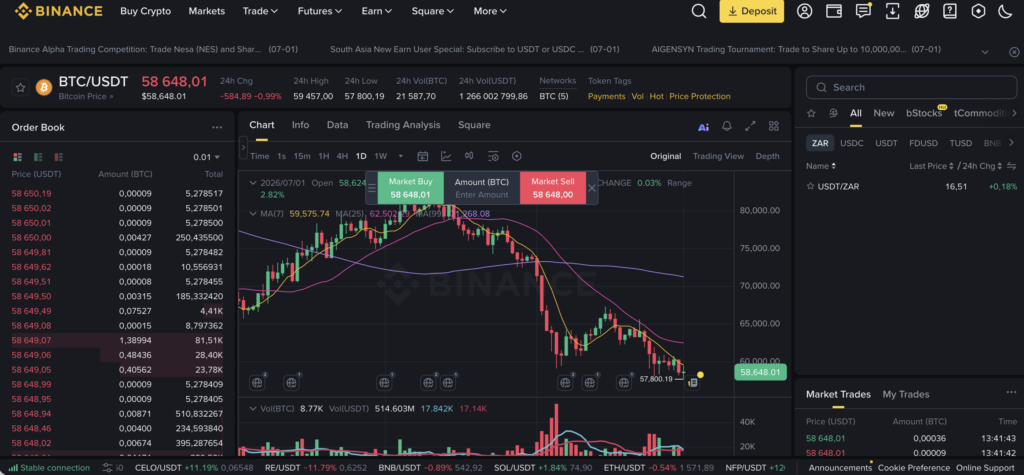
1. Binance has the broader ecosystem
Binance is not just an exchange.
It is a full crypto ecosystem.
It offers spot trading, futures, options, trading bots, copy trading, earn products, launch campaigns, fiat tools, Web3 access and a huge range of crypto services.
Binance’s own futures page lists products such as futures, options, trading bots, copy trading and smart money features, and highlights access to over 250 futures and options contracts.
That breadth is hard to beat.
If you want one account that can do almost everything, Binance has the advantage.
2. Binance is better for passive crypto users
This is where Binance is strongest.
Not every crypto user wants to trade every day.
Some users want to buy Bitcoin, hold Ethereum, earn on stablecoins, use staking products, participate in launch campaigns or manage a long-term crypto portfolio.
Binance is built for that kind of user.
Binance says users can earn rewards on more than 180 cryptocurrencies through Binance Earn.
That makes Binance more appealing for passive users than Bybit.
Bybit also has Earn products, but Binance generally feels more complete for users who want a broad range of passive crypto tools in one place.
3. Binance has massive product depth
Binance wins on ecosystem depth.
It is stronger if you want:
Spot trading
Futures
Options
Earn products
Launchpad-style access
Large asset coverage
BNB ecosystem integration
Payment features
Web3 tools
Trading bots
Copy trading
Institutional-style liquidity
A single platform for many crypto use cases
Bybit can compete strongly in active trading.
But Binance is harder to beat as a total crypto platform.
4. Binance fees are highly competitive
For regular users, Binance’s fee page lists standard spot maker and taker fees at 0.100% and 0.100%, with a reduced 0.07500% and 0.07500% rate when using the BNB discount. Binance also lists VIP tiers that can reduce fees further for higher-volume users.
That means Binance and Bybit are similar at the basic spot level.
Both start around 0.1% for regular spot users.
The real difference comes from:
VIP tiers
Promotions
BNB discounts
Trading volume
Market type
Product availability
Maker versus taker execution
Futures fee structure
Regional fee differences
For most beginners, fee differences between Bybit and Binance will not matter as much as spread, liquidity, withdrawal costs and whether they choose the right network.
For high-volume traders, fees matter a lot.
Always check the live fee page before trading.
5. Binance has proof-of-reserves transparency
Binance publishes a Proof of Reserves page stating that account balances are fully backed 1:1, and explains that Proof of Reserves refers to assets Binance holds in custody for users.
This does not remove all exchange risk.
Proof of reserves is not the same as a full traditional financial audit. It does not guarantee future solvency, perfect internal controls or zero legal risk.
But it is still an important transparency feature.
For users who keep funds on centralized exchanges, proof-of-reserves reporting is better than no visibility at all.
Use Binance here:
Open a Binance account and use referral code CPA_00SXKU7IO9.
Fees, Liquidity, Leverage and Product Range
Fees
At the basic spot level, Bybit and Binance are very competitive.
Bybit lists non-VIP crypto spot fees at 0.1000% maker and 0.1000% taker, and perpetual and futures fees at 0.0200% maker and 0.0550% taker.
Binance lists regular spot maker and taker fees at 0.100% and 0.100%, with a BNB discount option that can reduce the displayed rate.
For a normal user buying crypto occasionally, the fee difference is not huge.
For active futures traders, maker and taker behavior matters more.
A maker order adds liquidity to the order book.
A taker order removes liquidity from the order book.
Taker orders are usually more expensive.
Scalpers and high-frequency traders care about this deeply.
Beginners usually do not.
Liquidity
Binance generally has the edge in broad market liquidity because of its scale and ecosystem reach.
That matters if you trade large positions or major crypto pairs.
Bybit is still very strong, especially in futures and active trader markets.
For Bitcoin, Ethereum and major altcoins, both are usually deep enough for most retail users.
For smaller altcoins, liquidity can vary by pair.
Always check:
Order book depth
24-hour volume
Spread
Funding rate
Open interest
Withdrawal availability
Recent listing status
Do not assume every listed coin has good liquidity.
Leverage
Both exchanges offer leveraged products where available.
Leverage is useful for experienced traders and dangerous for beginners.
The exchange you choose will not protect you from bad risk management.
A beginner using 20x leverage on Binance can get liquidated.
A beginner using 20x leverage on Bybit can also get liquidated.
The platform is not the strategy.
Your position size is the strategy.
Product range
Binance wins on total product range.
Bybit wins on focused active-trader usability.
That is the cleanest distinction.
Use Binance if you want a broad crypto financial platform.
Use Bybit if you want a cleaner trading-first experience.
Safety and Risk Comparison
Neither Bybit nor Binance should be treated as risk-free.
Centralized exchanges carry several risks:
Custody risk
Regulatory risk
Cybersecurity risk
Withdrawal risk
Account freeze risk
Regional access risk
Product restriction risk
Operational risk
Binance has faced major regulatory scrutiny in multiple jurisdictions, and Reuters reported in June 2026 that Binance’s EU licensing path faced setbacks under the MiCA framework.
Bybit has also faced serious cybersecurity history. Reuters reported that the FBI attributed a roughly $1.5 billion Bybit hack in 2025 to North Korea.
That does not mean users should avoid both platforms.
It means users should behave like adults.
Use exchanges for trading.
Use self-custody for long-term holding.
Use app-based 2FA.
Use withdrawal whitelists.
Avoid keeping your entire portfolio on one exchange.
Send test transactions before large withdrawals.
Keep tax records.
Do not treat any exchange as a bank account.
Best Exchange for Beginners
Winner: Binance
Binance is better for beginners who want one platform with many crypto tools.
A beginner can use Binance to:
Buy crypto
Trade spot
Use simple convert tools
Explore earn products
Set up recurring buys
Learn through educational resources
Move gradually into advanced features
The risk is that Binance can feel overwhelming.
There are many products. Beginners may click into futures, margin, launch campaigns or earn products before they understand the risks.
If you use Binance as a beginner, keep it simple.
Start with spot buying.
Avoid leverage.
Avoid random small-cap coins.
Avoid complex yield products.
Learn withdrawals early.
Move long-term holdings to self-custody once balances become meaningful.
When Bybit is better for beginners
Bybit can be better for beginners who are specifically interested in copy trading or learning active trading.
The interface can feel cleaner.
But Bybit is also more trading-oriented, so beginners must be careful not to jump into leverage too early.
Best Exchange for Futures Traders
Winner: Bybit
Bybit is the better choice for many futures traders because the platform feels built around derivatives.
It has strong futures markets, competitive derivatives fees, trading bots, copy trading and a clean active-trader layout.
Binance Futures is also extremely powerful. It has deep liquidity, broad contract coverage and strong infrastructure. Binance’s futures page highlights access to over 250 futures and options contracts and emphasizes liquidity and execution.
So this is not a landslide.
The difference is feel.
Binance Futures is powerful.
Bybit Futures feels more focused.
For many active traders, that matters.
Best Exchange for Passive Crypto Users
Winner: Binance
If your goal is to buy, hold, stake, earn or manage crypto passively, Binance is the better fit.
Binance Earn, flexible savings, staking-style products, launch opportunities and ecosystem tools make it stronger for passive users.
Bybit is improving in this area, but Binance remains broader.
Passive users should still remember one thing.
Yield is not free.
Earn products may carry smart contract risk, counterparty risk, liquidity risk, lockup risk or product-specific terms.
Read the details before using any yield product.
Which One Should You Choose?
Choose Bybit if:
You trade futures regularly.
You want a clean active-trader interface.
You like copy trading.
You want trading bots.
You prefer a platform that feels crypto-native.
You care more about execution than ecosystem size.
You already understand leverage and risk management.
Use Bybit with referral code 46164.
Choose Binance if:
You want the broadest all-in-one crypto ecosystem.
You are a beginner who wants one main platform.
You want spot trading, earn products, launch campaigns and futures in one place.
You value large product coverage.
You want more passive crypto tools.
You want a platform that can handle many crypto use cases.
Use Binance with referral code CPA_00SXKU7IO9.
Use both if:
You are serious about crypto.
This is the best answer for many users.
Use Binance as your broad ecosystem exchange.
Use Bybit as your active trading exchange.
Keep long-term holdings in self-custody.
Keep trading capital separate from investment capital.
Keep tax records from day one.
Do not use either exchange as your entire financial system.
Final Verdict
Bybit and Binance are both excellent, but they are not excellent in the same way.
Binance is better if you want the biggest all-in-one crypto platform.
Bybit is better if you want a sharper active-trader experience.
For beginners, Binance is usually the better first choice.
For futures traders, Bybit is often the better trading terminal.
For passive users, Binance wins.
For serious traders, the smart setup is to use both selectively.
The best exchange is not the one with the most features.
It is the one that fits your actual strategy.
FAQ
Is Bybit better than Binance?
Bybit is better for many active traders, especially futures traders, copy trading users and people who want a cleaner trading-first experience. Binance is better for users who want the broader ecosystem.
Is Binance better than Bybit?
Binance is better if you want one large platform for spot trading, futures, earn products, launch campaigns, bots, copy trading and general crypto management. It is more complete as an ecosystem.
Which exchange is better for beginners?
Binance is usually better for beginners because it offers more basic buying, selling and passive crypto tools in one place. However, beginners should avoid leverage and complex products.
Which exchange is better for futures trading?
Bybit is often better for futures traders because its platform feels more focused on active trading. Binance Futures is also very strong, but Bybit has a cleaner derivatives-first feel.
Which exchange has lower fees?
For regular spot users, both exchanges are competitive. Bybit lists non-VIP crypto spot fees at 0.1000% maker and taker, while Binance lists regular spot maker and taker fees at 0.100% and 0.100%, with discounts available in some cases. Always check the live fee page before trading.
Is Bybit safe?
Bybit has strong products and transparency initiatives, but no centralized exchange is risk-free. Reuters reported that the FBI attributed a major 2025 Bybit hack to North Korea, so users should treat exchange custody seriously and avoid keeping their entire portfolio on any one platform.
Is Binance safe?
Binance is one of the largest crypto platforms and publishes Proof of Reserves, but it has also faced regulatory scrutiny in several regions. Users should check local access rules, enable strong security and avoid storing all funds on one exchange.
Can I use both Bybit and Binance?
Yes. Many serious crypto users use both. Binance can serve as the broad ecosystem exchange, while Bybit can serve as the active trading exchange.
Which exchange is better for passive income?
Binance is generally better for passive crypto users because Binance Earn offers rewards on more than 180 cryptocurrencies.
Which exchange should I choose in 2027?
Choose Binance if you want the broader ecosystem. Choose Bybit if you want a cleaner active-trader platform. Use both if you trade seriously and want platform diversification.
18+ Educational Disclaimer
This article is for educational purposes only and does not constitute financial advice, investment advice, tax advice or a recommendation to use any exchange, product or trading strategy. Crypto assets are volatile and you can lose money. Futures, margin and leverage trading are high-risk and can lead to rapid losses. Always do your own research, check live fees and regional availability, use strong account security, keep tax records and speak to a qualified professional if you need financial or tax guidance. Crypto trading and investing are intended for adults aged 18 and over.





