
Forensic Finance | Institutional Power Structures | June 2026
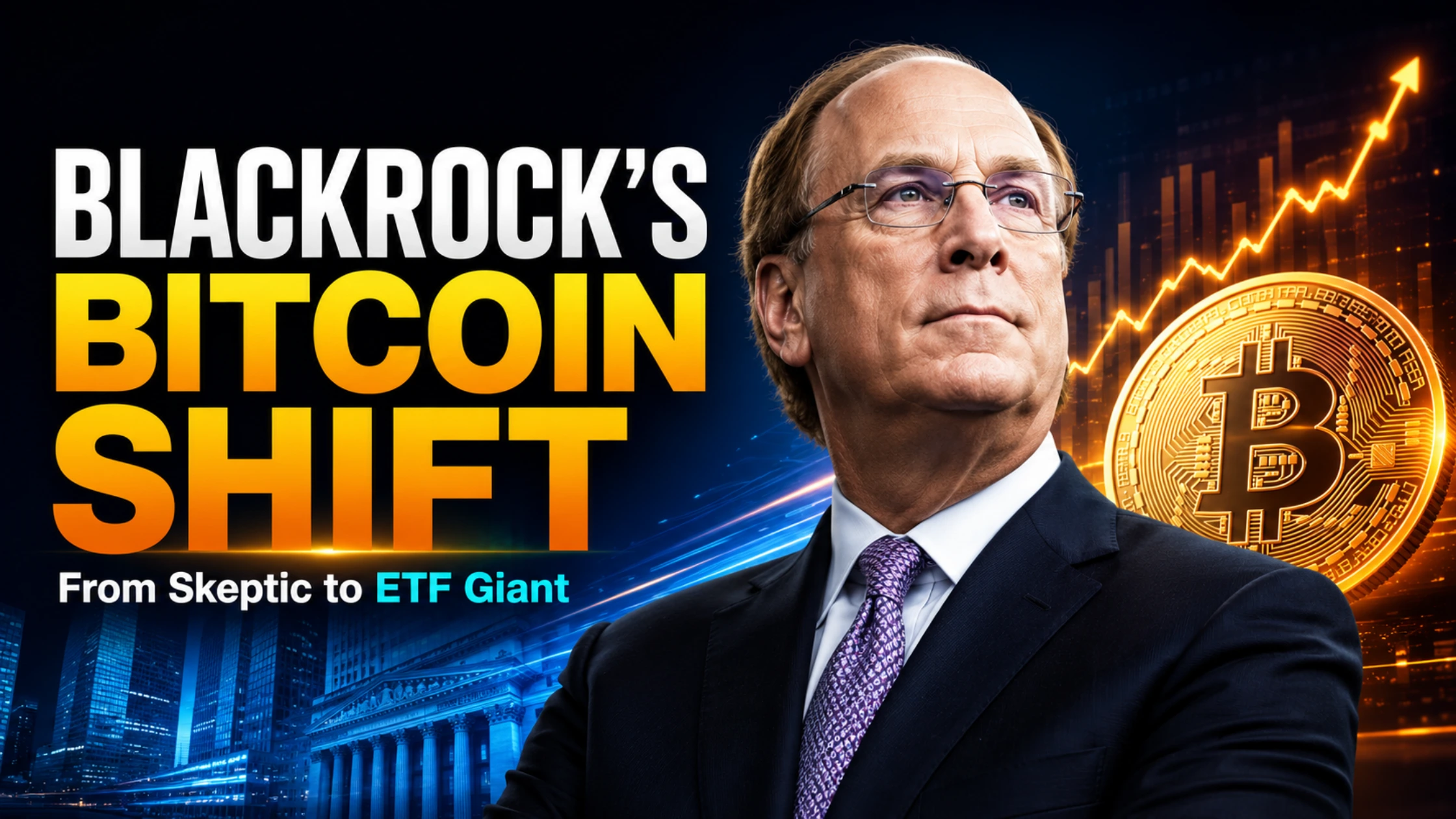
The BlackRock Capture: How Larry Fink Went From “Bitcoin Is an Index of Money Laundering” to Running the World’s Largest Bitcoin ETF — and What He Needs to Happen Next
On October 13, 2017, Larry Fink told the Institute of International Finance that Bitcoin was "an index of money laundering." By June 2026, his firm BlackRock holds over 800,000 BTC in its iShares Bitcoin Trust (IBIT) — the world's largest Bitcoin fund with ~$55B in AUM — generating $174.6M in fee revenue in 2025 alone. This article forensically traces every major Fink statement from 2017 to 2026, maps the precise financial incentives that drove each position change (fee compression, AUM pressure, client demand from sovereign wealth funds), and identifies the four specific outcomes BlackRock now needs to happen to protect its dominant market position and hit its $500M digital-asset revenue target: pension fund ERISA reform, Ethereum ETF staking approval, tokenized-asset regulatory framework, and continued Bitcoin price appreciation. BlackRock is no longer a passive observer of crypto. It is the world's most powerful structurally long Bitcoin institution — with the political access and regulatory relationships to engineer the environment it needs.
Seven words. That is all it took to write the most embarrassing sentence in the history of institutional finance.
On October 13, 2017, with Bitcoin trading at $5,685, Larry Fink stood before the Institute of International Finance and dismissed the entire asset class with a single verdict: "Bitcoin just shows you how much demand for money laundering there is in the world. That's all it is."
Eight years and approximately 800,000 BTC later, Fink's firm is the world's largest Bitcoin fund manager. His iShares Bitcoin Trust (IBIT) has generated $241M in cumulative fee revenue across its first two years. He is personally lobbying sovereign wealth funds to put 2-5% of their portfolios into the asset he once called a criminal index. And he has told BlackRock shareholders that digital assets will become a $500M annual revenue line within five years.
This is not a story about changing one's mind. Minds change. This is a story about a man who wields $14 trillion in assets under management recognising a business opportunity, reconfiguring his institution's regulatory, political, and lobbying machinery around it, and becoming the single most important structural force in Bitcoin's price trajectory.
The question is not whether Fink converted. He did. The question is what BlackRock needs to happen next — and whether the world's most powerful asset manager has the leverage to make those things happen.
"Private markets, insurance, digital assets, and active ETFs — we think these can all be $500 million revenue generators in the next five years."
— Larry Fink, BlackRock Shareholder Letter, 2026The Complete Reversal: Every Major Fink Statement, 2017 to 2026
The shift did not happen overnight. It happened in four discrete phases, each driven by a different financial incentive. Mapping the rhetoric against the incentive structure reveals that Fink's conversion was never ideological. It was transactional.
The Financial Incentive Map: Why the Reversal Was Inevitable
Understand what drove each phase and the reversal becomes predictable, not surprising.
Phase 1 (2017-2021): Regulatory risk management
In 2017, BlackRock had no business interest in Bitcoin and significant regulatory risk in endorsing it. The SEC was rejecting every ETF application. The DOJ was actively investigating crypto exchanges. A positive statement from the world's largest asset manager would have invited regulatory attention and potentially jeopardised BlackRock's core business relationships. The "money laundering" framing was not opinion. It was liability management.
Phase 2 (2022): Client demand crosses the threshold
The Coinbase partnership in August 2022 marks the true inflection point. BlackRock's Aladdin platform serves institutional clients managing approximately $21 trillion in assets. When enough of those clients started requesting crypto on-ramps, BlackRock's calculus shifted. The risk of not offering a product — and losing clients to Fidelity, which launched its crypto unit in 2018 — exceeded the regulatory risk of offering one. The partnership was the product-market fit signal.
Phase 3 (2023-2024): The ETF business case locks in
BlackRock's ETF filing in June 2023 was not a philosophical statement. It was the firmest possible product-market signal from a firm with a 575-1 ETF approval record. BlackRock does not file for products it does not expect to launch. The SEC approval on January 10, 2024 — and IBIT's subsequent $40B in first-year inflows — validated the business case completely. The fastest ETF launch in history generated $47.5M in fee revenue in its first calendar year and $174.6M in 2025.
Phase 4 (2025-present): Structurally long, politically active
With $78.4B in digital asset AUM on its books, BlackRock is now structurally long Bitcoin in a way that is categorically different from any previous institutional position. Every 10% move in Bitcoin price changes BlackRock's digital AUM by approximately $7.8B. Every $7.8B change in AUM changes annual fee revenue by approximately $19.5M at the 0.25% IBIT rate. Fink does not need to personally own Bitcoin for BlackRock to have a direct financial stake in its price. The fee model has created that stake automatically.
Fee math: At 0.25%, each $1B in IBIT AUM generates $2.5M annually. $500M target requires $200B AUM. At current 800K BTC holdings, Bitcoin would need to reach ~$250,000 per coin to hit that AUM level from price alone — or flows must grow the fund to ~2.8M BTC at today's prices.
BlackRock Is Now the World’s Most Powerful Structurally Long Bitcoin Institution
This framing matters. BlackRock does not hold Bitcoin on its corporate balance sheet in the way MicroStrategy does. What it holds is something more consequential: a fee-generating claim on Bitcoin's price appreciation that scales indefinitely with AUM growth.
At $78.4B in digital assets AUM (per BlackRock's own 2025 annual filings), the firm's fee income from the crypto segment runs at approximately $196M annually. At BlackRock's current total AUM of $14T, digital assets represent just 0.56% of the book — tiny. But that share is growing at a rate that has no parallel in the rest of BlackRock's business. The firm's Alternatives segment grew at a 22% CAGR over the last five years. Digital assets went from zero to $78.4B in two years.
The fee math creates a structural incentive that is permanent and self-reinforcing. Every 10% increase in Bitcoin's price adds approximately $5.5B to IBIT's AUM and approximately $13.8M to BlackRock's annual fee revenue. This is not a side bet. It is now a core business line — with a specific, disclosed revenue target ($500M) that can only be achieved if Bitcoin appreciates significantly from current levels or inflows dramatically accelerate.
At 0.25%, each $1 billion in additional IBIT AUM generates $2.5 million in annual recurring fee revenue. The world's largest asset manager now profits directly from Bitcoin price appreciation. This is what the "index of money laundering" comment has become.
The Numbers Behind the Conversion: IBIT by the Data
| Metric | Figure | Context |
|---|---|---|
| IBIT AUM (mid-2026) | ~$55B | ~800,000 BTC held in custody; largest Bitcoin fund globally by 3x |
| Total BLK digital asset AUM | $78.4B | Includes IBIT, ETHA, BUIDL; grew from $0 in 2023 to $78.4B by Dec 2025 |
| Digital assets as % of total AUM | 0.56% | Tiny share, but fastest-growing product category in BLK history |
| IBIT fee revenue 2024 | $47.5M | Launch year; $40B in inflows; fastest ETF to $10B/$20B/$30B in history |
| IBIT fee revenue 2025 | $174.6M | 267% growth YoY; driven by AUM expansion and Bitcoin price appreciation |
| Cumulative fee revenue (2024-2025) | $241M | From zero to $241M in 24 months; no ETF in history matched this pace |
| BLK total AUM | $13.9T (Q1 2026) | Digital assets 0.56% of total; $500M target requires ~1.4% of total AUM |
| AUM needed for $500M fee target | $200B | At 0.25% expense ratio; requires BTC ~$250K+ at 800K BTC holdings, or significant new inflows |
| Abu Dhabi SWF IBIT holdings (Sept 2025) | $1.1B+ | ADIC + Mubadala combined; ADIC tripled holdings in Q3 2025 alone |
| IBIT expense ratio | 0.25% | Each $1B in AUM = $2.5M annual fee; structural alignment with Bitcoin price |
The Wish List: What BlackRock Now Needs to Happen
The conversion is complete. The business model is locked. The remaining question — and the one with the most direct implications for crypto markets — is what BlackRock needs from regulators, legislators, and markets to protect its dominant position and hit its revenue targets.
1. ERISA reform: the $35 trillion unlock
The Department of Labor's 2022 guidance effectively warned ERISA-governed retirement plan fiduciaries against including cryptocurrency in 401(k) plans, citing speculative risk. BlackRock cannot fully access the $35 trillion U.S. pension system without reform to this guidance. IBIT is technically purchasable in an IRA, but inclusion as a default option in 401(k) lineups requires a clear DOL safe harbour. Even a 1% average allocation across U.S. pension assets would add $350B in potential IBIT-eligible demand — the single largest one-time unlock in Bitcoin investment history. BlackRock has the political relationships with Bessent's Treasury and the regulatory access to push for this change. It is the highest-value item on its legislative agenda.
2. Staked Ethereum ETF: the yield product gap
BlackRock has already filed for a staked Ethereum ETF. The approval of staking within an ETF structure would allow ETHA to generate yield from Ethereum network participation — transforming a price-only instrument into an income-generating product. This closes the competitive gap between ETHA and traditional fixed-income ETFs, BlackRock's dominant product category. It also dramatically expands the addressable market: yield-seeking institutional allocators who would not buy a non-yielding crypto ETF will consider one that generates 3-5% annual staking returns. The SEC's posture on this question in 2026 is the single most important regulatory variable for Ethereum's institutional demand trajectory.
3. Tokenized asset framework: the endgame
BlackRock has filed two new SEC proposals for tokenized fund products in May 2026: a tokenized Treasury reserve fund via Securitize, and on-chain shares of its $7B money market fund on Ethereum. These are not experiments. They are the next layer of BlackRock's on-chain strategy. The tokenized real-world asset market has grown from $9.9B to $30.9B in the past year, with Ethereum handling approximately 56% of settlements.
If a full tokenized-asset regulatory framework passes — allowing stock, bond, and fund shares to settle on-chain — BlackRock's Aladdin platform (which already manages $21T+ in third-party institutional assets) becomes the settlement layer for a portion of global finance. The firm is not quietly exploring tokenization. It is racing to be the dominant on-chain institutional infrastructure provider before anyone else occupies that position.
4. Bitcoin sustained above $150,000: the revenue inflection
This is the most direct market implication for crypto investors. At current IBIT holdings of approximately 800,000 BTC, every $50,000 increase in Bitcoin's price adds approximately $40B to IBIT AUM and approximately $100M to BlackRock's annual fee revenue run-rate. The $500M annual fee target requires either $200B in IBIT AUM (implying Bitcoin at roughly $250,000+) or a dramatic acceleration of new capital inflows. Bitcoin's price is now, structurally, a BlackRock business variable.
The Political Machine: Why BlackRock Can Engineer Parts of This Outcome
This is not passive wishful thinking. BlackRock has the political access to actively influence several of these outcomes.
Fink's relationship with Treasury Secretary Bessent is well-documented: both men operate at the intersection of global macro finance, sovereign wealth fund relationships, and Washington policy. Bessent's stablecoin agenda — positioning digital dollars as a tool for U.S. debt demand — is structurally aligned with BlackRock's on-chain tokenization strategy. They are building toward the same infrastructure, from different directions.
The Abu Dhabi data point is particularly revealing. ADIC and Mubadala together held $1.1B+ in IBIT shares as of September 2025, having tripled their position in a single quarter. Fink personally meets with sovereign wealth funds and has publicly disclosed these conversations. When he says "I was with a sovereign wealth fund this week discussing whether to put 2% or 5% in Bitcoin" at Davos, that is not metaphor. It is sales activity conducted by the CEO of the world's largest asset manager on behalf of a product that generates $2.5M in annual fees per billion in AUM.
BlackRock also has a direct path to SEC influence through its track record. Its 575-1 ETF approval record is not accidental — it reflects a relationship with regulators built over decades of producing compliant, transparent, institutional-grade products. That relationship is now being deployed in service of crypto product expansion. The staked Ethereum ETF filing is the test case. Its approval or rejection will signal how far BlackRock's regulatory capital extends into the crypto space.
The Risks to the BlackRock Crypto Thesis
Risk 2 — Competitor fee compression: Fidelity (FBTC), VanEck, and others are competing for institutional Bitcoin ETF market share. If competitors drop fees below 0.20%, BlackRock may need to match — compressing its fee engine at the exact moment it needs revenue growth. The $500M target assumes fee stability at 0.25%.
Risk 3 — Regulatory reversal: A change in SEC composition or a hostile Congressional response to tokenization could freeze BlackRock's on-chain ambitions. The ERISA pension reform, staked ETH approval, and tokenized asset framework are all dependent on regulatory goodwill that cannot be guaranteed beyond the current administration.
Risk 4 — Warsh hawkish reversion: Higher interest rates compress the multiple on risk assets broadly. If Warsh reverts to hawkish mode by 2027 — as JPMorgan projects as a base case scenario — Bitcoin AUM growth slows and the $500M revenue target becomes a 2030+ story. See DN Power Brokers Framework for the full Warsh rate scenario analysis.
The Bottom Line: Fink Is the Market Now
The man who called Bitcoin an index of money laundering has become the single most consequential structural force in Bitcoin's price trajectory. Not because he believes in it philosophically — his own statements suggest Bitcoin conviction rooted in fee revenue, not ideology — but because the business model he has built at IBIT creates a permanent, self-reinforcing alignment between BlackRock's revenue and Bitcoin's price.
That alignment has political legs. Fink meets with sovereign wealth funds, influences Treasury Department policy conversations, has a 575-1 ETF approval track record with regulators, and is actively filing for the next wave of on-chain products. He is not waiting for the environment to shift. He is engineering the shift.
For crypto investors, this is the most important institutional development since the spot ETF approval in January 2024. The question is no longer whether Bitcoin gets institutional adoption. It is whether BlackRock's four-item wish list — ERISA reform, staked ETH, tokenized asset framework, sustained Bitcoin price above $150K — gets delivered.
If all four arrive, the $500M revenue target becomes a 2028 reality, IBIT crosses $200B in AUM, and the "index of money laundering" comment becomes the most expensive seven words ever spoken in finance. Open positions through Bybit, Binance, or BloFin. Track the flow signal with the DN Fink Conviction Index above.
Frequently Asked Questions
On October 13, 2017, at the Institute of International Finance meeting, Fink said: "Bitcoin just shows you how much demand for money laundering there is in the world. That's all it is." He reiterated this position in a 2018 shareholder letter, called Bitcoin "not a real investment," and told Bloomberg in July 2018 that he believed no BlackRock client had sought out crypto exposure. By his own admission in a 2025 CBS interview, he was wrong: "Markets teach people, and everyone always has to re-evaluate their assumptions."
As of mid-2026, BlackRock's iShares Bitcoin Trust (IBIT) holds over 800,000 BTC with approximately $55B in assets under management, making it the largest Bitcoin fund on Earth by a factor of roughly three. BlackRock's total digital assets AUM across IBIT, ETHA (Ethereum ETF), and the BUIDL tokenized money market fund reached $78.4B as of December 31, 2025, per the firm's annual filings with the SEC.
IBIT charges a 0.25% annual sponsor fee. BlackRock's filings show IBIT collected approximately $47.5M in net sponsor-fee revenue during its 2024 launch year and approximately $174.6M in 2025. Combined with ETHA, total crypto ETF fee revenue across the first two years reached approximately $241M. Fink has publicly stated he expects digital assets to become a $500M annual revenue generator within five years — a target that requires approximately $200B in AUM at the current fee rate.
At the World Economic Forum in Davos in January 2025, Fink said: "Should we have a 2% allocation? Should we have a 5% allocation? If everybody adopted that conversation, it would be $500,000, $600,000, $700,000 for Bitcoin." He framed this explicitly as a hypothetical based on the math of sovereign wealth fund allocation — not a price target. If sovereign wealth funds collectively allocated 2-5% of their estimated $12T in AUM to Bitcoin, the resulting $240B-$600B in capital inflows would represent 16-40% of Bitcoin's current market capitalisation, implying substantial price appreciation.
At a 0.25% expense ratio, each 10% increase in Bitcoin's price adds approximately $5.5B to IBIT AUM and approximately $13.8M to BlackRock's annual fee revenue. This creates a permanent financial alignment between BlackRock's business performance and Bitcoin's price. The $500M digital revenue target Fink has stated publicly can only be achieved if Bitcoin appreciates significantly (to approximately $250,000+ at current holdings) or new inflows dramatically expand the fund. BlackRock's revenue model is structurally long Bitcoin regardless of any statement Fink makes publicly.
Four key outcomes: (1) ERISA pension reform allowing 401(k) and defined-benefit plans to include Bitcoin ETFs without fiduciary liability — this unlocks the $35T U.S. pension system; (2) SEC approval of staked Ethereum ETF, allowing ETHA to generate yield and compete with income-generating products; (3) A tokenized real-world asset regulatory framework enabling on-chain BlackRock fund shares at scale through its BUIDL and Aladdin platforms; (4) Sustained Bitcoin prices above $150,000 to push IBIT AUM past $120B and fee revenue past $300M annually.
BUIDL (BlackRock USD Institutional Digital Liquidity Fund) is BlackRock's tokenized money market fund launched on Ethereum in 2024, offering institutional investors on-chain exposure to short-term U.S. Treasuries. It was the firm's first foray into tokenized real-world assets and now serves as the proof-of-concept for BlackRock's broader on-chain strategy. In May 2026, BlackRock filed two new SEC proposals to expand this: a tokenized Treasury reserve fund via Securitize and on-chain shares of its $7B money market fund on Ethereum. The tokenized RWA market reached $30.9B by mid-2026, with Ethereum handling approximately 56% of settlements.
According to Fink's own disclosures, multiple sovereign wealth funds are buying Bitcoin incrementally, particularly during price dips. Abu Dhabi's ADIC tripled its IBIT holdings in Q3 2025 alone, reaching approximately $518M; Mubadala held an additional $567M in IBIT shares at the same date. Combined, the two Abu Dhabi funds held $1.1B+ in IBIT — making the UAE the most significant identified sovereign Bitcoin investor via ETF vehicles. Fink noted at Davos that these funds plan to hold for many years rather than trade short-term, framing their rationale as concern over long-term currency debasement and rising global debt.
The alignment is structural rather than conspiratorial. Bessent's stablecoin strategy positions digital dollars as demand for U.S. Treasury bills — directly complementary to BlackRock's BUIDL tokenized Treasury fund. Warsh's dovish rate thesis creates the risk-on environment that drives capital into IBIT and pushes Bitcoin higher, expanding BlackRock's fee base. Fink, Bessent, and Warsh all operate within the same macro framework: digital assets as infrastructure, not speculation; stablecoins as dollar dominance tools; Bitcoin as reserve asset. They converge on the same outcome from different institutional positions. See DN Power Brokers Framework for the full incentive map.
Embed grant: The DN Fink Conviction Index embedded above may be reproduced with attribution to decentralised.news.
DN-INTERNAL links to resolve: DN Power Brokers Framework, Cycle Position Clock, Debasement Clock, Stablecoin Trust Score, DN Perp DEX Power Rankings.
Sources: BlackRock SEC filings (8-K Q1 2026, FY2025 Annual Report), Institute of International Finance transcript Oct 2017, Bloomberg Davos Jan 2025, CBS interview Oct 2025, KuCoin Research March 2026, Bitget Research Dec 2025.
As of: June 13, 2026. AUM figures from BlackRock public filings. Fee revenue from KuCoin/BlackRock disclosed data. All scoring is editorial modelling, not investment advice.





