
For years, if you wanted to trade gold, oil, forex, indices, or macro risk more broadly, you usually needed the same basic stack: a broker account, regional access, banking rails, KYC, limited market hours, and a custody model where somebody else ultimately sat between you and your capital.
That model is starting to crack.
In 2026, a new class of on-chain trading platforms is giving crypto-native users access to markets that used to sit behind traditional brokerage infrastructure. The point is not that blockchain has magically replaced Wall Street. The point is that you can now get synthetic or derivative exposure to assets like gold, crude oil, stock indices, FX pairs, and related macro markets using stablecoins, wallets, and on-chain or hybrid exchange infrastructure instead of a conventional broker relationship.
That matters for three reasons.
First, access is becoming more global. Second, capital is becoming more portable. Third, macro trading is no longer reserved for people with a broker login, a bank account in the right jurisdiction, and a platform approved by a legacy intermediary. On-chain markets still carry real risks, and they are not a perfect substitute for regulated brokerage accounts in every context, but they are now far more than a niche experiment.
This is where the sharpest part of the story begins: not tokenized stocks as a vague narrative, but on-chain alternatives to brokers for people who want to trade macro assets from a wallet.
What “on-chain alternative to a broker” actually means
A broker typically gives you three things: market access, execution infrastructure, and custody or account administration. The new on-chain challengers are rebuilding that stack in a different way.
Instead of opening a brokerage account to trade something like gold or EUR/USD, you fund a trading account with USDC or another stablecoin, connect a wallet, and use perpetuals or synthetic derivative products that track the price of the underlying market. In some cases the system is fully on-chain; in others, matching is off-chain for speed while settlement remains on-chain. Either way, the user experience moves closer to “global markets from a wallet” than “brokerage access through a bank-linked account.”
This distinction matters. You are usually not buying the underlying barrel of oil, ounce of gold, or share certificate. You are trading price exposure. That makes these venues much closer to macro derivative platforms than to classical brokerages that hold the underlying instruments for you.
Why this category is getting real traction
The appeal is obvious once you see it.
You can keep collateral in stablecoins. You can move between crypto and macro exposures without wiring capital between different institutions. You can often go long or short from the same interface. And you can do it with a trading stack that feels native to crypto rather than bolted onto it. Ostium explicitly markets “stocks, commodities, and forex with real market liquidity” and emphasizes “no brokers, no freezes, full self-custody,” while Gains Network’s gTrade positions itself as access to 290+ assets across crypto, forex, stocks, indices, and commodities “all tradeable from your wallet.”
That does not mean every platform is equally mature, or that all of them already offer the same breadth of markets. It does mean the category has clearly moved beyond the stage where “on-chain macro” sounded like a future thesis and into the stage where traders can actually use real products today.
The four best on-chain broker alternatives to watch

1. Ostium: the cleanest pure-play macro trading pitch
If your goal is to trade indices, commodities, and FX on-chain without the usual broker setup, Ostium is one of the clearest expressions of that idea right now.
Its official positioning is unusually direct: trade perpetuals on stocks, commodities, and forex with “no brokers, no freezes, full self-custody.” The platform highlights exposure to assets like US100, gold, and oil, and reports more than $45 billion in trade volume, $251 million in open interest, and 25,000+ traders on its site. Those numbers matter less as marketing trophies than as a signal that Ostium is trying to become a serious home for crypto-native macro traders rather than just another small experimental DEX.
What makes Ostium especially compelling is the sharpness of the use case. This is not a generic “RWA” pitch. It is a direct answer to a specific problem: “I want macro exposure from my wallet.” Long or short US indices, gold, or oil. Stablecoin collateral. No traditional broker account. Open, auditable infrastructure. That is a much stronger story than simply tokenizing old assets and calling it innovation.
The best fit for Ostium is the trader who thinks in macro terms already. Someone watching CPI, oil shocks, central bank messaging, dollar strength, or geopolitical risk can use Ostium as an execution layer for those views without leaving the crypto-native environment. That is where the platform has the most obvious edge.
2. gTrade: the broadest on-chain multi-asset toolbox
If Ostium feels like a focused macro venue, gTrade feels like the broad all-terrain vehicle.
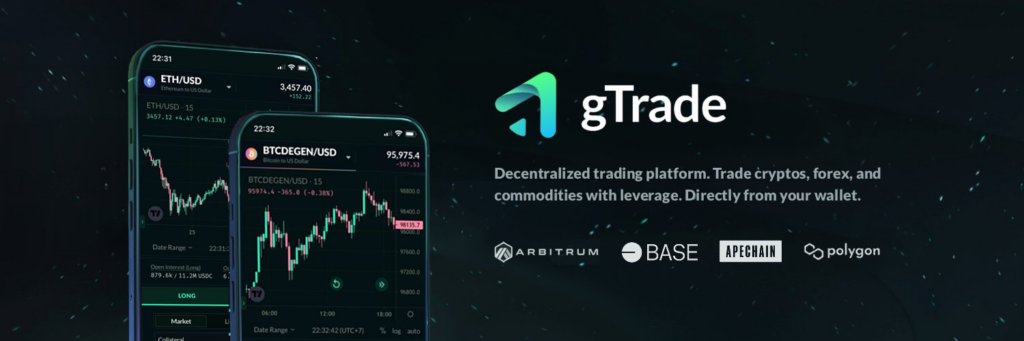
Gains Network says gTrade offers 290+ assets across crypto, forex, stocks, indices, and commodities from a wallet, and the platform reports more than $131 billion in total volume, 4 million+ trades, and 43,000+ users. That breadth is important because many traders do not just want one or two macro hedges. They want the ability to move across categories from one margin environment.
The more interesting detail is that gTrade’s documentation is very explicit about how mature its non-crypto asset coverage has become. Its docs show dedicated sections for forex, commodities, stocks, and indices, and its commodities page lists current access to gold, silver, crude oil, platinum, and palladium, with leverage ranges such as 2x–250x on gold and 2x–150x on several other commodities. The same docs also spell out market-time behavior, gap risk, and temporary spread/leverage adjustments around major USD news events and market closes. That kind of disclosure makes the platform feel more like a serious derivatives venue than a simplistic on-chain casino for price action.
This is where gTrade becomes especially useful as an alternative to brokers: not because it perfectly replicates traditional brokerage structure, but because it gives traders a broad derivative layer for macro and cross-asset views. A user can stay inside a crypto-native workflow and still trade a much wider set of ideas than “BTC up or down.”
For many readers, gTrade is probably the most practical “one venue, many markets” answer in this category today.

3. GRVT: the hybrid model that may matter most over time
GRVT is slightly different from the first two, and that is exactly why it matters.
Right now, GRVT is best understood as a hybrid exchange model rather than a pure wallet-native macro venue. Its current materials and recent educational content put real emphasis on RWA perpetuals, describing them as one of the fastest-growing product categories in crypto derivatives and framing them as synthetic exposure to commodities, FX, equities, and even Treasuries via perpetual contracts settled in stablecoins. Its March 2026 guide also explains the core appeal clearly: no brokerage account, no need to custody the underlying asset, and the ability to trade from a crypto wallet using perpetuals rather than conventional broker rails.
At the same time, GRVT’s roadmap matters because it shows where the platform wants to go next. In its 2026 roadmap, GRVT says it plans to extend perpetual trading beyond crypto into global equities, foreign exchange pairs, and commodities. That does not mean readers should treat GRVT as already identical to Ostium or gTrade on live non-crypto market breadth; it means GRVT is one of the most credible platforms trying to fuse professional exchange infrastructure with the coming expansion of on-chain TradFi perps.
Why is that important? Because the eventual winners in this category may not all be purely decentralized in a narrow sense. Some may be hybrid venues that combine high-performance execution, more familiar exchange UX, self-custody elements, and cross-market product expansion. If that thesis plays out, GRVT could become one of the most commercially important bridges between “crypto exchange” and “on-chain broker alternative.”
For now, the right way to frame GRVT is not “the most complete broker replacement already.” It is “one of the most important platforms to watch if you believe macro assets, perps, and hybrid on-chain infrastructure are converging.”

4. Aevo: not a full broker replacement, but an important part of the stack
Aevo deserves inclusion here, with one important caveat: it is not the cleanest direct alternative to a multi-asset broker if your main objective is broad exposure to oil, gold, FX, and indices today.
What Aevo does offer is a highly relevant model for where on-chain execution is going. Aevo says it supports options, perpetual futures, and other products within a single margin account, using off-chain matching with on-chain settlement, and it advertises throughput above 5,000 transactions per second. That combination matters because performance and latency are a major reason traditional brokers and centralized exchanges have historically kept the upper hand over pure on-chain venues.
In other words, Aevo is less about replacing a macro broker one-for-one and more about showing how high-performance, crypto-native derivatives infrastructure can narrow the usability gap. If the future of on-chain trading is a world where users expect serious execution quality, not just self-custody ideals, then Aevo is part of that future.
For readers specifically looking to trade macro assets, Aevo is better thought of as a derivatives infrastructure pick within the broader theme, rather than the first platform you choose for gold or FX exposure. It belongs in the conversation because performance, options support, and hybrid settlement models are likely to shape the long-term winners in this space. But it is not the same type of play as Ostium’s pure macro focus or gTrade’s multi-asset breadth.

What these platforms do better than traditional brokers
The biggest advantage is not regulation arbitrage or novelty. It is workflow compression.
Traditional finance forces most users to separate their capital stack. One account for crypto. Another for FX. Another for equities or CFDs. Different margin rules. Different withdrawal rails. Different settlement habits. Different regional limitations. On-chain alternatives compress that into a more unified environment where stablecoin collateral can become a common operating layer. GRVT’s own RWA perps guide explicitly frames this as one account, one collateral pool, multiple markets, while gTrade and Ostium both emphasize direct wallet-based access across asset classes.
The second advantage is access symmetry. Crypto traders can now express views on gold, oil, EUR/USD, or stock indices without abandoning the crypto stack they already understand. That changes the relationship between crypto and macro. Instead of reading the macro tape and then doing nothing because the right broker setup is missing, traders can increasingly act from the same on-chain environment they already use for digital assets.
The third advantage is that these venues often make shorting and hedging feel native. Many tokenized asset products let users buy exposure, but not build an actual macro trading workflow. Perpetuals change that. A trader can long gold, short an index, hedge crypto beta, or express a dollar-strength view without needing the underlying asset in custody.
What they still do worse than traditional brokers
This category is exciting, but it is not magic.
Liquidity can still be thinner than the deepest traditional venues, especially outside the most popular markets. Pricing depends on oracles, risk engines, vault models, or hybrid execution systems rather than the exact market microstructure traders know from institutional broker ecosystems. And market-hour realities still matter when the underlying asset itself has closure periods. gTrade’s documentation, for example, explicitly warns about market closures, weekend gaps, and the fact that stop losses cannot be guaranteed across gap events in some commodity markets. That is the kind of detail traders ignore at their own expense.
There is also smart contract risk, bridge risk, and platform-design risk. Traditional brokers expose users to intermediaries and account risk; on-chain systems replace some of that with protocol risk, oracle risk, and wallet security responsibility. You are trading one dependency stack for another, not eliminating dependency altogether.
Then there is the legal and operational reality. A fully regulated broker and an on-chain perpetuals venue are not interchangeable in every jurisdiction, tax context, or reporting framework. Sophisticated readers should treat these platforms as a different infrastructure layer, not as a simple one-click substitute for all legacy brokerage use cases.

Which platform is best for what
If you want the cleanest direct route to trading macro assets like indices, gold, oil, and FX from a wallet, Ostium is one of the strongest pure-play choices. Its value proposition is clear, focused, and easy to understand.
If you want the broadest current multi-asset coverage across crypto, forex, stocks, indices, and commodities, gTrade has a strong case as the most versatile “wallet-based cross-asset trader” in this group.
If you want exposure to the hybrid future of on-chain and professional-grade derivatives infrastructure, GRVT is one of the most important names to watch, especially because of its explicit roadmap into global equities, FX, and commodities.
If your priority is high-performance crypto-native derivatives infrastructure, especially with options and single-margin design, Aevo remains relevant, even if it is not yet the clearest direct answer for broad on-chain macro exposure.
The bigger story: broker functions are being unbundled
That is the real story here.
The old broker bundled together custody, access, execution, and account structure into one institution. The on-chain world is unbundling those functions and rebuilding them in modular form: wallet custody, stablecoin collateral, perpetual contracts, oracle-based or hybrid pricing, on-chain settlement, and increasingly global access to more markets from fewer platforms.
This does not mean brokers disappear. It means their monopoly on how people reach macro markets is weakening.
For crypto-native users, that is a major shift. It means gold no longer has to live in a commodities account, FX no longer has to live in a forex app, and index exposure no longer has to wait for a conventional broker relationship. Increasingly, those exposures can sit inside a digital-asset workflow that is faster, more portable, and closer to how a new generation of traders already thinks.

Key Takeaways
The best on-chain alternatives to brokers in 2026 are not just “RWA projects.” They are the beginning of a broader market structure shift.
Ostium is proving that wallet-native macro trading can be simple and focused. gTrade is showing that broad cross-asset access from a wallet is already practical. GRVT is pushing the hybrid model that may become one of the most important bridges between crypto trading and on-chain TradFi perps. Aevo shows that performance and serious derivatives design still matter if this category wants to compete with legacy finance at scale.
The broader implication is hard to miss: the future of macro trading may not belong exclusively to brokers. It may belong to platforms that give users direct, synthetic, capital-efficient access to the world’s biggest markets from a wallet.
And that is a far sharper, more powerful story than generic RWA hype.
Recommended reading:
How oil, bonds and code are quietly rewriting sovereignty in 2026
Why the Dollar Is Surging, Bitcoin Is Sliding, and Gold Is Quietly Winning
Crypto Geopolitical Risk: Iran-Israel-Saudi Axis Trading Guide 2026