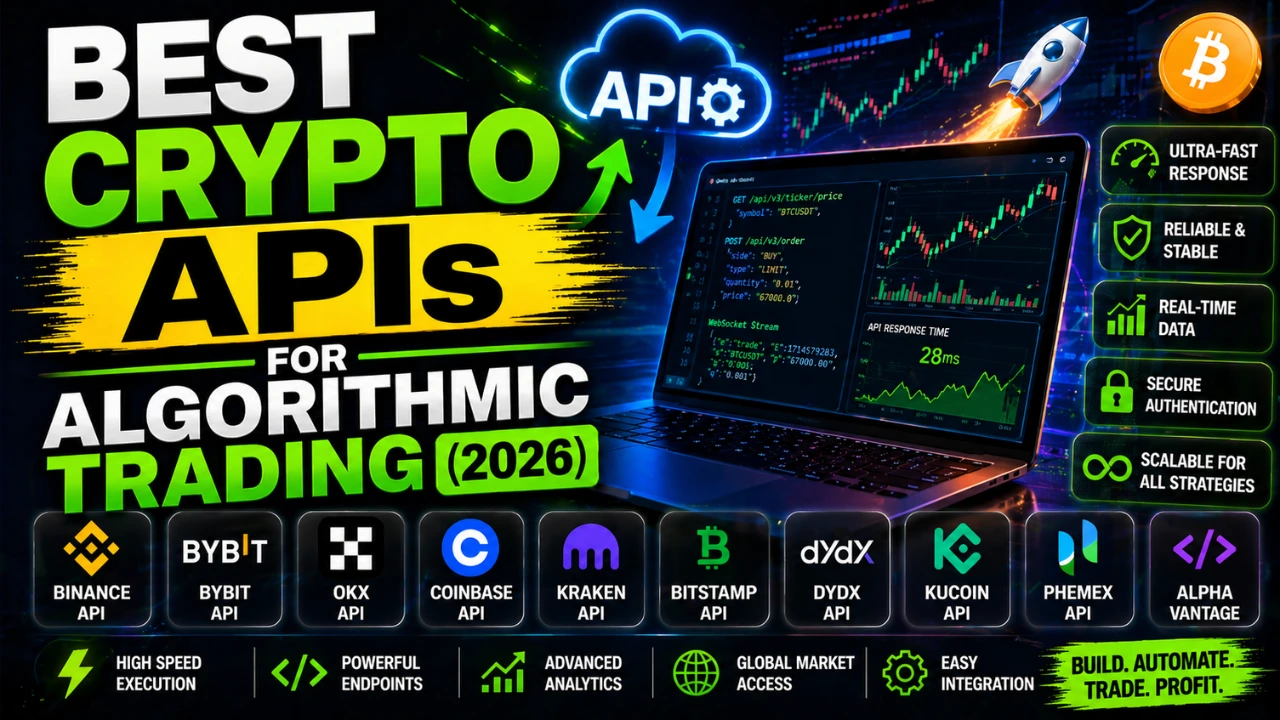
Why APIs Decide Who Wins in 2026
In 2026, crypto trading is no longer a human-driven activity.
Markets are now dominated by:
- High-frequency trading (HFT)
- Algorithmic execution systems
- Quantitative trading desks
- AI trading agents
- Institutional liquidity engines
At this level, strategy matters less than infrastructure.
The fastest trader wins. The most stable execution wins. The lowest latency system wins. Your trading API stack determines your profitability ceiling.
This guide explains:
- Crypto API architecture
- Latency engineering
- Strategy integration
- Execution optimization
- Best API-enabled trading platforms
For traders, quants, and system builders who operate beyond manual trading.
API Architecture for Algorithmic Crypto Trading
Modern crypto trading APIs consist of three critical layers:
1. Market Data APIs
- Order book depth
- Trade streams
- OHLCV feeds
- Funding rate data
- Open interest metrics
2. Execution APIs
- Order placement
- Order modification
- Cancel & replace
- Position management
- Margin management
3. Account & Risk APIs
- Balance tracking
- Risk metrics
- Portfolio exposure
- Liquidation monitoring
Professional trading systems use WebSocket streams for data ingestion and REST + FIX APIs for execution.
The Professional Trading API Stack (2026 Model)
Market Data → Strategy Engine → Risk Engine → Execution Router → Exchange APIs
This architecture allows:
- Millisecond-level decisions
- Cross-exchange routing
- Multi-strategy execution
- Automated risk throttling
- Portfolio-aware trade sizing
Latency: The Single Most Important Metric
In modern crypto markets, latency determines alpha.
Why Latency Matters:
- Faster order placement
- Reduced slippage
- Better queue positioning
- Improved arbitrage capture
- Safer liquidation avoidance
Latency Breakdown

Professional traders aim for sub-20ms round-trip execution.
API Performance Benchmarks (Practical Trading Perspective)
Best Low-Latency Crypto APIs:

Strategy Integration: From Theory to Execution
Professional trading strategies rely on API-driven execution loops.
Core Strategy Categories:
Market Making
- Spread capture
- Inventory management
- Delta-neutral execution
Statistical Arbitrage
- Pair trading
- Mean reversion
- Correlation decay models
Cross-Exchange Arbitrage
- Price spread exploitation
- Latency-based execution
- Funding rate arbitrage
Trend-Following Systems
- Momentum detection
- Breakout automation
- Volatility expansion models
AI Trading Agents
- Reinforcement learning
- Sentiment fusion
- Multi-agent orchestration
Strategy Execution Pipeline
Data → Signal → Risk → Order → Monitoring → Feedback Loop
Professional systems process 1000s of signals per second, executing only high-probability trades.
Execution Optimization: Where Profits Are Won or Lost
Core Execution Enhancements:
- Smart order routing
- TWAP execution
- Iceberg order slicing
- Volatility-adjusted execution speed
- Dynamic order book mirroring
Professional Execution Example:
Instead of:
Market Buy 100 BTC
A professional algo:
- Breaks into 200 micro orders
- Executes across multiple liquidity layers
- Adapts speed to volatility
- Minimizes market footprint
This reduces slippage by 20–40%.
Best Crypto APIs for Algorithmic Trading (2026 Rankings)
1. Binance API — Global Liquidity + Ultra-Low Latency

Best for: High-frequency trading, arbitrage, market making
Strengths:
- Deepest liquidity globally
- Extremely fast matching engine
- High WebSocket throughput
- FIX API support
- Institutional-grade stability
👉 Build your trading stack on Binance
2. Bybit API — Futures & Perpetual Trading Powerhouse

Best for: Perpetual scalping, leverage strategies, arbitrage
3. OKX API — Professional Multi-Market Infrastructure

Best for: Quant trading, derivatives, DeFi integrations
4. Deribit API — Options & Volatility Trading King
Best for: Options market making, volatility arbitrage

5. BloFin API — Advanced Derivatives Execution
Best for: Futures bots, cross-exchange arbitrage
6. KCEX API — No-KYC High-Leverage Execution
Best for: Privacy-focused algo trading
7. Bitunix API — High-Leverage Trading Automation
Best API-Based Trading Bots & Execution Engines
Pionex — Best Built-In Algo Platform
👉 Read the review here.
Coinrule — No-Code Strategy Automation
Check out the best bots.
gTrade — On-Chain Algorithmic Trading
👉 Read the review here.
Professional Trading Infrastructure Stack (2026 Model)
Exchange APIs:
Strategy Engines:
- Python (CCXT + Pandas + NumPy)
- Rust (HFT-grade bots)
- AI Agent frameworks
Execution Optimization:
- TWAP algorithms
- Smart order routing
- Volatility throttling
Monitoring:
- Real-time PnL dashboards
- Latency tracking
- Order book analytics
API Risk Management Framework
Professional systems include real-time defense layers:
- Slippage caps
- Drawdown auto-shutdown
- Volatility kill-switch
- Funding rate throttles
- Liquidation proximity alerts
This prevents catastrophic losses.
AI Agents + Crypto APIs: The Next Evolution
AI trading agents now:
- Process sentiment
- Detect manipulation
- Predict liquidity cascades
- React to news in milliseconds
The fusion of AI + low-latency APIs is defining next-generation crypto trading.
Professional Algo Trading Stack
Core Execution:
Advanced Derivatives:
No-KYC Trading:
Bots & Automation:
Final Verdict: Infrastructure Is the Strategy
In 2026, trading success is no longer about finding alpha — it is about executing alpha faster than everyone else.
Your:
- API stack
- Latency
- Execution architecture
- Risk controls
will determine your long-term survival and profitability.
Continue Your Algorithmic Mastery
- Best Crypto Trading Bots (2026)
- Crypto Arbitrage Strategy Guide
- Liquidity Wars & Market Maker Playbooks
- AI Trading Agents Explained
- Professional Crypto Risk Management