How Much Does It Cost to Run an AI Model in 2026? The DN Compute Cost Index
The price of intelligence is collapsing on an exponential curve — and that single deflation quietly reprices the entire AI economy. Here is the index that tracks it.
The cost of running an AI model — measured in price per million tokens — has fallen roughly tenfold for frontier-tier capability since 2022, and far more for cheaper models, declining at close to fifty percent a year. That means the cost of intelligence is roughly halving every twelve to thirteen months at the frontier and faster below it. The DN Compute Cost Index below tracks this deflation curve across model tiers, lets you price your own workload today versus two years ago, and shows why falling compute cost — not any single model release — is the force reshaping who wins and loses in AI.
Ask what is really happening in artificial intelligence and most answers reach for model names and benchmark scores. The deeper story is an economic one, and it is measured in a single falling number: the cost of a unit of intelligence. Year after year, the price to generate a million tokens — to have a machine read, reason and write — has collapsed, and it is still collapsing. That deflation is the quiet engine under everything else, and almost no one tracks it as the economic series it deserves to be.
The DN Compute Cost Index exists to be that series — a clean, citable reference for how fast intelligence is getting cheaper, and what it means. It plots the cost of frontier and economy model tiers over time, distils the rate of decline into a cost-halving cadence, and lets you price your own usage against the recent past. It is built to be the chart developers, founders and analysts link to when they need to ground a claim about where AI economics are heading.
This index is free to reference and embed. When citing, please credit Decentralised News and link back.
—
Why compute cost is the real story
Every business model in artificial intelligence is, at its core, a bet on the price of compute. A startup wrapping a model in an app is betting the cost of the tokens it consumes will fall faster than its prices; a hyperscaler pouring tens of billions into data centres is betting the demand unlocked by cheaper inference will exceed the capital sunk into it; an enterprise weighing whether to deploy AI across its workflows is really asking when the cost will cross the threshold of obvious profitability. The model names change every few months. The variable that decides who wins is the cost curve underneath them all.
This is why a single, well-kept measure of compute cost is more useful than another benchmark leaderboard. Benchmarks tell you what is possible; the cost curve tells you what is affordable, and affordability is what turns a demo into an economy. When the cost of intelligence falls by an order of magnitude, things that were uneconomic — running a model on every customer email, every line of code, every support ticket — suddenly pencil out, and entire categories of product become viable overnight. Tracking that threshold is tracking the real frontier.
The deflation curve
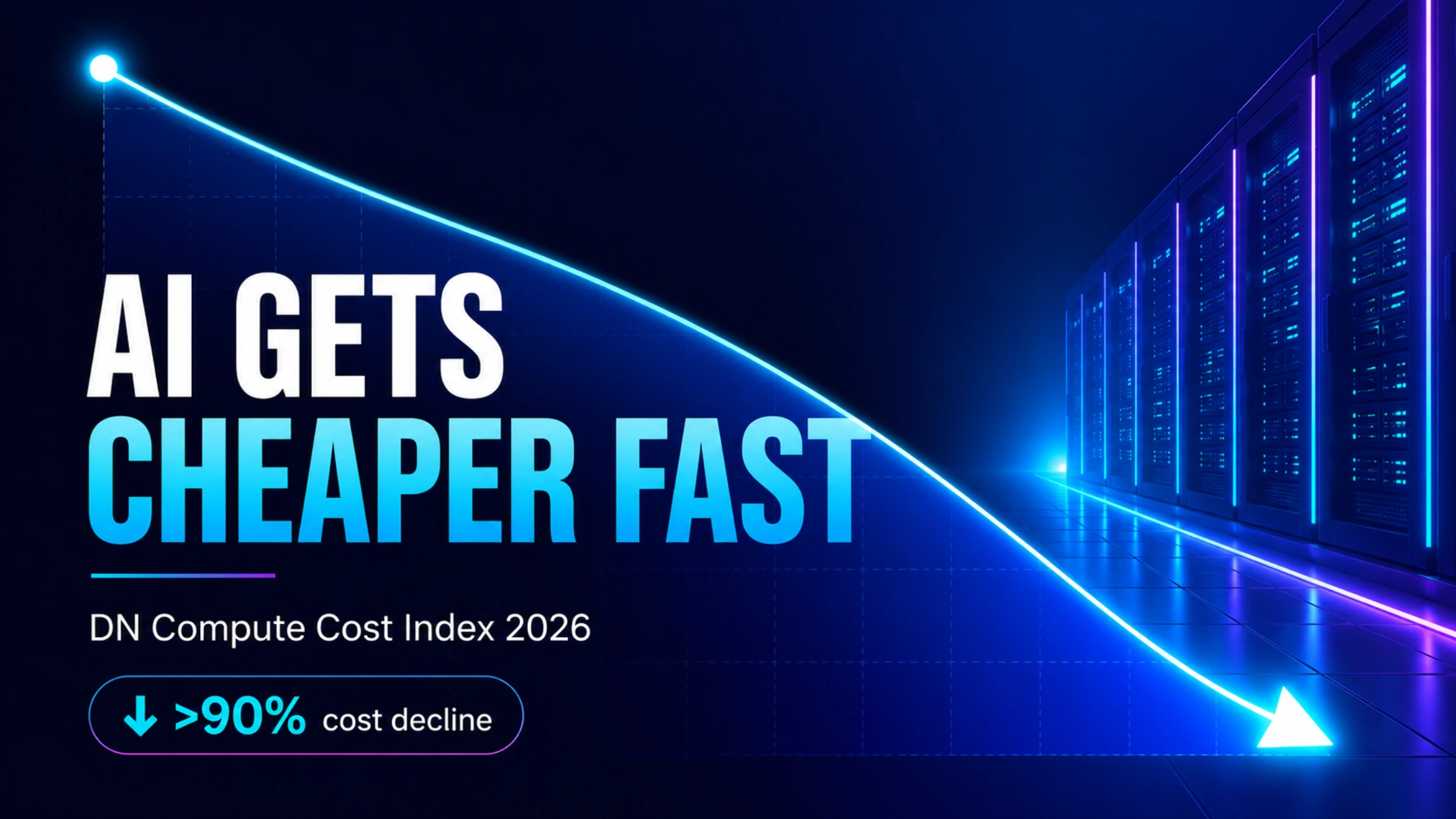
Plotted on a logarithmic scale, the cost of frontier-tier intelligence falls in something close to a straight line — the signature of a constant exponential decline, the same shape that defined Moore's Law in semiconductors. The index distils it: with the cost of a million frontier tokens indexed to 100 in 2022, it now sits around ten, meaning frontier intelligence costs roughly a tenth of what it did, an order of magnitude cheaper in barely three years. Below the frontier, the decline is even more violent, as last year's flagship capability becomes this year's commodity at a fraction of the price.
Cost-halving cadence = months in span ÷ log₂(base ÷ current)
Lower index = cheaper intelligence
The most useful way to express the rate is the cost-halving cadence — how often the price halves. At the frontier it has been roughly every twelve to thirteen months; for economy-tier models the halving comes faster still. Framed that way, the trajectory is stark: a workload that is expensive today is, on this curve, plausibly half the price within a year and a quarter of the price within two. Any strategy that assumes today's prices will persist is quietly assuming the most reliable trend in the industry is about to stop.
Who wins as it falls
Falling compute cost does not shrink the AI market — it explodes it. This is the Jevons paradox, the old observation that when a resource becomes cheaper to use, total consumption rises rather than falls, because cheapness unlocks uses that were previously unthinkable. Cheaper tokens mean more tokens consumed, not fewer dollars spent, which is why the deflation is bullish for the broad AI economy even as it is brutal for anyone whose moat is simply selling access to a model.
Winners
The application layer and end users, who get dramatically more capability per dollar; the picks-and-shovels — chips, power, networking, inference infrastructure — whose volumes rise even as unit prices fall; and any business that can convert cheaper intelligence into more usage faster than its margins compress.
Under pressure
Anyone whose entire value is reselling raw model access at a markup, since that margin is the first thing competed away; capital sunk into infrastructure that does not earn its return before prices fall further; and pricing strategies that assume today's token costs are permanent.
The deeper implication is that durable value in AI accrues to whoever owns the demand and the distribution, not the model weights, because the weights keep getting cheaper to rent. The winners are positioned to ride the cost curve down — turning each new drop in price into a new wave of usage — rather than being eroded by it.
The investment read
For investors, the index reframes the central questions. The bull case for the infrastructure layer rests on the Jevons effect — that falling cost drives enough new demand to fill every data centre being built — while the bear case is precisely that the deflation outruns the demand, stranding capital. The application layer's prospects hinge on whether falling input costs flow to the bottom line or are competed away in lower prices. And the entire debate over whether AI spending will pay off, which the DN AI Bubble Gauge scores, ultimately turns on the slope of this very curve. Those wanting to position around it can screen the exposed names — chips, power, cloud and the application leaders — on charting platforms such as TradingView, mapping each to where it sits on the cost curve.
Frequently asked questions
How much does it cost to run an AI model in 2026?
It depends heavily on the tier. Representative frontier-tier models cost on the order of single-digit dollars per million output tokens, while economy-tier models cost a fraction of that — cents per million. Both have fallen sharply: frontier-tier cost is down roughly tenfold since 2022. Use the calculator above to price your own monthly usage at each tier, and note input tokens are typically cheaper than output.
What is the DN Compute Cost Index?
It is a Decentralised News reference series that indexes the representative cost of a million tokens to 100 at a 2022 base, so its current value shows how far the cost of intelligence has fallen. An index of 10 means frontier intelligence costs about a tenth of its 2022 price — roughly ten times cheaper.
How fast is AI getting cheaper?
At the frontier, the cost of a unit of intelligence has been roughly halving every twelve to thirteen months — close to a fifty percent annual decline — and economy-tier models fall faster. On a logarithmic chart this appears as a near-straight line, the signature of a constant exponential decline similar to Moore's Law.
Why does falling compute cost matter for AI investing?
Because every AI business model is a bet on the cost curve. Falling cost tends to expand total usage rather than shrink spending — the Jevons paradox — which favours infrastructure volumes and the application layer, while squeezing anyone whose only edge is reselling raw model access. The whole question of whether AI capex pays off turns on this curve's slope.
Will AI compute costs keep falling?
The trend has been remarkably persistent, driven by better hardware, more efficient models and intense competition, but no exponential lasts forever. Bottlenecks in power, advanced chips or capital could slow it. The index is built to track the rate as it evolves, so the cadence reflects current data rather than a fixed assumption.
Where does the data come from?
The index is a DN-maintained series of representative per-million-token prices by model tier, built from public provider pricing and updated periodically. The figures are representative rather than vendor-specific quotes, intended to capture the trend and magnitude of the deflation rather than any single provider's current price list.
This tool and article are for educational and informational purposes only and do not constitute financial, investment or trading advice. The DN Compute Cost Index is a DN-maintained, illustrative reference series of representative prices, not vendor-specific quotes or official data, and should be checked against current provider pricing. Cost trends may not persist. Always do your own research and consider consulting a licensed professional before making investment decisions.