When Bots Negotiate: Inside the First Agent-to-Agent OTC Markets (2026)
Software can now find a counterparty, haggle over terms, and settle the bill without a human touching any of it. The infrastructure is real. The volume everyone quotes is not what they think it is. So we built an instrument to measure the part that actually counts.
The short version
- Agent-to-agent settlement is now technically live. An AI agent can discover another agent through an on-chain registry, negotiate price and terms through a commerce protocol, and pay in stablecoins over an HTTP-native rail, with no human approving each step.
- The headline "agent economy" number is misleading. The widely quoted figure of 100 million-plus agentic transactions on Base blends three different things: bots farming incentives, humans triggering an agent once, and genuine machine-to-machine commerce. Only the third is what this article calls agent-to-agent OTC.
- Nobody cleanly measures the third bucket, because the rails do not emit a "this was machine-to-machine, negotiated, no human" flag. The market is pricing a number it cannot actually see.
- That gap is the opportunity. Our DN A2A Volume Tracker decomposes the total into testing, human-in-loop, and genuine A2A, and shows why the honest answer is a wide range rather than a single figure.
- The winners will be the venues and rails that can prove and capture real A2A flow. The measurement problem is temporary. The repricing that follows once it is solved is not.
A trade with no human in it
Picture a settlement that took nine hundred milliseconds and involved no person at all.
One agent needs a specialised data feed for the next thirty seconds. It queries an on-chain registry, finds three agents advertising that capability, and reads their reputation scores the way a trading desk reads a counterparty's credit history. It picks one. The two agents exchange a short, structured negotiation over terms: what is being delivered, at what price, under what conditions. The buyer's agent signs a spending mandate its owner pre-authorised. The seller returns a payment request. The buyer settles in stablecoins. A receipt is generated, the reputation ledger is updated, and both agents move on. No dashboard. No checkout button. No human in the loop.
This is not a thought experiment. Every component just described shipped in production during 2025 and 2026. What has not shipped is any honest way to measure how often it actually happens, as opposed to how often the industry says it happens. That distinction is the whole story.
Why "OTC" is the right word
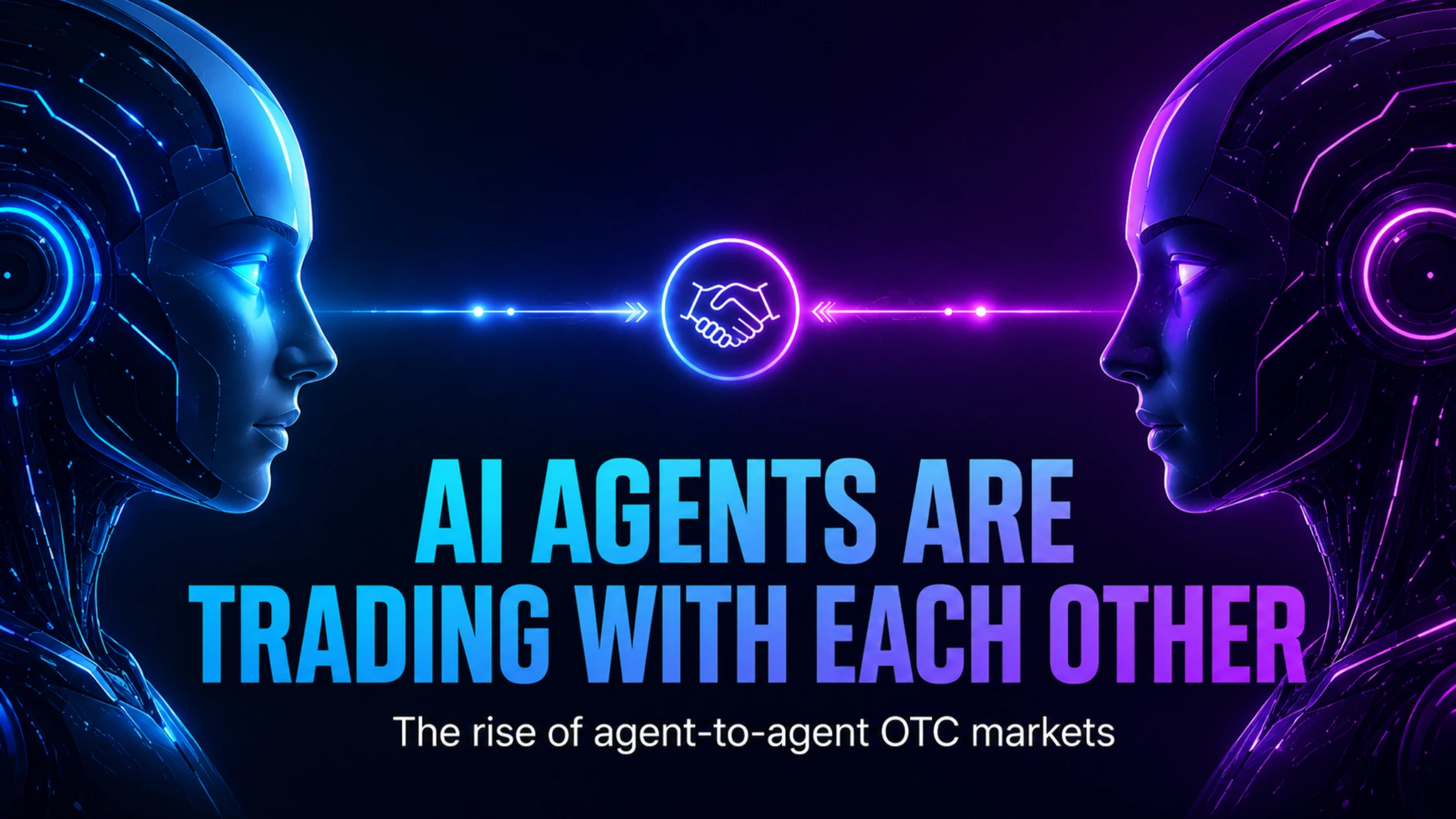
Most coverage of the agent economy borrows the language of retail: agents "shopping," agents "checking out," agents "buying stuff." That framing captures a real and large phenomenon, but it obscures the more interesting one. When two autonomous programs discover each other, negotiate bilaterally over terms, and settle a one-off obligation between them, that is not a checkout. It is an over-the-counter trade.
OTC markets have always been the parts of finance that never fit on an order book: bespoke, negotiated, bilateral, priced by relationship and reputation rather than by a public quote. That is exactly the shape of genuine agent-to-agent commerce. There is no central limit order book where a compute agent and a data agent meet. There is discovery, there is a request for quote, there is a negotiated fill, and there is settlement. The machines have, without much fanfare, rebuilt the OTC desk, except the desk is a registry and the trader is a model.
The plumbing for this arrived in layers. A discovery-and-communication layer lets agents find and talk to each other. A commerce layer standardises how they negotiate carts, capabilities and prices; the leading specification added explicit capability negotiation to its standard in early 2026. A payments layer authorises the transaction against a signed, owner-issued mandate. And a settlement layer moves the actual value, reviving a decades-dormant corner of the web's own plumbing to let one machine pay another in stablecoins the instant a request is made. On the identity side, a new on-chain standard gives each agent a portable identity, a reputation record, and a validation history, so that a buyer can price counterparty risk before committing. Payments were deliberately left out of that identity standard; it pairs with the settlement rail instead, and an agent can attach a cryptographic payment proof to the feedback it leaves. Put together, these pieces are the machine equivalent of KYC, an RFQ, a trade ticket, and a settlement instruction.
The number everyone quotes, and what is wrong with it
Here is the figure you will see repeated everywhere: agentic payments on one major chain crossed one hundred million transactions in roughly three quarters, surging from almost nothing. It is a genuine, verifiable milestone, and it is real evidence that the rails work at scale. It is also routinely misused.
The problem is that a single transaction count silently blends three populations that have almost nothing to do with each other:
Testing and farming. A large share of early agentic volume was meme-coin incentive farming and load-testing, not commerce. One high-throughput application demonstrated that the rail could survive enormous concurrency, which is a valuable thing to prove, but a stress test is not an economy. The wallets driving much of this activity look nothing like real customers: younger, holding many more asset types, carrying smaller balances.
Human-in-the-loop automation. A person tells an assistant to restock the household essentials under a budget, and the agent executes one purchase. That is automation, and it matters, but it is a human decision expressed through software. It is not machines transacting with machines on their own account.
Genuine agent-to-agent commerce. One agent hiring, paying, or trading with another agent, autonomously, with no human deciding that specific transaction. This is the new thing. This is the OTC layer. And it is the smallest and least visible of the three.
The transaction data hints at a shift without resolving it. Transactions of a dollar or more rose from under half of volume in early 2025 to the overwhelming majority a year later, while sub-dollar micro-transactions collapsed as a share. The economic weight is moving toward larger, more deliberate transfers, which is what you would expect if real commerce were displacing farming. But "consistent with real commerce" is not "measured as real commerce." Skeptics point out that despite billions in ecosystem valuation, one credible read put genuine daily settlement volume in the tens of thousands of dollars, arguing the infrastructure is being built years ahead of the demand. Bulls point to autonomous trading agents executing hundreds of thousands of self-directed trades and managing tens of millions in assets, and to claims that a striking share of on-chain activity is now agent-initiated. Both camps are looking at the same rails and reaching opposite conclusions, because neither has a clean instrument for the one bucket that matters.
That divergence is not a failure of research. It is the signature of a market pricing something it cannot see. In our framework, that is the definition of a bottleneck: a structural gap in transparency that consensus prices anyway. So we instrumented it.
The DN A2A Volume Tracker
The tracker below does something deliberately unglamorous: it refuses to give you a single number. Instead it exposes every assumption that a single number would have to hide, and lets you move them. You set how many agentic transactions exist, what the average one is worth, how much of the total is testing and farming rather than commerce, and how much of the real commerce is genuinely machine-to-machine rather than a human triggering an agent once. It returns the estimated cumulative agent-to-agent settlement, an honest range around it, an implied monthly run-rate, a forward projection, and a transparency-confidence score that falls as the range widens.
Three preset scenarios anchor the debate. The Chainalysis-anchored preset stays conservative and close to published transaction data. The agent-native bull preset assumes commerce is displacing farming quickly and machines are increasingly transacting with machines. The skeptic preset assumes most of what looks like an agent economy is still testing. Load each one and watch the headline figure swing by an order of magnitude. That swing is the point. Anyone quoting you a precise figure for agent-to-agent volume has quietly chosen values for the two variables this tool leaves in the open.
A2A Volume Tracker
A transparent estimator for genuine agent-to-agent settlement volume. This is a model, not a live feed — every assumption is exposed and adjustable, because the honest answer to “how much are the machines actually trading with each other?” is a range, not a headline.
Chainalysis put x402 transactions on Base past 100M in roughly three quarters.
Transactions of $1+ rose from 49% of volume in early 2025 to 95% by early 2026 — the weight has shifted to larger transfers.
Much early volume was meme-coin farming and load-testing rather than genuine commerce. This is the biggest single unknown.
Of the volume that is real economic activity, how much is machine-to-machine rather than a human triggering an agent once.
Applied to the current run-rate to project forward. Growth moderated in early 2026 as speculative activity cooled.
How far ahead to compound the estimated monthly run-rate.
Adjust the assumptions to see how wide the honest range really is.
Instrument logic is fully transparent and adjustable. Figures are model outputs derived from the assumptions above, anchored to published transaction data; they are estimates, not audited settlement totals. Not financial advice. © Decentralised News — A2A Volume Tracker.
Model outputs are estimates derived from your assumptions, anchored to published data. They are not audited settlement totals. Share your reading and challenge the assumptions; that is how a contested number becomes a measured one.
What is actually being built
The reason this stops being speculative is that the largest platforms in both crypto and cloud have shipped agent-native rails as production infrastructure, not previews.
On the settlement side, the HTTP-native payment rail that revives the web's long-reserved "payment required" response has grown a discovery layer cataloguing thousands of registered resource servers, alongside software kits in multiple languages. A cloud provider launched a managed service letting agents autonomously discover, authorise and execute those micropayments with built-in wallets, spending controls and a full audit trail. On the identity side, the on-chain trustless-agents standard went live on mainnet in early 2026, giving agents portable identity, bounded reputation, and independent validation across organisational boundaries; community trackers have counted a fast-growing population of registered agent identities across several chains. A purpose-built layer-one has positioned itself as the settlement home for the agentic internet, issuing agents a passport with programmable spending rules.
The exchanges made the loudest bet. One venue shipped an open command-line tool built from the ground up for machine consumption rather than human use, with well over a hundred trading commands. Another released a suite of modular agent skills covering execution, wallet intelligence and risk screening. A third launched an agent trading kit spanning dozens of chains and hundreds of decentralised venues, fielding well over a billion interface calls a day. A fourth shipped programmatically controlled wallets for fully autonomous on-chain operation. These are not experiments bolted onto a roadmap. They are the largest trading businesses in the industry deciding where volume is going and building the on-ramp for it.
On the open-market side, autonomous trading agents are already a measurable force in the venues that suit them. In fast, short-horizon games such as arbitrage and prediction markets, machines have taken meaningful share: arbitrage windows that once lasted seconds now close in a fraction of that time, and the agents fast enough to execute capture most of the profit. In longer-horizon judgement games, humans still hold their own, which is a useful reminder that "agents are winning" is a claim that needs a time horizon attached before it means anything.
The risks the marketing pages skip
An honest account of this market has to sit with what can go wrong, because the failure modes are specific and already visible.
Correlated collapse. When thousands of agents run similar models against similar data feeds, they behave similarly under stress. One episode in early 2026 saw a wave of agents exit positions at once, amplifying rather than dampening volatility and contributing to a nine-figure cascade of liquidations. Diversity of strategy is a systemic safety feature; a monoculture of agents is a systemic risk.
A trust gap between layers. The settlement rail bridges a synchronous web request, which either succeeds or fails in milliseconds, and a blockchain, which offers only probabilistic finality. Security researchers have catalogued an attack surface across that seam, including the risk that a compromised discovery layer steers an agent toward an adversarial counterparty before payment even begins. Reputation systems mitigate this, but a reputation score is only as trustworthy as the validation behind it.
Old crimes in new clothes. Wash trading, spoofing and layering remain prohibited whether a human or an autonomous agent executes them, and disclosure rules for automated activity are tightening across jurisdictions. An agent that discovers a profitable manipulation is still running a manipulation, and "the model did it" is not shaping up to be a defence. Regulators are moving toward holding the deploying entity accountable for an agent's autonomous errors.
None of this makes the trend less real. It makes the measurement more important. You cannot manage the systemic risk of a layer whose true size you refuse to estimate.
Who captures the flow
If genuine agent-to-agent settlement is even a modest share of real volume today, and if the trajectory points up, the strategic question stops being whether machines will transact and becomes which venues and rails capture the flow. Value tends to accrue to the layer that can prove and price the activity: the identity and reputation registries that let agents trust each other, the settlement rails that clear the payment, and the trading venues whose infrastructure the agents actually route through. The tokens and assets tied to those layers are where a market that believes this thesis expresses it.
Where to trade the agent-economy thesis
For readers who want exposure to this shift rather than merely a view on it, the practical expression runs through the liquid venues where the relevant assets and their derivatives trade. Two that the Decentralised News audience uses for this kind of thematic, derivatives-led positioning are BloFin, which offers deep perpetuals liquidity and copy-trading for traders who want to mirror a strategy rather than build one, and KCEX, which lists a broad set of newer AI and agent-sector tokens for those hunting earlier-stage exposure. Both are places to size positions around the theme; neither is a substitute for understanding the risk. Agent-sector tokens are among the most volatile and narrative-driven assets in the market, and the same measurement uncertainty this article is about applies double to anything trading on the story of an agent economy rather than its audited revenue. Position accordingly, and never with money you cannot afford to lose.
The takeaway
The machines are, in a narrow and real sense, already negotiating with each other. The rails are built, the identities are on-chain, the exchanges have shipped the tooling, and the first genuine agent-to-agent trades are clearing. What is missing is not capability but candour: a clean, honest measure of how much of the celebrated "agent economy" is machines transacting with machines, rather than bots farming and humans automating. Until that measure exists, the number will keep being quoted with a confidence the data does not support. The publication that builds and maintains the honest instrument becomes the reference the rest of the market cites. That is the bottleneck, and this is the tracker that fills it.
Frequently asked questions
What is agent-to-agent trading?
Agent-to-agent trading is commerce in which one autonomous AI agent discovers, negotiates with, and pays another agent directly, with no human approving the individual transaction. It differs from AI-assisted shopping, where a human instructs an agent to make a purchase on their behalf.
How is agent-to-agent commerce different from AI shopping agents?
AI shopping agents act on a human's instruction to complete a purchase, so a person still makes the underlying decision. Genuine agent-to-agent commerce is machine-to-machine: agents hire, pay, or trade with other agents autonomously as part of their own operation, such as one agent paying another for a data feed or a computation.
Why is it described as an OTC market rather than an exchange?
Because the trades are bilateral and negotiated rather than matched on a public order book. An agent finds a specific counterparty through a registry, requests a quote, negotiates terms, and settles a one-off obligation. That is the structure of an over-the-counter desk, not an exchange.
How much volume do agent-to-agent markets actually do?
No one can answer this precisely, which is the central point. Public transaction counts blend testing, human-triggered automation, and genuine machine-to-machine activity into one figure. Depending on the assumptions applied, honest estimates of the genuine agent-to-agent share range from a thin slice to a material portion of total volume. The DN A2A Volume Tracker exists to make those assumptions explicit rather than hidden.
What technology makes agent-to-agent settlement possible?
Four layers working together: a discovery and communication layer so agents can find and talk to each other, a commerce layer that standardises negotiation of terms and capabilities, a payments layer that authorises transactions against owner-issued mandates, and an HTTP-native settlement rail that moves stablecoins the moment a request is made. A separate on-chain identity standard gives each agent a portable identity and reputation record.
Is agent-to-agent trading safe?
It carries specific risks. Fleets of agents running similar strategies can move together and amplify volatility, as happened in an early-2026 liquidation cascade. There are trust gaps between the web and blockchain layers of the settlement rail, and market abuse such as spoofing remains illegal whether a human or an agent commits it. The technology is real, but so are the failure modes.
Which exchanges support AI trading agents?
Several major venues shipped agent tooling during 2025 and 2026, including command-line interfaces built for machine use, modular agent skill suites, and multi-chain agent trading kits. For traders wanting exposure to the theme through derivatives and newer sector tokens rather than building an agent, venues such as BloFin and KCEX are commonly used by the Decentralised News audience.
Will AI agents replace human traders?
Only in part, and it depends on the time horizon. In fast, short-horizon games such as arbitrage and short-dated prediction markets, agents already capture much of the available edge. In longer-horizon judgement calls, where fundamentals shift and adaptation matters, humans still perform competitively. "Agents are winning" is a claim that only means something once a time horizon is attached to it.
Disclaimer: This article is for informational and educational purposes only and does not constitute financial, investment, legal, or tax advice. Cryptocurrency and agent-sector tokens are highly volatile and can result in the total loss of capital. Model outputs from the DN A2A Volume Tracker are estimates derived from user-supplied assumptions and published transaction data; they are not audited figures and should not be relied upon as precise measurements. Some links in this article are affiliate links, which may earn Decentralised News a commission at no additional cost to you; they do not influence our editorial analysis. Always do your own research and consult a qualified professional before making financial decisions.
Reporting and data. This analysis draws on published transaction data and adoption reporting from Chainalysis, Coinbase's x402 documentation and the x402 ecosystem, Amazon Web Services, Google Cloud, Stripe and OpenAI's commerce-protocol specifications, the ERC-8004 standard on the Ethereum Improvement Proposals registry, DeFiLlama stablecoin data, and public reporting on autonomous trading agents and agent-market incidents through mid-2026. Figures cited in the text are the most recent available at the time of writing and may have moved since. The DN A2A Volume Tracker is a proprietary Decentralised News instrument; its methodology is fully transparent and adjustable within the tool.
By Heath Muchena, author of Blockchain Applied and Tokenized Trillions. Decentralised News, 2026.