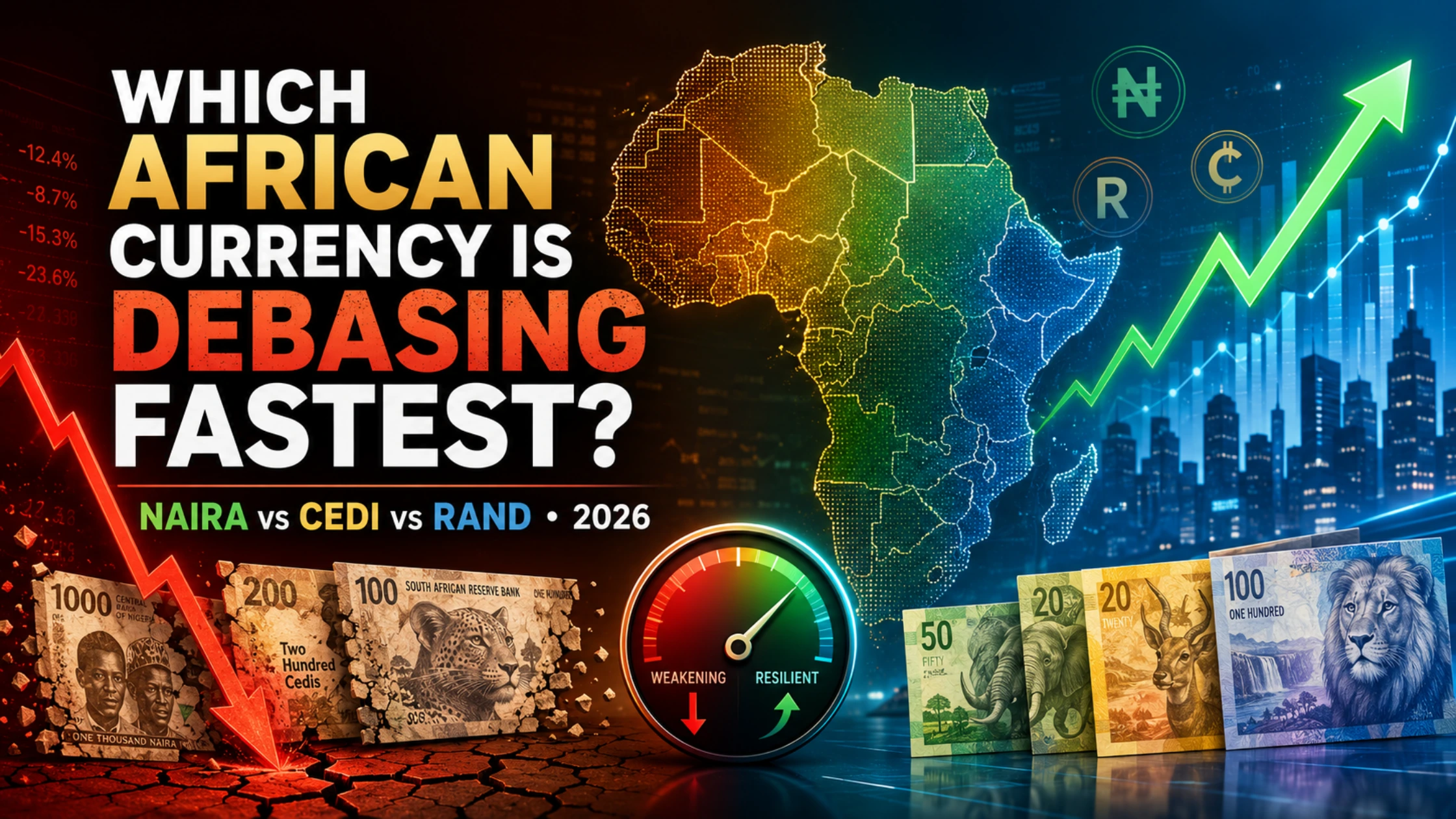
The Naira, the Cedi, the Rand: Which African Currency Is Debasing Fastest in 2026?
Inflation is the quietest tax there is. No one votes for it, no bill arrives, and yet every month a portion of what a family has saved simply evaporates — the same wage buying less bread, the same savings renting a smaller life. Across much of Africa this erosion runs faster than almost anywhere on earth, and for the worker in Juba or Addis it is not an abstraction but the difference between a full plate and a thin one. To ask which African currency is debasing fastest is therefore not a trading-floor curiosity. It is a question about where purchasing power is being destroyed most violently, and about what an ordinary person can do to step out of the path.
But the honest answer in 2026 resists the lazy headline that all African money is dying. It is not. The year just past split the continent in two: some currencies collapsed while others staged remarkable recoveries, and the difference between them was almost always policy. This piece ranks the fastest-debasing currencies honestly, with dated figures and the official-versus-street distinction that most rankings ignore — and then shows how people are protecting what they have. The Debasement Clock below makes the erosion concrete in your own currency, at your own savings.
What "debasing" really means
Two forces are usually conflated into one word, and separating them matters. Inflation is the rate at which prices rise inside a country, which is the same as the rate at which cash held under a mattress loses its buying power. Depreciation is the rate at which a currency falls against a harder one, usually the US dollar, which is what makes imported goods — fuel, medicine, electronics — more expensive. The two feed each other: a falling currency raises import prices, which lifts inflation, which further erodes confidence in the currency. A currency is "debasing" when this spiral is running, and the measure that matters most to a saver is the loss of purchasing power, whichever force is driving it.
There is a third factor that most league tables quietly omit, and it is the most important of all: the gap between the official exchange rate and the parallel, or street, rate. In several economies the government posts a flattering official number while real transactions happen at a far weaker rate in the informal market. When Zimbabwe's authorities pegged a ceiling that did not reflect reality, the true rate lived on the street; the same pattern has marked Nigeria, Ethiopia and South Sudan at various points. Judge a currency by its official rate alone and you will understate how fast it is debasing, sometimes by half. A truthful clock reads both dials.
The Debasement Clock: Africa 2025
The Debasement Clock ranks currencies by how fast they strip a holder of purchasing power, reading both the inflation dial and the exchange-rate dial. The table below sets out where the major and most-watched African currencies stood through 2025, using official figures — with the reminder that parallel-market reality is often worse. Read it as a snapshot of a moving picture: these rates change, and the lesson of 2025 is precisely that they can change in either direction.
| Currency | Recent annual inflation | Dollar move | Clock reading |
|---|---|---|---|
| South Sudanese pound | ~108% (Sep 2025) | Worst performer of 2025 | Collapsing |
| Zimbabwe ZiG | ~92% mid-2025, then single digits | ~-94% since 2024 launch | Volatile, stabilising |
| Burundian franc | ~38% | Steady decline | Severe |
| Malawian kwacha | ~28% | ~-40% devaluation (2023–24) | Severe |
| Angolan kwanza | ~28% | Oil-driven weakness | Severe |
| Nigerian naira | ~23% (eased from ~35%) | ~-40% in 2024, steadier in 2025 | High but easing |
| Ethiopian birr | ~20%+ | -15%+ in 2025 | High |
| Ghanaian cedi | ~9% (fell from highs) | +20% in 2025 (after -19% in 2024) | Recovering |
| Kenyan shilling | ~6% | Broadly stable | Relatively stable |
| South African rand | ~4% | Among the continent's most resilient | Most stable here |
2025 figures from official sources (World Bank, IMF, national statistics agencies), rounded and dated. Parallel-market rates are frequently weaker than official rates shown. Inflation and exchange rates move continually; treat this as a point-in-time snapshot.
The calculator below turns the Clock on your own money. Choose a currency, or enter the inflation rate you actually live with, and see how much buying power your cash keeps over time.
The Debasement Clock
How much buying power your cash keeps as inflation runs. Pick a currency or enter your own real inflation rate. Runs entirely in your browser.
Educational tool, not financial advice. Models the loss of purchasing power of cash at a constant inflation rate; real inflation varies year to year and parallel-rate effects can be worse. Stablecoins and Bitcoin carry their own risks. Figures are illustrative.
The split screen of 2025
The most useful thing to understand about African currencies in 2026 is that they no longer move as a bloc. The African Development Bank expected roughly twenty-one of the continent's fifty-four currencies to weaken against the dollar in 2025 and around twenty-five to strengthen — a near-even split that demolishes the idea of a single African monetary story. At one extreme, the South Sudanese pound collapsed as war in neighbouring Sudan severed the oil pipeline that funds the state, sending inflation toward 108%. The Ethiopian birr, battered by dollar shortages and a debt restructuring, became one of the weakest currencies in the world.
At the other extreme stood genuine recoveries. Ghana's cedi, which had lost nearly a fifth of its value in 2024, reversed to gain more than twenty percent in 2025 on the back of strong cocoa and gold earnings, tighter policy, and a completed debt restructuring; its inflation fell back toward single digits. Zambia's kwacha strengthened on similar foundations. Even Zimbabwe, whose ZiG had shed roughly 94% against the dollar since its 2024 launch and seen annual inflation spike above ninety percent, clawed its way to single-digit monthly inflation by late 2025 after the central bank stopped printing money and tightened hard. The lesson written across the whole continent is the same: currencies debase when policy is loose and recover when it is disciplined. No currency is guaranteed to fall, and none is guaranteed to hold.
How people escape the clock
When the local currency is melting, the instinct everywhere in history has been the same: get into something harder. For generations that meant US dollars stuffed in a drawer or a savings account that the unbanked could never open. Stablecoins have democratised that instinct. A dollar-pegged stablecoin such as USDT or USDC holds its value in dollars rather than a depreciating local currency, and anyone with a phone can hold one — a dollar bank account in the pocket, no bank required. For a saver watching the naira or birr erode, moving a portion of savings into stablecoins is the most direct way to stop the bleeding, and it is precisely why stablecoin adoption has surged across Nigeria, Kenya and beyond.
Some go further, into Bitcoin — a harder asset still, with no central bank able to inflate it, but one that is far more volatile in the short term and can fall sharply as well as rise. The honest framing is that stablecoins preserve dollar purchasing power while Bitcoin is a longer-horizon bet on a scarce asset, and the two serve different purposes. For South Africans, both are a few taps away on VALR or Luno in rand; across the wider continent, Binance and its peer-to-peer market are the common gateway. Our companion guides cover the practical steps in detail — buying Bitcoin with rand, and using stablecoins to send money home for almost nothing.
The honest part
Escaping a debasing currency is not the same as getting rich, and treating it that way is how people get hurt. Stablecoins preserve dollar value, but they carry their own risks: the issuer is a counterparty, and in rare extreme conditions a stablecoin can briefly slip from its peg. Bitcoin protects against monetary debasement over long horizons but can halve in a bad year, so it is no place for money you need next month. And as 2025 proved, local currencies can recover — the saver who fled the cedi at its 2024 low missed a twenty-percent rebound. The goal of reading the Debasement Clock is not to predict or to speculate; it is to make a clear-eyed decision about how much of your purchasing power you are willing to leave exposed to a currency that may keep falling, and to hold the rest in something harder. That is prudence, not a punt. None of this is financial advice, and the right balance depends on your own circumstances.
Reading your own clock
Start with the truth rather than the official number. Find the inflation rate you actually live with — the rate at which your real shopping basket is rising, which is often closer to the parallel-market reality than the government's headline — and put it into the calculator above. See how much of your savings the clock will take over five or ten years if you do nothing. Then decide, deliberately, what share of your money should sit in a harder store of value, whether dollar-pegged stablecoins for stability or Bitcoin for the long horizon, and what share stays in local currency for daily life. The clock is always running. The only choice is whether it runs against you or not.
Frequently asked questions
Which African currency is debasing the fastest in 2026?
Through 2025 the fastest-debasing major currency was the South Sudanese pound, with inflation reaching roughly 108% as war disrupted oil revenues, followed by the Ethiopian birr. Several others — the Burundian franc, Malawian kwacha and Angolan kwanza — also saw severe erosion. Rates change continually, so treat any ranking as a dated snapshot.
Are all African currencies losing value?
No. 2025 was a split year: the African Development Bank expected about 21 of 54 currencies to weaken and 25 to strengthen. The Ghanaian cedi gained over 20%, Zambia's kwacha strengthened, and Zimbabwe's ZiG stabilised after a brutal start. Policy discipline, not geography, decided which currencies fell and which recovered.
Why does the official exchange rate matter less than the parallel rate?
Governments sometimes post a flattering official rate while real transactions happen at a weaker parallel, or street, rate. Judging a currency by the official rate alone can understate how fast it is truly debasing, sometimes by a wide margin. An honest assessment reads both, which is why your lived inflation often exceeds the headline figure.
How do I protect my savings from a falling currency?
The most direct method is to hold a portion of savings in dollar-pegged stablecoins, which keep their value in dollars rather than a depreciating local currency. Some also hold Bitcoin as a harder, longer-horizon asset, though it is more volatile. The right split depends on your circumstances, and local currency is still needed for daily life.
Is holding stablecoins safer than holding local currency?
For preserving purchasing power in a high-inflation economy, a dollar-pegged stablecoin is generally more stable than a rapidly depreciating local currency. But stablecoins carry counterparty risk from the issuer and can rarely slip from their peg in extreme conditions, so they are a tool for preservation rather than a guarantee.
Did the Nigerian naira recover in 2025?
Partly. After losing roughly 40% of its value in 2024 and seeing inflation peak near 35%, the naira steadied through 2025 as reforms took hold and inflation eased. It remained weak by historical standards but was no longer among the very worst performers on the continent.
What happened to Zimbabwe's ZiG currency?
The gold-backed ZiG, introduced in April 2024, lost roughly 94% against the dollar within its first year and saw annual inflation spike above 90% in mid-2025. After the central bank halted money printing and tightened sharply, monthly inflation fell to near zero and annual inflation dropped into single digits late in the year, though a parallel-market premium remained.
Is Bitcoin a good hedge against currency debasement?
Over long horizons Bitcoin is valued by many as a hedge against monetary debasement because no central bank can inflate its supply. In the short term, however, it is highly volatile and can fall sharply, so it suits long-term holdings rather than money needed soon. Stablecoins are the steadier choice for simply preserving value.