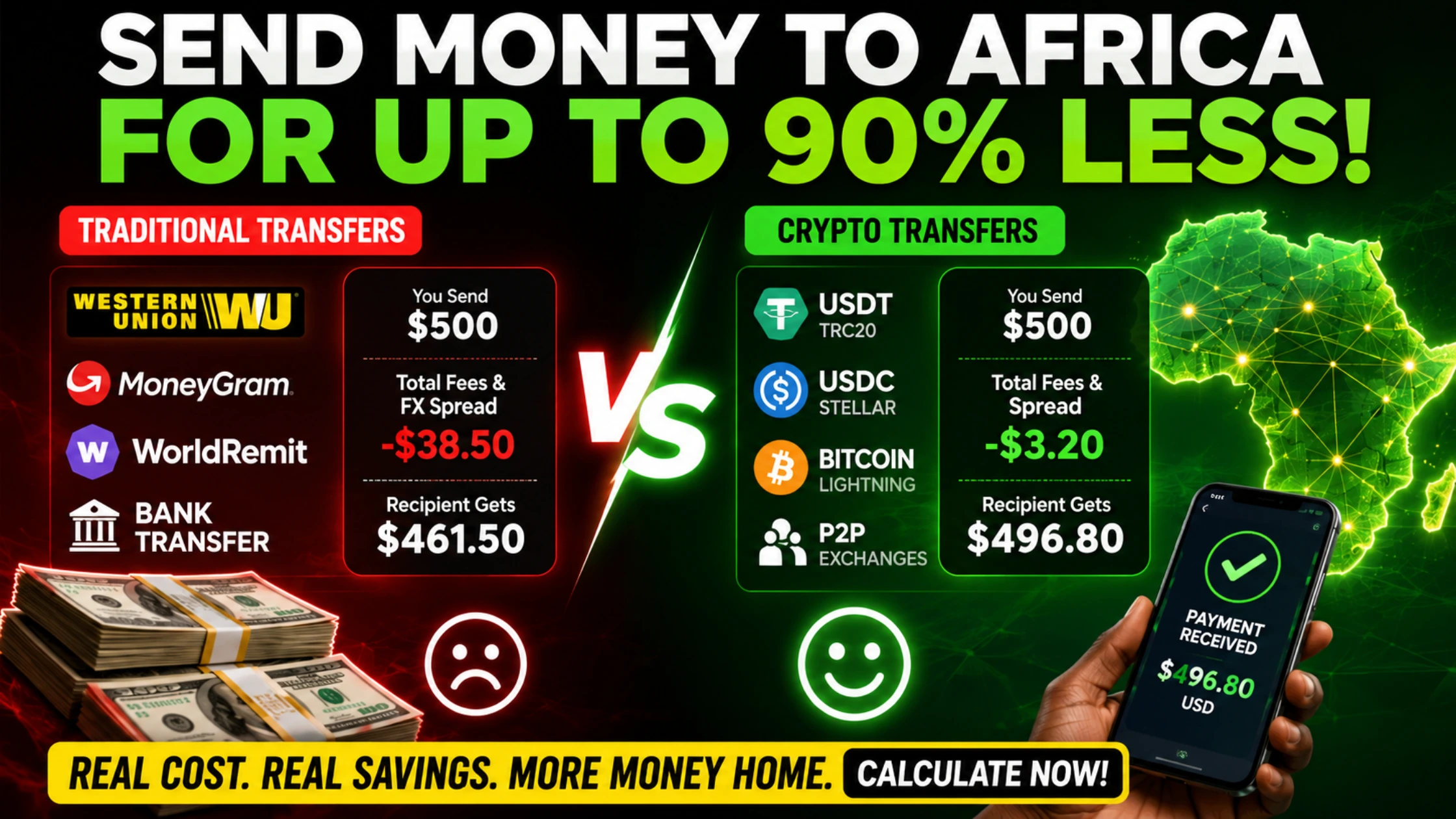
Sending $500 from the United States to Nigeria costs approximately $22 via Western Union after accounting for the FX spread. The same $500 sent as USDT on the Tron network costs under $2. The calculator below shows this comparison for six send countries, six receive countries, and six transfer methods simultaneously — including the full cost breakdown that providers advertise selectively, and the local currency your recipient actually receives.
The $48 Billion Annual Tax on Africa’s Diaspora
Remittances to Sub-Saharan Africa exceeded $48 billion in 2024. Of that total, somewhere between $3 billion and $5 billion was paid in transfer fees and unfavourable exchange rate spreads to Western Union, MoneyGram, WorldRemit, banks, and their intermediaries. The money did not disappear. It transferred from African diaspora workers to financial service companies headquartered predominantly in the United States and Europe.
The average cost of sending $200 to Sub-Saharan Africa sits at approximately 8% according to World Bank data, significantly above the global average of 6.4% and more than double the UN Sustainable Development Goal target of 3%. On a $500 monthly transfer, 8% represents $40 per month, $480 per year, taken from families that typically cannot afford to lose it.
This fee level has persisted for decades despite technological advances that should have eliminated it. The reason is not technical complexity. Sending money digitally across borders is not hard. The reason is regulatory capture, correspondent banking relationships that add friction at every step, and the absence of competitive alternatives that most diaspora workers know how to access.
Crypto has been changing this calculation for years. What has been missing is a clear, corridor-specific, honest comparison showing exactly how much the change is worth in dollar terms for any specific transfer.
That is what this article and the calculator below provide.

How Traditional Remittance Providers Actually Charge You
Most people who use Western Union or WorldRemit believe they understand the cost: there is a fee displayed at checkout, and that is what they pay. This is incomplete.
The displayed fee is real and visible. It covers the provider’s operational cost for processing the transaction. It ranges from $3 to $30 depending on the provider, corridor, payment method, and amount.
The FX spread is where the larger cost hides. Every traditional remittance provider offers an exchange rate that is worse than the mid-market rate, typically by 2 to 5 percentage points. On a $500 transfer, a 4% FX spread costs $20 regardless of what the displayed fee shows. The recipient receives local currency calculated at the provider’s rate, not the rate you would find on Google or XE.com. The provider keeps the difference.
On a $500 transfer with a $5 displayed fee and a 4% FX spread, the total cost is $25, of which only $5 appears on the payment screen. The other $20 is invisible at the point of purchase. This structure is legal, common, and deliberately opaque.
SWIFT bank transfers are often assumed to be cheaper because they do not charge a “remittance fee” in the same way. In reality, bank transfers typically carry a $15 to $35 sending fee, a potential $5 to $15 receiving bank fee, and a 2 to 3% FX spread from your bank’s treasury desk. The total cost on a $500 bank transfer is commonly $35 to $60, making it one of the most expensive options in the market despite its perceived institutional trustworthiness.
The calculator below includes all of these costs in its total cost output, not just the advertised fee. The “total cost as a percentage of send amount” column is the number that matters.

How Crypto Changes the Cost Equation
Cryptocurrency does not eliminate the cost of moving value across borders. It replaces expensive intermediary infrastructure with cheap network infrastructure.
USDT on the Tron network (TRC20) is the most widely used corridor for Africa remittances in practice. The network transaction fee is approximately $1 or less. To send USDT, a sender buys it on an exchange like Binance P2P or MEXC paying the exchange’s spot or P2P rate, incurring approximately 0.1% in exchange fees. The recipient receives USDT in their wallet within 1 to 3 minutes, then converts to local currency through a P2P exchange or over-the-counter desk, paying the local P2P spread which varies by corridor. In Nigeria’s large and liquid P2P market, this spread is approximately 0.8% to 1.2%. In Ethiopia’s more restricted market, it may be 1.5% to 2%.
Total cost for USDT TRC20: approximately 1.5% to 2.5% of the transfer amount, depending on corridor. On $500, this is $7.50 to $12.50 versus $20 to $35 via traditional providers.
USDC on Stellar offers even lower network fees (fractions of a cent) with faster settlement (seconds rather than minutes). The cost structure is similar to USDT TRC20, with the primary variable being the P2P spread in the receiving country. Stellar has strong integration with Yellow Card, a regulated African crypto-to-fiat platform operating in Nigeria, Ghana, Kenya, Tanzania, and Uganda. Yellow Card’s rates are publicly listed and competitive, making USDC on Stellar a transparent and increasingly practical corridor option.
Bitcoin Lightning is theoretically the cheapest transfer mechanism on the planet. Lightning network fees are fractions of a cent, delivery is instantaneous, and no FX spread exists because BTC is BTC in any country. The practical limitation is receiving infrastructure: the recipient needs a Lightning-enabled wallet (like Muun, Wallet of Satoshi, or Breez) and a means of converting BTC to local currency. In Nigeria, Kenya, and South Africa, this infrastructure exists and is improving rapidly. In Ethiopia and Zimbabwe, it remains limited.

Corridor by Corridor — Where Crypto Wins Most
United Kingdom to Nigeria is the corridor where crypto’s cost advantage is largest and most well-documented. The traditional provider market for UK-Nigeria transfers has historically maintained high FX spreads because of the naira’s volatility and the CBN’s restriction history. Western Union and WorldRemit apply spreads of 3 to 5% on this corridor. Crypto’s advantage versus traditional: approximately $15 to $25 per $500 transfer.
United States to Kenya is the corridor most transformed by mobile money integration. WorldRemit’s M-Pesa delivery makes it more competitive than most corridors, with lower FX spreads and fast delivery. The crypto advantage exists but is smaller: approximately $8 to $15 per $500. Bitcoin Lightning is particularly well-suited here because of Kenya’s strong Lightning infrastructure through local startups.
UAE to Ethiopia is one of the most expensive traditional corridors. Ethiopia’s restricted forex market, limited formal banking infrastructure, and CBE regulations create high costs for traditional providers. The informal crypto market has grown substantially as a result. Crypto’s cost advantage versus bank transfer on this corridor can exceed $30 per $500 transfer.
South Africa to Zimbabwe is unique because Zimbabwe uses USD as a primary currency, which eliminates the FX spread component for USD-denominated crypto transfers. The corridor’s cost difference between traditional and crypto comes primarily from the fixed fees, making crypto’s advantage proportionally larger on smaller transfer amounts. VALR and Luno both operate in South Africa with ZAR on-ramp functionality that makes crypto access straightforward for the South African sender.
Use the Calculator
Select your send country, receive country, and transfer amount. The tool shows all six methods side by side with full cost breakdown.
The Last-Mile Problem — How Recipients Convert Crypto to Cash
The calculator’s cost comparison is only complete when you account for the last-mile conversion: how the recipient transforms USDT, USDC, or BTC into the local currency they actually spend.
In Nigeria, the P2P crypto market is one of the largest globally by volume. Platforms including Binance P2P, MEXC, and local OTC desks operate active USDT-to-naira markets. Recipients can sell USDT directly to buyers who pay naira into their bank account, typically within 15 to 30 minutes of posting the sell order. The P2P spread, the difference between the USDT-to-naira rate offered by buyers versus the mid-market rate, is typically 0.8% to 1.5% on active platforms. Yellow Card offers a regulated alternative with listed rates and direct mobile money or bank transfer settlement.
In Kenya, M-Pesa integration makes the last mile remarkably smooth. Yellow Card supports direct M-Pesa withdrawal from USDC holdings. Luno operates in Kenya with KES withdrawal to M-Pesa and bank transfer. Binance P2P has active KES-to-USDT markets with M-Pesa as a payment method. The P2P spread on the Kenya corridor is typically the tightest in Africa at 0.4% to 0.8%, reflecting the corridor’s liquidity.
In Ghana, Yellow Card and MEXC P2P support cedi withdrawals. The market is liquid but smaller than Nigeria, resulting in slightly wider P2P spreads of 0.7% to 1.2%.
In Ethiopia, the formal crypto market is restricted but functional through informal channels. Yellow Card does not currently operate in Ethiopia. Recipients typically use local OTC desks or trusted P2P networks. The spread is higher at 1.5% to 2.5%, reflecting the additional friction.
In Tanzania and Zimbabwe, Yellow Card and Binance P2P provide the most accessible last-mile options. Tanzania’s mobile money ecosystem (M-Pesa, Airtel Money, Tigo Pesa) integrates with crypto platforms more readily than some other markets. Zimbabwe’s USD-based economy makes stablecoin remittances particularly straightforward.

How to Execute a USDT Corridor Transfer — Step by Step
For a first-time crypto remittance sender, the process is less complicated than it appears. Here is the practical workflow for a UK sender and a Nigerian recipient:
Sender side (UK):
- Register on Binance P2P or MEXC, complete KYC verification (typically 5 to 15 minutes)
- Buy USDT with GBP via bank transfer, Faster Payments, or debit card. Faster Payments on Binance settles the purchase within seconds.
- Withdraw the USDT to the recipient’s TRC20 wallet address. Double check the network selection: TRC20 (Tron) rather than ERC20 (Ethereum). TRC20 fees are approximately $1 vs $5 to $15 for ERC20.
- The recipient’s wallet balance updates within 1 to 3 minutes.
Recipient side (Nigeria):
- The recipient needs a wallet that accepts TRC20 USDT — Trust Wallet, TokenPocket, or a crypto exchange account (Binance, MEXC, or a local platform) all work.
- Once USDT is received, the recipient posts a sell order on Binance P2P or the local platform, setting their preferred naira rate and payment method (bank transfer, cash).
- A buyer matches the order, transfers naira to the recipient’s bank account, and confirms payment.
- The recipient releases the USDT to the buyer. Total time from receipt to naira in bank: typically 15 to 30 minutes.
The first transfer is the steepest learning curve. Most senders and recipients who complete one transfer describe the subsequent ones as straightforward. Saving the TRC20 wallet address after the first transfer eliminates the address-entry step entirely for recurring monthly transfers.

Tax and Compliance
For senders: In the UK, US, and EU, buying USDT and immediately using it for a transfer is generally treated as a disposal of a crypto asset. If you buy USDT for £1 and send £1 worth, the capital gain is zero because the purchase price equals the disposal value. Check your specific jurisdiction’s guidance, and use Koinly to track any transactions that might carry a gain.
For recipients: In most African jurisdictions, receiving USDT and converting it to local currency is not separately taxed as a crypto gain if the conversion happens immediately. The naira received is treated as ordinary income under Nigerian tax law if it represents business income, or as a personal transfer (not taxable) if it is a family remittance. Consult local tax guidance for your specific situation.
For compliance purposes: Most jurisdictions classify remittances below a certain threshold (typically the equivalent of $10,000 to $15,000) as personal transfers that do not require formal reporting. Above this threshold, AML and KYC requirements apply regardless of whether you use Western Union or USDT.

FAQ
Is it legal to receive USDT remittances in Nigeria? Receiving USDT in a personal wallet and converting it to naira via P2P is currently practised by millions of Nigerians. The CBN’s 2021 crypto banking restrictions prohibited banks from servicing crypto exchanges but did not make personal crypto holding or P2P trading illegal. Nigeria’s SEC has subsequently moved toward a regulated framework for crypto assets. The legal landscape is evolving: check current CBN and SEC guidance before large transfers.
What is the cheapest way to send money to Kenya? For transfers where the sender can use limit orders and the recipient has an M-Pesa account, USDC on Stellar delivered via Yellow Card is among the cheapest options, with total costs in the 1% to 1.5% range versus 3% to 6% for WorldRemit. Bitcoin Lightning is similarly cheap for recipients who have Lightning wallet access. The calculator above gives exact comparisons for your specific transfer amount.
Does the recipient need a crypto wallet? For USDT or USDC transfers, yes. The recipient needs either a non-custodial wallet (Trust Wallet, MetaMask, Phantom for Stellar) or an account on a crypto exchange that supports deposits in the relevant country. Yellow Card provides a regulated custodial option across five African markets without requiring the recipient to manage their own wallet. For Bitcoin Lightning, the recipient needs a Lightning-enabled wallet.
How do I avoid the P2P spread on the receiving end? Platforms like Yellow Card publish listed rates with transparent FX spreads, reducing the spread below typical P2P market rates through regulated operations. Using a reputable P2P platform like Binance P2P in high-volume corridors (particularly Nigeria and Kenya) also provides competitive rates because the volume creates tighter bid-ask spreads.
What is the maximum safe transfer amount via crypto for a remittance? There is no technical maximum on crypto transfers, but practical considerations apply at larger amounts. Above $5,000 in a single USDT transfer, P2P buyers may take longer to match because individual buyers have capital limits. Splitting large transfers into multiple transactions is standard practice. Above $10,000 equivalent, AML compliance requires additional documentation from the sender on most regulated platforms.
What happens if I send to the wrong wallet address? Crypto transactions are irreversible. Sending USDT to the wrong TRC20 address permanently loses the funds if the address is not under the recipient’s control. Always verify the wallet address character by character before confirming, and test with a small amount on the first transfer before sending the full remittance.
Send your first crypto remittance: Binance P2P — largest P2P market, Nigeria/Kenya/Ghana supported · Yellow Card — regulated African fiat-to-crypto platform · Luno — South Africa and Kenya · MEXC P2P — competitive rates across Africa · VALR — South Africa ZAR on-ramp

Start Here — Build Your Crypto Infrastructure Safely
You don’t need to use everything at once.
Professionals reduce risk by having access to multiple rails so they are never dependent on a single platform.
Below is a simple, practical setup used by many experienced traders and investors.
1) Your Fiat Gateway (Primary Access)
Best starting point for deposits & withdrawals
Binance — reliable onboarding, deep liquidity, global coverage
👉 sign up
Why open this:
- Move from bank → crypto easily
- Convert large amounts efficiently
- Emergency exit capability
2) Your Trading Execution Venue (Fast & Flexible)
Best for active trading and broad market access
MEXC — huge altcoin selection & low trading friction
👉 sign up
Why open this:
- Trade markets not listed elsewhere
- Better execution during volatility
- Lower dependence on a single exchange

3) Your Advanced Tools & Derivatives Platform
Best for leverage, hedging and professional execution
Bybit — strong order controls & derivatives infrastructure
👉 sign up
Why open this:
- Proper stop loss tools
- Hedging capability
- Strategy flexibility

4) Your Yield & Passive Income Layer
Best for structured products and capital efficiency
Gate.com — structured yield & automated earning tools
👉 sign up
Why open this:
- Earn on idle capital
- Diversify platform risk
- Access structured strategies
5) Your Altcoin & Ecosystem Expansion Layer
Best for early market access and wide listings
KuCoin — broad token ecosystem
👉 sign up
Why open this:
- Access emerging markets
- Portfolio diversification
- Redundancy if one platform restricts access
Why This Structure Matters
Using one exchange creates a single point of failure.
Using multiple rails creates:
- Liquidity redundancy
- Faster reaction ability
- Lower operational risk
- Greater opportunity access
You don’t need large capital to start — you just need prepared infrastructure.

Practical Next Step
Open accounts gradually and verify them before you need them.
Most people only prepare during stress —
professionals prepare before it.
(Decentralised News provides infrastructure education, not financial advice. Always use proper security practices.)