Artificial intelligence is rapidly evolving from passive software into autonomous agents capable of acting on the internet. These agents can analyze data, trade assets, access APIs, and execute workflows without human intervention. But for the agent economy to function at scale, agents need something fundamental: native payment rails.
Traditional payment systems were built for humans. They rely on accounts, invoices, subscriptions, and slow settlement processes. Autonomous software does not operate this way. AI agents need the ability to pay instantly, programmatically, and globally, often for tiny amounts such as API calls, compute cycles, or data access.
This is where machine-payment protocols come in. These systems allow software agents to hold wallets, send payments, and interact with services in a fully automated way. In many cases, blockchain infrastructure provides the most natural foundation because it enables programmable money, permissionless access, and near-instant settlement.
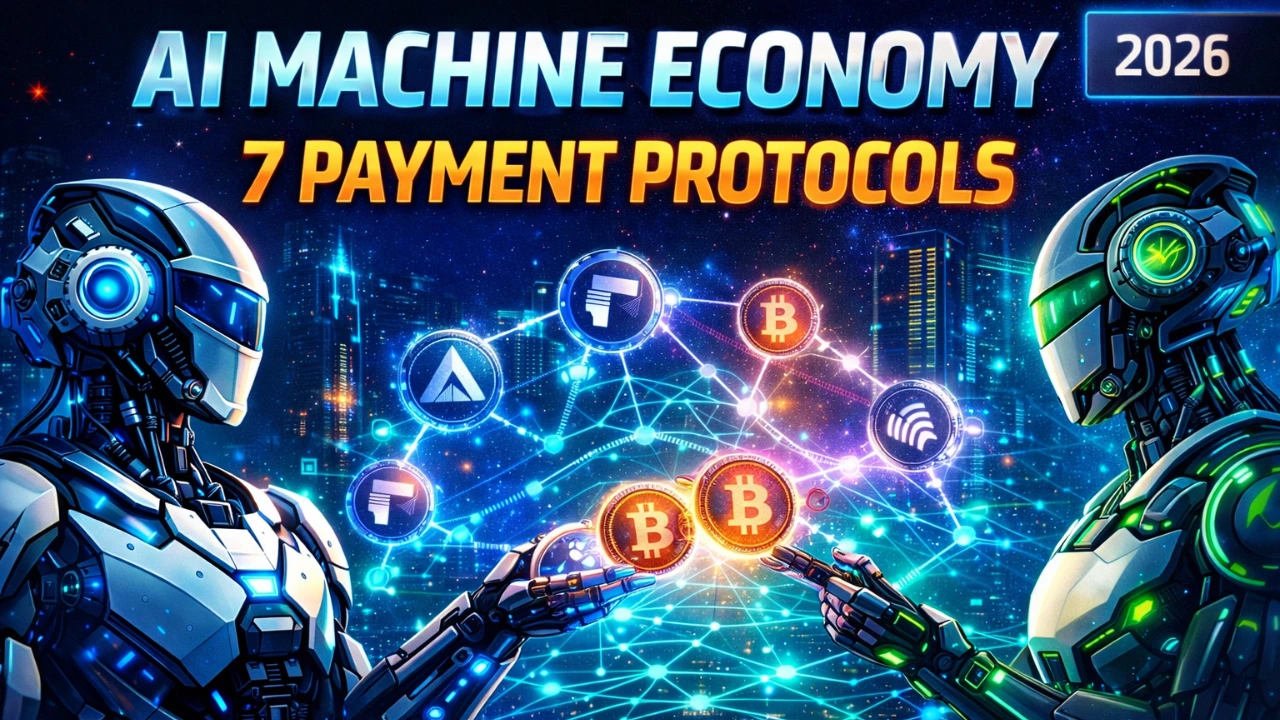
The protocols below represent some of the most important infrastructure being developed today to enable machine-to-machine commerce, autonomous software agents, and the next phase of the crypto economy.

1. x402 (Coinbase)
One of the most widely discussed machine-payment standards emerging today is x402, an open payment protocol developed within the Coinbase developer ecosystem.
x402 essentially allows software agents to pay for services directly over HTTP, the same protocol that powers the web. Instead of registering accounts or subscribing to platforms, an agent can simply send a payment alongside its request. The service verifies the payment and executes the request immediately.
In practice, this enables things like:
- AI agents paying for API calls
- Software paying for compute resources
- Data feeds charging per request
- Autonomous apps monetizing micro-services
Because payments can be settled using stablecoins, x402 opens the door to true pay-per-use digital services rather than traditional subscription models.
If this model scales, it could reshape how software monetization works across the internet.
2. Lightning Network
Bitcoin’s Lightning Network is one of the earliest examples of infrastructure designed for machine-level payments.
Lightning allows near-instant transactions with extremely low fees, which makes it well suited for microtransactions between machines.
Potential agent-economy use cases include:
- AI agents paying for data feeds
- automated services paying per computation
- IoT devices paying for bandwidth or resources
- real-time payment streaming
Because Lightning is built on top of Bitcoin, it also inherits strong decentralization and security properties.
Many developers believe Lightning could become one of the most important global payment rails for autonomous software systems.
3. Chainlink Payment Automation
Chainlink is best known for oracles, but its infrastructure is increasingly being used for automated economic workflows between smart contracts and off-chain services.
Chainlink enables programmable payments tied to real-world triggers, including:
- data delivery
- event verification
- API execution
- computation services
Through its automation and oracle layers, Chainlink effectively allows smart contracts to pay external services automatically once conditions are met.
In the agent economy, this could allow autonomous systems to purchase data, execute tasks, or trigger financial transactions without human involvement.

4. Superfluid
Superfluid introduces a different concept for machine payments: continuous payment streaming.
Instead of sending discrete payments, agents can stream value over time.
This enables workflows such as:
- AI services charging per second of usage
- software subscriptions priced dynamically
- bandwidth payments streaming continuously
- compute resources billed in real time
Payment streaming is especially powerful for machine economies because it removes the need for invoices or batch payments.
Agents can start, stop, or adjust payments instantly based on usage.
5. Helium Network Payments
Helium’s decentralized wireless network has already demonstrated a machine-to-machine payment model in the real world.
In the Helium ecosystem:
- IoT devices pay for network connectivity
- payments occur automatically using crypto tokens
- infrastructure providers earn rewards for providing coverage
This model essentially creates a marketplace where machines pay other machines for infrastructure services.
As AI agents begin interacting with IoT systems, networks like Helium could become a core part of the broader machine-economy infrastructure stack.
6. Ocean Protocol Data Payments
AI agents rely heavily on data. Ocean Protocol focuses specifically on enabling data marketplaces where information can be bought and sold using crypto payments.
Through tokenized data assets, Ocean enables:
- pay-per-dataset access
- machine-to-machine data transactions
- monetization of AI training datasets
- secure data sharing for autonomous agents
In an AI agent economy, this kind of infrastructure is crucial because agents must be able to acquire reliable information automatically.
Protocols that allow agents to purchase data without human negotiation may become foundational to autonomous digital markets.

7. Fetch.ai Agent Payments
Fetch.ai was one of the earliest projects exploring the idea of autonomous economic agents interacting through decentralized networks.
In the Fetch ecosystem:
- agents can negotiate transactions
- services can be discovered automatically
- payments can be executed between agents
This allows AI software to perform actions such as:
- booking services
- purchasing resources
- negotiating prices
- executing transactions autonomously
Fetch’s approach represents one of the clearest visions of a future where software agents behave as economic actors.
Why Machine Payments Matter
The agent economy will likely require billions of automated transactions between machines.
Examples include:
- AI agents paying for market data
- trading algorithms paying for execution infrastructure
- bots purchasing compute resources
- autonomous vehicles paying for charging stations
- digital assistants paying APIs for services
Traditional financial systems were never designed for this level of automation or granularity.
Blockchain infrastructure offers several advantages:
- programmable money
- instant settlement
- borderless payments
- permissionless access
- composability with software
As a result, crypto networks may become the default financial layer for machine commerce.

How Investors Can Position for the Agent Economy
If machine payments become a major part of the AI economy, several sectors of crypto could benefit:
- AI infrastructure tokens
- decentralized compute networks
- oracle networks
- data marketplaces
- agent launch platforms
- payment protocols
The simplest way to gain exposure is by trading these tokens on major crypto exchanges.
Popular platforms used by many traders include:

For advanced charting and market analysis tools used by professional traders:
And for secure long-term storage of crypto assets:

Final Thoughts
The AI revolution is not just about smarter software. It is about software that can participate in the economy.
For that to happen, agents must be able to send and receive payments autonomously. The protocols building those payment rails today could become some of the most important infrastructure layers in the entire digital economy.
If the agent economy grows the way many technologists expect, machine-payment systems may eventually power millions of transactions per second between autonomous software agents.
And the projects enabling that future may become some of the most valuable infrastructure in the next phase of the internet.

Start Here — Build Your Crypto Infrastructure Safely
You don’t need to use everything at once.
Professionals reduce risk by having access to multiple rails so they are never dependent on a single platform.
Below is a simple, practical setup used by many experienced traders and investors.
1) Your Fiat Gateway (Primary Access)
Best starting point for deposits & withdrawals
Binance — reliable onboarding, deep liquidity, global coverage
👉 sign up
Why open this:
- Move from bank → crypto easily
- Convert large amounts efficiently
- Emergency exit capability
2) Your Trading Execution Venue (Fast & Flexible)
Best for active trading and broad market access
MEXC — huge altcoin selection & low trading friction
👉 sign up
Why open this:
- Trade markets not listed elsewhere
- Better execution during volatility
- Lower dependence on a single exchange
3) Your Advanced Tools & Derivatives Platform
Best for leverage, hedging and professional execution
Bybit — strong order controls & derivatives infrastructure
👉 sign up
Why open this:
- Proper stop loss tools
- Hedging capability
- Strategy flexibility
4) Your Yield & Passive Income Layer
Best for structured products and capital efficiency
Gate.com — structured yield & automated earning tools
👉 sign up
Why open this:
- Earn on idle capital
- Diversify platform risk
- Access structured strategies
5) Your Altcoin & Ecosystem Expansion Layer
Best for early market access and wide listings
KuCoin — broad token ecosystem
👉 sign up
Why open this:
- Access emerging markets
- Portfolio diversification
- Redundancy if one platform restricts access
Why This Structure Matters
Using one exchange creates a single point of failure.
Using multiple rails creates:
- Liquidity redundancy
- Faster reaction ability
- Lower operational risk
- Greater opportunity access
You don’t need large capital to start — you just need prepared infrastructure.
Practical Next Step
Open accounts gradually and verify them before you need them.
Most people only prepare during stress —
professionals prepare before it.
(Decentralised News provides infrastructure education, not financial advice. Always use proper security practices.)